
Market Report · July 22, 2026

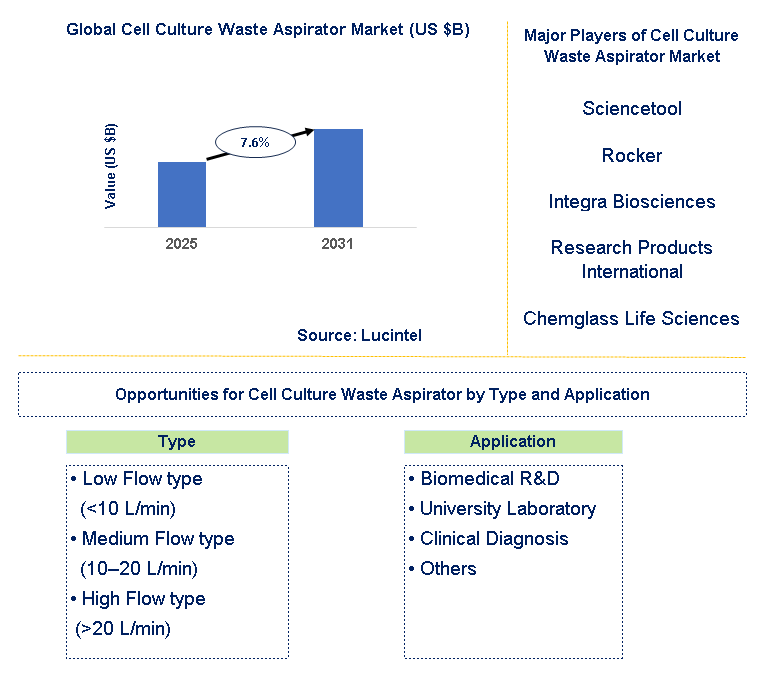
Key data points: The growth forecast = 7.6% annually for the next 7 years. Scroll below to get more insights. This market report covers trends, opportunities and forecasts in cell culture waste aspirator market to 2031 by type (low flow type (<10 L/min), medium flow type (10–20 L/min), and high flow type (>20 L/min)), application (biomedical r&d, university laboratory, clinical diagnosis, and others), and region (North America, Europe, Asia Pacific, and the Rest of the World)
We'll send your sample report shortly.
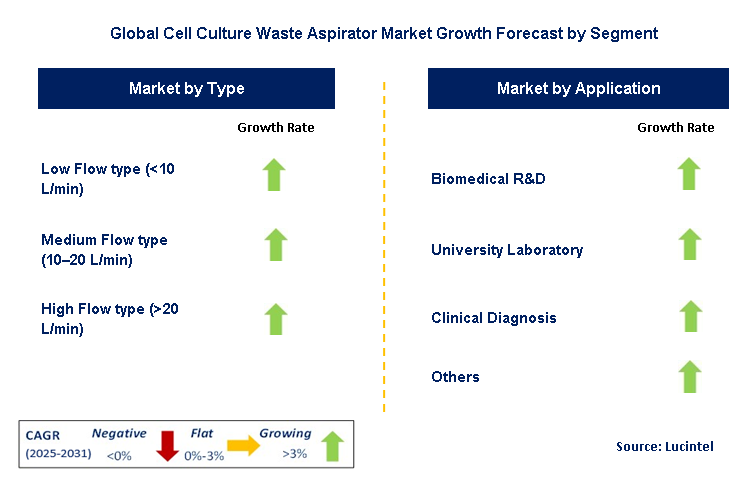
• Lucintel forecasts that, within the type category, high flow type (>20 L/min) is expected to witness the highest growth over the forecast period.
• Within the application category, biomedical r&d is expected to witness the highest growth.
• In terms of region, North America is expected to witness the highest growth over the forecast period. Gain valuable insights for your business decisions with our comprehensive 150+ page report. Sample figures with some insights are shown below.
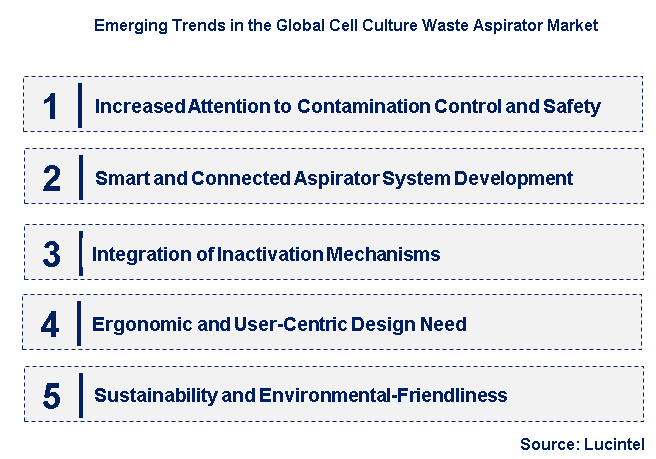
• Increased Attention to Contamination Control and Safety: One key emerging trend is the increased focus on avoiding biological contamination when aspirating waste. This involves incorporating advanced hydrophobic filters with high holding capacities, integrated automated disinfection cycles, and fully enclosed systems to reduce aerosol release. The end result is a safer working environment for laboratory staff and lower risk of cross-contamination when conducting sensitive cell culture experiments, resulting in more accurate research results.
• Smart and Connected Aspirator System Development: An emerging trend involves the addition of smart functionalities to waste aspirators, including real-time collection bottle fill-level monitoring, filter replacement alerts, and integration with laboratory information management systems (LIMS) to track waste disposal. The effect is enhanced efficiency, less manual intervention, and more efficient data management for laboratory operations, leading to optimized processes and less room for error.
• Integration of Inactivation Mechanisms: The integration of inactivation mechanisms for waste directly into the aspirator systems is a new trend. This may involve chemical inactivation by automated dispensing of disinfectants or physical inactivation such as UV irradiation in the collection pathway. The effect is an enhanced contained and safer waste disposal process, lowering the risk of exposure to biohazards and streamlining downstream waste management procedures.
• Ergonomic and User-Centric Design Need: With the understanding of the repetitive nature of cell culture activities, there is a growing need for waste aspirators with ergonomic designs, including lightweight handheld controllers, adjustable suction capacities with memory capabilities, and easy-to-use user interfaces. The effect is decreased strain and fatigue for lab staff, increased comfort during extended use, and improved overall efficiency in cell culture processes.
• Sustainability and Environmental-Friendliness: One of the new trends is the creation of more environmentally friendly waste aspiration solutions. This entails using recyclable components when constructing the devices, efficient use of energy, and product designs that make it simpler and safer to dispose of retrieved waste with minimal damage to the environment. The effect is a smaller environmental footprint of cell culture labs and compliance with overall sustainability efforts in the scientific world. These new trends are transforming the cell culture waste aspirator market through innovation that is safer, smarter, more ergonomic, and sustainable. Emphasis on contamination control, connectivity, integrated inactivation, user comfort, and environmental responsibility is likely to translate into more sophisticated and user-friendly waste aspiration systems in the future.
• Enhanced Hydrophobic Filtration Systems: One of the recent important developments is the use of more sophisticated hydrophobic filters in waste aspirators. These filters, in many cases having pore sizes to 0.22 µm, offer greater protection against aerosol contamination and liquid entry into the vacuum pump, assuring user safety and equipment longevity. This development has a direct beneficial effect on laboratory biosafety levels and minimizes the risk of expensive equipment damage.
• Liquid Level Sensors and Overflow Protection Integration: Most new aspirator designs include integrated liquid level sensors that automatically shut off aspiration when the collection bottle is full. This averts overfilling and possible release of harmful waste, greatly enhancing safety and minimizing the necessity for continuous manual supervision. The feature adds to a more automated and secure laboratory set-up.
• All-in-One Systems and Compact Development: Current trends involve the development of smaller and more integrated waste aspiration systems that integrate the vacuum source, collection bottle, and safety measures in a single system. All-in-one systems conserve precious bench real estate, make setup easier, and typically enhance portability in the lab. This space conservation and mobility increase lab organization and workflow.
• Automated Disinfection Protocols Introduction: Several newer cell culture waste aspirators feature automated disinfection protocols. These units are able to automatically purge the aspiration tubing and collection bottle with disinfectant solutions, preventing microbial growth and contamination within the system itself. This aspect adds to a more sterile working environment and reduces the frequency of manual disinfection protocols.
• Adjustable Suction Ergonomic Handheld Controllers: Companies are paying more attention to the ergonomic design of handheld aspiration controllers. Light weight, ergonomic grip, and adjustable suction levels with memory settings enhance user comfort and control over aspiration. This minimizes hand fatigue and enables accurate removal of waste from all types of cell culture vessels, optimizing efficiency and user acceptance. These new developments are making a big impact on the cell culture waste aspirator market by making cell biology lab waste management safer, more efficient, and more intuitive. Emphasis on advanced filtration, overflow protection, system integration, automated disinfection, and ergonomic design is leading to a safer and more productive research environment.
• Academic and Basic Research Laboratories: One of the most basic growth prospects is providing academic and basic research laboratories with high-end cell culture waste aspirators. The laboratories tend to work with a variety of cell lines and experimental configurations, necessitating flexible and reliable aspiration systems with strong safety capabilities to avoid contamination and user harm. Offering competitively priced but high-performance solutions with good filtration and ergonomic configurations can win a huge chunk of this market.
• Biopharmaceutical Manufacturing Facilities: The biopharmaceutical sector, with its bulk cell culture for pharmaceutical production, is a huge growth opportunity. These facilities need automated, high-capacity waste aspiration systems that have inactivation built-in to deal with large quantities of potentially toxic waste efficiently and safely. Creating scalable and compliant solutions for this space is key.
• Clinical Diagnostic Laboratories: Clinical diagnostic laboratories conducting cell-based diagnostics and assays also need dependable waste aspiration. In this application, the emphasis is on avoiding cross-contamination among samples and protecting laboratory staff that work with patient-derived materials. Easy-to-disinfect, compact aspirators with robust containment capabilities are essential to capture this growth opportunity.
• Stem Cell Research and Therapy Development: The swiftly expanding area of stem cell research and therapy development has particular requirements for waste aspiration, specifically in the preservation of cell culture sterility and avoidance of contamination. Sensitive application requirements include aspirators that offer high filtration, laminar flow compatibility, and integrated inactivation capability options, representing a substantial growth opportunity.
• Contract Research Organizations (CROs): CROs working for pharmaceutical and biotech firms perform an extensive variety of cell-based assays and drug development research. They need flexible and dependable waste aspiration systems capable of treating diverse types of cells and waste streams under strict safety and regulatory compliance requirements. Providing adaptable and validated aspiration solutions may meet the variable demands of CROs. These strategic development opportunities are influencing the cell culture waste aspirator market by propelling the creation of application-specific solutions with improved safety features, automated capabilities, and scalability. By capitalizing on the distinctive demands of academic research, biopharmaceutical manufacturing, clinical diagnostics, stem cell research, and CROs, manufacturers can access growing market segments and help ensure safer and more efficient cell-based workflows throughout the life sciences.
• Sciencetool
• Rocker
• Integra Biosciences
• Research Products International
• Chemglass Life Sciences
• Low Flow type (<10 L/min)
• Medium Flow type (10–20 L/min)
• High Flow type (>20 L/min)
• Biomedical R&D
• University Laboratory
• Clinical Diagnosis
• Others
• North America
• Europe
• Asia Pacific
• The Rest of the World
• United States: The US Cell Culture Waste Aspirator market is experiencing a high demand for high-performance and safety-oriented systems. Some of the recent developments involve the incorporation of sophisticated hydrophobic filters for aerosol contamination protection and automated liquid level monitoring with overflow protection. Compact, all-in-one units that integrate aspiration, collection, and optional inactivation capabilities are also gaining traction. A strong emphasis on lab safety standards and regulatory guidelines are the major drivers in this market.
• China: The Chinese cell culture waste aspirator market is growing at a rapid pace, fueled by the growing biotechnology and pharmaceutical industries. The latest trends involve greater availability of locally produced aspirators, which tend to provide cost-effective options. There is also increased use of functionality such as autoclavable parts and simple safety filters. As the number of cell culture laboratories continues to grow, demand for waste aspiration solutions that are both cost-effective and dependable will remain on the rise.
• Germany: Germany's cell culture waste aspirator market is characterized by a heavy focus on quality, durability, and high-end safety features, in accordance with the nation's high standards for laboratories. The most recent advances include incorporation of highly advanced containment systems, including activated carbon filters for volatile waste, and ergonomic designs for long-term usability. Quiet operation and ease of maintenance are also favored. The market is being driven by a firmly established research infrastructure and laboratory safety commitment.
• India: The Indian cell culture waste aspirator market is slowly expanding, consistent with the growing life sciences research and biopharmaceutical sectors. Developments in the past few years have included rising consciousness of the need to properly manage waste in cell culture and the transition towards the implementation of more specialized aspiration systems in place of improvised solutions. There is increasing demand for affordable yet dependable aspirators with standard safety features such as collection bottles and filters. Global brands are also picking up strength in research-focused laboratories.
• Japan: Japan's cell culture waste aspirator market is typified by a preference for compact, efficient, and easy-to-use designs that serve the typically space-limited laboratory setting. Some recent advancements include the addition of aspirators with controlled suction accuracy and built-in sensors to ensure safe use. In addition, there is growing interest in systems that are easy to disinfect and have silent operation. The market is propelled by a highly research-oriented culture and highly regarded laboratory safety and efficiency.


• Sciencetool
• Rocker
• Integra Biosciences
• Research Products International
• Chemglass Life Sciences Q5. Which cell culture waste aspirator market segment will be the largest in future? Answer: Lucintel forecasts that, within the type category, high flow type (>20 L/min) is expected to witness the highest growth over the forecast period. Q6. In cell culture waste aspirator market, which region is expected to be the largest in next 5 years? Answer: In terms of region, North America is expected to witness the highest growth over the forecast period. Q7. Do we receive customization in this report? Answer: Yes, Lucintel provides 10% customization without any additional cost.


Choose a license that fits your team. Instant PDF delivery.
Prices exclude taxes. Instant delivery. Custom licensing available on request.
Market Report · July 22, 2026
Market Report · July 22, 2026
Market Report · July 22, 2026
Trusted partner for strategic intelligence and business growth


Receive a complimentary market analysis tailored to your industry. Our analysts will identify key growth opportunities and competitive dynamics specific to your business.

Market size, growth rate, and key trend analysis for your specific sector.

Top competitor positioning and market share analysis.

Strategic recommendations backed by data-driven insights.
Get curated market intelligence and competitive moves straight to your inbox.
By subscribing, you agree to receive our monthly insights. Unsubscribe anytime.
Receive a complimentary market analysis tailored to your industry. Our analysts will identify key growth opportunities and competitive dynamics specific to your business.
Market size, growth rate, and key trend analysis for your specific sector.
Top competitor positioning and market share analysis.
Strategic recommendations backed by data-driven insights.
Get curated market intelligence, emerging trends, and competitive moves straight to your inbox each month.
By subscribing, you agree to receive our monthly insights. Unsubscribe anytime.
We'll send your sample report shortly.