
Market Report · July 22, 2026

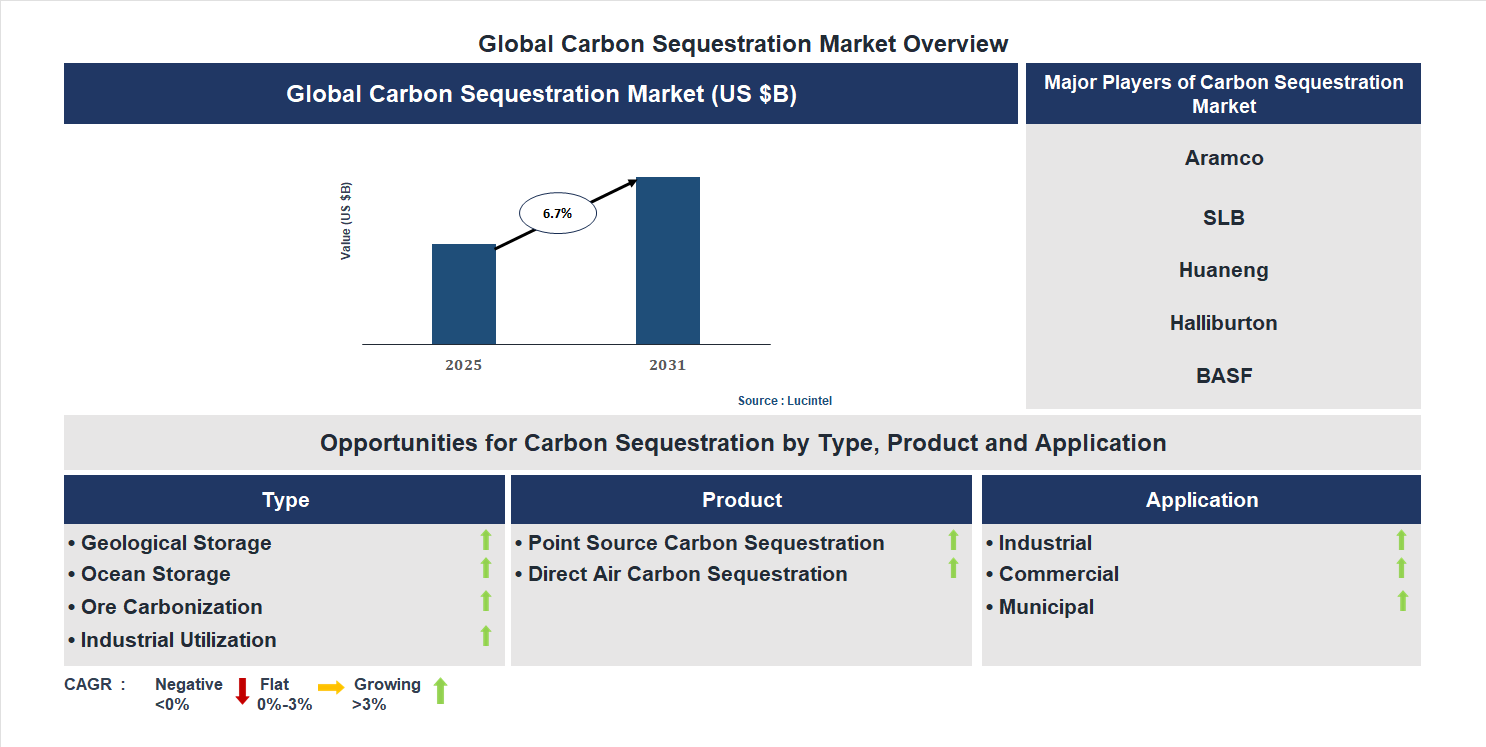
Key data points: The growth forecast = 6.7% annually for the next 6 years. Scroll below to get more insights. This market report covers trends, opportunities and forecasts in carbon sequestration market to 2031 by type (geological storage, ocean storage, ore carbonization, and industrial utilization), product (point source carbon sequestration and direct air carbon sequestration), application (industrial, commercial, and municipal), and region (North America, Europe, Asia Pacific, and the Rest of the World)
We'll send your sample report shortly.
• Lucintel forecasts that, within the type category, geological storage is expected to witness the highest growth over the forecast period.
• Within the application category, industrial is expected to witness the highest growth.
• In terms of region, APAC is expected to witness the highest growth over the forecast period. Gain valuable insights for your business decisions with our comprehensive 150+ page report. Sample figures with some insights are shown below.
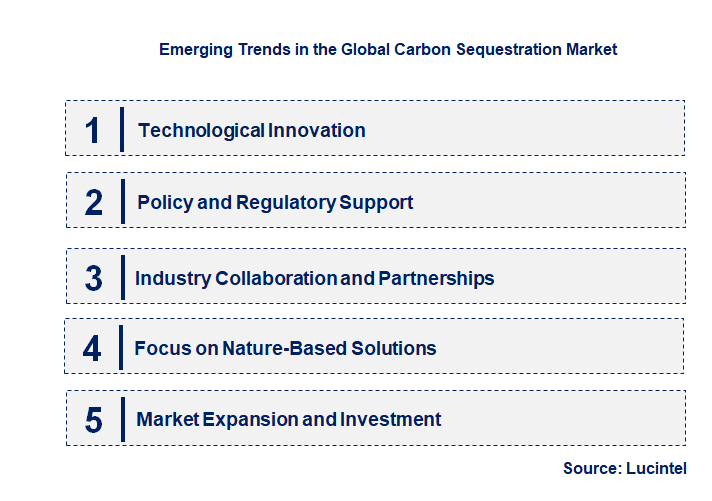
• Technological Innovation: Development of advanced sequestration techniques such as mineralization, bioenergy with carbon capture and storage (BECCS), and direct air capture (DAC) is accelerating. These innovations improve efficiency, reduce costs, and enable the sequestration of larger volumes of CO2, making solutions more viable for widespread adoption. Enhanced technology also opens new avenues for integrating sequestration with existing industrial processes, fostering sustainable practices.
• Policy and Regulatory Support: Governments worldwide are implementing stricter regulations, carbon pricing, and incentives to promote sequestration projects. Policies such as carbon credits and subsidies are encouraging industries to invest in sequestration technologies. This regulatory environment creates a more predictable market, attracting investments and fostering innovation while ensuring compliance with climate goals.
• Industry Collaboration and Partnerships: Increasing collaboration between governments, research institutions, and private companies is driving market growth. Partnerships facilitate knowledge sharing, joint development of technologies, and large-scale pilot projects. Such collaborations help overcome technical and financial barriers, accelerating the deployment of effective sequestration solutions across sectors like power generation, cement, and oil & gas.
• Focus on Nature-Based Solutions: There is a rising emphasis on nature-based sequestration methods such as reforestation, afforestation, and soil carbon enhancement. These solutions are cost-effective, scalable, and provide additional environmental benefits like biodiversity conservation. Their integration into broader climate strategies enhances the overall impact of sequestration efforts and appeals to stakeholders seeking sustainable, multi-benefit approaches.
• Market Expansion and Investment: The market is witnessing increased investments from venture capital, private equity, and government funding. This influx of capital supports research, pilot projects, and commercial-scale deployments. As the market expands, new players enter, and existing companies scale up operations, the overall capacity for carbon sequestration grows, making it a more integral part of global climate mitigation strategies. In summary, these emerging trends are transforming the carbon sequestration market by fostering technological advancements, strengthening policy frameworks, encouraging collaborations, emphasizing nature-based solutions, and attracting investments. Collectively, they are making carbon sequestration more effective, accessible, and integrated into global efforts to achieve net-zero emissions, thereby reshaping the future landscape of climate change mitigation.
• Enhanced Geological Storage Techniques: Recent innovations in geological storage, such as deep saline formations and depleted oil fields, have increased storage capacity and safety. These advancements reduce risks of leakage and improve long-term stability, making sequestration more viable. Enhanced monitoring technologies ensure integrity and compliance, boosting confidence among regulators and investors. This progress accelerates deployment at scale, supporting global climate goals and creating new opportunities for infrastructure development and service providers.
• Advancements in Bioenergy with Carbon Capture (BECCS): BECCS technology is gaining traction as a dual solution for energy production and carbon removal. Recent developments include more efficient biomass conversion processes and integrated capture systems. These innovations enable large-scale negative emissions, essential for meeting net-zero targets. The impact includes increased investment in bioenergy projects, job creation, and a significant contribution to climate mitigation efforts, positioning BECCS as a critical component of sustainable energy strategies.
• Policy and Regulatory Frameworks Strengthening: Governments worldwide are establishing incentives, carbon pricing, and regulatory frameworks to promote sequestration projects. Recent policies include tax credits, subsidies, and stricter emission standards, encouraging private sector participation. These measures reduce financial risks and foster innovation. The strengthened frameworks create a more predictable environment, attracting investments and accelerating project deployment, ultimately driving market growth and supporting global climate commitments.
• Development of Carbon Capture Technologies: New capture technologies, such as solvent-based, solid sorbents, and membrane systems, are achieving higher efficiency at lower costs. Recent breakthroughs include scalable modular designs and renewable energy integration, making capture more economically feasible. These advancements expand applicability across industries, from power plants to cement manufacturing. The increased adoption of cost-effective capture solutions enhances overall market competitiveness and accelerates the transition to low-carbon operations.
• Growing Investment and Funding Initiatives: Venture capital, government grants, and private investments are surging into the market. Recent funding initiatives support research, infrastructure, and pilot projects, reducing financial barriers. This influx of capital fosters innovation and accelerates commercialization. The increased investment signals strong market confidence, leading to more large-scale deployments, job creation, and technological breakthroughs, ultimately driving the market toward a sustainable and resilient future. The overall impact of these developments is a more robust, innovative, and investment-friendly carbon sequestration market. Enhanced technologies, supportive policies, and increased funding are collectively accelerating deployment, reducing costs, and improving safety. These factors are positioning the market as a vital component in global climate strategies, fostering sustainable growth, and enabling industries to meet ambitious emission reduction targets efficiently.
• Increasing Adoption of Industrial Carbon Capture Technologies: Industrial sectors such as cement, steel, and chemical manufacturing are adopting advanced carbon capture systems to meet emission reduction targets. Government incentives and stricter regulations are encouraging companies to invest in cost-effective sequestration solutions. The integration of these technologies into existing infrastructure is expected to drive market growth, reduce environmental impact, and support sustainable industrial practices.
• Expansion of Natural Carbon Sequestration Methods: Natural solutions like reforestation, afforestation, and soil carbon enhancement are gaining prominence as cost-effective and environmentally friendly options. Governments and organizations are investing in large-scale projects to enhance natural carbon sinks. These methods not only sequester carbon but also promote biodiversity, improve land use, and support local communities, making them a vital component of comprehensive climate strategies.
• Development of Advanced Geological Storage Solutions: Innovations in geological storage, including deep saline formations and depleted oil and gas fields, are expanding the capacity for long-term carbon storage. Enhanced monitoring and safety protocols are increasing confidence in these methods. Investment in exploration and infrastructure development is expected to boost storage capacity, reduce costs, and facilitate large-scale deployment of sequestration projects globally.
• Integration of Carbon Sequestration in Renewable Energy Projects: Incorporating sequestration techniques into renewable energy infrastructure, such as bioenergy with carbon capture and storage (BECCS), offers a pathway to achieve negative emissions. This integration supports the transition to a low-carbon economy by offsetting residual emissions from renewable sources. It also enhances the overall effectiveness of climate mitigation strategies and opens new revenue streams for renewable energy developers.
• Policy and Regulatory Frameworks Supporting Market Growth: Governments worldwide are establishing policies, incentives, and carbon pricing mechanisms to promote sequestration initiatives. These frameworks create a favorable environment for investment and innovation in carbon capture and storage technologies. Strengthening international cooperation and standardization efforts will further accelerate market development, ensuring scalable and sustainable solutions to meet global climate commitments. In conclusion, these growth opportunities collectively strengthen the carbon sequestration market by fostering technological innovation, expanding natural and geological solutions, integrating with renewable energy, and creating supportive policy environments. Together, they enable a comprehensive approach to reducing atmospheric CO2 levels, supporting global climate goals, and driving sustainable economic development. The markets evolution will be pivotal in addressing the urgent need for effective carbon management solutions worldwide.
• Technological Innovation: The development of advanced carbon capture, utilization, and storage (CCUS) technologies is a primary driver. Breakthroughs in solvent-based capture, mineralization, and direct air capture have significantly improved efficiency and reduced costs. These innovations enable industries to meet stringent emission targets and support sustainable practices. As technology matures, deployment becomes more feasible across various sectors, including power generation and heavy industry, fostering market growth and encouraging further R&D investments.
• Government Policies and Regulations: Governments worldwide are implementing stricter environmental regulations and providing incentives to reduce carbon emissions. Policies such as carbon pricing, tax credits, and subsidies for CCUS projects create a favorable environment for market expansion. Regulatory mandates compel industries to adopt sequestration solutions, driving demand. Additionally, international climate agreements like the Paris Accord motivate nations to invest in carbon reduction strategies, further bolstering the market.
• Rising Environmental Awareness and Corporate Commitments: Increasing awareness of climate change impacts has led corporations to adopt sustainability goals, including carbon neutrality. Many companies are investing in sequestration projects to offset emissions and enhance their environmental reputation. This shift in corporate responsibility not only boosts demand for sequestration services but also encourages innovation and collaboration within the industry, creating a positive feedback loop for market development.
• Economic Incentives and Funding: The availability of funding from public and private sources significantly propels the market. Grants, subsidies, and favorable financing options reduce the financial burden of implementing sequestration projects. Additionally, the potential for carbon credits and trading schemes offers economic benefits to adopters. These incentives make sequestration projects more financially viable, encouraging broader adoption across sectors and regions.
• Growing Industrial and Power Sector Emissions: The increasing emissions from industries such as cement, steel, and power generation are driving the need for effective mitigation solutions. As these sectors seek compliance with environmental standards, carbon sequestration becomes a critical component of their emission reduction strategies. The rising scale of industrial activity amplifies the demand for scalable and efficient sequestration technologies, fueling market growth. The challenges facing this carbon sequestration market include:-
• High Implementation and Operational Costs: The deployment of carbon sequestration technologies involves substantial capital expenditure and operational costs. Infrastructure development, capture equipment, and transportation logistics require significant investment, which can be prohibitive, especially for smaller firms. These costs hinder widespread adoption and slow market growth, necessitating continued innovation to reduce expenses and improve cost-effectiveness.
• Technological Uncertainties and Risks: While advancements have been made, many sequestration technologies remain in developmental stages with uncertain long-term performance and safety. Risks related to leakage, storage integrity, and environmental impacts pose concerns for investors and regulators. These uncertainties delay project approvals and limit large-scale deployment, impeding the market’s expansion.
• Regulatory and Policy Barriers: Despite supportive policies in some regions, inconsistent regulations and lack of clear legal frameworks hinder market progress. Uncertainty regarding liability, monitoring standards, and long-term storage rights complicate project planning and investment. Regulatory delays and bureaucratic hurdles can significantly slow down project implementation and market growth. In summary, the carbon sequestration market is driven by technological progress, supportive policies, corporate sustainability initiatives, economic incentives, and rising emissions. However, high costs, technological risks, and regulatory challenges present notable barriers. These factors collectively shape the market’s trajectory, requiring strategic innovation and policy support to realize its full potential. The market’s future depends on balancing these drivers and overcoming challenges to facilitate sustainable and scalable carbon sequestration solutions.
• Aramco
• SLB
• Huaneng
• Halliburton
• BASF
• Siemens
• Svante
• Air Products
• CarbonCapture Inc.
• Worley
• Geological Storage
• Ocean Storage
• Ore Carbonization
• Industrial Utilization
• Point Source Carbon Sequestration
• Direct Air Carbon Sequestration
• Industrial
• Commercial
• Municipal
• North America
• Europe
• Asia Pacific
• The Rest of the World
• United States: The US has seen substantial investments in carbon capture and storage (CCS) projects, with government incentives like the 45Q tax credit encouraging industry participation. Major oil and gas companies are integrating CCS into their operations, and new facilities are being developed across Texas and Louisiana. Technological innovations, including direct air capture, are gaining traction, supported by private sector funding and research institutions. The US also emphasizes policies to facilitate infrastructure development for carbon transportation and storage.
• China: China is rapidly expanding its carbon sequestration capacity, driven by its commitment to peak emissions before 2030 and achieve carbon neutrality by 2060. The country has launched several pilot projects focusing on both geological storage and afforestation-based sequestration. Investments in CCS technology are increasing, with collaborations between government agencies and private firms. China is also exploring innovative methods like mineral carbonation and large-scale reforestation to enhance its sequestration efforts.
• Germany: Germany continues to advance its carbon sequestration initiatives as part of its broader climate strategy. The country is focusing on integrating CCS with existing industrial processes, especially in the steel and cement sectors. Recent developments include pilot projects for capturing CO2 from biogas plants and utilizing captured carbon for synthetic fuels. Germany is also investing in research to improve the efficiency and safety of underground storage, alongside policies promoting renewable energy to reduce overall emissions.
• India: India is gradually developing its carbon sequestration market, primarily through afforestation and soil carbon enhancement projects. The government has launched initiatives to promote sustainable land management and reforestation, aiming to increase natural carbon sinks. While CCS technology adoption is still in its early stages, India is exploring partnerships and pilot projects to assess its feasibility. The country’s focus remains on balancing economic growth with environmental sustainability, with an emphasis on leveraging natural sequestration methods.
• Japan: Japan is actively investing in advanced CCS technologies, including direct air capture and offshore storage solutions. The country has established several demonstration projects and is collaborating with international partners to develop scalable solutions. Japan’s policies support innovation in carbon utilization, such as converting captured CO2 into fuels and chemicals. The government aims to achieve carbon neutrality by 2050, with ongoing research to improve storage safety and efficiency, alongside efforts to expand renewable energy sources.


• Aramco
• SLB
• Huaneng
• Halliburton
• BASF
• Siemens
• Svante
• Air Products
• CarbonCapture Inc.
• Worley Q5. Which carbon sequestration market segment will be the largest in future? Answer: Lucintel forecasts that, within the type category, geological storage is expected to witness the highest growth over the forecast period. Q6. In carbon sequestration market, which region is expected to be the largest in next 5 years? Answer: In terms of region, APAC is expected to witness the highest growth over the forecast period. Q7. Do we receive customization in this report? Answer: Yes, Lucintel provides 10% customization without any additional cost.


Choose a license that fits your team. Instant PDF delivery.
Prices exclude taxes. Instant delivery. Custom licensing available on request.
Market Report · July 22, 2026
Market Report · June 26, 2026
Market Report · May 18, 2026
Trusted partner for strategic intelligence and business growth


Receive a complimentary market analysis tailored to your industry. Our analysts will identify key growth opportunities and competitive dynamics specific to your business.

Market size, growth rate, and key trend analysis for your specific sector.

Top competitor positioning and market share analysis.

Strategic recommendations backed by data-driven insights.
Get curated market intelligence and competitive moves straight to your inbox.
By subscribing, you agree to receive our monthly insights. Unsubscribe anytime.
Receive a complimentary market analysis tailored to your industry. Our analysts will identify key growth opportunities and competitive dynamics specific to your business.
Market size, growth rate, and key trend analysis for your specific sector.
Top competitor positioning and market share analysis.
Strategic recommendations backed by data-driven insights.
Get curated market intelligence, emerging trends, and competitive moves straight to your inbox each month.
By subscribing, you agree to receive our monthly insights. Unsubscribe anytime.
We'll send your sample report shortly.