
Market Report · July 22, 2026

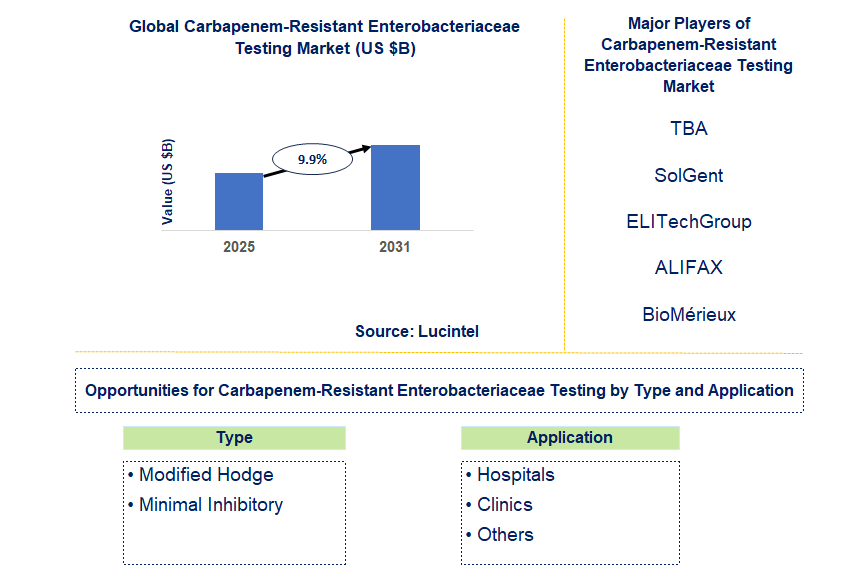
Key data points: The growth forecast = 9.9% annually for the next 7 years. Scroll below to get more insights. This market report covers trends, opportunities and forecasts in carbapenem-resistant enterobacteriaceae testing market to 2031 by type (modified hodge and minimal inhibitory), application (hospitals, clinics, and others), and region (North America, Europe, Asia Pacific, and the Rest of the World)
We'll send your sample report shortly.
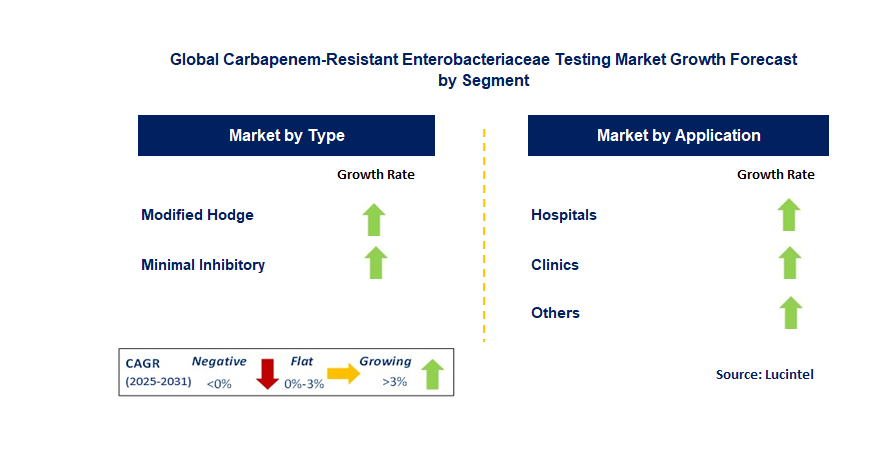
• Lucintel forecasts that, within the type category, minimal inhibitory is expected to witness higher growth over the forecast period.
• Within the application category, hospital is expected to witness higher growth.
• In terms of region, APAC is expected to witness the highest growth over the forecast period. Gain valuable insights for your business decisions with our comprehensive 150+ page report. Sample figures with some insights are shown below.
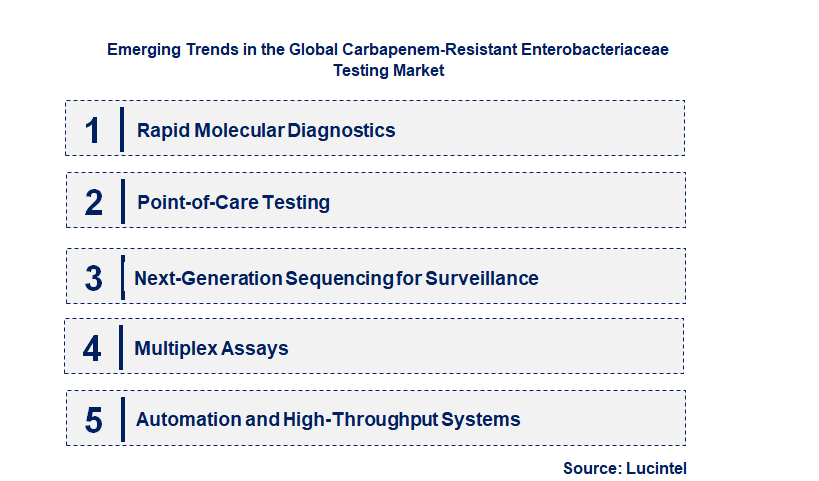
• Rapid Molecular Diagnostics: There’s a strong trend towards rapid molecular diagnostic platforms capable of detecting carbapenems genes within hours, rather than days. This allows for quicker identification of carbapenem-resistant enterobacteriaceae, enabling faster implementation of infection control measures and timely administration of appropriate antibiotics, directly impacting patient outcomes.
• Point-of-Care Testing: The development of carbapenem-resistant enterobacteriaceae testing solutions suitable for point-of-care settings is an emerging trend. POCT reduces the need for sending samples to centralized laboratories, facilitating quicker diagnosis at the patient’s bedside or in smaller clinics, which is crucial for early intervention and preventing further transmission in various healthcare settings.
• Next-Generation Sequencing for Surveillance: NGS is increasingly being utilized for detailed genomic characterization of carbapenem-resistant enterobacteriaceae isolates for surveillance purposes. This allows for precise identification of resistance mechanisms, tracking transmission routes, and understanding the epidemiology of outbreaks, informing public health strategies to contain the spread of carbapenem-resistant enterobacteriaceae.
• Multiplex Assays: The adoption of multiplex assays capable of simultaneously detecting multiple carbapenemase genes and other resistance markers is a key trend. These assays offer comprehensive information from a single test, reducing testing complexity, improving diagnostic efficiency, and enabling more informed treatment decisions.
• Automation and High-Throughput Systems: Automation and high-throughput systems are becoming more prevalent in clinical laboratories for carbapenem-resistant enterobacteriaceae testing. This trend aims to increase testing capacity, reduce manual errors, and improve workflow efficiency, allowing laboratories to process a larger volume of samples with consistent and reliable results. These trends are fundamentally reshaping the carbapenem-resistant enterobacteriaceae testing market by driving towards faster, more accessible, and comprehensive diagnostic solutions. They enable quicker clinical decisions, enhance infection control efforts, support robust surveillance, and ultimately contribute significantly to the global fight against antimicrobial resistance.
• Commercialization of Rapid Molecular Tests: A significant development is the commercialization and increased adoption of rapid molecular diagnostic tests for carbapenem-resistant enterobacteriaceae. These tests can identify specific carbapenems genes (e.g., KPC, NDM, OXA-48) directly from clinical samples in a few hours, drastically reducing turnaround time compared to traditional culture-based methods.
• Development of Novel Phenotypic Assays: Recent years have seen the introduction of new phenotypic assays, such as carbapenem inactivation methods (CIM) and modified carbapenem inactivation methods. These low-cost, easy-to-perform tests are becoming more widely adopted for confirming carbapenems production in clinical laboratories, offering reliable results.
• Increased Focus on Point-of-Care Devices: There’s a growing trend in the development of near point-of-care or even true point-of-care devices for carbapenem-resistant enterobacteriaceae detection. While still in early stages for some complex targets, efforts are focused on providing rapid results at the bedside, enabling immediate infection control measures and treatment initiation.
• Integration with Laboratory Automation Systems: Manufacturers are increasingly focusing on developing carbapenem-resistant enterobacteriaceae testing solutions that seamlessly integrate with existing laboratory automation systems. This enhances high-throughput capabilities, reduces manual labor, and minimizes the risk of human error, improving overall laboratory efficiency and consistency.
• Enhanced Surveillance and Reporting Platforms: Recent developments include the creation of more sophisticated digital platforms for real-time surveillance and reporting of carbapenem-resistant enterobacteriaceae cases. These platforms aid public health agencies in monitoring resistance trends, identifying outbreak clusters, and implementing targeted interventions to control the spread of carbapenem-resistant enterobacteriaceae effectively. These developments are collectively impacting the carbapenem-resistant enterobacteriaceae testing market by enabling faster and more accurate diagnosis, facilitating earlier infection control, improving accessibility of testing in diverse settings, streamlining laboratory workflows, and strengthening public health surveillance, all contributing to a more effective response against antimicrobial resistance.
• Hospital and Clinical Diagnostics: The primary growth opportunity lies in equipping hospitals and clinical laboratories with advanced carbapenem-resistant enterobacteriaceae testing solutions. Rapid and accurate identification is crucial for timely patient management, preventing healthcare-associated infections, and implementing effective isolation protocols to contain outbreaks within healthcare facilities.
• Infection Control and Surveillance Programs: Governments and healthcare organizations are investing heavily in national and regional infection control and surveillance programs. This presents a major growth opportunity for carbapenem-resistant enterobacteriaceae testing, as diagnostics are fundamental for monitoring resistance trends, identifying high-risk areas, and guiding public health interventions.
• Pharmaceutical and Biotech R&D: The development of new antibiotics and therapeutic strategies against carbapenem-resistant enterobacteriaceae requires extensive testing during preclinical and clinical trials. This creates a niche but significant growth opportunity for specialized carbapenem-resistant enterobacteriaceae testing services and kits that can accurately assess the efficacy of novel antimicrobial compounds.
• Veterinary Diagnostics: While human health is the primary focus, the "One Health" approach recognizes the link between human and animal health. Growing awareness of antimicrobial resistance in livestock and companion animals presents an emerging opportunity for carbapenem-resistant enterobacteriaceae testing in veterinary diagnostics to monitor and control resistance spread.
• Point-of-Care and Decentralized Testing: The push for decentralized healthcare and rapid decision-making creates opportunities for compact, easy-to-use carbapenem-resistant enterobacteriaceae testing devices suitable for smaller clinics, emergency rooms, or even remote settings. This expands accessibility and reduces turnaround times, crucial for immediate patient management and infection control. These strategic growth opportunities are profoundly impacting the carbapenem-resistant enterobacteriaceae testing market by driving the development of specialized and versatile diagnostic solutions tailored to the unique needs of each application. This leads to increased innovation, diversified product portfolios, and expanded market reach, ultimately strengthening the global response to antimicrobial resistance.
• TBA
• SolGent
• ELITechGroup
• ALIFAX
• BioMérieux
• Modified Hodge
• Minimal Inhibitory
• Hospitals
• Clinics
• Others
• North America
• Europe
• Asia Pacific
• The Rest of the World
• United States: The US market is characterized by a strong emphasis on rapid molecular diagnostics and advanced automated systems for carbapenem-resistant enterobacteriaceae detection, driven by the CDC’s focus on antimicrobial resistance. Significant investment in R&D aims to provide faster turnaround times for results, crucial for managing outbreaks and guiding appropriate treatment in healthcare settings.
• China: China carbapenem-resistant enterobacteriaceae testing market is rapidly expanding due to increasing awareness, growing healthcare expenditure, and a rising incidence of antibiotic-resistant infections. There’s a dual focus on developing indigenous diagnostic solutions and adopting international technologies to strengthen its capacity for rapid and accurate carbapenem-resistant enterobacteriaceae identification.
• Germany: Germany market for carbapenem-resistant enterobacteriaceae testing prioritizes high-quality, reliable diagnostic platforms, integrating seamlessly with its advanced healthcare infrastructure. Developments include sophisticated molecular assays and phenotypic tests, supporting comprehensive antimicrobial stewardship programs and robust surveillance efforts to control resistance.
• India: India carbapenem-resistant enterobacteriaceae testing market is witnessing significant growth, spurred by a large patient population, improving healthcare facilities, and a growing burden of antibiotic resistance. There’s an increasing demand for cost-effective and rapid diagnostic solutions, including both conventional and molecular methods, to address the challenge of carbapenem-resistant enterobacteriaceae in diverse clinical settings.
• Japan: Japan carbapenem-resistant enterobacteriaceae testing market emphasizes precision and technological innovation, with a focus on advanced molecular diagnostics for rapid identification of carbapenems genes. Developments are geared towards highly sensitive and specific tests to support strict infection control measures and facilitate prompt, targeted treatment strategies in its healthcare system.


• TBA
• SolGent
• ELITechGroup
• ALIFAX
• BioMérieux Q5. Which carbapenem-resistant enterobacteriaceae testing market segment will be the largest in future? Answer: Lucintel forecasts that, within the type category, minimal inhibitory is expected to witness higher growth over the forecast period. Q6. In carbapenem-resistant enterobacteriaceae testing market, which region is expected to be the largest in next 5 years? Answer: In terms of region, APAC is expected to witness the highest growth over the forecast period. Q7. Do we receive customization in this report? Answer: Yes, Lucintel provides 10% customization without any additional cost.


Choose a license that fits your team. Instant PDF delivery.
Prices exclude taxes. Instant delivery. Custom licensing available on request.
Market Report · July 22, 2026
Market Report · July 22, 2026
Market Report · July 22, 2026
Trusted partner for strategic intelligence and business growth


Receive a complimentary market analysis tailored to your industry. Our analysts will identify key growth opportunities and competitive dynamics specific to your business.

Market size, growth rate, and key trend analysis for your specific sector.

Top competitor positioning and market share analysis.

Strategic recommendations backed by data-driven insights.
Get curated market intelligence and competitive moves straight to your inbox.
By subscribing, you agree to receive our monthly insights. Unsubscribe anytime.
Receive a complimentary market analysis tailored to your industry. Our analysts will identify key growth opportunities and competitive dynamics specific to your business.
Market size, growth rate, and key trend analysis for your specific sector.
Top competitor positioning and market share analysis.
Strategic recommendations backed by data-driven insights.
Get curated market intelligence, emerging trends, and competitive moves straight to your inbox each month.
By subscribing, you agree to receive our monthly insights. Unsubscribe anytime.
We'll send your sample report shortly.