
Market Report · July 22, 2026

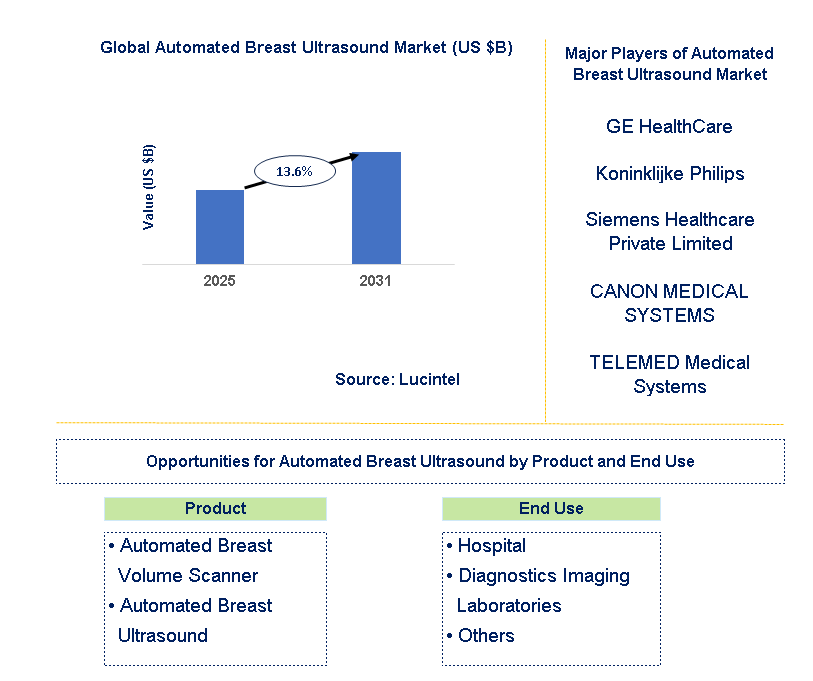
Key data points: The growth forecast = 13.6% annually for the next 7 years. Scroll below to get more insights. This market report covers trends, opportunities and forecasts in automated breast ultrasound market to 2031 by product (automated breast volume scanner and automated breast ultrasound), end use (hospital, diagnostics imaging laboratories, and others), and region (North America, Europe, Asia Pacific, and the Rest of the World)
We'll send your sample report shortly.
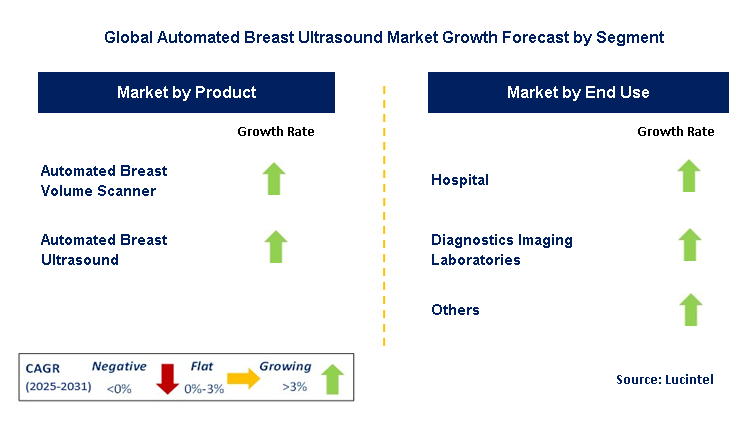
• Lucintel forecasts that, within the product category, automated breast ultrasound is expected to witness higher growth over the forecast period.
• Within the end use category, hospital is expected to witness higher growth.
• In terms of region, APAC is expected to witness the highest growth over the forecast period. Gain valuable insights for your business decisions with our comprehensive 150+ page report. Sample figures with some insights are shown below.
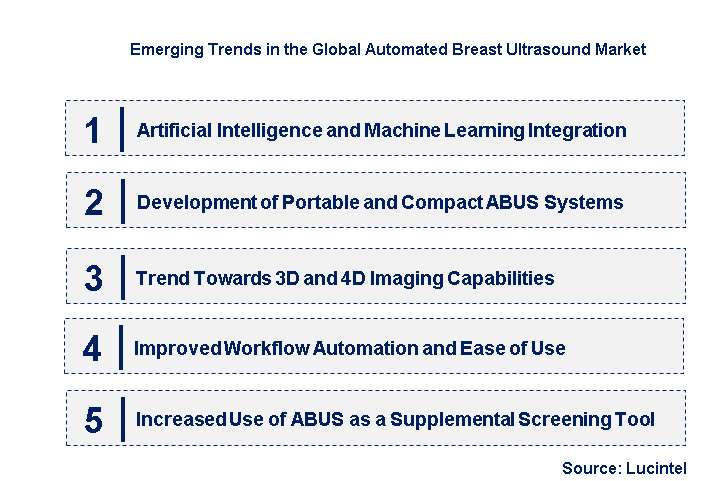
• Artificial Intelligence and Machine Learning Integration: The trend entails integrating AI and ML algorithms into ABUS systems for automatic image analysis, lesion detection, and characterization. AI can help radiologists by pointing out suspicious regions, lowering reading time, and lessening inter-operator variation. The effect is increased diagnostic accuracy, potentially resulting in earlier and more accurate cancer detection, particularly in dense breasts where abnormality may be masked. AI also assists in image interpretation standardization and can act as an excellent second opinion, enhancing workflow productivity in high-volume imaging centers.
• Development of Portable and Compact ABUS Systems: This line of development targets the production of compact, lightweight, and portable ABUS units. Most standard ABUS systems are large and intended for stationary installation in hospitals. Portable systems make deployment in different clinical settings possible, such as in outpatient clinics, mobile screening units, and even in remote areas. The effect is a dramatic enhancement in access to breast ultrasound screening, especially in under-resourced rural communities or places with limited medical infrastructure, hence elevated early detection rates across more populations.
• Trend Towards 3D and 4D Imaging Capabilities: This trend highlights the shift from standard 2D ultrasound towards sophisticated 3D and upcoming 4D (real-time 3D) imaging in ABUS technology. 3D imaging gives a complete volumetric image of the breast so radiologists can view slices in any plane, including the all-important coronal view frequently hidden in 2D. The effect is better visualization of breast tissue and lesions and improved diagnostic confidence and accuracy, particularly for difficult cases or dense breasts. 4D imaging builds on this with real-time anatomical and functional data.
• Improved Workflow Automation and Ease of Use: This trend aims to simplify the ABUS scanning and interpretation process through increased automation and user-friendly interfaces. Automated breast volume acquisition, standardized scanning protocols, and easy image navigation are being incorporated. The effect is decreased operator reliance, reducing image acquisition variability, and shortening the overall examination time. This simplifies ABUS systems for technologists and radiologists to use, producing greater throughput, improved efficiency, and uniform image quality with varying operators.
• Increased Use of ABUS as a Supplemental Screening Tool: This trend reflects the increased acceptance and use of ABUS as a necessary supplement to mammography in women with dense breasts. Regulatory agencies and clinical guidelines increasingly suggest supplementary screening of this population, since mammography is less sensitive in dense breasts. The effect is a considerable gain in rates of breast cancer detection among a high-risk group, resulting in earlier diagnosis and improved outcomes for treatment. The trend is fueling market expansion by meeting a key unmet need for breast cancer screening. These new trends are significantly transforming the Automated Breast Ultrasound Market by making breast cancer screening more efficient, accessible, and effective. Combining AI and innovations in 3D/4D imaging increases diagnostic precision, while portable system developments and intuitive interfaces enhance accessibility and workflow. The growing use of ABUS for dense breasts fills an important gap in screening. Together, these trends are propelling the market toward more integrated, personalized, and preventive breast health management, ultimately enhancing early detection and patient outcomes.
• Artificial Intelligence Powered Image Analysis: The most noteworthy recent advancement is the infusion of artificial intelligence and machine learning algorithms into ABUS systems. These AI applications aid radiologists to review tremendous quantities of volumetric data, detect faint lesions, and sort benign from malignant findings. The effect is a considerable increase in diagnostic correctness, fewer false positives, and shorter per-case reading times for radiologists, thus optimizing the diagnostic process in high-volume clinics. AI-driven solutions also aid in standardization of interpretation, reducing inter-reader variability.
• Advanced 3D and Coronal Plane Visualization: The recent push has been toward increasing the resolution and quality of 3D image acquisition of ABUS, especially with greater emphasis on the coronal plane. It is a special view difficult to achieve with handheld ultrasound that facilitates more efficient visualization of lesions within the overall breast volume. The effect is a wider knowledge of breast anatomy and pathology, allowing radiologists to identify cancers that would be lost on routine mammography or 2D ultrasound, particularly in dense breasts, for earlier diagnosis and more accurate diagnosis.
• Improved Workflow and User Interface Simplification: Manufacturers have responded in recent times with important upgrades to ABUS system workflows and user interfaces, which are more intuitive and effective. Such developments incorporate capabilities such as guided acquisition protocols, automatic image registration, and easy navigation through big datasets. The result is a decrease in operator reliance and training time, resulting in more consistent image quality as well as higher patient throughput. Enhanced user experience also promotes wider use in clinical practice, guaranteeing routine acquisition of high-quality scans.
• Greater Emphasis on Patient Comfort and Ergonomics: Current ABUS design focuses on patient comfort and ergonomic design to enhance the overall scanning experience. This encompasses softer transducers, patient positioning aids that can be adjusted, and quieter operation. The effect is less patient anxiety and discomfort during the test, leading to greater compliance with screening guidelines. Enhanced comfort also helps in producing a higher quality image by reducing patient movement, making the ABUS exam more acceptable for women who receive supplementary screening.
• Regulatory Clearances and Clinical Guideline Updates: There has been a significant rise in regulatory clearances for new ABUS systems and software, and updates in clinical guidelines by major medical groups that endorse ABUS as a complementary screening modality for dense breasts in women. The effect is increasing acceptance and incorporation of ABUS into routine breast cancer screening protocols. These approvals give assurance to healthcare professionals and provide wider insurance coverage, speeding up the use of ABUS in clinical practice and enhancing access to eligible patients. These recent advances are collectively transforming the Automated Breast Ultrasound Market by making the screening of breast cancer more sophisticated, streamlined, and patient-focused. The convergence of AI, improved imaging power, and optimized workflows is increasing diagnostic accuracy and optimizing processes. In addition, emphasis on patient comfort and favorable regulatory settings is fueling broader adoption. These innovations place ABUS as a go-to tool in the new landscape of breast health, making the significant contribution to earlier detection and improved outcomes for women worldwide.
• Dense Breast Screening as an Adjunct to Mammography: This is the most important strategic growth opportunity. Around 40-50% of women possess dense breast tissue, which hides cancers on mammograms. ABUS shines in this case, giving a full 3D image. The effect is significantly better detection of cancer among these women, resulting in earlier treatment and diagnosis. Educating patients and healthcare providers regarding breast density and the advantages of ABUS as an adjunct screening tool will propel broad adoption and market growth in this space.
• Diagnostic Evaluation of Indeterminate Findings and Follow-up: ABUS presents a strategic option for the clarification of indeterminate results on mammograms or clinical exams. It can provide the level of detail in volumetric images necessary to distinguish benign from malignant lesions, so unnecessary biopsies may be fewer. The effect is enhanced diagnostic confidence, decreased patient anxiety, and more effective patient management pathways. As a second-line diagnostic tool of prime importance, ABUS can make the diagnostic process more efficient and maximize resource utilization in breast imaging facilities.
• Breast Cancer Screening in High-Risk Groups: This option targets the use of ABUS for screening high-risk women at increased breast cancer risk, including a strong family history, genetic abnormality, or prior breast abnormality, for whom more intensive or frequent follow-up could be beneficial. Since it is radiation-free, ABUS is very appealing for young high-risk women who are in need of ongoing screening. The effect is earlier diagnosis and enhanced surveillance protocols for this high-risk population, leading to enhanced long-term outcomes and lower mortality rates.
• Integration into Comprehensive Breast Centers and Oncology Pathways: Strategic expansion is in integrating ABUS well into multigenetic breast centers and complete oncology pathways. This. Much more than simply purchasing ABUS machines, this entails the inclusion of their information with other imaging modalities, electronic health records, and tumor boards. The implementation is a comprehensive approach to breast cancer management where they are part of an entire diagnostic picture with ABUS findings, resulting in better-coordinated care, streamlined decision-making processes, and optimized treatment plans for patients along their cancer journey.
• Growth in Emerging Markets and Under-Served Areas: There exists a large untapped growth potential in emerging economies and under-served rural areas with limited access to sophisticated breast imaging. Producing more affordable, portable, and user-friendly ABUS systems designed for these markets and training programs for local healthcare providers will be key. The effect is greater access to life-saving breast cancer screening for massive populations, resulting in enhanced early detection rates and public health outcomes in areas where breast cancer death is still high because of late diagnosis. All these strategic expansion opportunities are having a deep impact on the Automated Breast Ultrasound Market by allocating innovation and investment in key unmet needs in breast cancer detection. Through dense breast screening, follow-up diagnostics, high-risk patients, integrated care, and emerging markets, however, market participants can greatly increase the utility and availability of ABUS. Not only does this strategic application drive market expansion, but it also helps contribute broadly to enhanced world breast health outcomes through more timely and accurate diagnoses.
• GE HealthCare
• Koninklijke Philips
• Siemens Healthcare Private Limited
• CANON MEDICAL SYSTEMS CORPORATION
• TELEMED Medical Systems
• Hologic
• SuperSonic Imagine
• Automated Breast Volume Scanner
• Automated Breast Ultrasound
• Hospital
• Diagnostics Imaging Laboratories
• Others
• North America
• Europe
• Asia Pacific
• The Rest of the World
• United States: The United States is a key market for ABUS, underpinned by high rates of breast cancer incidence, high awareness programs, and good insurance coverage for supplemental screening in women with dense breasts. Recent trends have involved more FDA clearances for new ABUS equipment and software, frequently including artificial intelligence to provide better image analysis and workflow management. There is ongoing emphasis on the integration of ABUS into current breast imaging protocols and electronic health records to enhance patient management and decrease diagnostic delay. Research and development investment by market leaders remains strong.
• China: The Chinese ABUS market is growth-driven, with high patient volumes, growing breast cancer rates, and intensifying investment in cutting-edge medical technology. Recent advancements include an upsurge in local manufacturing capacity to make cheaper ABUS systems available, opening up access to more hospitals and diagnostic centers across the board. There has been a strong government initiative for early cancer detection schemes, with the inclusion of progressive imaging technologies such as ABUS. International and domestic company collaborations are also driving market growth and technology transfer.
• Germany: Germany‘s ABUS market is dominated by a strong focus on high-quality medical devices, extensive clinical verification, and incorporation into established healthcare systems. Latest trends involve the common usage of ABUS in university hospitals and specialized breast centers as part of integrated breast cancer screening programs. Efforts are being made for the optimization of ABUS protocols and incorporation of artificial intelligence for increased diagnostic confidence and decreased reading times for radiologists. Germany
• India: India‘s ABUS market is developing with high growth opportunities, fueled by an underserved large patient pool, rising awareness of breast cancer, and improving healthcare infrastructure. New developments involve increasing demand for affordable and portable ABUS solutions to access rural and remote locations. There is growing use of ABUS in large city-based diagnostic facilities and private hospitals, frequently in combination with mammography. Government programs and private investment to increase cancer screening facilities are set to drive ABUS adoption even faster.
• Japan: Japan‘s technologically sophisticated and mature ABUS market has a high focus on patient comfort and precision imaging. Recent advances involve ongoing innovation in transducer technology and image processing algorithms to enhance resolution and diagnostic performance, especially for small lesions in dense breasts. Japanese vendors are concentrating on creating holistic systems that naturally integrate ABUS with other imaging techniques. The aging demographics and high prevalence of breast cancer propel the requirement for holistic and effective breast screening solutions.


• GE HealthCare
• Koninklijke Philips
• Siemens Healthcare Private Limited
• CANON MEDICAL SYSTEMS CORPORATION
• TELEMED Medical Systems
• Hologic
• SuperSonic Imagine Q5. Which automated breast ultrasound market segment will be the largest in future? Answer: Lucintel forecasts that, within the product category, automated breast ultrasound is expected to witness higher growth over the forecast period. Q6. In automated breast ultrasound market, which region is expected to be the largest in next 5 years? Answer: In terms of region, APAC is expected to witness the highest growth over the forecast period. Q7. Do we receive customization in this report? Answer: Yes, Lucintel provides 10% customization without any additional cost.


Choose a license that fits your team. Instant PDF delivery.
Prices exclude taxes. Instant delivery. Custom licensing available on request.
Market Report · July 22, 2026
Market Report · July 22, 2026
Market Report · July 22, 2026
Trusted partner for strategic intelligence and business growth


Receive a complimentary market analysis tailored to your industry. Our analysts will identify key growth opportunities and competitive dynamics specific to your business.

Market size, growth rate, and key trend analysis for your specific sector.

Top competitor positioning and market share analysis.

Strategic recommendations backed by data-driven insights.
Get curated market intelligence and competitive moves straight to your inbox.
By subscribing, you agree to receive our monthly insights. Unsubscribe anytime.
Receive a complimentary market analysis tailored to your industry. Our analysts will identify key growth opportunities and competitive dynamics specific to your business.
Market size, growth rate, and key trend analysis for your specific sector.
Top competitor positioning and market share analysis.
Strategic recommendations backed by data-driven insights.
Get curated market intelligence, emerging trends, and competitive moves straight to your inbox each month.
By subscribing, you agree to receive our monthly insights. Unsubscribe anytime.
We'll send your sample report shortly.