
Market Report · July 22, 2026

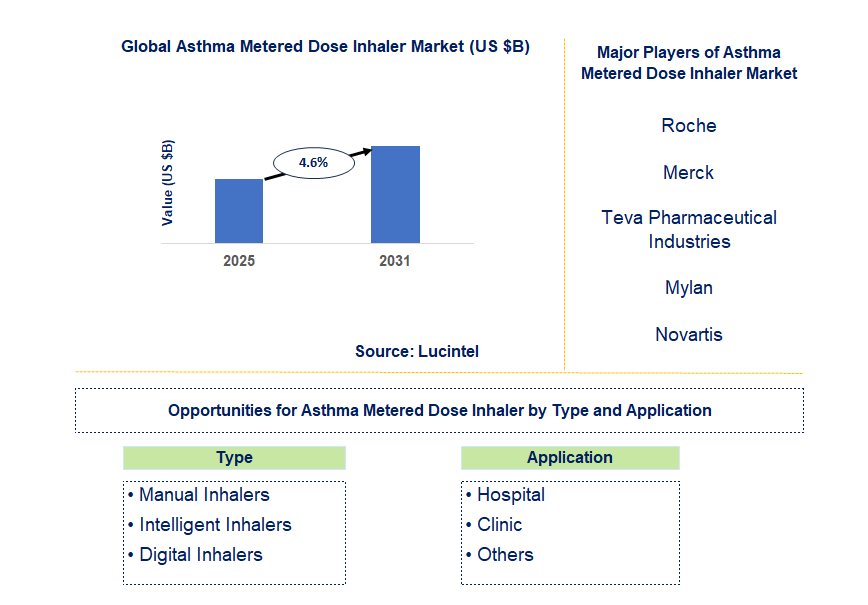
Key data points: The growth forecast = 4.6% annually for the next 7 years. Scroll below to get more insights. This market report covers trends, opportunities and forecasts in asthma metered dose inhaler market to 2031 by type (manual inhalers, intelligent inhalers, and digital inhalers), application (hospital, clinic, and others), and region (North America, Europe, Asia Pacific, and the Rest of the World)
We'll send your sample report shortly.
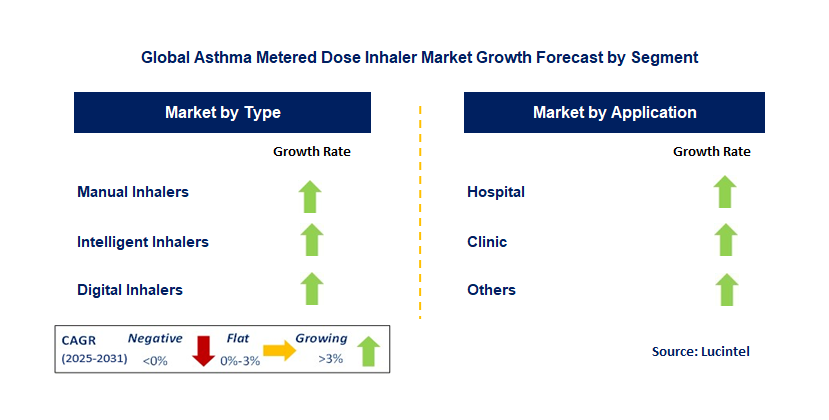
• Lucintel forecasts that, within the type category, digital inhaler is expected to witness the highest growth over the forecast period.
• Within the application category, hospital is expected to witness higher growth.
• In terms of region, APAC is expected to witness the highest growth over the forecast period. Gain valuable insights for your business decisions with our comprehensive 150+ page report. Sample figures with some insights are shown below.
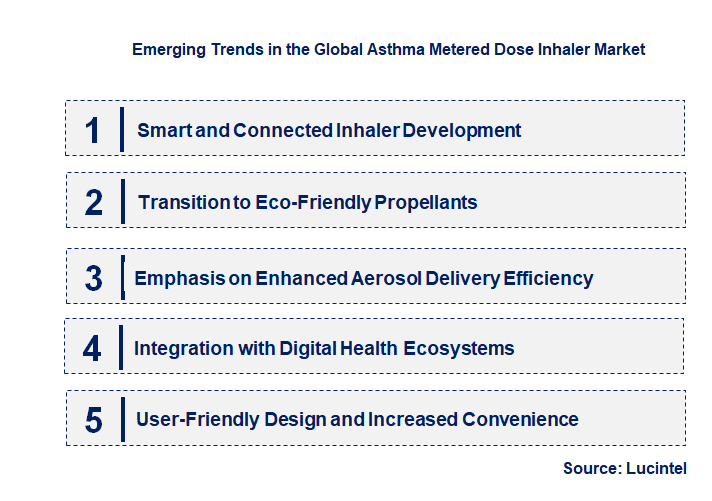
• Smart and Connected Inhaler Development: Coupling sensors and connectivity to monitor usage, technique, and environmental variables, smart MDIs offer useful information to patients and physicians, enhancing compliance and allowing for personalized control of asthma. Optimizing treatment regimens based on real-time usage patterns and possible triggers is facilitated by this technology.
• Transition to Eco-Friendly Propellants: With growing environmental consciousness, there is tremendous pressure to substitute HFA propellants with those having a lower global warming potential, thereby decreasing the carbon footprint of MDI treatments. This transition fits in with worldwide sustainability initiatives in the pharmaceutical sector.
• Emphasis on Enhanced Aerosol Delivery Efficiency: Innovations in MDI device design and formulation are directed towards improved delivery of drug to the lungs for maximum therapeutic effect with reduced systemic side effects. It involves optimizing the particle size and plume parameters for enhanced lung deposition.
• Integration with Digital Health Ecosystems: MDIs are being increasingly designed to integrate with mobile apps and other digital health platforms, enabling effortless data exchange, medication reminders, and remote monitoring by healthcare providers. Such integration enables a more comprehensive asthma care approach.
• User-Friendly Design and Increased Convenience: Companies are aiming to develop MDIs that are more convenient to use, such as dose counters, better ergonomics, and easier actuation mechanisms, to increase patient compliance, particularly in children and the elderly. This emphasis on usability is to minimize medication errors. These trends are remapping the asthma MDI market in directions more intelligent, sustainable, and patient-centric. The uptake of digital technology and environmental pressure are prime determinants shaping future MDI directions of development and use.
• Introduction of MDIs with Low Global Warming Potential Propellants: Pharmaceutical firms are introducing MDIs that employ propellants such as HFA-152a and HFO-1234ze, which have much lower global warming potential than conventional HFAs, a move towards more environmentally friendly asthma treatment.
• Innovations in Digital Add-on Devices for MDIs: Various firms are also creating and marketing clip-on sensors and digital platforms to be attached to conventional MDIs to monitor use, send reminders, and provide comments on inhalation technique, essentially making them smart inhalers.
• Regulatory Clearances for New MDI Combinations and Novel Formulations: Regulatory agencies are clearing new formulations of MDIs and combination medications that provide increased efficacy, convenience (e.g., once daily), or treatment of specific phenotypes of asthma, offering more targeted treatment opportunities.
• Introduction of Breath-Actuated MDIs with Advanced Features: More recent breath-actuated MDIs are being released with features such as dose counters and enhanced triggering mechanisms, to make them easier to use and provide patients with the right dose irrespective of the strength of their inhalation.
• Partnerships for Integrating MDIs into Telehealth Platforms: MDI manufacturers and telehealth providers are forming partnerships to enable remote monitoring of asthma patients, enabling healthcare professionals to monitor adherence and intervene if necessary. These innovations are influencing the asthma MDI market by making treatments more environmentally friendly, improving patient adherence and monitoring through digital integration, and offering more effective and easier-to-use inhaler products.
• Integration with Personalized Asthma Management Programs: Customizing MDI choice and usage recommendations based on individual patient profiles, such as asthma severity, triggers, and inhalation abilities, can maximize treatment results and compliance. Smart inhaler information can also make these programs more personalized.
• Expansion in Emerging Markets with Growing Asthma Prevalence: With increasing urbanization and air pollution rates in emerging economies, the asthma prevalence is on the rise, and hence a great opportunity for MDI makers to offer inexpensive and accessible treatment.
• Use in School Health Programs and Pediatric Asthma Care: The use of MDIs in school health programs and child-friendly devices with adequate education can enhance asthma control in children, a population with a high prevalence of the disease.
• Application in Sports and Exercise-Induced Asthma Management: Portable and rapid-acting MDIs are essential for exercise-induced bronchoconstriction management, offering an opportunity to create specialized MDIs and educational materials for athletes and physically active individuals.
• Inclusion into Home Healthcare and Remote Monitoring Services: Integration of MDIs with telehealth platforms allows remote monitoring of asthma patients in the home setting, enhancing compliance, enabling timely intervention, and minimizing frequent hospital visits. These opportunities for growth underscore the value of MDIs in responding to varied needs in asthma care, ranging from personalized treatment and emerging markets to specialty applications and remote healthcare environments.
• Roche
• Merck
• Teva Pharmaceutical Industries
• Mylan
• Novartis
• Pfizer
• Chiesi Farmaceutici
• Johnson and Johnson
• Monsanto
• Boehringer Ingelheim
• Manual Inhalers
• Intelligent Inhalers
• Digital Inhalers
• Hospital
• Clinic
• Others
• North America
• Europe
• Asia Pacific
• The Rest of the World
• United States: Emphasis on intelligent inhalers and HFA substitutes. Developments in the recent past have included FDA approval for connected MDIs that monitor usage and technique, and launch of MDIs with lower global warming potential propellants, reflecting environmental focus and striving for improved patient outcomes through improved adherence.
• China: Growing adoption fueled by air pollution and domestic manufacturing. China is experiencing growing use of MDIs due to the high level of air pollution and increasing cases of asthma and COPD. Domestic producers are stepping up output, and there‘s a steady adoption of newer MDI technology, although cost remains a major consideration.
• Germany: Focus on environmentally friendly solutions and well-established healthcare systems. Germany leads the way in switching to MDIs with environmentally friendly propellants. The well-established healthcare system is conducive to the implementation of new MDI technologies with a focus on patient education and correct inhaler use.
• India: Affordability-driven and accessible growth market. India‘s MDI market is growing as a result of rising incidence of respiratory disease and enhanced accessibility to healthcare. Cost-effectiveness is important but there is also an emerging desire for smart features in inhalers and local manufacturing to address expanding demand.
• Japan: Transition to alternative non-CFC options and patient safety. Japan has achieved major strides in CFC-based MDI phase-down. Recent action is aimed at maintaining patient safety in the course of switching over to alternative propellants as well as fostering the appropriate usage of MDIs among the growing elderly population of patients suffering from respiratory ailments.


• Roche
• Merck
• Teva Pharmaceutical Industries
• Mylan
• Novartis
• Pfizer
• Chiesi Farmaceutici
• Johnson and Johnson
• Monsanto
• Boehringer Ingelheim Q5. Which asthma metered dose inhaler market segment will be the largest in future? Answer: Lucintel forecasts that, within the type category, digital inhaler is expected to witness the highest growth over the forecast period. Q6. In asthma metered dose inhaler market, which region is expected to be the largest in next 5 years? Answer: In terms of region, APAC is expected to witness the highest growth over the forecast period. Q7. Do we receive customization in this report? Answer: Yes, Lucintel provides 10% customization without any additional cost.


Choose a license that fits your team. Instant PDF delivery.
Prices exclude taxes. Instant delivery. Custom licensing available on request.
Market Report · July 22, 2026
Market Report · July 22, 2026
Market Report · July 22, 2026
Trusted partner for strategic intelligence and business growth


Receive a complimentary market analysis tailored to your industry. Our analysts will identify key growth opportunities and competitive dynamics specific to your business.

Market size, growth rate, and key trend analysis for your specific sector.

Top competitor positioning and market share analysis.

Strategic recommendations backed by data-driven insights.
Get curated market intelligence and competitive moves straight to your inbox.
By subscribing, you agree to receive our monthly insights. Unsubscribe anytime.
Receive a complimentary market analysis tailored to your industry. Our analysts will identify key growth opportunities and competitive dynamics specific to your business.
Market size, growth rate, and key trend analysis for your specific sector.
Top competitor positioning and market share analysis.
Strategic recommendations backed by data-driven insights.
Get curated market intelligence, emerging trends, and competitive moves straight to your inbox each month.
By subscribing, you agree to receive our monthly insights. Unsubscribe anytime.
We'll send your sample report shortly.