
Market Report · July 20, 2026

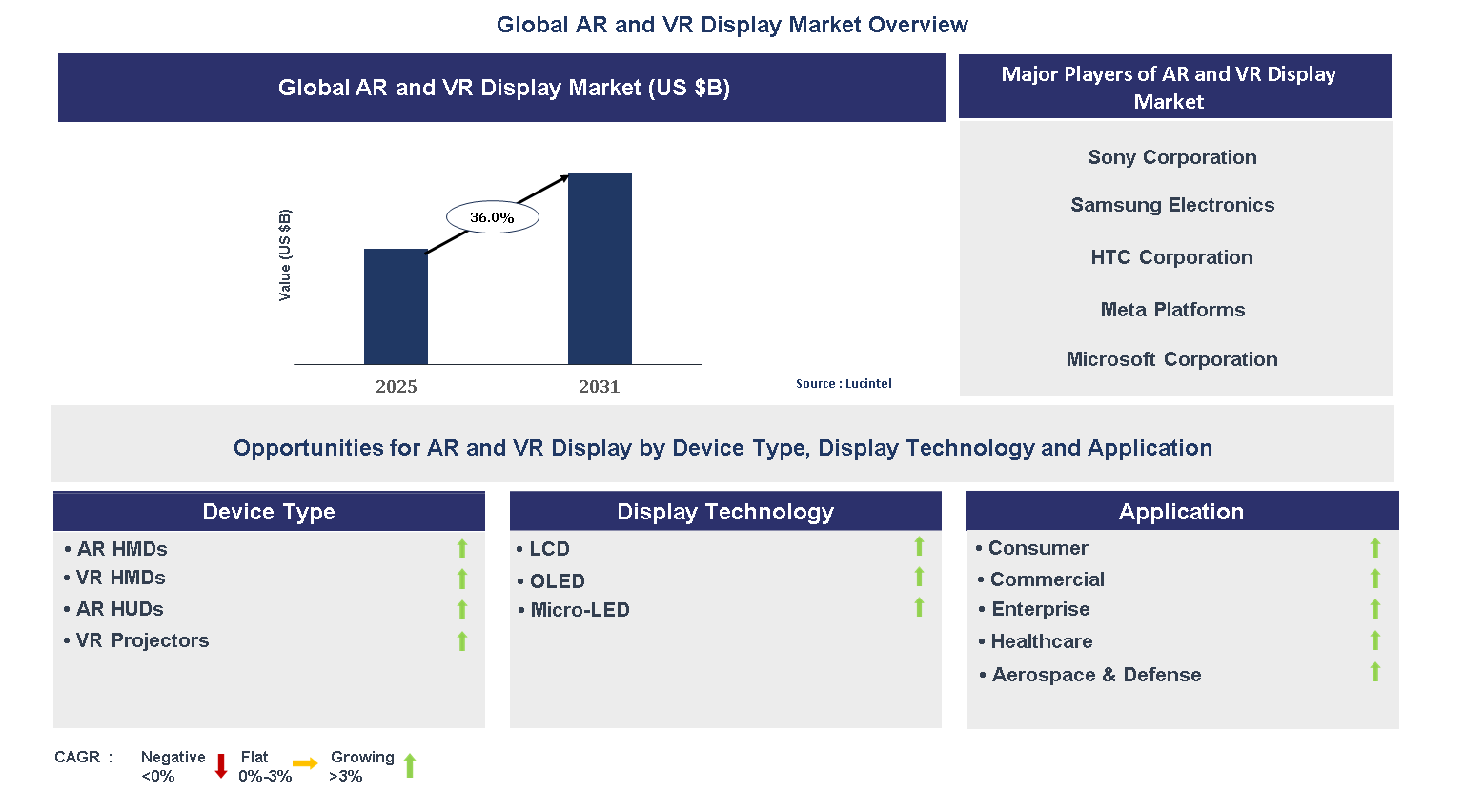
Key data points: The growth forecast = 36% annually for the next 7 years. Scroll below to get more insights. This market report covers trends, opportunities and forecasts in AR and VR display market to 2031 by device type (AR HMDs, VR HMDs, AR HUDs, and VR projectors), display technology (LCD, OLED, and micro-LED), application (consumer, commercial, enterprise, healthcare, and aerospace & defense), and region (North America, Europe, Asia Pacific, and the Rest of the World)
We'll send your sample report shortly.
• Lucintel forecasts that, within the device type category, VR HMD is expected to witness the highest growth over the forecast period.
• Within the application category, consumer, commercial, enterprise, healthcare, and aerospace & defense is expected to witness the highest growth.
• In terms of region, APAC is expected to witness the highest growth over the forecast period. Gain valuable insights for your business decisions with our comprehensive 150+ page report. Sample figures with some insights are shown below.
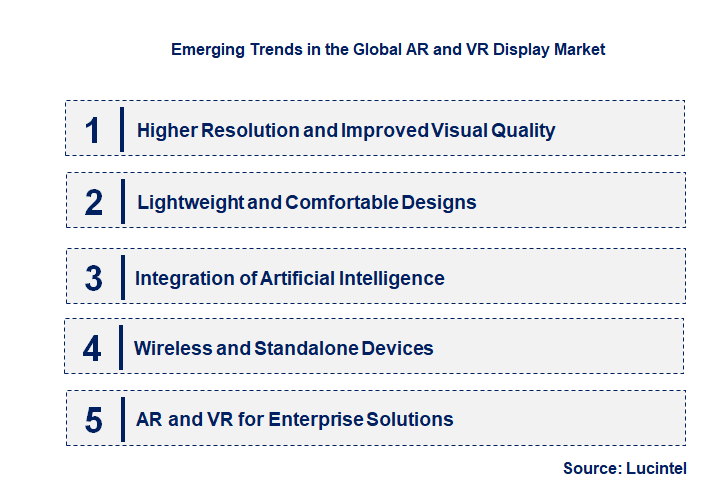
• Higher Resolution and Improved Visual Quality: A major trend is the development of displays with higher resolutions, such as 8K and beyond, to provide a more immersive experience. This trend is driven by the demand for clearer, more lifelike visuals in gaming, simulations, and entertainment. Enhanced resolution is crucial for reducing motion sickness and improving user comfort in AR/VR environments.
• Lightweight and Comfortable Designs: Manufacturers are focusing on reducing the weight and increasing the comfort of AR and VR headsets. As the technology matures, consumers demand headsets that are easy to wear for extended periods. This trend is pushing the design of lightweight materials, ergonomic forms, and improved balance, which helps cater to both professional and consumer applications.
• Integration of Artificial Intelligence: AI integration in AR and VR displays is enhancing user experiences by enabling more natural interactions and real-time adjustments. AI-driven features, like facial recognition, gesture control, and predictive analytics, are making AR/VR systems more intuitive and efficient. This trend is especially important in healthcare, gaming, and education, where personalized experiences are in demand.
• Wireless and Standalone Devices: The shift toward wireless, standalone AR/VR headsets is transforming the market by removing the need for external PCs or mobile devices. These devices offer greater freedom and convenience, enhancing user immersion. Companies are focusing on integrating powerful processors, improved battery life, and advanced connectivity options to provide seamless, high-quality AR/VR experiences.
• AR and VR for Enterprise Solutions: Beyond consumer entertainment, AR and VR are increasingly being adopted for enterprise applications like training, product design, and remote collaboration. The demand for immersive and interactive solutions in industries like manufacturing, automotive, and healthcare is fueling this trend. Companies are developing customized AR/VR displays to improve productivity and operational efficiency in the workplace. These emerging trends—higher resolution, lightweight designs, AI integration, wireless devices, and enterprise applications—are redefining the AR/VR display market. As these technologies advance, the line between virtual and real worlds continues to blur, enabling more immersive and personalized experiences across various sectors. Manufacturers must stay ahead of these trends to remain competitive and cater to diverse user needs.
• Launch of Standalone VR Headsets: The development of standalone VR headsets, such as the Oculus Quest 2 and HTC Vivi Focus, has revolutionized the market. These devices no longer require a connection to a PC or console, making VR experiences more accessible and portable. The trend of all-in-one VR headsets is pushing the market toward greater consumer adoption.
• Advancements in OLED and Micro LED Displays: AR/VR displays are benefiting from significant improvements in OLED and Micro LED technology, offering deeper blacks, vibrant colors, and better contrast. These advancements improve the visual quality of immersive experiences, making them more lifelike. Micro LED, in particular, promises even higher brightness levels, wider color gamut’s, and lower power consumption.
• AR Glasses for Consumer and Enterprise Use: AR glasses are making a significant impact in both consumer and enterprise markets. Companies like Microsoft (HoloLens) and Magic Leap are advancing AR glasses that offer real-time data overlay and interactive experiences. These glasses are gaining traction in industries such as healthcare, automotive, and education, where hands-free access to information is crucial.
• Integration of 5G with AR/VR Displays: The rollout of 5G networks is enhancing the performance of AR and VR devices by providing faster data transfer speeds and lower latency. This development is particularly important for cloud-based AR/VR applications, allowing users to access high-quality immersive experiences in real-time. 5G is helping AR/VR technology scale for broader use, especially in enterprise and remote work applications.
• AI-Powered Personalization in AR/VR: AI-driven personalization features are being integrated into AR/VR displays, enabling users to have more tailored experiences. AI can optimize display settings, track user preferences, and even predict actions. This development is improving user engagement, especially in gaming, virtual tourism, and training simulations, where personalized content is key to enhancing immersion. These recent developments, such as the launch of standalone VR headsets, advancements in display technologies, the rise of AR glasses, 5G integration, and AI-powered personalization, are driving the AR/VR display market forward. These innovations are making immersive technologies more accessible, efficient, and engaging across a variety of applications, with significant potential for further growth.
• AR/VR in Healthcare: The healthcare sector is increasingly adopting AR/VR for applications such as surgical training, remote consultations, and patient therapy. This growing demand presents significant opportunities for AR/VR display manufacturers to create specialized solutions for medical professionals and patients. These technologies are improving accuracy in surgery and providing immersive environments for rehabilitation and mental health treatments.
• VR in Education and Training: VR is being used more widely in education, offering immersive learning experiences in fields like medicine, engineering, and vocational training. The opportunity for AR/VR display makers lies in developing systems that offer realistic simulations and interactive content. As the demand for remote education and skill-based training grows, VR displays will play a critical role in enhancing learning experiences.
• AR/VR in Retail and E-Commerce: Retailers are increasingly turning to AR/VR to offer virtual shopping experiences and product visualizations. Consumers can try out products virtually, enhancing their online shopping experiences. For manufacturers of AR/VR displays, this presents opportunities to create highly engaging, high-definition displays that support augmented and virtual reality-based shopping environments in both physical and digital retail spaces.
• AR/VR in Gaming and Entertainment: The gaming and entertainment industries continue to drive demand for advanced AR and VR displays, especially with the growing interest in esports, interactive storytelling, and immersive virtual worlds. Developers have the opportunity to create displays that support these experiences, enhancing user engagement through high-quality visuals, low latency, and high frame rates.
• AR/VR for Remote Work and Collaboration: With the rise of remote work, AR/VR displays are becoming essential tools for virtual meetings, remote collaboration, and virtual conferences. The potential for virtual workplaces and collaborative environments is growing, offering opportunities to develop AR/VR displays that provide realistic, interactive, and productive virtual workspaces for professionals across industries. The strategic growth opportunities in healthcare , education, retail, gaming, and remote work are helping to expand the AR/VR display market. As these applications continue to evolve and grow, manufacturers have a chance to create tailored solutions that address specific industry needs, driving further adoption and market development.
• Sony Corporation
• Samsung Electronics
• HTC Corporation
• Meta Platforms
• Microsoft Corporation
• Apple
• Panasonic Corporation
• Magic Leap
• Lenovo Group Limited
• AR HMDs
• VR HMDs
• AR HUDs
• VR Projectors
• LCD
• OLED
• Micro-LED
• Consumer
• Commercial
• Enterprise
• Healthcare
• Aerospace & Defense
• North America
• Europe
• Asia Pacific
• The Rest of the World
• United States: The U.S. remains a key player in the AR/VR display market, with a significant focus on developing high-resolution, lightweight, and immersive headsets for both consumer and enterprise applications. Companies like Oculus, Microsoft, and Apple are leading innovation, with advancements in display technology that enhance user experience. The military, healthcare, and entertainment sectors are major adopters of AR and VR in the U.S.
• China: China’s AR/VR market is rapidly growing, supported by strong government investment and a booming tech ecosystem. Chinese manufacturers such as HTC and Alibaba are leading the development of affordable, high-quality AR/VR displays for gaming, education, and healthcare. With the government’s “Made in China 2025” initiative, there’s a significant push toward creating innovative AR/VR solutions to compete globally.
• Germany: Germany’s AR/VR display market is heavily influenced by industrial applications, particularly in manufacturing, automotive, and engineering. German companies are focusing on precision and high-performance displays that integrate with enterprise-level software solutions. With the country’s strong tech ecosystem, Germany is leading the development of VR solutions for training, simulations, and design visualization, especially in the automotive sector.
• India: India’s AR/VR display market is on the rise, driven by increasing investment in education, entertainment, and mobile technology. With a young, tech-savvy population and rapid digital adoption, India is embracing AR/VR for training, education, and gaming. However, affordability remains a key challenge, and local manufacturers are developing low-cost AR/VR headsets to cater to the mass market.
• Japan: Japan is advancing AR/VR technology with a focus on entertainment, robotics, and healthcare. The country is investing in next-generation AR displays for gaming, retail, and tourism. Japans major tech companies, like Sony and Panasonic, are developing immersive VR headsets and AR applications. The government’s push for a Super Smart Society is accelerating the integration of AR/VR into daily life.


• Sony Corporation
• Samsung Electronics
• HTC Corporation
• Meta Platforms
• Microsoft Corporation
• Apple
• Panasonic Corporation
• Magic Leap
• Lenovo Group Limited Q5. Which AR and VR display market segment will be the largest in future? Answer: Lucintel forecasts that, within the device type category, VR HMD is expected to witness the highest growth over the forecast period. Q6. In AR and VR display market, which region is expected to be the largest in next 5 years? Answer: In terms of region, APAC is expected to witness the highest growth over the forecast period. Q7. Do we receive customization in this report? Answer: Yes, Lucintel provides 10% customization without any additional cost.


Choose a license that fits your team. Instant PDF delivery.
Prices exclude taxes. Instant delivery. Custom licensing available on request.
Market Report · July 20, 2026
Market Report · July 16, 2026
Market Report · July 15, 2026
Trusted partner for strategic intelligence and business growth


Receive a complimentary market analysis tailored to your industry. Our analysts will identify key growth opportunities and competitive dynamics specific to your business.

Market size, growth rate, and key trend analysis for your specific sector.

Top competitor positioning and market share analysis.

Strategic recommendations backed by data-driven insights.
Get curated market intelligence and competitive moves straight to your inbox.
By subscribing, you agree to receive our monthly insights. Unsubscribe anytime.
Receive a complimentary market analysis tailored to your industry. Our analysts will identify key growth opportunities and competitive dynamics specific to your business.
Market size, growth rate, and key trend analysis for your specific sector.
Top competitor positioning and market share analysis.
Strategic recommendations backed by data-driven insights.
Get curated market intelligence, emerging trends, and competitive moves straight to your inbox each month.
By subscribing, you agree to receive our monthly insights. Unsubscribe anytime.
We'll send your sample report shortly.