
Market Report · July 22, 2026

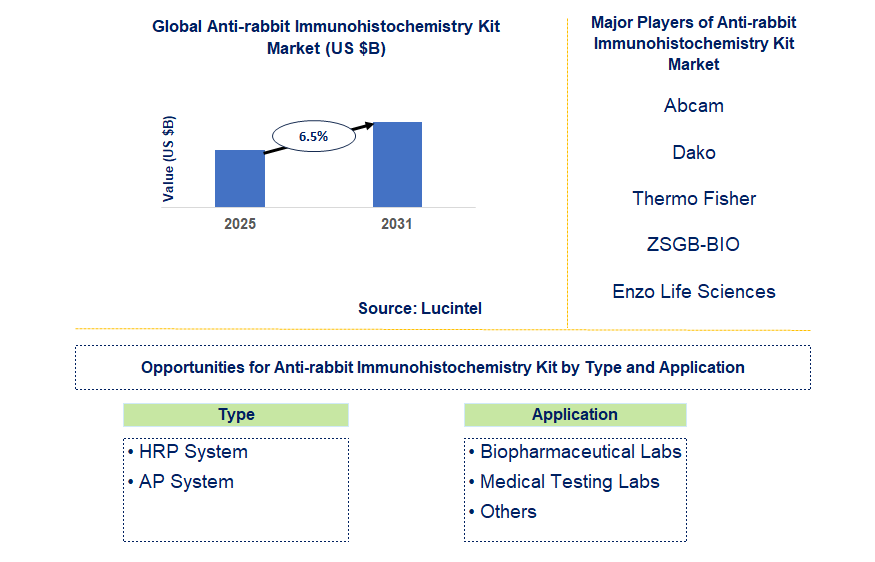
Key data points: The growth forecast = 6.5% annually for the next 7 years. Scroll below to get more insights. This market report covers trends, opportunities and forecasts in anti-rabbit immunohistochemistry kit market to 2031 by type (HRP system and AP system), application (biopharmaceutical labs, medical testing labs, and others), and region (North America, Europe, Asia Pacific, and the Rest of the World)
We'll send your sample report shortly.
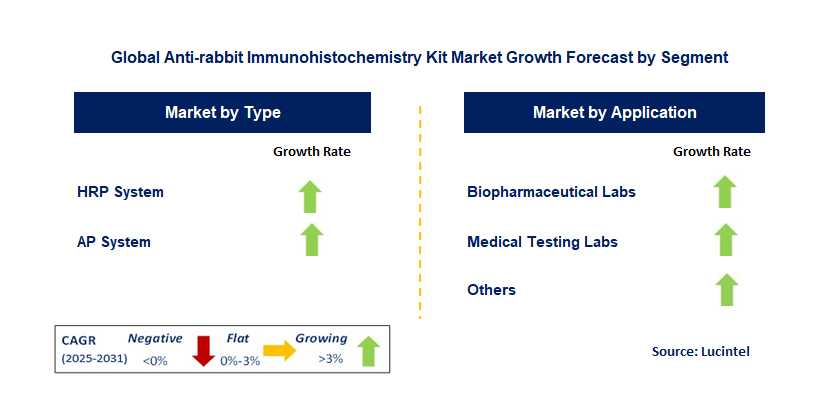
• Lucintel forecasts that, within the type category, HRP system is expected to witness higher growth over the forecast period.
• Within the application category, medical testing lab is expected to witness the highest growth.
• In terms of region, APAC is expected to witness the highest growth over the forecast period. Gain valuable insights for your business decisions with our comprehensive 150+ page report. Sample figures with some insights are shown below.
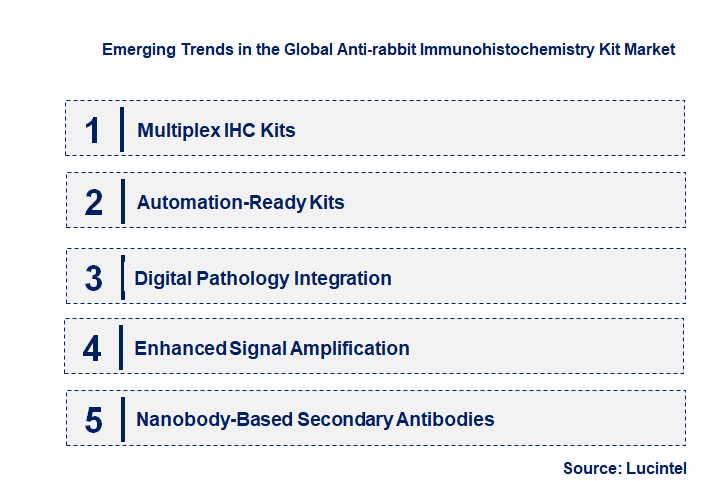
• Multiplex IHC Kits: A significant trend is the development of multiplex anti-rabbit IHC kits, enabling simultaneous detection of multiple targets within a single tissue section. This allows for comprehensive phenotyping of cells, analysis of co-localization, and characterization of complex cellular microenvironments, particularly crucial in cancer immunology and neuroscience research.
• Automation-Ready Kits: There is a growing demand for anti-rabbit IHC kits optimized for automated IHC platforms. These kits are designed for consistency, ease of use, and reduced manual intervention, streamlining workflows in high-throughput diagnostic laboratories and large-scale research studies, improving efficiency and reproducibility.
• Digital Pathology Integration: The increasing integration of anti-rabbit IHC kits with digital pathology solutions is a key trend. This involves optimized kits for digital imaging and AI-powered analysis, enabling quantitative assessment of staining, objective interpretation, and remote pathology consultations, accelerating diagnosis and research insights.
• Enhanced Signal Amplification: Manufacturers are developing anti-rabbit IHC kits with enhanced signal amplification technologies, such as polymer-based detection systems (e.g., micro-polymers) or tyramide signal amplification (TSA). This provides higher sensitivity for detecting low-abundance antigens, crucial for early disease diagnosis and biomarker discovery.
• Nanobody-Based Secondary Antibodies: An emerging trend is the development of anti-rabbit secondary antibodies based on nanobodies (single-domain antibodies). These offer advantages like smaller size, improved tissue penetration, and potential for recombinant production, providing a sustainable and highly specific alternative to traditional polyclonal secondary antibodies, impacting future kit formulations. These emerging trends are fundamentally reshaping the anti-rabbit IHC kit market by delivering more comprehensive, efficient, and technologically advanced solutions. The focus on multiplexing, automation, digital integration, and novel antibody formats is driving innovation and expanding the market's capabilities in diagnostics and research.
• Polymer-Based Detection Systems: Recent developments include the widespread adoption and refinement of polymer-based anti-rabbit detection systems (e.g., HRP polymers). These biotin-free systems offer superior sensitivity, lower background staining, and simpler protocols compared to traditional streptavidin-biotin methods, leading to clearer and more reliable results.
• Ready-to-Use (RTU) Kits: Manufacturers are increasingly offering ready-to-use (RTU) anti-rabbit IHC kits that are pre-diluted and optimized for convenience. These kits reduce preparation time, minimize errors, and improve consistency across different users, making IHC protocols more accessible and standardized for routine diagnostics and research.
• Multiplex Fluorescent IHC Kits: A notable development is the introduction of multiplex fluorescent anti-rabbit IHC kits (e.g., Opal 4-color anti-Rabbit Automation IHC Kit). These kits allow simultaneous detection of multiple rabbit primary antibodies on a single slide, enabling detailed co-localization studies and comprehensive phenotypic analysis in complex tissue samples.
• Improved Antigen Retrieval Solutions: Recent advancements in anti-rabbit IHC kits often include optimized antigen retrieval solutions. These formulations enhance epitope unmasking, which is crucial for detecting antigens in formalin-fixed paraffin-embedded (FFPE) tissues, ensuring stronger and more consistent staining results.
• Validated Antibody-Kit Combinations: Companies are increasingly providing pre-validated anti-rabbit primary antibody and kit combinations, often with detailed protocols and expected staining patterns. This minimizes optimization time for researchers and diagnostic labs, providing a turnkey solution for specific biomarker detection and ensuring high confidence in results. These developments are profoundly impacting the anti-rabbit IHC kit market by making IHC more sensitive, specific, efficient, and user-friendly. The market is characterized by sophisticated, integrated solutions that enhance both diagnostic accuracy and the depth of biological insights gained from tissue analysis.
• Cancer Diagnostics and Prognostics: A primary growth opportunity lies in expanding the use of anti-rabbit IHC kits in cancer diagnostics and prognostics. Rabbit monoclonal antibodies are frequently used for highly specific cancer biomarkers, making the corresponding kits essential for precise tumor classification, staging, and predicting patient response to therapies.
• Companion Diagnostics Development: Targeting the growing field of companion diagnostics offers significant growth. Anti-rabbit IHC kits are crucial for identifying specific patient populations likely to respond to targeted therapies by detecting biomarker expression, ensuring personalized medicine approaches become more widespread and effective.
• Neurological Disease Research: Expanding applications in neurological disease research presents another significant opportunity. Rabbit antibodies are widely used to study brain structures, neuronal markers, and disease pathologies (e.g., Alzheimer's, Parkinson's). Anti-rabbit IHC kits provide essential tools for understanding disease mechanisms and developing new treatments.
• Infectious Disease Diagnostics: Exploring opportunities in infectious disease diagnostics by developing and promoting anti-rabbit IHC kits for detecting microbial antigens in tissue. This offers a robust method for identifying pathogens directly within infected tissues, aiding in diagnosis and understanding disease progression.
• Automated IHC Platform Integration: Collaborating with manufacturers of automated IHC staining platforms to ensure seamless integration and optimization of anti-rabbit IHC kits. This broadens market reach by catering to high-throughput laboratories and diagnostic centers seeking efficiency and standardization, driving adoption of automated workflows. These strategic growth opportunities are poised to significantly impact the anti-rabbit IHC kit market by solidifying its role in critical disease areas, accelerating drug development, and enhancing diagnostic capabilities. Focusing on these applications will foster market growth and contribute to significant advancements in healthcare and biological understanding.
• Abcam
• Dako
• Thermo Fisher
• ZSGB-BIO
• Enzo Life Sciences
• Proteintech
• ScyTek Laboratories
• Neuromics
• Starter Bio
• Biocare Medical
• HRP System
• AP System
• Biopharmaceutical Labs
• Medical Testing Labs
• Others
• North America
• Europe
• Asia Pacific
• The Rest of the World
• United States: The U.S. market is driven by substantial investments in cancer diagnostics and personalized medicine. Recent developments include FDA approvals for companion diagnostics utilizing anti-rabbit antibodies (e.g., Roche's anti-HER2/neu), advancements in automated IHC platforms, and continued emphasis on validated, high-specificity kits for both clinical and research applications, ensuring robust and reliable results.
• China: China's anti-rabbit IHC kit market is rapidly expanding due to increasing healthcare expenditure and a growing number of cancer cases. Local manufacturers are improving product quality and offering cost-effective solutions, while international players are keen on expanding their presence through partnerships and local production to cater to the vast and rapidly developing market.
• Germany: Germany's market focuses on high-quality, precise, and standardized IHC solutions. Developments include robust validation protocols for anti-rabbit kits, integration with digital pathology systems, and a strong emphasis on consistent performance for diagnostic accuracy, aligning with Germany's stringent quality standards in medical diagnostics and research.
• India: India is witnessing growing adoption of anti-rabbit IHC kits, spurred by an increasing number of pathology laboratories, rising cancer incidence, and improved diagnostic infrastructure. While cost-effectiveness remains a factor, there's a growing preference for reliable and sensitive kits, leading to increased availability of both imported and locally manufactured products.
• Japan: Japan's market emphasizes highly specific and sensitive anti-rabbit IHC kits, particularly for research in neuroscience and oncology. Developments include advanced chromogenic and fluorescent detection systems, and specialized kits for demanding applications like multiplexed staining, reflecting Japan's focus on high-precision diagnostics and sophisticated research tools.


• Abcam
• Dako
• Thermo Fisher
• ZSGB-BIO
• Enzo Life Sciences
• Proteintech
• ScyTek Laboratories
• Neuromics
• Starter Bio
• Biocare Medical Q5. Which anti-rabbit immunohistochemistry kit market segment will be the largest in future? Answer: Lucintel forecasts that, within the type category, HRP system is expected to witness higher growth over the forecast period. Q6. In anti-rabbit immunohistochemistry kit market, which region is expected to be the largest in next 5 years? Answer: In terms of region, APAC is expected to witness the highest growth over the forecast period. Q7. Do we receive customization in this report? Answer: Yes, Lucintel provides 10% customization without any additional cost.


Choose a license that fits your team. Instant PDF delivery.
Prices exclude taxes. Instant delivery. Custom licensing available on request.
Market Report · July 22, 2026
Market Report · July 22, 2026
Market Report · July 22, 2026
Trusted partner for strategic intelligence and business growth


Receive a complimentary market analysis tailored to your industry. Our analysts will identify key growth opportunities and competitive dynamics specific to your business.

Market size, growth rate, and key trend analysis for your specific sector.

Top competitor positioning and market share analysis.

Strategic recommendations backed by data-driven insights.
Get curated market intelligence and competitive moves straight to your inbox.
By subscribing, you agree to receive our monthly insights. Unsubscribe anytime.
Receive a complimentary market analysis tailored to your industry. Our analysts will identify key growth opportunities and competitive dynamics specific to your business.
Market size, growth rate, and key trend analysis for your specific sector.
Top competitor positioning and market share analysis.
Strategic recommendations backed by data-driven insights.
Get curated market intelligence, emerging trends, and competitive moves straight to your inbox each month.
By subscribing, you agree to receive our monthly insights. Unsubscribe anytime.
We'll send your sample report shortly.