
Market Report · May 18, 2026

This market report covers trends, opportunities, and forecasts in the global analog ic for automotive market to 2031 by product technology (general purpose ic and application specific ic), end use industry (adas, in-vehicle networking, engine management, transmission control system, and others), and region (North America, Europe, Asia Pacific, and the Rest of the World)
We'll send your sample report shortly.
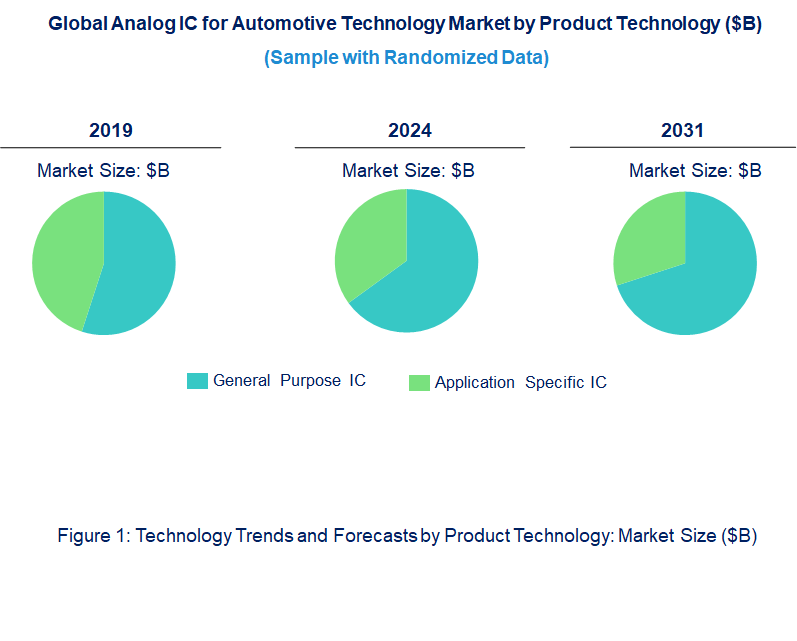
![Analog IC for Automotive Market Trend and Forecast by End Use Industry [Value from 2019 to 2031]:](https://lucintel.com/images/Analog-IC-for-Automotive-Technology-Market-Segment.png "Analog IC for Automotive Market Trend and Forecast by End Use Industry [Value from 2019 to 2031]:")
• Integration of Analog and Digital Functions: Analog ICs are increasingly integrating analog and digital functions onto a single chip. This approach toward mixed-signal ICs reduces the number of components, optimizes space usage, and improves system performance. It provides more compact and efficient designs for applications such as infotainment, ADAS, and in-vehicle networking.
• Power Efficiency and Energy Management: Power management is now a key concern for automotive firms in their quest for sustainability and fuel efficiency. Advanced power management ICs (PMICs) are now specifically developed for electric vehicle and hybrid vehicle applications to ensure energy consumption is fully optimized. The ICs play a vital role in controlling battery life, charging systems, and improving vehicle efficiency.
• Integration with ADAS and Autonomous Driving: The growth of ADAS and autonomous vehicles has led to a high demand for Analog ICs to support these systems. High-performance sensors, sensor fusion ICs, and image-processing ICs are integral to systems like lane-keeping assistance, collision avoidance, and automated parking. Analog ICs are evolving into more complex sensor data processing with minimal latency and very high reliability, which is essential for safe autonomous driving.
• In-Vehicle Connectivity and Networking: The need for advanced communication ICs that support high-speed data transfer within vehicles has been driven by the trend toward smarter vehicles. In-vehicle networking technology, such as Ethernet-based IVN and CAN (Controller Area Network), has become indispensable for the connected vehicle ecosystem. Analog ICs are poised to meet these high-bandwidth communication needs and simplify the integration of infotainment, navigation, and driver assistance systems.
• Automotive-Grade Reliability and Safety: With tough safety and reliability standards in the automotive industry, there is an increased demand for automotive-grade ICs, which must survive extreme temperatures, vibration, and electromagnetic interference. More ICs are being developed with enhanced robustness to meet standards like ISO 26262 for functional safety, ensuring critical vehicle systems operate without failure, even under harsh conditions. Automotive technologies are becoming increasingly complex, and thus, the analog IC for the automotive market is undergoing deep transformations. It is driven by integrated solutions, energy efficiency, and the growing adoption of advanced driver assistance systems. Emerging trends in in-vehicle connectivity, autonomous driving, and evolving power management requirements continue to shape the landscape, promoting innovation and gaining support for the next generation of smart, safe, and sustainable vehicles.
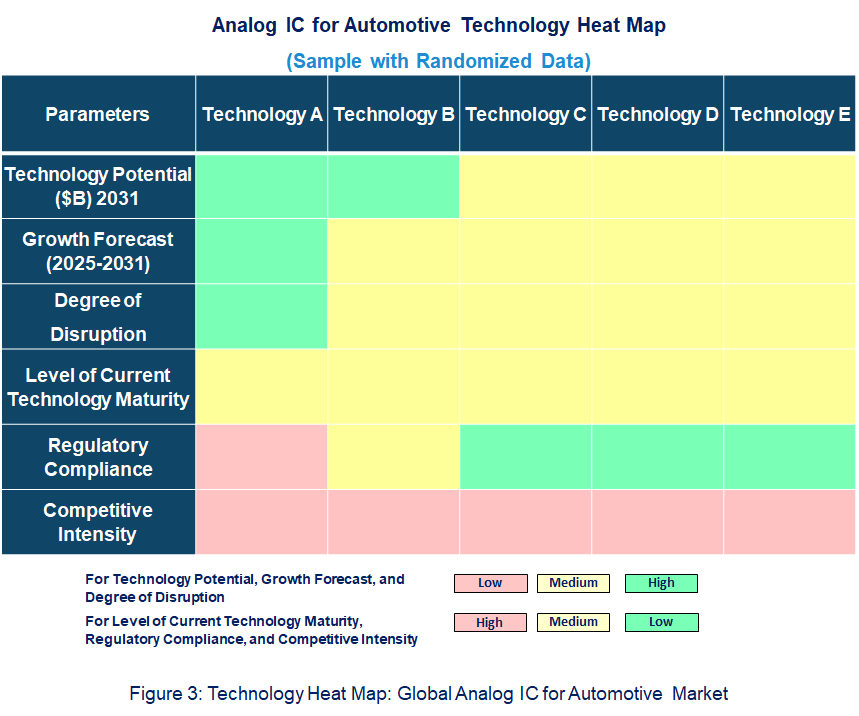
• Potential in Technology : Analog ICs are vital in automotive applications due to their ability to handle signals that are continuously variable, like sensor inputs, power management, and communication. The potential of these chips lies in their ability to support increasingly complex vehicle systems, including autonomous driving, electric vehicles (EVs), and advanced driver-assistance systems (ADAS).
• Degree of Disruption: The degree of disruption in this market is moderate to high. As automotive technologies evolve, the integration of more sophisticated systems like AI and electrification drives demand for more advanced analog ICs. These ICs enable seamless integration between power systems, sensors, and control units, enhancing overall vehicle performance.
• Current Technology Maturity Level: Analog ICs for automotive use are relatively mature. However, the shift towards electric and autonomous vehicles is accelerating innovation in this space, with more advanced ICs being developed to manage the complexity of modern vehicle systems.
• Regulatory Compliance: Regulatory compliance in automotive analog ICs is stringent, with safety and quality standards like ISO 26262 and AEC-Q100 governing the reliability and performance of components used in critical automotive applications, especially for ADAS and EVs.
• Infineon Technologies: Infineon has developed high-integration analog ICs in power management and sensor applications, particularly for EVs. Their key work on ICs related to optimized battery management and charging infrastructure forms the backbone for the growing needs of the fast-evolving electric vehicle market, providing solutions that improve energy efficiency and extend the life of vehicle batteries.
• Microchip Technology: Microchip has expanded its portfolio of automotive analog ICs, emphasizing solutions for battery management and automotive safety systems. Their recent developments in analog-to-digital converters (ADCs) and voltage regulators for automotive applications play a key role in advancing EVs and hybrid vehicles, enhancing performance and reliability in electric powertrains.
• NXP Semiconductor: NXP has focused on analog ICs for automotive radar, ADAS, and in-vehicle networking. It is now progressing the development of driverless cars with solutions for automotive radar sensors, which include collision avoidance and adaptive cruise control.
• Qualcomm Inc.: Qualcomm continues to further develop its automotive solutions with analog ICs designed specifically for connectivity and infotainment systems. Supporting low-power ICs, their work in integrating 5G and Wi-Fi connectivity into next-generation vehicle communication systems and infotainment will enhance the overall experience for both drivers and passengers.
• Richtek Technology: Richtek has designed analog ICs focused on power management, with a dedicated focus on automotive powertrains and battery management. Their innovations help optimize the performance of electric and hybrid vehicles, ensuring better power delivery and improving energy efficiency in vehicle systems.
• Skyworks Solutions: Skyworks has been actively developing analog ICs for automotive wireless communications. Its ICs support next-generation automotive connectivity solutions, enabling high-speed communication for autonomous vehicles, vehicle-to-everything (V2X) systems, and in-car infotainment, contributing to safer and more connected driving environments.
• STMicroelectronics: STMicroelectronics has strengthened its presence in automotive applications through expanded analog IC offerings, including power management, safety, and sensor ICs. Their work in integrating motor control solutions and battery management systems is critical to the development of more efficient electric vehicles and is driving the adoption of EV technology.
• Taiwan Semiconductor Co.: The company has improved its analog IC solutions in the domains of power management and energy efficiency for automotive. Their innovations focus on improving power efficiency in electric vehicles, with highly efficient voltage regulators and DC-DC converters that lead to improved EV range and battery life.
• Texas Instruments: Texas Instruments remains ahead through innovation in automotive analog ICs, with an emphasis on sensor integration and power management. Analog ICs for automotive safety, such as advanced driver-assistance systems (ADAS) from Texas Instruments, play a critical role in ensuring the enhanced safety and performance of autonomous vehicles, enabling better sensor fusion and real-time data processing. Such technologies stand out with a fresh vision regarding the widely influential role analog ICs play in automotive industry transformations. These companies are working to overcome new requirements for electric and self-driving vehicles, further improve safety, connectivity, and energy efficiency in vehicles, and drive the next generation of automotive technologies forward.
• Growing Demand for Electric Vehicles (EVs): This is the most significant driver. Analog ICs are critical for power management and optimal battery life with minimum energy consumption. Their demand is increasing due to the consequent need by automobile manufacturers for more energy-efficient solutions for electric powertrains.
• Advances in Autonomous Driving and ADAS: With the increased deployment of autonomous driving and ADAS technologies, the development of high-reliability and high-efficiency analog ICs is on the rise. ICs enable critical functions such as sensor integration, power management, and safety features for smarter and safer vehicles.
• Increased Use of Connected Vehicles and V2X Communication: The increasing number of connected vehicles and vehicle-to-everything (V2X) communication systems drives the demand for high-performance analog ICs for real-time data processing, enhanced connectivity, and seamless interaction between the vehicle and its environment.
• Focus on Enhanced Safety and Performance: Emphasis is placed by automobile manufacturers on safety features like collision avoidance, adaptive cruise control, and emergency braking capabilities. Analog ICs play an essential role in making these features possible through efficient sensor integration, reliable power management, and real-time processing that enables faster decision-making.
• Regulatory Pressure for Safety and Efficiency: Increased safety and environmental regulations put pressure on automakers to meet automotive standards, including functional safety standards such as ISO 26262. In such a scenario, analog ICs are integral to meeting these regulations in terms of safety, efficiency, and compliance with standards. Key Challenges Impacting the Market:
• High R&D and Development Costs: Producing advanced analog ICs customized for automotive applications is a capital-intensive effort. Developing ICs for specialized automotive uses involves significant costs related to research, development, and testing, which may affect profitability and market entry for smaller players.
• Complexity in High-Integration Systems: While automotive systems are becoming highly integrated—for example, autonomous driving and electrification—the complexity of analog ICs continues to scale. It becomes challenging to ensure compatibility, performance, and reliability across different vehicle systems while maintaining cost-effective solutions.
• Long Time-to-Market for Automotive Solutions: The development cycles in the automotive industry are notoriously long due to the rigorous testing, certifications, and regulatory approval processes involved. This delays the availability of new analog IC technologies and keeps solutions behind the curve of deployment in the highly competitive automotive sector.
• Supply Chain Disruptions and Component Shortages: Disruptions in the global semiconductor supply chain and the shortage of components have caused severe setbacks to the automotive sector. Analog IC companies are unable to maintain a smooth supply of required components, resulting in extended production times and increased costs.
• Rapid Technological Progression and Obsolescence: The fast pace of technological advancements in the automotive industry is a challenge for companies developing analog ICs. Companies must continuously innovate, or their products may become obsolete. To stay competitive, they need to be one step ahead in addressing the challenges posed by emerging electric, connected, and autonomous vehicles. Growth opportunities and challenges are impacting the analog IC market for automobiles. The increasing demand for electric vehicles and growing investments in autonomous driving, coupled with a greater emphasis on safety and connectivity, are driving the growth of analog ICs in automotive applications. However, for sustained growth, the challenges of high R&D costs, integration complexity, and supply chain disruptions must be addressed. In this ever-changing market, it is the ability to capitalize on opportunities and overcome challenges that will allow players to maintain an edge in the rapidly shifting landscape of the automotive industry.
• Infineon Technologies
• Microchip Technology
• NXP Semiconductor
• Qualcomm Inc.
• Richtek Technology
• Skywork Solutions
• Technology Readiness by Technology Type: GPICs: GPICs have an excellent level of technology readiness in the automotive sector because they are mature and have widespread applications. They are suitable for general automotive applications like infotainment, power management, and basic sensors. In terms of regulatory compliance, both GPICs and ASICs must meet strict automotive standards. However, ASICs become more complex due to their highly integrated nature and sophisticated functions. For ASICs, competitive intensity is lower, but they require substantial investment in R&D; GPICs, it remain highly competitive due to their versatility.
• Competitive Intensity and Regulatory Compliance: In analog IC for automotive market, due to their wide application across various industries, GPICs face greater competitive intensity since multiple suppliers offer similar products. However, ASIC face a more niche competitive landscape, with fewer players focusing on high-performance solutions. Both types of ICs must comply with strict automotive regulations, such as ISO 26262 for functional safety, and environmental standards like RoHS. Automotive ICs must meet very strict regulatory compliance due to their role in road safety and reliability, and thus both solutions must undergo heavy testing and certification before use.
• Disruption Potential: General-purpose IC (GPICs) and application-specific ICs (ASICs) each possess different forms of potential for disruption in the automotive industry. GPIC offer adaptability and scalability features, which translate to agile adaptation in a wide variety of vehicle systems, contributing to moderate disruption based on cost-effectiveness and customization. However, ASICs, with their application-specific designs for automotive applications, are the triggers for potentially greater disruption due to better, performance-optimized solutions for tomorrow’s technologies, such as autonomous driving, electrification, and advanced driver-assistance systems. ASICs, due to their capability to integrate several functions onto a single chip, revolutionize vehicle electronics by providing substantial improvements in space, power consumption, and reliability.
• General Purpose IC
• Application Specific IC
• ADAS
• In-Vehicle Networking
• Engine Management
• Transmission Control System
• Others
• North America
• Europe
• Asia Pacific
• The Rest of the World
• Latest Developments and Innovations in the Analog IC for Automotive Technologies
• Companies / Ecosystems
• Strategic Opportunities by Technology Type


Choose a license that fits your team. Instant PDF delivery.
Prices exclude taxes. Instant delivery. Custom licensing available on request.
Market Report · May 18, 2026
Market Report · May 18, 2026
Market Report · May 18, 2026
Trusted partner for strategic intelligence and business growth


Receive a complimentary market analysis tailored to your industry. Our analysts will identify key growth opportunities and competitive dynamics specific to your business.

Market size, growth rate, and key trend analysis for your specific sector.

Top competitor positioning and market share analysis.

Strategic recommendations backed by data-driven insights.
Get curated market intelligence and competitive moves straight to your inbox.
By subscribing, you agree to receive our monthly insights. Unsubscribe anytime.
Receive a complimentary market analysis tailored to your industry. Our analysts will identify key growth opportunities and competitive dynamics specific to your business.
Market size, growth rate, and key trend analysis for your specific sector.
Top competitor positioning and market share analysis.
Strategic recommendations backed by data-driven insights.
Get curated market intelligence, emerging trends, and competitive moves straight to your inbox each month.
By subscribing, you agree to receive our monthly insights. Unsubscribe anytime.
We'll send your sample report shortly.