
Market Report · May 18, 2026

This market report covers trends, opportunities, and forecasts in the global ai ocrs market to 2031 by technology (intelligent character recognition, intelligent text recognition, and optical mark recognition), application (finance, educate, bank, medical, and logistics), and region (North America, Europe, Asia Pacific, and the Rest of the World)
We'll send your sample report shortly.

• Integration of AI and Machine Learning for Improved Accuracy: AI and machine learning algorithms are being integrated into OCR systems to enhance their ability to recognize and interpret more complex text, including handwriting, cursive, and non-standard fonts. This development allows OCR to handle a wider range of document types with greater precision and fewer errors.
• Support for Multilingual and Cross-Language Document Recognition: AI OCRs systems are increasingly capable of processing documents in multiple languages, including complex scripts like Chinese, Arabic, and Cyrillic. This trend is driven by the growth of global businesses and the need for solutions that can handle multilingual content seamlessly.
• Cloud-Based OCR Solutions: The shift toward cloud-based OCR systems is gaining momentum, enabling businesses to access OCR technologies remotely with scalable storage and processing power. Cloud solutions also allow for better integration with other enterprise applications, like data management systems and workflow automation tools.
• Increased Use of Intelligent Text Recognition (ITR): Intelligent Text Recognition (ITR) is an emerging technology that goes beyond traditional OCR by not only recognizing text but also understanding its context. ITR systems can detect and classify structured and unstructured data, such as tables, forms, and invoices, improving data extraction accuracy.
• Enhanced Data Security and Privacy Features: With increasing concerns over data privacy and security, particularly in sectors like finance and healthcare, AI OCRs systems are being enhanced with advanced encryption and secure cloud storage options. This ensures that sensitive information, such as personal or financial data, is processed in compliance with regulatory standards like GDPR and HIPAA. These emerging trends in the AI OCRs market ranging from the integration of machine learning for improved accuracy to the rise of cloud-based solutions are transforming how businesses manage and process documents. Multilingual capabilities and intelligent text recognition enable businesses to handle diverse and complex data formats with greater ease and speed. Moreover, enhanced data security features are addressing privacy concerns, particularly in sensitive industries. Together, these trends are reshaping the AI OCRs landscape, offering more efficient, secure, and scalable solutions that cater to the growing demands of modern businesses across various sectors.
• Technology Potential: AI-powered OCR technology has immense potential to streamline document processing and data extraction. By combining AI with deep learning and natural language processing, OCR systems can handle complex tasks such as handwriting recognition, document layout parsing, and multilingual text extraction. This enables businesses to automate document workflows, reduce manual labor, and accelerate information processing.
• Degree of Disruption: AI OCRs are disrupting industries by replacing manual data entry and document management with automation. This disruption is especially significant in sectors like finance, healthcare, and legal, where large volumes of data must be processed accurately and efficiently. AI OCRs can dramatically reduce operational costs and human error.
• Current Technology Maturity: AI OCR technology is at a high level of maturity, with advanced capabilities in text recognition, handwriting interpretation, and multilingual support. Many AI OCRs solutions are already commercially available, widely adopted, and continuously improving in accuracy and efficiency.
• Regulatory Compliance: As OCR technology processes sensitive data, regulatory compliance (e.g., GDPR, HIPAA) is crucial. Vendors are enhancing their solutions to meet data privacy and security standards, ensuring that AI OCRs systems can be safely deployed in regulated industries while maintaining compliance with data protection laws.
• Qualitas Technologies: Qualitas Technologies has recently enhanced its AI OCRs platform with deep learning capabilities, improving the recognition of handwritten text and complex document structures. Their solution now incorporates machine learning models that can process forms, invoices, and contracts with greater accuracy and speed.
• Rossum: Rossum has developed an AI-powered data extraction platform that uses deep learning to read and extract data from invoices, receipts, and other documents without predefined templates. Their technology leverages advanced NLP to automatically learn document layouts and extract key data points.
• AIGEN: AIGEN has recently introduced a next-generation AI OCRs system with enhanced recognition capabilities for unstructured data, including images and scanned documents. The company’s solution also integrates AI-based document classification and categorization, offering better efficiency in organizing large volumes of paperwork.
• Automation Hero: Automation Hero has expanded its OCR offering by integrating robotic process automation (RPA) with AI-powered document processing. This hybrid approach allows for seamless automation of complex workflows, from data extraction to decision-making and action implementation.
• Advance Innovations: Advance Innovations has focused on building AI OCRs solutions with real-time data processing capabilities, particularly for industries such as logistics and supply chain management. Their platform is capable of scanning documents on the go and extracting relevant data instantly.
• Mint: Mint has recently introduced an AI OCRs solution with specialized capabilities for the financial sector, such as bank statement processing and check recognition. The system integrates AI models that can understand financial documents, categorize them, and extract key data points automatically.
• Net Smile: Net Smile has enhanced its OCR technology by incorporating machine learning algorithms that continuously improve the accuracy of text recognition as more data is processed. Their platform is designed for e-commerce and customer support applications, automating data extraction from customer communications. These recent developments by leading players in the AI OCRs market highlight the ongoing advancements and increasing sophistication of OCR solutions. Companies like Qualitas Technologies and Rossum are pushing the boundaries of document data extraction with improved accuracy and speed, while AIGEN and Automation Hero are combining OCR with AI-driven document classification and RPA for smarter automation. Innovations from Mint and Net Smile further illustrate the sector’s shift towards specialized solutions, such as financial document processing and customer support automation. As these technologies evolve, they are set to transform how businesses manage and process documents, making workflows more efficient and reducing human intervention across various industries.
• Increased Adoption of Automation Across Industries: Automation is becoming a priority for businesses looking to streamline operations and reduce manual labor. AI-powered OCR systems are key enablers of automation, particularly in document-intensive industries like finance, healthcare, and logistics.
• Growing Demand for Document Digitization and Paperless Solutions: Organizations are increasingly moving toward digital transformation, with a significant push to go paperless. AI OCRs is pivotal in converting paper-based documents into digital formats for easier storage, retrieval, and analysis.
• Rising Need for Multilingual and Cross-Border Document Processing: Global businesses and multinational organizations need OCR systems that can handle documents in various languages and formats. AI-based OCR systems are becoming more adept at recognizing text in different languages and complex scripts.
• Integration with Cloud-Based Platforms: Cloud-based OCR solutions are becoming increasingly popular due to their scalability, cost-effectiveness, and ease of integration with existing business systems. Cloud OCR platforms allow organizations to store and access documents remotely while leveraging powerful AI tools.
• Technological Advancements in Machine Learning and Deep Learning: Machine learning and deep learning technologies are enabling AI OCRs systems to recognize more complex data types, including handwriting, cursive, and poorly scanned text. These advances significantly improve the accuracy and efficiency of OCR solutions. Challenges in the AI OCRs market are:
• Data Privacy and Security Concerns: As AI OCRs systems handle sensitive data, including financial and personal information, there are concerns about data privacy and security. Regulatory frameworks like GDPR and HIPAA place strict requirements on how data is processed and stored.
• High Initial Investment and Maintenance Costs: While AI OCRs systems offer significant long-term benefits, the initial investment in AI technologies and infrastructure can be high. Additionally, these systems often require ongoing maintenance, updates, and skilled personnel.
• Challenges with Unstructured Data and Document Formats: Despite advancements, AI OCRs systems still face challenges when it comes to processing unstructured data or documents with complex layouts, such as handwritten notes, images, or forms with mixed content types. The AI OCRs market is driven by the growing need for automation, digital transformation, and multilingual document processing. Advances in cloud-based solutions, machine learning, and deep learning have further accelerated its growth. However, challenges related to data security, high implementation costs, and the complexity of unstructured data remain. These drivers and challenges are reshaping the AI OCRs landscape, providing opportunities for innovation while highlighting the need for continuous technological advancements and compliance with regulatory standards.
• Qualitas Technologies
• Rossum
• Aigen
• Automation Hero
• Advance Innovations
• Mint
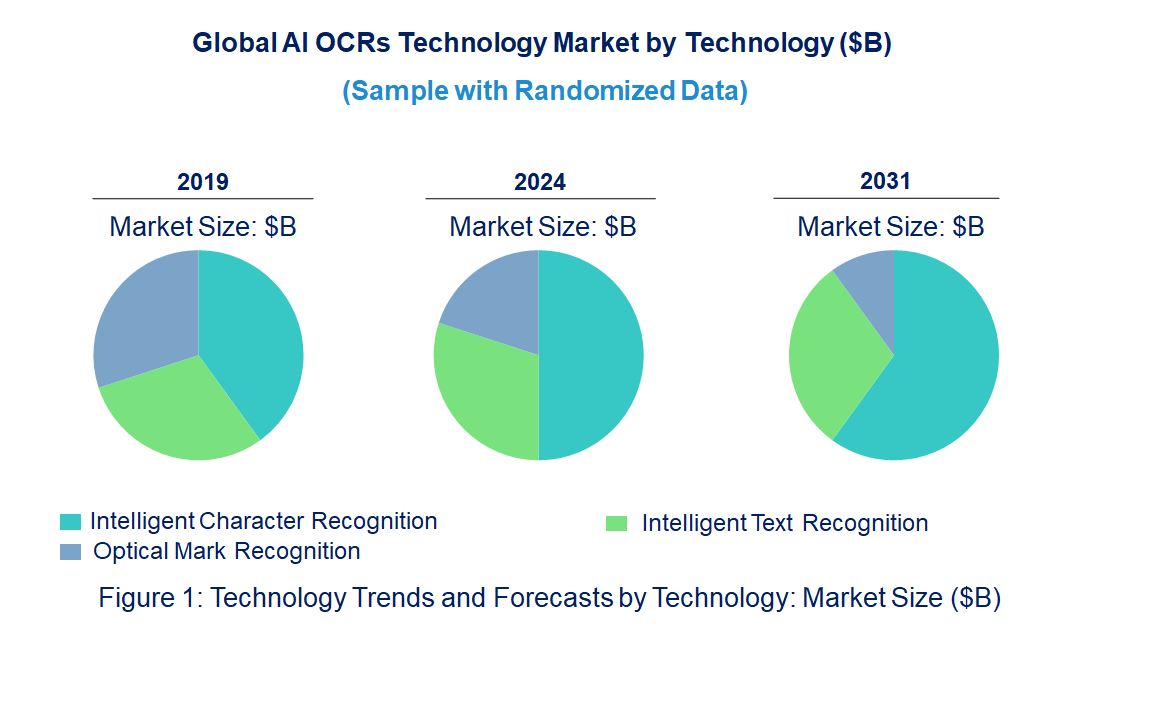
• Technology Readiness of Technology type: Intelligent character recognition (ICR) is highly mature and widely used in industries that require accurate text recognition, including banking and healthcare. The technology is well-developed, with a strong competitive edge, especially in systems handling handwritten and cursive text. Intelligent Text Recognition (ITR) is still evolving but has reached significant maturity in processing structured and unstructured documents, making it suitable for enterprise-level applications. It faces high competition from ICR, especially in sectors needing deep learning models for document classification and data extraction. Optical Mark Recognition (OMR) is the most straightforward among these technologies and has a solid market presence, particularly in education and research applications. It’s less competitive compared to ICR and ITR in industries requiring advanced document processing, but its readiness and reliability in handling forms, tests, and surveys make it a key technology. Regulatory compliance for all three technologies is critical, especially for ICR and ITR in industries like finance and healthcare, where strict data privacy laws apply. All technologies are increasingly integrating AI and machine learning to stay competitive and compliant with evolving standards.
• Competitive Intensity and Regulatory Compliance: The competitive intensity in the AI OCRs market is high, with players racing to enhance their technologies. ICR systems are particularly competitive as they cater to high-demand sectors like banking and healthcare, where accurate recognition of handwritten text is essential. ITR, due to its ability to understand context, is emerging as a more advanced solution with broad applications, including legal document review and enterprise resource planning (ERP). OMR is widely used for education and survey-based applications, but it faces competition from more versatile systems like ITR and ICR. Regulatory compliance is crucial, especially in industries dealing with sensitive data, such as healthcare and finance. ICR and ITR technologies must comply with stringent data privacy regulations like GDPR and HIPAA, as they handle personal information. OMR, being less sensitive in this regard, faces fewer compliance challenges, but solutions still need to adhere to regional data protection laws.
• Disruption Potential of technology type: Intelligent Character Recognition (ICR), Intelligent Text Recognition (ITR), and Optical Mark Recognition (OMR) each bring distinct disruption potential to the AI OCRs market. ICR enables highly accurate recognition of handwritten characters, opening doors for applications in the banking, healthcare, and legal sectors. ITR goes beyond basic OCR by recognizing not just characters but the context of the text, allowing for more advanced document parsing and classification in sectors like finance and logistics. OMR, while focused on form data and checkboxes, offers automated processing for surveys, tests, and assessments, significantly streamlining data collection processes. Together, these technologies enhance document automation by enabling a more diverse range of document types and data formats to be processed, reducing reliance on manual labor and minimizing human error. As businesses continue to digitize, these OCR technologies will drive innovation in data extraction and document management, transforming traditional workflows and creating new business models.
• Intelligent Character Recognition
• Intelligent Text Recognition
• Optical Mark Recognition
• Finance
• Educate
• Bank
• Medical
• Logistics
• North America
• Europe
• Asia Pacific
• The Rest of the World
• Latest Developments and Innovations in the AI OCRs Technologies
• Companies / Ecosystems
• Strategic Opportunities by Technology Type


Choose a license that fits your team. Instant PDF delivery.
Prices exclude taxes. Instant delivery. Custom licensing available on request.
Market Report · May 18, 2026
Market Report · May 18, 2026
Market Report · May 18, 2026
Trusted partner for strategic intelligence and business growth


Receive a complimentary market analysis tailored to your industry. Our analysts will identify key growth opportunities and competitive dynamics specific to your business.

Market size, growth rate, and key trend analysis for your specific sector.

Top competitor positioning and market share analysis.

Strategic recommendations backed by data-driven insights.
Get curated market intelligence and competitive moves straight to your inbox.
By subscribing, you agree to receive our monthly insights. Unsubscribe anytime.
Receive a complimentary market analysis tailored to your industry. Our analysts will identify key growth opportunities and competitive dynamics specific to your business.
Market size, growth rate, and key trend analysis for your specific sector.
Top competitor positioning and market share analysis.
Strategic recommendations backed by data-driven insights.
Get curated market intelligence, emerging trends, and competitive moves straight to your inbox each month.
By subscribing, you agree to receive our monthly insights. Unsubscribe anytime.
We'll send your sample report shortly.