
Market Report · May 18, 2026

This market report covers trends, opportunities, and forecasts in the global ai apis market to 2031 by technology (web api, program api, and others), application (automotive, consumer electronics, industrial robot, and others), and region (North America, Europe, Asia Pacific, and the Rest of the World)
We'll send your sample report shortly.
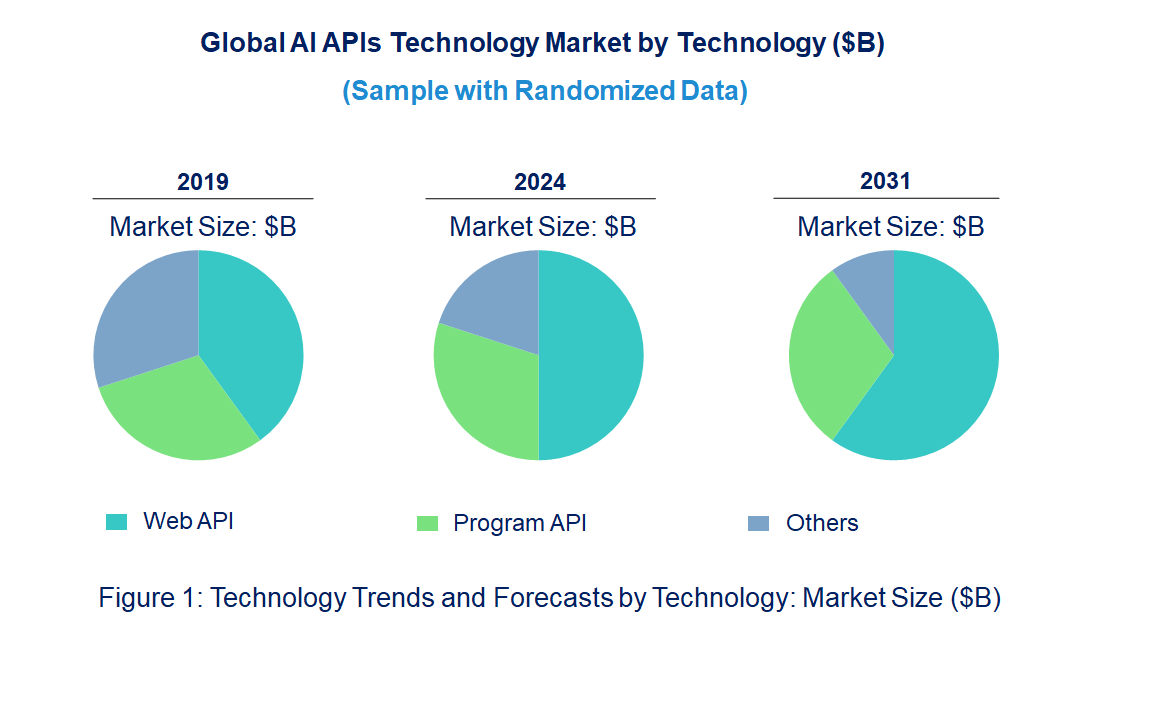
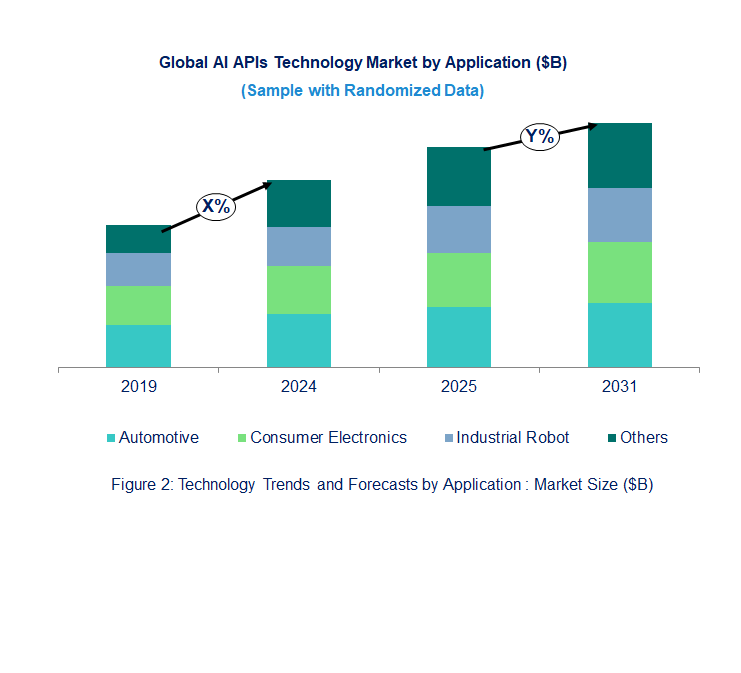
• Rise of Serverless AI APIs: Serverless computing is revolutionizing the AI APIs market by eliminating the need for developers to manage servers. This trend enables businesses to focus on building AI-powered solutions while the cloud service provider handles the infrastructure. Serverless AI APIs allow for easier scalability, faster deployment, and cost efficiency, especially for companies that want to scale their AI capabilities without investing heavily in infrastructure.
• Integration of Multi-modal AI APIs: AI is no longer limited to single data types such as text or images. The integration of multi-modal AI APIs allows for the processing of multiple data types such as text, voice, and images within the same API. This trend is enabling more sophisticated applications, such as smart assistants and autonomous vehicles, where multiple input modes must be analyzed simultaneously. Multi-modal AI APIs are driving more holistic, adaptive, and intelligent systems.
• Low-Code/No-Code AI APIs: Low-code and no-code platforms are making AI more accessible by allowing users with minimal technical expertise to integrate AI into their applications. These platforms provide pre-built AI API services that can be easily customized through simple interfaces. The trend towards low-code/no-code AI APIs is democratizing AI development, empowering business analysts and non-developers to create AI-powered applications quickly and cost-effectively.
• AI APIs for Edge Computing: With the growing adoption of IoT devices and the need for real-time data processing, AI APIs are increasingly being deployed on edge devices. Edge computing reduces latency by processing data locally rather than sending it to centralized cloud servers. This trend is particularly impactful for applications like autonomous vehicles, industrial automation, and smart cities, where immediate decision-making is critical. AI APIs designed for edge computing are helping businesses deploy AI solutions that are both faster and more efficient.
• Explainable AI (XAI) in APIs: As AI systems become more integral to decision-making, there is increasing demand for transparency and interpretability. Explainable AI (XAI) APIs are emerging to provide insights into how AI models arrive at specific decisions. This trend is particularly important for sectors like healthcare, finance, and law, where understanding the rationale behind AI-driven decisions is crucial. XAI APIs are helping organizations build trust in AI systems while ensuring regulatory compliance. The emerging trends in the AI APIs market such as serverless computing, multi-modal capabilities, low-code/no-code solutions, edge computing, and explainable AI are reshaping the landscape of AI integration and application. These advancements are not only making AI more accessible, scalable, and efficient but also ensuring that AI systems are more transparent, adaptive, and capable of handling complex, real-time demands. As these trends continue to develop, businesses will be better equipped to leverage AI for innovation and competitive advantage across industries.
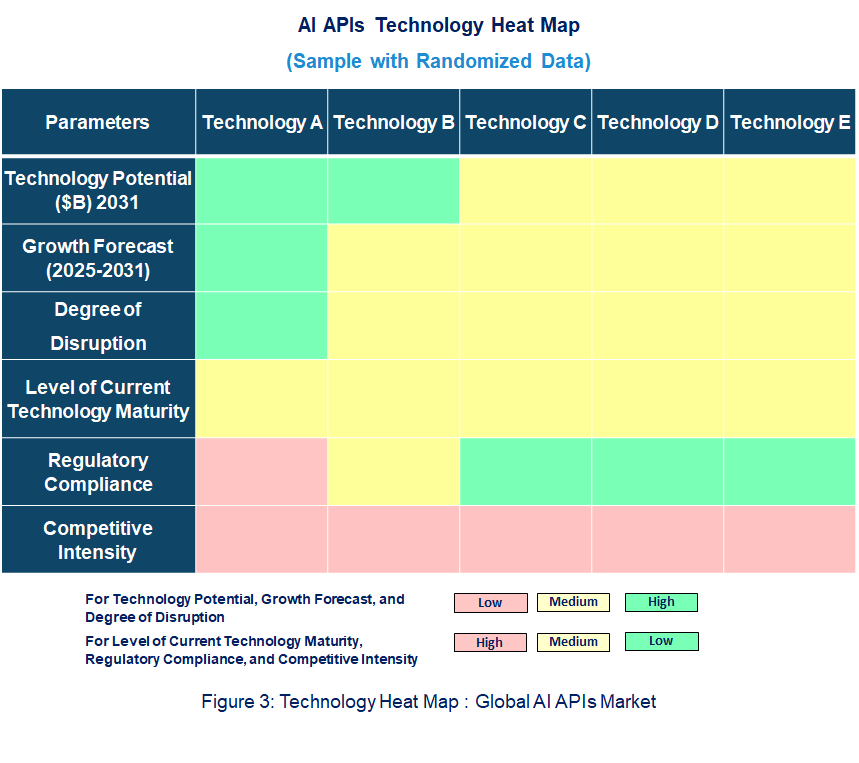
• Technology Potential AI APIs hold significant potential for transforming industries by enabling businesses to integrate intelligent automation, predictive analytics, and data processing capabilities seamlessly. These APIs provide ready-to-use models for a wide range of applications, from customer service chatbots to advanced image recognition systems. Their potential lies in making AI more accessible, scalable, and adaptable for businesses of all sizes.
• Degree of Disruption The degree of disruption from AI APIs is high. They are reshaping industries by automating complex tasks, improving efficiency, and enabling new business models. AI-powered applications such as autonomous systems, personalized recommendations, and fraud detection are revolutionizing sectors like automotive, finance, and healthcare.
• Level of Technology Maturity The maturity of AI API technology varies across different sectors. While some APIs (e.g., NLP and image recognition) are highly advanced and widely adopted, others (e.g., explainable AI) are still evolving. Generally, most AI APIs are in an intermediate stage of maturity.
• Regulatory Compliance Regulatory compliance is a key concern, particularly in sectors like healthcare and finance. Ensuring AI APIs adhere to standards such as GDPR and HIPAA is crucial for fostering trust and ensuring legal and ethical use of AI technologies.
• Baidu: Baidu has been expanding its AI API offerings through its Apollo autonomous driving platform and DuerOS, an AI assistant that powers voice-activated devices. The company has made significant strides in developing AI models for natural language processing (NLP) and facial recognition. Baidu’s AI APIs are gaining adoption in sectors like smart transportation and healthcare, particularly through their deep learning technologies, which aim to improve efficiency and automation.
• OpenAI: OpenAI has revolutionized the AI API space with its GPT-4 language model, which powers applications in conversational AI, content generation, and automation. OpenAI’s APIs, offered through the ChatGPT platform, enable developers to easily integrate advanced NLP capabilities into their applications. OpenAI’s innovations, particularly in deep learning and reinforcement learning, have significantly advanced the quality and accuracy of AI-driven applications, creating new opportunities for businesses to innovate.
• Tencent: Tencent’s AI initiatives, driven by its cloud division, have focused on integrating machine learning and deep learning into its APIs for a wide range of applications, including gaming, healthcare, and entertainment. Tencent's AI APIs have enabled real-time image and video processing, as well as natural language understanding in its social media platforms. The company’s development of AI-powered customer service solutions and smart healthcare systems is setting new standards in automation and efficiency.
• Google: Google has continued to enhance its AI API capabilities with the launch of new services under its Google Cloud AI umbrella. The company’s Vision AI, Speech-to-Text, and Translation APIs have seen widespread adoption across industries. Google has also introduced AI APIs for structured data processing and custom machine learning model deployment, helping businesses build tailored AI applications. Google's AI models, such as BERT for NLP, have set a new benchmark for language understanding, making it easier for businesses to build intelligent applications.
• Microsoft Azure: Microsoft Azure has positioned itself as a leader in AI APIs through its Cognitive Services suite, which offers pre-built APIs for vision, speech, language, and decision-making. The Azure AI ecosystem enables companies to integrate machine learning models and automate complex tasks with minimal effort. Recent developments in Azure’s OpenAI partnership have further strengthened its offering, with API access to GPT-4 and other cutting-edge models, allowing businesses to leverage powerful AI capabilities in their cloud environments.
• Amazon: Amazon Web Services (AWS) has continued to enhance its AI offerings through services like Amazon SageMaker, AWS Lex, and Polly, which provide developers with pre-built APIs for machine learning, chatbots, and speech synthesis. Amazon has also made strides in making AI more accessible with easy-to-use APIs that simplify the development process for non-experts. AWS’s vast infrastructure supports large-scale AI deployments, making it a preferred choice for enterprises looking to integrate AI into their operations.
• IBM: IBM Watson has remained a key player in the AI API market, offering a wide range of AI services, including natural language understanding, visual recognition, and machine learning model training. IBM Watson APIs are widely used in healthcare, finance, and customer service for automating decision-making processes and enhancing data-driven insights. Recent updates to Watson have focused on improving model explainability and transparency, particularly in regulated industries, strengthening trust in AI applications. These developments from key players are pushing the boundaries of what is possible with AI APIs, making it easier for businesses to implement advanced AI functionalities and accelerating the adoption of AI technologies across different industries. Each company’s unique offerings continue to contribute to the transformation of the AI landscape.
• Increasing Demand for AI-powered Automation: As industries move toward digital transformation, the demand for AI-powered automation is growing. AI APIs enable businesses to automate processes like customer service, data analytics, and content generation. This demand for automation boosts the adoption of AI APIs, enhancing operational efficiency and reducing human errors in repetitive tasks.
• Advancements in Cloud Computing and Edge AI: Cloud infrastructure advancements, paired with edge computing, are enabling real-time processing and scalable AI solutions. AI APIs that can operate efficiently on the cloud and edge devices are driving growth, particularly in industries like IoT, autonomous systems, and smart cities, where low latency and real-time decision-making are critical.
• Growing Need for Personalization and Customer Insights: Companies are increasingly using AI to offer personalized customer experiences. AI APIs for natural language processing (NLP), recommendation systems, and predictive analytics are playing a key role in improving user experiences and generating actionable insights. This need for personalized solutions is driving the adoption of AI-powered APIs across sectors like e-commerce, media, and finance.
• Expansion of AI Capabilities in Various Industries: The broadening range of AI applications from healthcare and finance to retail and manufacturing—is a major driver for AI APIs. As more industries recognize AI's potential to enhance decision-making, optimize operations, and create innovative products, the demand for AI APIs is increasing, driving market growth and fostering new AI solutions. Challenges in the AI APIs market are:
• Data Privacy and Security Concerns: With the use of AI comes the challenge of safeguarding sensitive data. AI APIs often handle vast amounts of personal and business data, raising concerns about data privacy and security. Regulatory frameworks like GDPR require APIs to ensure that data is processed securely, creating challenges in maintaining compliance while scaling AI capabilities.
• Integration Complexity and Interoperability: Integrating AI APIs into existing systems can be complex, particularly for legacy systems. Many organizations face difficulties in ensuring compatibility between AI models and their current infrastructure. This complexity can delay the deployment of AI solutions, hindering the widespread adoption of AI-powered applications.
• High Costs of Development and Maintenance: Developing, training, and maintaining AI models can be resource-intensive and expensive. Companies may struggle with the high initial costs and the ongoing expense of refining and updating models to remain competitive. These financial challenges may limit the adoption of AI APIs, particularly for small to mid-sized enterprises. The AI APIs market is growing rapidly, driven by the increasing demand for automation, personalized customer experiences, and the broader application of AI across industries. However, challenges such as data privacy concerns, integration complexity, high costs, and lack of transparency remain significant obstacles. Addressing these drivers and challenges will be key to the market's continued expansion, ensuring that AI APIs can deliver value across sectors while maintaining trust, security, and efficiency. As the technology matures and these barriers are overcome, AI APIs will become even more integral to digital transformation strategies worldwide.
• Baidu
• Openai
• Tencent
• Microsoft Azure
• Amazon
• Technology Readiness by Technology Type: Web APIs are highly mature and widely adopted across various industries, offering ready-to-use AI functionalities for applications like natural language processing and image recognition. Their competitive level is high, with key players like Google, Amazon, and IBM leading the market, and regulatory compliance remains a key concern, particularly regarding data privacy. Program APIs are more specialized and currently in an intermediate stage of readiness, providing deep integration for advanced AI capabilities, such as autonomous vehicles and robotics. These APIs face intense competition, especially in complex industries, and regulatory compliance is critical, particularly in healthcare and finance. Other APIs, like GraphQL, are emerging with a focus on more dynamic and efficient data handling. While their readiness is growing, they remain less mature in AI-specific applications, though their flexibility makes them a promising technology for future growth.
• Competitive Intensity and Regulatory Compliance: The competitive intensity in the AI APIs market is high across Web APIs, Program APIs, and other API technologies. Web APIs dominate due to their ease of use and accessibility, attracting a broad range of developers, while Program APIs, which offer more specialized capabilities, create intense competition among tech giants like Google, Microsoft, and Amazon. Regulatory compliance remains a significant concern, especially for Program APIs used in sensitive sectors like healthcare and finance, where privacy laws such as GDPR and HIPAA apply. Web APIs are also under scrutiny for data privacy but generally face fewer regulatory hurdles. Emerging technologies like GraphQL and others are subject to evolving regulations as their adoption grows, creating challenges for providers in maintaining compliance.
• Disruption Potential of Different Technologies: Web APIs, Program APIs, and other API types are each poised to disrupt the AI APIs market in distinct ways. Web APIs offer accessibility and ease of integration, making AI functionalities more available to developers across industries. They enable quick deployment and flexibility, fostering innovation in sectors like e-commerce and healthcare. Program APIs, with their more specialized and performance-oriented functions, offer deep integrations and efficiency, enabling sophisticated AI systems in industries such as automotive, robotics, and finance. Other API technologies, such as GraphQL and RESTful APIs, are enhancing AI by providing more dynamic data access and enabling real-time decision-making capabilities. This disruption is transforming industries, reducing development times, and fostering the rapid adoption of AI-powered solutions.
• Web API
• Program API
• Others
• Automotive
• Consumer Electronics
• Industrial Robot
• Others
• North America
• Europe
• Asia Pacific
• The Rest of the World
• Latest Developments and Innovations in the AI APIs Technologies
• Companies / Ecosystems
• Strategic Opportunities by Technology Type


Choose a license that fits your team. Instant PDF delivery.
Prices exclude taxes. Instant delivery. Custom licensing available on request.
Market Report · May 18, 2026
Market Report · May 18, 2026
Market Report · May 18, 2026
Trusted partner for strategic intelligence and business growth


Receive a complimentary market analysis tailored to your industry. Our analysts will identify key growth opportunities and competitive dynamics specific to your business.

Market size, growth rate, and key trend analysis for your specific sector.

Top competitor positioning and market share analysis.

Strategic recommendations backed by data-driven insights.
Get curated market intelligence and competitive moves straight to your inbox.
By subscribing, you agree to receive our monthly insights. Unsubscribe anytime.
Receive a complimentary market analysis tailored to your industry. Our analysts will identify key growth opportunities and competitive dynamics specific to your business.
Market size, growth rate, and key trend analysis for your specific sector.
Top competitor positioning and market share analysis.
Strategic recommendations backed by data-driven insights.
Get curated market intelligence, emerging trends, and competitive moves straight to your inbox each month.
By subscribing, you agree to receive our monthly insights. Unsubscribe anytime.
We'll send your sample report shortly.