
Market Report · May 18, 2026

This market report covers trends, opportunities, and forecasts in the global agricultural software market to 2031 by deployment technology (cloud and on-premise), application (precision farming, livestock tracking and monitoring, smart greenhouse, precision forestry, and others), and region (North America, Europe, Asia Pacific, and the Rest of the World)
We'll send your sample report shortly.
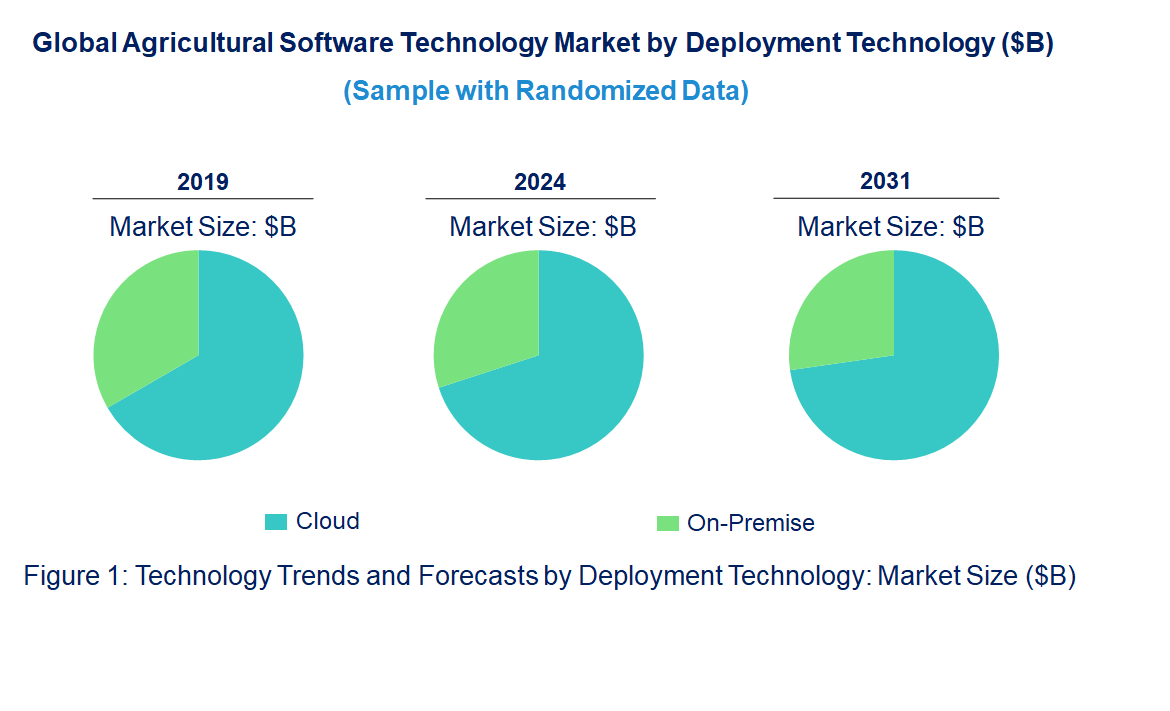
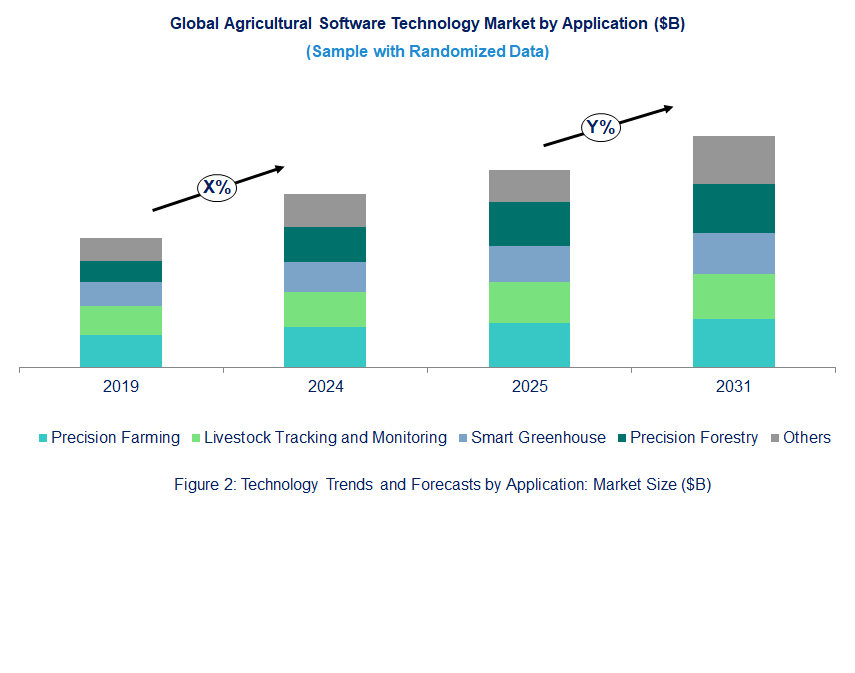
• Cloud-based software adoption: There is a shift towards cloud-based platforms rather than on-premise software. The former allows farmers to view data in real time from anywhere and offers scalability, flexibility, and collaboration while also reducing costs in terms of data storage and processing.
• IoT and AI: The integration of IoT and AI is revolutionizing precision farming. IoT devices collect real-time data from sensors in fields, and AI analyzes this data to optimize crop management, irrigation, and pest control, which improves overall farm productivity and sustainability.
• Precision agriculture software: Precision farming tools are gaining popularity, and the software applications allow farmers to make data-driven decisions on planting, fertilization, and irrigation. This approach improves resource efficiency and reduces costs, thus contributing to higher yields and more sustainable farming practices.
• Livestock tracking and monitoring solutions: These solutions are increasingly being used in agricultural software. They track and monitor the health, behavior, and location of livestock by using GPS and IoT technologies, helping farmers manage their herds more efficiently, reduce losses, and ensure better animal welfare.
• Smart greenhouses and precision forestry: Software growth for smart greenhouses and precision forestry is rapid, assisting farmers and foresters in checking and controlling environmental conditions, such as temperature, humidity, and light. This promotes controlled environments, quality crops, and optimal resource use. These emerging trends in the agricultural software market are changing the face of the industry, making farming more data-driven, efficient, and sustainable. With the adoption of cloud solutions, IoT, AI, and precision tools, the agricultural sector is becoming more connected, automated, and capable of meeting the challenges of modern farming practices.
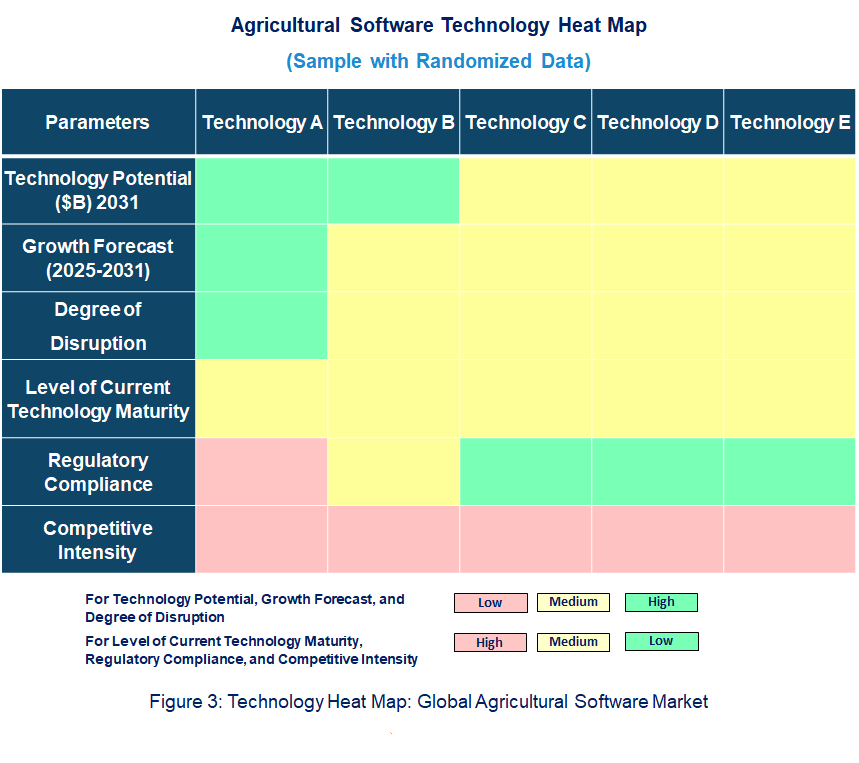
• Technology Potential: The potential of technology deployment in agricultural software is vast. Cloud-based solutions allow easy scalability, enable real-time monitoring, and provide access to large data sets for enhanced decision-making. Integration with IoT and AI further optimizes farming processes through data analysis.
• Degree of Disruption: Cloud-based platforms have disrupted traditional on-premise solutions. Cloud technologies have transformed agricultural practices by providing flexibility, reducing infrastructure costs, and offering real-time access to data. IoT adds another layer of disruption, especially in precision farming and livestock monitoring.
• Current Level of Maturity of the Technology: The maturity of agricultural software technologies is advancing rapidly, particularly in cloud computing and IoT. SaaS solutions are highly stable, while AI and ML applications in agriculture are evolving but maturing quickly.
• Trimble: Trimble has advanced its precision agriculture software by integrating IoT, GPS, and data analytics to provide real-time insights into crop health, field conditions, and equipment performance. This has enabled farmers to make data-driven decisions, optimizing yield and reducing input costs.
• AGRIVI: AGRIVI has expanded its farm management software platform, offering end-to-end solutions that integrate crop management, field planning, inventory, and financial management. Their solution helps farmers track field activities, optimize resource use, and ensure better traceability and sustainability practices.
• Oracle Corporation: Oracle emphasizes the development of its agriculture-focused cloud-based offerings by building analytics, machine learning, and IoT capabilities. These innovations help farmers process real-time data and gain predictive insights to enhance productivity and sustainability through operations.
• Conservis: Conservis has developed a full farm management software package focused on financial and operational efficiency. It integrates field-level data with financial insights, allowing farmers to track costs, understand profit margins, and make better business decisions.
• Farmbrite: Farmbrite is an all-in-one farm management platform that enhances farm operations through tools for crop and livestock management, accounting, and inventory. The solutions are targeted at small and medium-sized farmers, helping them improve operational efficiency and profitability with data-driven insights.
• Deere & Company: Deere & Company has combined its agricultural equipment with sophisticated software solutions, creating a seamless ecosystem for precision farming. Their software enables farmers to collect and analyze data from machinery, improving crop yields and operational efficiency through data-driven decision-making.
• Ag Leader Technology Inc: Ag Leader Technology promotes precision agriculture by incorporating and developing the company’s hardware through accompanying software for products, which include planters and harvesters. The software provides field performance analysis, helping farmers improve or fine-tune their processes for greater efficiency and profitability. Such developments by key players are changing the agricultural software market, enhancing productivity, sustainability, and efficiency. These innovations now provide farmers with solutions that can optimize their operations in the modern world.
• Technological Advancements: The integration of IoT, AI, machine learning, and other cloud-based solutions is transforming the agricultural sector. These technologies provide real-time data collection and analysis, enhancing decision-making, resource management, and productivity. Therefore, they can offer optimized farming practices with greater automation and predictive insights for improved efficiency and sustainability.
• Rising Demand for Sustainability: As global concerns over climate change and food security escalate, the demand for sustainable farming practices is growing. Agricultural software solutions help farmers manage resources more efficiently, reduce waste, and implement environmentally sound practices. Sustainability has thus become a key driver of this market's expansion.
• Increasing Use of Farm Data: The use of big data analytics in agriculture is gaining momentum, allowing for higher precision in monitoring and managing farm operations. These software solutions provide farmers with actionable insights from large datasets, optimizing crop yields, improving operational efficiency, and enhancing profitability. This trend is boosting the market. Challenges in the agricultural software market are:
• High Start-Up Costs: Despite the benefits, one challenge remains in the high upfront costs of adopting agricultural software. Many small and medium-sized farmers struggle to afford these solutions, limiting widespread adoption. Addressing the affordability issue is crucial for market expansion.
• Regulatory Compliance: As agriculture becomes more data-driven, regulatory bodies are introducing stricter requirements related to data privacy, sustainability, and traceability. Agricultural software solutions must comply with these regulations to remain competitive. Adapting to evolving regulatory frameworks while fostering innovation presents a challenge for companies in the market. The agricultural software market is growing rapidly due to technological advancements, the demand for sustainability, and the increased use of farm data. High costs and regulatory compliance remain challenges, but these developments are reshaping the sector, making agriculture more efficient, data-driven, and environmentally sustainable. The market will continue to expand as these technologies evolve, offering greater automation, optimization, and profitability for farmers worldwide.
• Trimble
• AGRIVI
• Oracle Corporation
• Conservis
• Farmbrite
• Deere & Company
• Technology Readiness of Technology Types in the Agricultural Software Market: Cloud-based technology has a higher level of readiness and development compared to on-premise systems in the agricultural software market. Cloud platforms are rapidly advancing with innovations in AI, IoT integration, and data analytics, making them more suitable for applications in precision farming, resource management, and farm optimization. These technologies are highly competitive, offering real-time data, scalability, and better resource management. On-premise solutions are more mature in traditional settings but are limited in scalability and innovation. Regulatory compliance is important for both cloud and on-premise technologies, with cloud systems having an advantage due to centralized updates and better data management features. Each technology supports different applications: cloud-based solutions are more suitable for large-scale, data-driven applications, while on-premise solutions are better suited for controlled, local environments.
• Competitive Intensity and Regulatory Compliance of Different Technologies in the Agricultural Software Market: The agricultural software market is becoming increasingly competitive, with cloud-based solutions outpacing on-premise models in terms of flexibility and value. The scalability and accessibility of cloud solutions enable better collaboration, intensifying competition among market leaders. Regulatory compliance, such as data privacy, environmental, and sustainability standards, is crucial, especially for cloud solutions. Regulations also impact on-premise solutions, but these are less affected by data-sharing issues. Both cloud and on-premise technologies must adapt to evolving regulatory frameworks to stay ahead of the competition and meet increasing consumer demand for sustainable, compliant, and secure data solutions.
• Disruption Potential of Sundry Technologies in the Agri-Software Market: Cloud and on-premises technologies are disrupting the agri-software market by changing the way data and resources are managed in farming. Cloud-based solutions offer scalability, flexibility, and real-time access to data, which enables farmers to manage operations from anywhere while integrating IoT, AI, and big data analytics. On-premises solutions, though still relevant, struggle to scale and incur high infrastructure costs. The shift towards cloud-based solutions is transforming traditional farming into a more automated, efficient, and sustainable industry. Innovation in cloud platforms, such as predictive analytics and resource optimization, is driving the digitalization of agriculture, leading to higher efficiency and sustainability in operations.
• Cloud
• On-Premise
• Precision Farming
• Livestock Tracking And Monitoring
• Smart Greenhouse
• Precision Forestry
• Others
• North America
• Europe
• Asia Pacific
• The Rest of the World
• Latest Developments and Innovations in the Agricultural Software Technologies
• Companies / Ecosystems
• Strategic Opportunities by Technology Type


Choose a license that fits your team. Instant PDF delivery.
Prices exclude taxes. Instant delivery. Custom licensing available on request.
Market Report · May 18, 2026
Market Report · May 18, 2026
Market Report · May 18, 2026
Trusted partner for strategic intelligence and business growth


Receive a complimentary market analysis tailored to your industry. Our analysts will identify key growth opportunities and competitive dynamics specific to your business.

Market size, growth rate, and key trend analysis for your specific sector.

Top competitor positioning and market share analysis.

Strategic recommendations backed by data-driven insights.
Get curated market intelligence and competitive moves straight to your inbox.
By subscribing, you agree to receive our monthly insights. Unsubscribe anytime.
Receive a complimentary market analysis tailored to your industry. Our analysts will identify key growth opportunities and competitive dynamics specific to your business.
Market size, growth rate, and key trend analysis for your specific sector.
Top competitor positioning and market share analysis.
Strategic recommendations backed by data-driven insights.
Get curated market intelligence, emerging trends, and competitive moves straight to your inbox each month.
By subscribing, you agree to receive our monthly insights. Unsubscribe anytime.
We'll send your sample report shortly.