
Market Report · May 18, 2026

This market report covers trends, opportunities, and forecasts in the global 6g market to 2031 by technology (terahertz communication, quantum communication, and holographic communication), end use industry (consumer, industrial, and others), and region (North America, Europe, Asia Pacific, and the Rest of the World)
We'll send your sample report shortly.
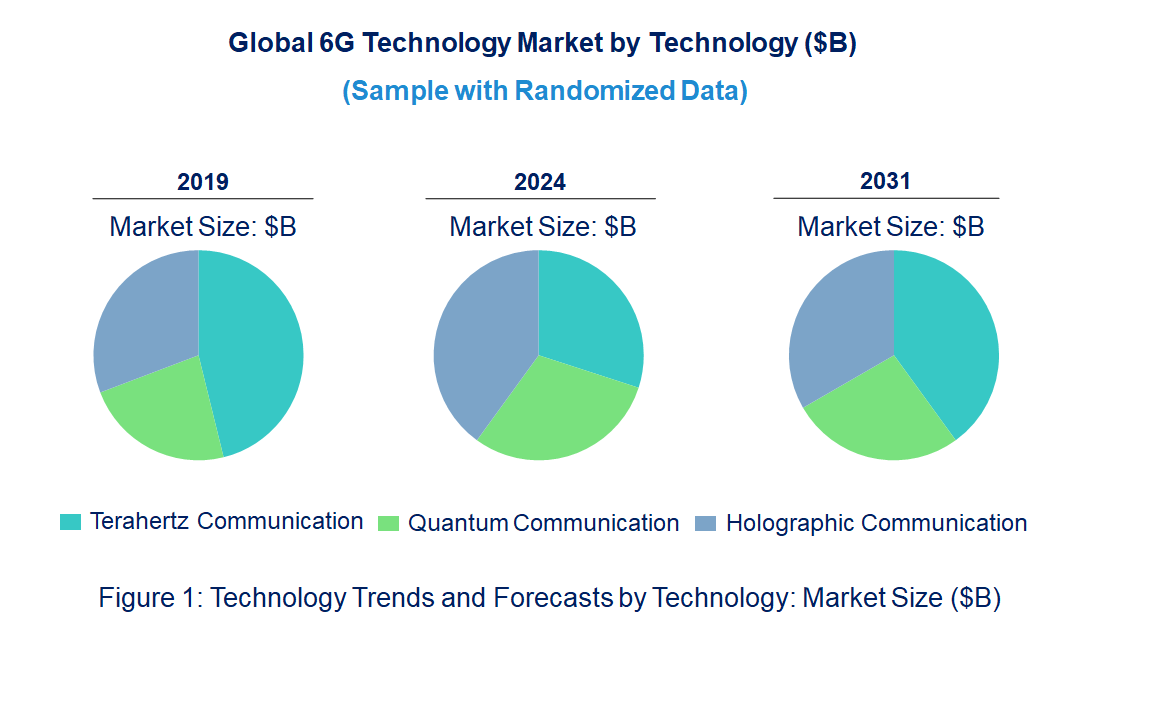
![6G Market Trend and Forecast by End Use Industry [Value from 2019 to 2031]:](https://lucintel.com/images/6G-Technology-Market-Segment.png "6G Market Trend and Forecast by End Use Industry [Value from 2019 to 2031]:")
• Terahertz Communication: The shift from millimeter-wave frequencies to terahertz frequencies is one of the most significant advancements. Terahertz communication promises ultra-fast data transfer speeds and low latency, which are essential for 6G applications such as augmented reality (AR) and virtual reality (VR).
• Quantum Communication: The development of quantum communication aims to provide highly secure communication systems that are resistant to cyberattacks. Quantum encryption methods will enhance the security of 6G networks, ensuring data integrity and protection against future threats.
• Holographic Communication: Holographic communication technology will enable three-dimensional, lifelike communication experiences. This will allow for more immersive meetings, entertainment, and remote interactions, significantly enhancing the way people and businesses communicate.
• Artificial Intelligence (AI) Integration: AI and machine learning will play a crucial role in optimizing 6G networks. From network management and resource allocation to personalized user experiences, AI will drive automation and efficiency across the entire 6G infrastructure.
• Edge Computing and Distributed Networks: The integration of edge computing with 6G will bring data processing closer to the user, reducing latency and improving network performance. This will be critical for time-sensitive applications like autonomous vehicles and industrial automation. These emerging trends in the 6G market are set to redefine connectivity, making communication faster, more secure, and more immersive. As technologies like terahertz communication, quantum communication, and holographic systems develop, the 6G market will offer new opportunities across various industries, enhancing both user experiences and operational efficiency. The convergence of AI, edge computing, and advanced wireless technologies will further accelerate the deployment of next-generation communication systems.
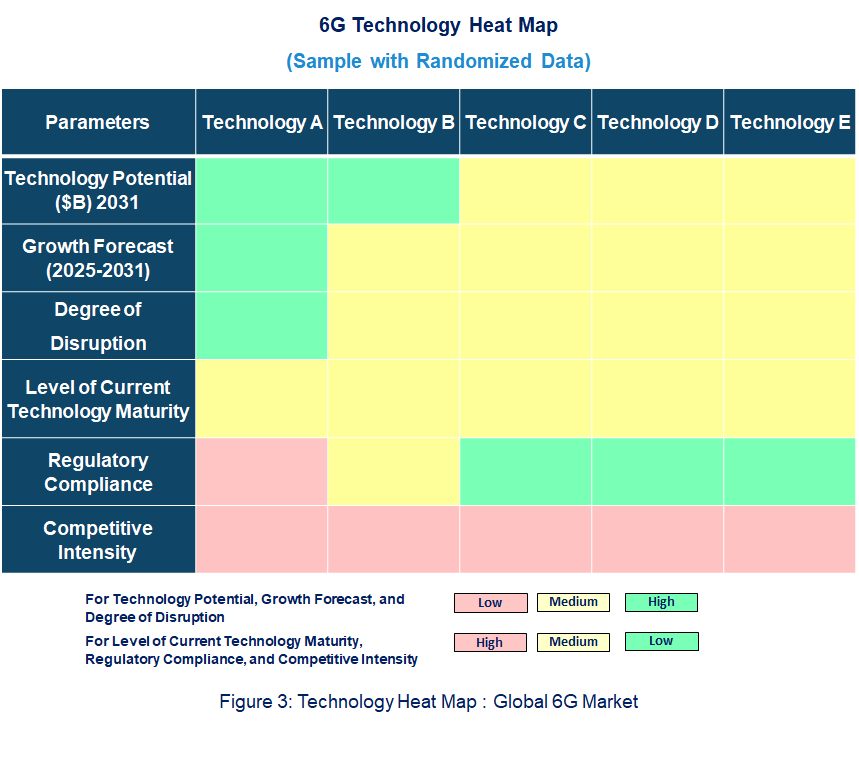
• Potential in Technology: The technology potential of 6G is immense, with theoretical speeds surpassing 1 terabit per second, offering unprecedented data transmission and near-zero latency. Quantum communication will revolutionize security with unbreakable encryption, while terahertz and holographic communication could transform everything from AI-powered applications to immersive holographic environments.
• Degree of Disruption: The disruption potential is profound, as these technologies will unlock new use cases, reshape industries, and introduce advanced applications like real-time remote surgeries, hyper-automation, and immersive virtual spaces.
• Current Technology Maturity Level: Currently, the maturity of 6G technology is in its early research and experimental phases. While foundational concepts and prototypes are being tested, mass deployment is still years away.
• Regulatory Compliance: Regulatory compliance poses a significant challenge, as global standards for spectrum allocation, security protocols, and interoperability need to be developed to enable the widespread adoption of these technologies. Ensuring equitable access and addressing spectrum challenges will require extensive collaboration between governments, regulators, and industry stakeholders.
• AT&T: AT&T is focusing on intensifying its research on terahertz communication and quantum networks for future 6G applications. The company has allied itself with several tech innovators to explore the potential of ultra-fast wireless communication aim is to achieve the theoretical 6G speeds that exceed 1 terabit per second. It is going to bring ultra-low latency and higher bandwidth capabilities to the market through efforts towards next-generation wireless technologies and improve services for the enterprise, healthcare, and autonomous transportation sectors.
• Broadcom: Broadcom is actively developing semiconductor solutions that play a critical role in 6G communication systems. In the latest efforts by Broadcom, it has launched new advanced chipsets designed to operate in higher frequency bands. As a result, these chipsets will enhance 6G performance by achieving greater data processing speeds with much lower latency while paving the way for ultra-high-speed data transfer in mobile devices, IoT, and AI applications.
• Cisco: Cisco has been investing in its network infrastructure innovations to lead in the development of the future of connectivity. Their innovations focus on network automation through AI and machine learning. Optimizing 6G networks will integrate key developments in AI and machine learning. Work by Cisco in developing programmable, software-defined networks is expected to achieve dimensioning scalability and efficiency in 6G, allowing consumers and businesses to connect seamlessly and adaptively in increasingly complex digital ecosystems.
• Ericsson: Ericsson is one of the leaders of 6G, with multiple research projects being conducted on network architecture and spectrum utilization. The firm is also working on making 6G energy-efficient and sustainable. As sustainable communication systems are a must for future applications, this is critical. Ericsson has also been testing advanced 6G use cases such as holographic communications and ultra-reliable low-latency communications (URLLC), which will open new applications in healthcare, manufacturing, and immersive media. These latest developments in the 6G market by major players demonstrate the enormous potential of next-generation communication systems. In so far as these companies continue to push boundaries even beyond what technology previously allowed, change will be promised by 6G with significantly widespread effects on industries across the global scale.
• Technological Advancements: Rapid advancements in terahertz communication, quantum computing, and AI enable the development of 6G networks. These technologies promise ultra-fast data transmission, low latency, and improved network efficiency, driving demand for 6G systems across industries like healthcare, autonomous driving, and manufacturing.
• Demand for High-Speed Connectivity: As the world moves towards IoT, AI, and smart cities, there is an increasing need for faster, more reliable, and secure networks. 6G is poised to meet the demand for ultra-high-speed data transmission, fostering innovation in sectors such as autonomous vehicles, remote surgery, and immersive media experiences.
• Industry Investment: Major investments by global telecom companies and governments in research and development are accelerating the 6G timeline. This funding is essential for overcoming the technical challenges of 6G deployment and for realizing its potential in global connectivity, driving advancements in communication infrastructure. Challenges in the 6G market are:
• High Development Costs: The cost of developing 6G infrastructure, including the research, testing, and deployment of terahertz-based communication systems, is substantial. High investments are required for building next-generation networks, which could slow down widespread adoption.
• Regulatory and Spectrum Issues: Regulatory hurdles, including spectrum allocation and global standardization, pose significant challenges. Establishing universal policies for 6G technologies requires cooperation among governments and industry players to ensure fairness, security, and interoperability, delaying the global rollout.
• Security Concerns: With the introduction of quantum communication and AI-driven systems, 6G networks will need robust cybersecurity measures to prevent new vulnerabilities. Addressing security concerns will require continued innovation to protect sensitive data, which can be challenging at such advanced technological levels. The 6G market is poised for significant growth, driven by technological innovation and a strong demand for faster and more reliable networks. However, the development of 6G faces substantial challenges, including high development costs, regulatory complexity, and cybersecurity concerns. Overcoming these hurdles will be crucial for the successful deployment and adoption of 6G technology.
• AT&T
• Broadcom
• Cisco
• Deepsig
• Ericsson
• Technology Readiness by Technology Type for 6G Market: Terahertz communication is advancing rapidly, with ongoing research focused on increasing transmission speeds and reducing interference. Quantum communication is at an early stage, with progress in quantum key distribution but still a long way to go for full-scale implementation. Holographic communication is still developing, with prototypes in use but limited widespread application, facing technological hurdles in real-time processing.
• Competitive Intensity and Regulatory Compliance for 6G Technologies: The competitive intensity of terahertz communication, quantum communication, and holographic communication is high, as multiple companies and countries vie for leadership in these cutting-edge fields. Regulatory compliance is complex, as each technology faces distinct challenges, including spectrum management for terahertz waves, quantum encryption standards, and safety regulations for holographic systems, all requiring global cooperation.
• Disruption Potential of Different Technologies for 6G Market: Terahertz communication, quantum communication, and holographic communication are highly disruptive technologies for the 6G market. Terahertz communication offers ultra-fast data transmission, potentially transforming high-speed internet and communication networks. Quantum communication enables secure, unhackable networks, while holographic communication can revolutionize interactive communication and virtual reality experiences, fostering new applications.
• Terahertz Communication
• Quantum Communication
• Holographic Communication
• Consumer
• Industrial
• Others
• North America
• Europe
• Asia Pacific
• The Rest of the World
• Latest Developments and Innovations in the 6G Technologies
• Companies / Ecosystems
• Strategic Opportunities by Technology Type


Choose a license that fits your team. Instant PDF delivery.
Prices exclude taxes. Instant delivery. Custom licensing available on request.
Market Report · May 18, 2026
Market Report · May 18, 2026
Market Report · May 18, 2026
Trusted partner for strategic intelligence and business growth


Receive a complimentary market analysis tailored to your industry. Our analysts will identify key growth opportunities and competitive dynamics specific to your business.

Market size, growth rate, and key trend analysis for your specific sector.

Top competitor positioning and market share analysis.

Strategic recommendations backed by data-driven insights.
Get curated market intelligence and competitive moves straight to your inbox.
By subscribing, you agree to receive our monthly insights. Unsubscribe anytime.
Receive a complimentary market analysis tailored to your industry. Our analysts will identify key growth opportunities and competitive dynamics specific to your business.
Market size, growth rate, and key trend analysis for your specific sector.
Top competitor positioning and market share analysis.
Strategic recommendations backed by data-driven insights.
Get curated market intelligence, emerging trends, and competitive moves straight to your inbox each month.
By subscribing, you agree to receive our monthly insights. Unsubscribe anytime.
We'll send your sample report shortly.