
Market Report · May 18, 2026

This market report covers trends, opportunities, and forecasts in the global 5g mmwave technology market to 2031 by technology (embb, fwa, mmtc, and urllc), end use industry (aerospace & defense, telecom, media & entertainment, automotive & transportation, public safety, healthcare & life sciences, and others), and region (North America, Europe, Asia Pacific, and the Rest of the World)
We'll send your sample report shortly.
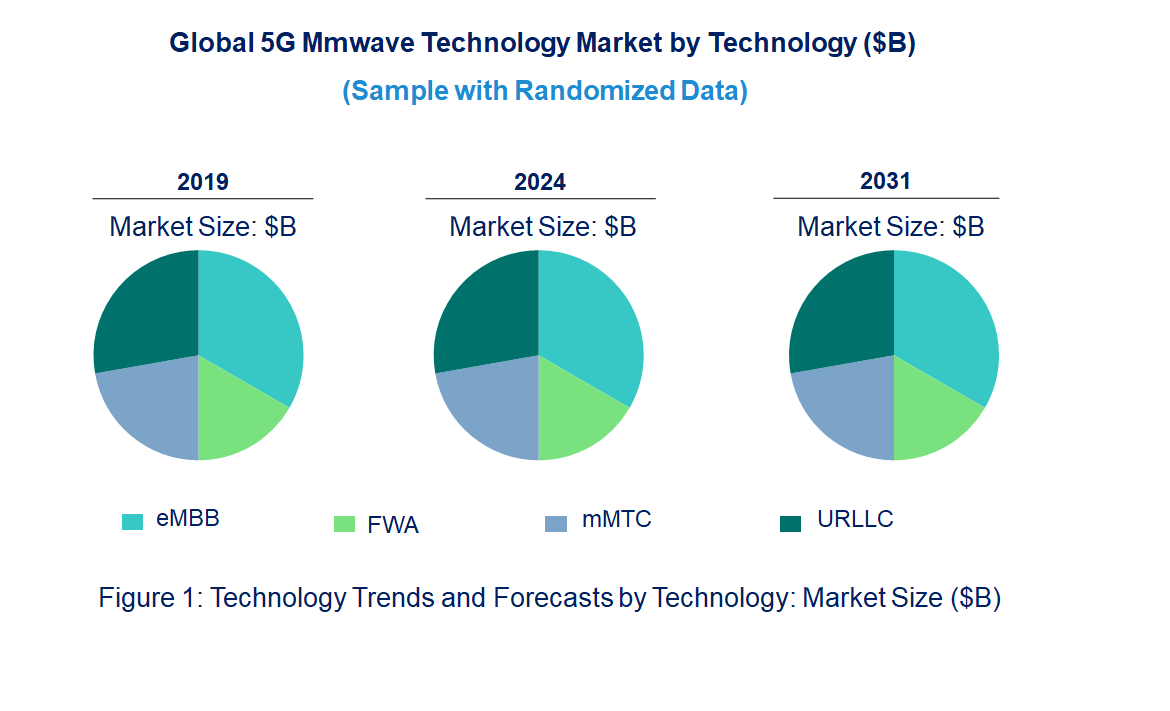
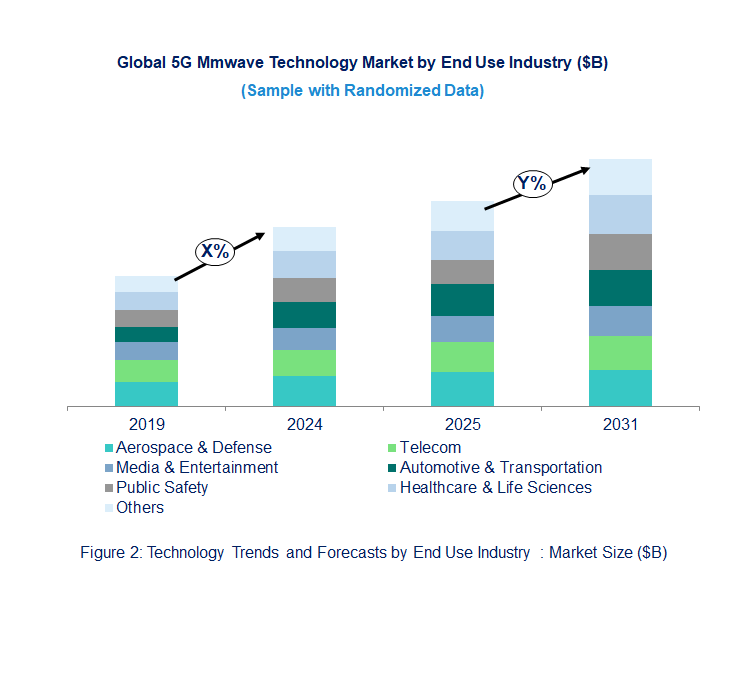
• Deployment of mmWave in 5G Networks: Due to its ability to offer very high speeds and support dense urban environments with heavy data demand, mmWave is increasingly being adopted in 5G networks. This is particularly important for eMBB, ensuring robust performance for smartphones, AR/VR, and other high-bandwidth services.
• FWA mmWave: The deployment of mmWave is being increasingly integrated into FWA solutions, mainly where fixed or wired broadband infrastructures are limited. This will disrupt classical broadband services and provide high-speed internet to remote and underserved areas, primarily targeting the telecom and media sectors.
• URLLC Expansion: URLLC, based on mmWave, is becoming crucial in fields such as automotive, healthcare, and public safety. It enables critical applications, such as autonomous vehicles, remote surgeries, and smart grids, that require ultra-low latencies and high reliability in real-time communication.
• Advances in 5G Network Infrastructure: The increasing demand for mmWave-based 5G services will force telecom operators to create new infrastructure that supports these high-frequency bands. To achieve seamless connectivity in mmWave deployments, small cell networks, advanced beamforming technologies, and dense radio access networks (RAN) will play key roles.
• Evolution of mmWave Chips and Components: The development of more efficient mmWave chips with improved power consumption, size, and cost is primarily driven by advancements in semiconductor technologies. Companies like NXP Semiconductors and AMD are leading the way in developing chips for these new mmWave technologies, supporting applications in 5G, automotive, and IoT. With the increasing trends in mmWave deployment across 5G, FWA, URLLC, advancements in network infrastructure, and the evolution of mmWave chips, the 5G mmwave technology market is changing, with possibilities for increased connectivity, novel applications, and support for high-speed wireless communication across industries.
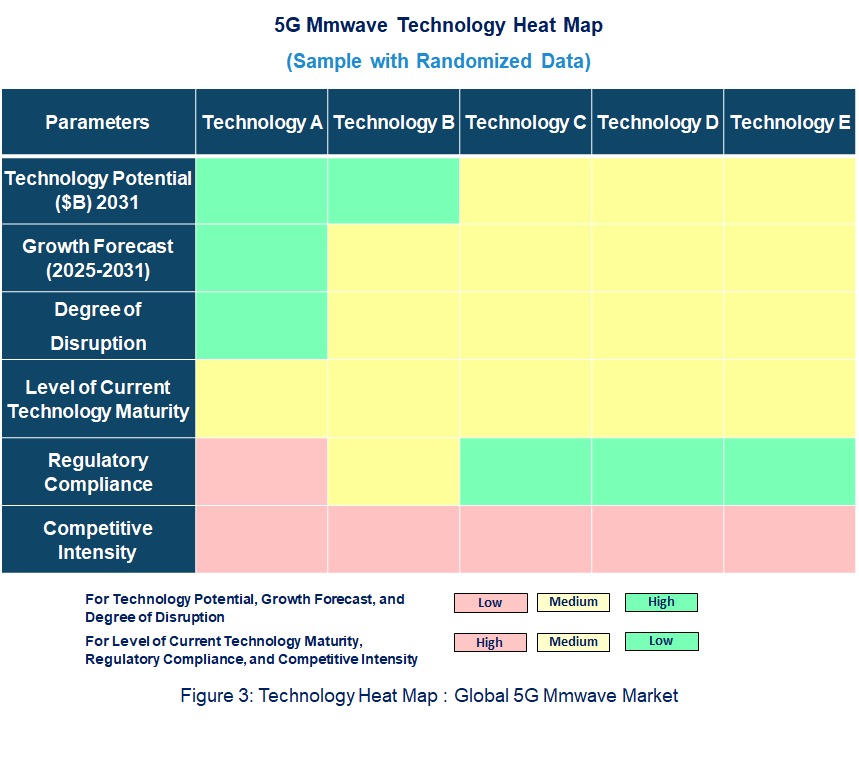
• Technology Potential: The potential of 5G mmWave technology is immense, offering significantly faster data rates (up to 10 Gbps) and higher capacity compared to traditional sub-6 GHz 5G technologies. It enables dense, high-speed connectivity for next-generation applications, including 4K/8K video streaming, augmented reality (AR), virtual reality (VR), and industrial IoT. As 5G infrastructure expands, mmWave’s ability to handle large data volumes with minimal latency positions it as a cornerstone of future communication networks.
• Degree of Disruption: The degree of disruption is high, as mmWave technology will transform various industries by enabling new use cases that were not feasible with earlier wireless technologies. However, its widespread adoption faces challenges, including high deployment costs, limited range, and sensitivity to physical obstructions, such as buildings and foliage.
• Level of Current Technology Maturity: While 5G mmWave technology is still evolving, it has reached a relatively high level of maturity in terms of infrastructure deployment, with initial commercial rollouts in select urban areas. Ongoing advancements focus on improving signal range, power efficiency, and cost-effectiveness.
• Regulatory Compliance: 5G mmWave technology must comply with strict regulatory standards set by bodies such as the FCC, ITU, and regional telecommunications authorities. These regulations ensure effective spectrum management, interference mitigation, and safety standards for high-frequency communications, promoting fair competition and reliable service.
• NXP Semiconductors: NXP is leading the charge in creating mmWave components for 5G applications. Recently, they introduced new chips capable of supporting enhanced mobile broadband and FWA. NXP’s innovations help telecom providers and OEMs create more efficient and scalable 5G networks, further driving global 5G adoption.
• Airspan Networks: Airspan has expanded its portfolio of 5G mmWave solutions, focusing on small cell networks and FWA. These solutions enable telecom operators to deploy 5G infrastructure quickly, offering better coverage and network speeds in urban and underserved regions.
• AT&T: AT&T has conducted extensive testing and deployed mmWave 5G in select cities across the United States. The company is focusing on improving eMBB services with ultra-fast data speeds for consumers and enterprises, as well as expanding FWA solutions to connect homes and businesses in rural areas.
• Fastweb: Fastweb is one of the major European leaders in using mmWave for FWA solutions. By strategically deploying mmWave, the company delivers high-speed internet to rural and underserved areas, revitalizing broadband penetration across Italy.
• Softbank: Softbank is using mmWave for 5G deployment in Japan, targeting high-capacity eMBB services in urban centers and enterprise customers. Their strategic use of mmWave spectrum supports the growth of IoT and smart city applications.
• Corning: Corning is investing in enabling the next generation of wireless infrastructure with optical fiber solutions for 5G mmWave networks. High-capacity networks require optical investments to allow for dense small-cell network deployments needed for mmWave 5G services.
• Nokia: Nokia has developed a series of solutions to help deploy mmWave 5G, from network infrastructure to 5G radio access solutions. Its work to integrate mmWave technologies with existing LTE and 5G networks has helped operators deliver reliable high-speed services.
• Mavenir: Mavenir is working towards open, cloud-native 5G networks, with solutions supporting the mmWave spectrum. These solutions allow operators to build scalable and flexible networks capable of handling the challenges of eMBB, URLLC, and other 5G applications.
• NTT Docomo: NTT Docomo is a leader in Japanese 5G and has significantly invested in mmWave technology to support ultra-high-speed mobile and fixed broadband services. Their efforts are central to Japan’s push for 5G leadership.
• AMD: AMD has expanded its portfolio of semiconductor solutions for 5G mmWave technologies, including high-performance processors and RF components. These innovations are helping enable more efficient and cost-effective 5G deployments, particularly for network operators and device manufacturers. These developments highlight how key players in the market are advancing mmWave technologies to drive the expansion of 5G capabilities, enrich service offerings, and promote the widespread adoption of next-generation wireless networks.
• Increasing High-Speed Connectivity Needs: The current and future demand for high-speed internet in urban areas is driving the adoption of 5G mmWave technology. Since mmWave offers significantly higher data rates, it is ideal for applications such as AR/VR, 4K/8K video streaming, and other bandwidth-intensive services. This is one of the primary factors motivating telecom companies to accelerate 5G rollouts.
• 5G Network Growth: As 5G spreads worldwide, massive mmWave deployment is considered crucial to achieve faster and lower-latency speeds. Telecom operators are building mmWave infrastructure to meet the high demand for data, especially in densely populated cities.
• IoT and Smart Devices Evolution: The increasing ubiquity of IoT devices and smart devices is creating demand for high-capacity, low-latency connectivity, for which mmWave is well-suited. This creates significant opportunities for the deployment of mmWave in both consumer and industrial applications, particularly in healthcare, automotive, and public safety. Challenges in the 5G Mmwave Technology include:
• Regulatory and Spectrum Allocation Challenges: A major challenge for mmWave adoption is the complex regulatory environment surrounding spectrum allocation. Different countries have varying policies on mmWave spectrum availability, which can impact the speed of 5G rollouts and overall market growth.
• High Infrastructure Costs: Deploying mmWave technology requires dense small-cell networks and extensive infrastructure, which can be costly. Operators face challenges in ensuring return on investment (ROI) while building these networks, especially in less-populated or rural areas where demand may be lower. The demand for high-speed connectivity and the growth of IoT, along with 5G network expansion, is driving the growth of the market for 5G Mmwave Technology. However, challenges related to spectrum regulation and high infrastructure costs must be addressed for sustained long-term growth in the market.
• NXP Semiconductors
• Airspan Networks
• AT&T
• Fastweb
• Softbank
• Corning
• Technology Readiness by Type: The readiness of 5G mmWave technologies varies by use case. eMBB is the most mature, with thorough testing and commercial launch, supporting higher speeds and an improved mobile experience. FWA is developing rapidly, with deployments in both urban and rural areas offering broadband alternatives to fiber. MmTC is gaining momentum with wide support for large-scale IoT deployments, though challenges persist in power efficiency and network scalability. URLLC is in the early development stage, with ongoing trials in sectors requiring low-latency and high-reliability communication, such as autonomous vehicles and industrial automation. Competitive levels are high in eMBB and FWA, while mMTC and URLLC are more specialized services that require regulatory compliance, focusing on spectrum allocation, latency, and reliability. The success of different applications depends on overcoming technological and regulatory hurdles.
• Competitive Intensity and Regulatory Compliance: The competition intensity in the 5G mmWave market is high, with major telecom providers, equipment manufacturers, and tech companies all vying for dominance in eMBB, FWA, mMTC, and URLLC. eMBB and FWA are driving competition in consumer broadband and mobile services, while mMTC and URLLC focus on IoT and critical communications. Regulatory compliance varies by region: eMBB and FWA require spectrum licensing and network deployment compliance, while mMTC faces challenges in spectrum management and energy efficiency standards. URLLC must meet stringent reliability and latency benchmarks, often requiring collaboration with regulatory bodies to ensure safety in mission-critical applications. Spectrum allocation, data privacy, and security regulations remain key concerns as the market evolves.
• Potential Disruption of 5G MmWave Technologies: The 5G mmWave technologies, ranging from eMBB to FWA, from mMTC to URLLC, have variable potential across industries. eMBB (Enhanced Mobile Broadband) enables high-speed mobile internet, supporting real-time HD/4K streaming and immersive AR/VR experiences. FWA (Fixed Wireless Access) offers a cost-effective alternative to fiber broadband, expanding connectivity in underserved regions. mMTC (Massive Machine Type Communications) will transform IoT with vast device connectivity and ultra-low power requirements, driving smart city and industrial automation growth. URLLC (Ultra-Reliable Low Latency Communications) has the potential to revolutionize sectors requiring real-time, high-precision data, such as autonomous vehicles and telemedicine. Each technology unlocks unique growth opportunities, and their integration will accelerate the widespread adoption of 5G mmWave networks across industries.
• eMBB
• FWA
• mMTC
• URLLC
• Aerospace & Defense
• Telecom
• Media & Entertainment
• Automotive & Transportation
• Public Safety
• Healthcare & Life Sciences
• Others
• North America
• Europe
• Asia Pacific
• The Rest of the World
• Latest Developments and Innovations in the 5G Mmwave Technology Technologies
• Companies / Ecosystems
• Strategic Opportunities by Technology Type


Choose a license that fits your team. Instant PDF delivery.
Prices exclude taxes. Instant delivery. Custom licensing available on request.
Market Report · May 18, 2026
Market Report · May 18, 2026
Market Report · May 18, 2026
Trusted partner for strategic intelligence and business growth


Receive a complimentary market analysis tailored to your industry. Our analysts will identify key growth opportunities and competitive dynamics specific to your business.

Market size, growth rate, and key trend analysis for your specific sector.

Top competitor positioning and market share analysis.

Strategic recommendations backed by data-driven insights.
Get curated market intelligence and competitive moves straight to your inbox.
By subscribing, you agree to receive our monthly insights. Unsubscribe anytime.
Receive a complimentary market analysis tailored to your industry. Our analysts will identify key growth opportunities and competitive dynamics specific to your business.
Market size, growth rate, and key trend analysis for your specific sector.
Top competitor positioning and market share analysis.
Strategic recommendations backed by data-driven insights.
Get curated market intelligence, emerging trends, and competitive moves straight to your inbox each month.
By subscribing, you agree to receive our monthly insights. Unsubscribe anytime.
We'll send your sample report shortly.