
Market Report · July 29, 2026

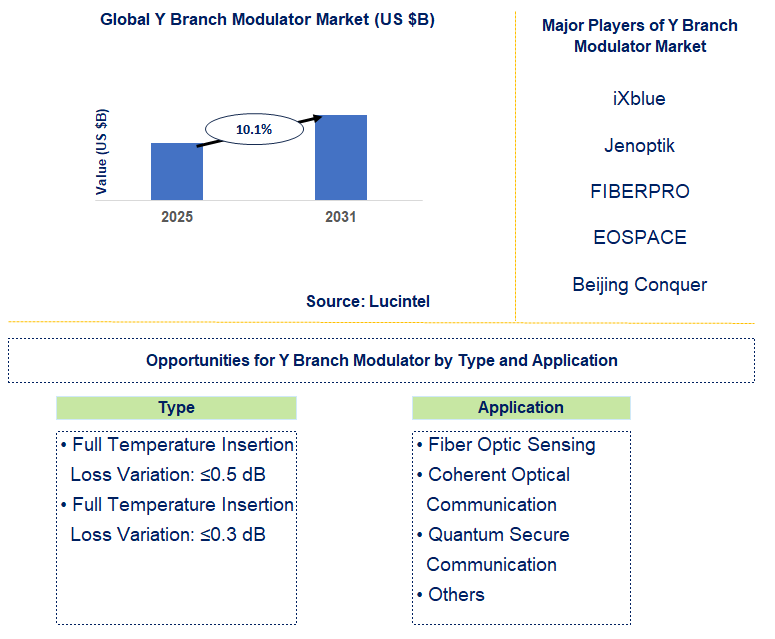
Key data points: The growth forecast = 10.1% annually for the next 7 years. Scroll below to get more insights. This market report covers trends, opportunities and forecasts in Y branch modulator market to 2031 by type (full temperature insertion loss variation: ≤0.5 dB and full temperature insertion loss variation: ≤0.3 dB), application (fiber optic sensing, coherent optical communication, quantum secure communication, and others), and region (North America, Europe, Asia Pacific, and the Rest of the World)
We'll send your sample report shortly.
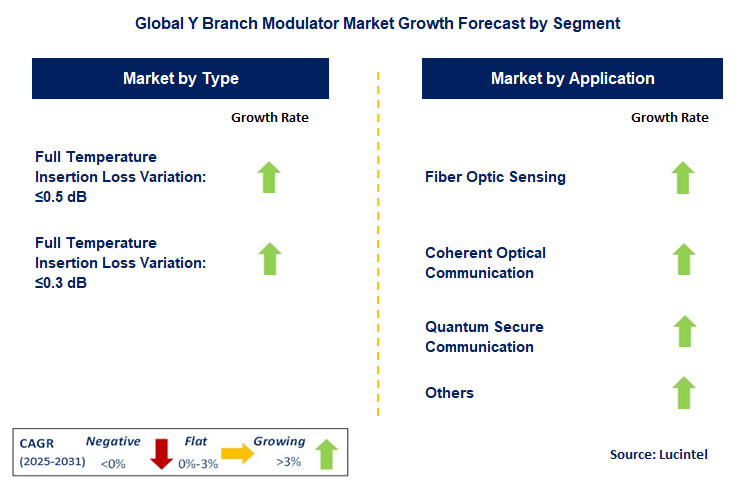
• Lucintel forecasts that, within the type category, full temperature insertion loss variation: ≤0.3 dB is expected to witness higher growth over the forecast period.
• Within the application category, coherent optical communication is expected to witness the highest growth.
• In terms of region, APAC is expected to witness the highest growth over the forecast period. Gain valuable insights for your business decisions with our comprehensive 150+ page report. Sample figures with some insights are shown below.
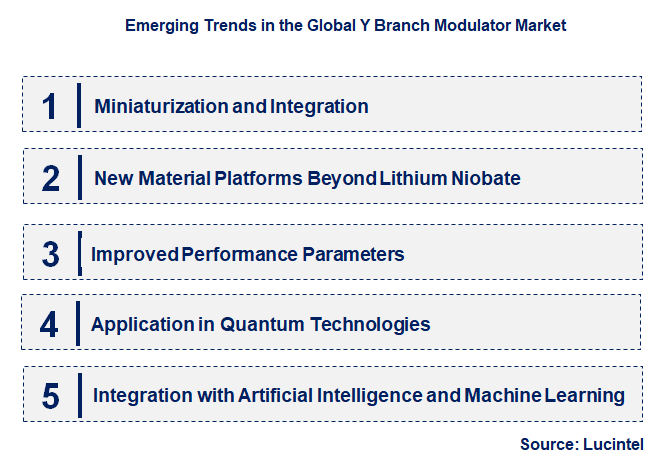
• Miniaturization and Integration: There is a very strong trend toward miniaturizing the physical dimension of Y-branch modulators and integrating them into large photonic integrated circuits (PICs). This includes fabricating many optical components onto one chip, resulting in low-volume, rugged, and economical solutions. The effect is profound for applications with high component density requirements, including data centers and telecommunication networks, where space and power usage are paramount. Miniaturization also facilitates new functions and sophisticated optical signal processing on-chip, lowering packaging cost and enhancing overall system reliability.
• New Material Platforms Beyond Lithium Niobate: Although lithium niobate has been a dominant material in optical modulators in the past, there is now an increased trend towards searching and embracing new material platforms. Silicon photonics, thin-film lithium niobate (TFLN), and even polymer-based material are picking up speed as a result of their potential for lower power consumption, greater integration density, and compatibility with conventional semiconductor manufacturing techniques. The effect is a manufacturing diversification, allowing modulators with high performance features such as lower Vπ (half-wave voltage), broader bandwidths, and decreased insertion loss, addressing specific application requirements and driving innovation.
• Improved Performance Parameters: The market is observing a persistent push to advance significant performance parameters of Y-branch modulators such as extending the extinction ratio, minimizing insertion loss, and widening the operational bandwidth. All these advancements are important for sustaining higher data rates for optical communication and more accurate measurements in sensing. The effect is a direct enhancement in system performance, enabling clearer signal transmission over larger distances, more precise sensor measurements, and the capability to process ever more complicated modulation schemes, which are crucial in future high-capacity networks.
• Application in Quantum Technologies: One of the trends to emerge is increased use of Y-branch modulators for quantum computing and quantum communication devices. Their capability to handle single photons or entangled pairs of photons with precision to split them makes them critical elements in quantum photonic circuits. The impact is the facilitation of novel quantum technologies through the supply of optical control devices needed. The trend creates a high-value, high-growth niche market for Y-branch modulators that demand very low loss and high fidelity of modulation.
• Integration with Artificial Intelligence and Machine Learning: The industry is witnessing early stages of developing Y-branch modulators with artificial intelligence (AI) and machine learning (ML) for enhanced performance and adaptive control. AI algorithms can fine-tune modulator parameters in real-time, correct environmental variations, and forecast optimal operating conditions. The effect is increased system resilience, reduced performance variation over time, and perhaps the ability to create self-optimizing optical networks. The trend has the potential to fundamentally change the way that optical components are controlled and deployed in complicated systems. These new trends are essentially redefining the Y-branch modulator market by pushing innovation towards lower size, greater efficiency, and better performance devices. The market is breaking free from conventional constraints, venturing into new materials and smart control mechanisms to address the increasing needs of next-generation optical communication, sensing, and quantum technology.
• Thin-Film Lithium Niobate Modulator Advancements: One particular recent advancement is the fast development and production ramp of Y-branch modulators made on thin-film lithium niobate (TFLN) substrates. TFLN has better electro-optic characteristics than conventional bulk lithium niobate, allowing for greater bandwidths, lower voltage drive requirements, and reduced footprints. The effect is a new generation of high-speed modulators that are energy-efficient and easier to integrate into miniaturized optical systems, thus being extremely desirable for data centers and next-generation telecommunication networks with increased speeds and reduced power consumption.
• Rising Research and Development in Silicon Photonics: There has been a spike in research and development work aiming to develop high-speed Y-branch modulators with silicon photonics platforms. Although silicon itself does not have a significant electro-optic effect, clever designs based on carrier depletion or accumulation phenomena in silicon waveguides are providing compact and CMOS-compatible modulators. The effect is the prospect of mass production at reduced costs, utilizing available semiconductor manufacturing capabilities. The innovation is important for making optical devices seamlessly compatible with electronic circuits, pushing the use of photonic integrated circuits (PICs).
• High-Extinction Ratio and Low-Loss Device Development: Current advancements have witnessed a major emphasis on enhancing the critical performance parameters like extinction ratio and insertion loss in Y-branch modulators. Researchers are using innovative waveguide geometry, optimized electrode structures, and sophisticated fabrication methods to obtain higher ON-OFF contrast ratio and reduce signal deterioration. The effect is a direct enhancement in the optical system's signal quality and power efficiency, allowing for longer transmission distances and more fault-tolerant data communication, essential for satisfying the requirements of high-bandwidth applications.
• Research in Polymer-Based Electro-Optic Modulators: New advancements involve growing interest and investigation in the area of polymer-based electro-optic Y-branch modulators. These compounds bring high electro-optic coefficients, low dielectric constants, and good temperature stability, promising lower drive voltages and higher speeds of operation. The effect is a potential alternative to inorganic compounds, specifically for very low power consumption and flexible device manufacturing. This advancement creates opportunities for novel form factors and integration concepts in optical systems.
• Utilization in Fiber Optic Gyroscopes: Recent developments emphasize the ongoing significance and optimization of Y-branch modulators in particular for fiber optic gyroscope (FOG) use. The modulators are essential for inducing phase shifts and equalizing light paths in FOGs, which are employed for accurate navigation and sensing. The effect is an improvement in the accuracy and reliability of FOGs to allow for more dependable use in challenging applications in aerospace, defense, and autonomous systems, where high accuracy and robustness against environmental conditions are essential. These new advancements are significantly influencing the Y-branch modulator market by promoting the design of more efficient, higher-performing, and diverse optical devices. The market is trending towards increasing integration, novel material discovery, and performance optimization to address the growing demands of contemporary communication, sensing, and nascent quantum technologies.
• Data Center Interconnects: A key strategic growth area exists in the fast-emerging data center interconnects (DCIs) market. With data traffic in and among data centers growing exponentially, there is an urgent demand for high-speed, small-footprint, low-power optical modulators. Y-branch modulators on silicon photonics or TFLN platforms can provide density integration and low power consumption solutions, achieving higher data throughput rates and lowering data center operations cost. This segment has strong volume demand potential.
• Fiber Optic Sensing: The high-precision sensing market for fiber optics, particularly for such applications as fiber optic gyroscopes (FOGs) and hydrophones, presents a significant growth opportunity. Y-branch modulators are critical for phase modulation and signal processing in these sensors, which are critical for navigation, structural health monitoring, and underwater acoustic detection. The strategic opportunity is to offer highly stable, reliable, and high-performance Y-branch modulators specifically designed for harsh environments and long-term operation in these sensitive applications.
• 5G and Next-Generation Telecommunication Networks: The worldwide deployment of 5G and the evolution of next-generation telecommunication networks is a huge growth opportunity. These networks require ultra-high-bandwidth, low-latency, and power-efficient optical components for their backhaul and fronthaul infrastructure. Y-branch modulators are critical for the generation and switching of high-speed optical signals. The strategic play is to provide modulators with support for more advanced modulation formats and higher data rates, which enable the cost-effective transmission of huge volumes of data.
• Quantum Computing and Quantum Communication: One of the emerging strategic growth areas is in the newly emerging but strongly developing areas of quantum computing and quantum communication. Y-branch modulators are building blocks in quantum photonic circuits to split and manipulate single photons or entangled states. The potential is in creating ultra-low loss, high precision, and stable Y-branch modulators tailored for specific quantum applications, where quantum coherence and fidelity must be preserved. This is a high-value, research-driven segment.
• Integrated Photonics for Automotive and Consumer Electronics: The long-term growth strategic opportunity is the overall embedding of Y-branch modulators in photonic integrated circuits for automotive LiDAR, augmented reality (AR) devices, and other consumer electronics. As optical sensing and display technology becomes increasingly ubiquitous, the demand for small, mass-producible, and low-cost optical components will skyrocket. The opportunity is to create and scale Y-branch modulator manufacturing to fill the high volume and cost-sensitive needs of these new markets. These strategic growth opportunities will strongly influence the Y-branch modulator market by stimulating demand for more integrated, higher performance, and specialized devices. Firms that successfully focus on these principal applications and invest in the attendant technological advancements will be well-placed for large market growth and competitiveness.
• iXblue
• Jenoptik
• FIBERPRO
• EOSPACE
• Beijing Conquer
• Tianjing Lingxin
• Beijing Pudan
• Shandong Jiliang Information Technology Development
• Turingq
• BEIJING SWT INTELLIGENT OPTICS TECHNOLOGY
• Full Temperature Insertion Loss Variation: ≤0.5 dB
• Full Temperature Insertion Loss Variation: ≤0.3 dB
• Fiber Optic Sensing
• Coherent Optical Communication
• Quantum Secure Communication
• Others
• North America
• Europe
• Asia Pacific
• The Rest of the World
• United States: In the United States, the market for Y-branch modulators is driven mainly by research in optical communication systems, data centers, and defense. Current trends emphasize high-speed and low-power devices, especially those utilizing silicon photonics and thin-film lithium niobate platforms for integrated circuits. There is strong focus placed on research and development of modulators with higher extinction ratios and lower insertion loss, essential in next-generation optical networking and quantum computing uses. Domestic investment in manufacturing capability for advanced photonic components is also highlighted.
• China: China is a fast-growing Y-branch modulator market, driven by huge investments in optical communications infrastructure, 5G rollout, and photonics research. Recent breakthroughs saw important developments in integrated optical modulators, with emphasis placed on affordable mass production and enhanced performance. Chinese companies and research organizations are actively making compact and energy-efficient Y-branch modulators based on diverse material platforms, with the aim of making their position more dominant in the global supply chain for optical components and enabling the widespread application of high-speed data transmission.
• Germany: Germany's Y-branch modulator market is dominated by a focus on precision engineering, high reliability, and specialty applications in industrial sensing, aerospace, and specialized optical instrumentation. The latest advances are the improvement of lithium niobate-based modulators for high stability and accuracy in demanding conditions, e.g., in fiber optic gyroscopes. German enterprises are also developing new material systems and advanced production technologies to reach high-performance requirements for high-frequency applications and embed modulators into complex optical systems.
• India: India's Y-branch modulator market is in the infant but rising stage, induced by growing investments in the telecommunications infrastructure, digital transformation programs, and expanding research in photonics. New developments include a growing interest in local development and production of optical components to cut down on imports. There is an emphasis on affordable solutions for broadening fiber optic networks and tapping the potential of Y-branch modulators in new applications such as smart cities and high-end sensing technologies. University and industry partnerships are driving expansion.
• Japan: The Y-branch modulator market in Japan is characterized by its search for ultra-high performance, miniaturization, and integration into high-end optical systems. Recent advances highlight new modulator designs for greater bandwidth, reduced drive voltages, and improved extinction ratios, specifically targeted at high-end optical telecommunications and sensor technologies. Japanese industry and research organizations are pursuing new materials platforms and fabrication processes, including silicon photonics and advanced polymer ones, to optimize device performance and facilitate next-generation optical applications.


• iXblue
• Jenoptik
• FIBERPRO
• EOSPACE
• Beijing Conquer
• Tianjing Lingxin
• Beijing Pudan
• Shandong Jiliang Information Technology Development
• Turingq
• BEIJING SWT INTELLIGENT OPTICS TECHNOLOGY Q5. Which Y branch modulator market segment will be the largest in future? Answer: Lucintel forecasts that, within the type category, full temperature insertion loss variation: ≤0.3 dB is expected to witness higher growth over the forecast period. Q6. In Y branch modulator market, which region is expected to be the largest in next 5 years? Answer: In terms of region, APAC is expected to witness the highest growth over the forecast period. Q7. Do we receive customization in this report? Answer: Yes, Lucintel provides 10% customization without any additional cost.


Choose a license that fits your team. Instant PDF delivery.
Prices exclude taxes. Instant delivery. Custom licensing available on request.
Market Report · July 29, 2026
Market Report · July 20, 2026
Market Report · July 20, 2026
Trusted partner for strategic intelligence and business growth


Receive a complimentary market analysis tailored to your industry. Our analysts will identify key growth opportunities and competitive dynamics specific to your business.

Market size, growth rate, and key trend analysis for your specific sector.

Top competitor positioning and market share analysis.

Strategic recommendations backed by data-driven insights.
Get curated market intelligence and competitive moves straight to your inbox.
By subscribing, you agree to receive our monthly insights. Unsubscribe anytime.
Receive a complimentary market analysis tailored to your industry. Our analysts will identify key growth opportunities and competitive dynamics specific to your business.
Market size, growth rate, and key trend analysis for your specific sector.
Top competitor positioning and market share analysis.
Strategic recommendations backed by data-driven insights.
Get curated market intelligence, emerging trends, and competitive moves straight to your inbox each month.
By subscribing, you agree to receive our monthly insights. Unsubscribe anytime.
We'll send your sample report shortly.