
Market Report · July 29, 2026

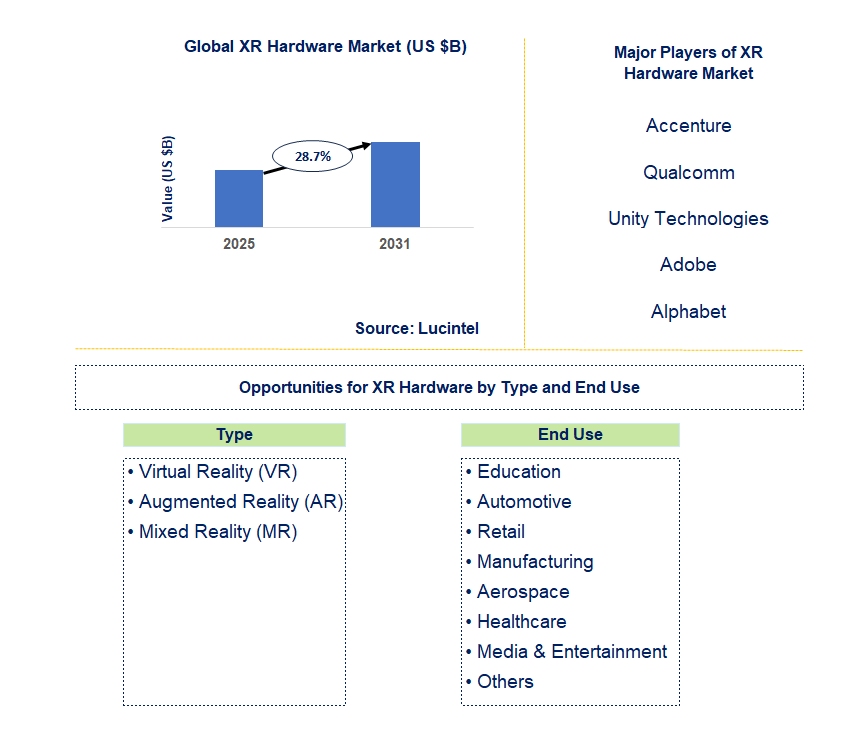
Key data points: The growth forecast = 28.7% annually for the next 7 years. Scroll below to get more insights. This market report covers Trends, opportunity and forecast in XR hardware market to 2031 by type (virtual reality (VR), augmented reality (AR), and mixed reality (MR)), end use (education, automotive, retail, manufacturing, aerospace, healthcare, media & entertainment, and others), and region (North America, Europe, Asia Pacific, and the Rest of the World)
We'll send your sample report shortly.
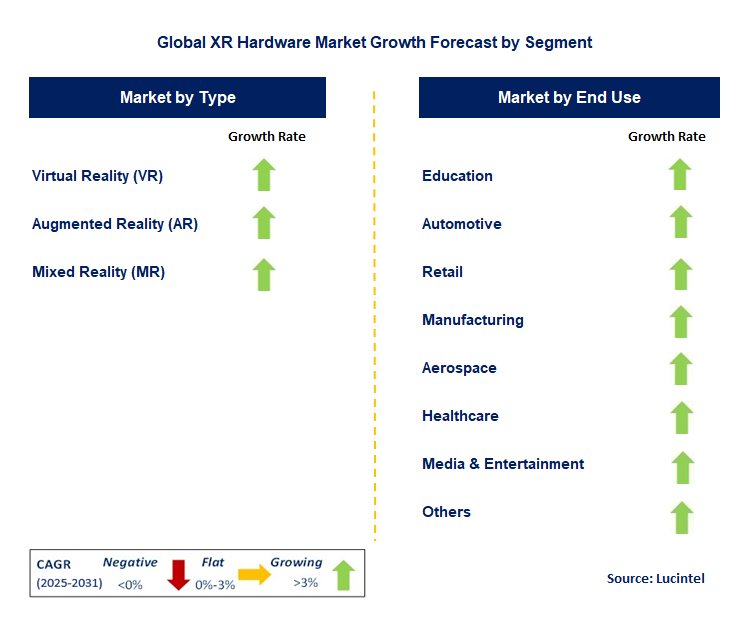
• Lucintel forecasts that, within the type category, virtual reality is expected to witness the highest growth over the forecast period.
• Within the application category, education is expected to witness the highest growth.
• In terms of region, APAC is expected to witness the highest growth over the forecast period. Gain valuable insights for your business decisions with our comprehensive 150+ page report. Sample figures with some insights are shown below.
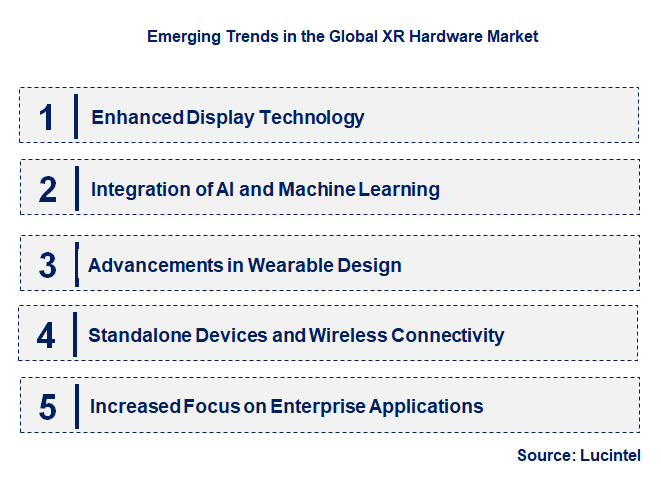
• Enhanced Display Technology: The development of better display technology is one of the most significant trends in XR hardware. OLED and MicroLED screens are increasingly being used in XR headsets to offer sharper, brighter, and more vibrant visuals. These advancements allow for higher resolution, better color accuracy, and reduced motion sickness, enhancing the overall user experience. The focus is also on reducing the "screen door effect," where users can see individual pixels, making the experience more immersive and realistic. This trend is crucial in driving consumer adoption across gaming, healthcare, and other sectors by delivering highly engaging visual experiences.
• Integration of AI and Machine Learning: AI and machine learning are transforming XR hardware by improving the responsiveness, adaptability, and personalization of devices. AI-powered hand tracking, gesture recognition, and voice commands are becoming standard features, allowing for more intuitive interactions with XR environments. This integration helps create smoother, more immersive experiences by reducing lag and enhancing user control. Additionally, machine learning algorithms can improve the real-time rendering of virtual worlds, making them more realistic and responsive to user inputs. As these technologies evolve, AI’s role in XR hardware will continue to expand, providing more seamless and engaging interactions.
• Advancements in Wearable Design: There is a strong trend towards making XR hardware more comfortable, lightweight, and wearable. Manufacturers are designing smaller, lighter headsets with ergonomic features, such as adjustable straps and improved weight distribution, to make prolonged use more comfortable. This is especially important for industries like healthcare and training, where extended use is common. Innovations such as flexible materials, lightweight components, and even the integration of haptic feedback are improving the user experience. As wearable XR devices become more practical, they are likely to see increased adoption across sectors where comfort is a priority.
• Standalone Devices and Wireless Connectivity: Standalone XR devices, which do not require an external computer or console, are becoming increasingly popular. These devices, such as Oculus Quest, allow users to experience VR and AR without being tethered to a PC, offering more freedom of movement and a better immersive experience. Wireless connectivity, particularly with the advent of 5G, is also improving the performance of these devices by enabling faster data transmission and reducing latency. The rise of standalone, wireless XR devices is helping to democratize the technology, making it more accessible to consumers and businesses and increasing their utility in real-time, mobile environments.
• Increased Focus on Enterprise Applications: While consumer applications such as gaming and entertainment continue to drive the XR hardware market, there is an increasing focus on enterprise solutions. Industries like healthcare, architecture, and manufacturing are adopting XR technologies for training, simulation, design, and remote collaboration. This has led to the development of specialized hardware tailored to professional use, including XR headsets with advanced sensors, higher durability, and longer battery life. The enterprise segment is expected to grow rapidly as XR hardware becomes integral to workflow optimization, employee training, and operational efficiencies, especially in sectors that require high-fidelity simulations. The XR hardware market is undergoing a transformative shift, with innovations in display technology, AI, wearables, wireless devices, and enterprise solutions driving its evolution. As XR hardware becomes more accessible, immersive, and user-friendly, it is poised to reshape industries across the board, from gaming and entertainment to healthcare and enterprise applications. The continued development of standalone, wireless, and AI-enhanced devices is opening up new possibilities, while comfort and ease of use are making XR more appealing to a broader audience. These trends are helping XR move from niche applications to mainstream adoption, marking a pivotal moment in its growth.
• Advancement in Standalone VR Headsets: Recent advancements in standalone VR headsets, such as Meta’s Quest 3 and Pico’s 4, have made significant strides in offering high-quality experiences without the need for external hardware like PCs or consoles. These devices feature improved processors, higher-resolution displays, and more intuitive user interfaces. This development is democratizing access to VR, making it more affordable and accessible for consumers and businesses alike. As standalone VR headsets become more powerful and versatile, they are paving the way for wider adoption across entertainment, education, and training sectors, significantly expanding the market.
• Integration of AI and Machine Learning in XR Hardware: AI and machine learning technologies are being increasingly integrated into XR hardware, enhancing user experiences with features like eye-tracking, gesture recognition, and adaptive content. For example, AI-driven eye-tracking in VR headsets can optimize rendering by reducing the load on the device, making the experience smoother. AI also enables more personalized interactions in AR and VR environments, improving engagement and usability. This development is expanding the potential applications of XR hardware, from immersive gaming to remote collaboration and personalized healthcare solutions, making the technology more practical and appealing across industries.
• 5G and XR Hardware Synergy: The rollout of 5G networks is playing a crucial role in enhancing the performance and capabilities of XR hardware. With its low latency and high-speed data transmission, 5G enables seamless real-time interactions in XR applications, especially in cloud gaming, remote collaboration, and telemedicine. XR hardware that leverages 5G connectivity, such as AR glasses and lightweight VR headsets, is now capable of delivering more immersive and interactive experiences without the need for bulky, tethered devices. This development is accelerating the adoption of XR across various sectors, particularly in industries requiring mobile and on-the-go solutions.
• Development of AR Glasses for Consumer and Enterprise Applications: The evolution of AR glasses, such as Microsoft’s HoloLens 2 and Apple’s upcoming AR headset, represents a significant leap forward in both consumer and enterprise applications. These devices are becoming more lightweight, stylish, and functional, catering to both personal use and professional settings. In enterprises, AR glasses are increasingly being used for remote assistance, training, and maintenance, while consumer-facing devices focus on enhancing experiences in entertainment, gaming, and shopping. This development is broadening the scope of XR hardware, attracting new markets, and making AR a more integrated part of daily life.
• Immersive Healthcare and Training Solutions: XR hardware is gaining momentum in healthcare and training applications, offering immersive environments for simulations, surgeries, and education. For instance, XR headsets are being used for medical training, allowing students and professionals to practice procedures in a risk-free virtual environment. In healthcare, MR technology is aiding in patient treatment plans by providing visualization tools for complex conditions. The growing interest in XR’s potential for realistic and cost-effective training solutions, especially in sectors like aviation, medicine, and the military, is driving demand for specialized XR hardware, contributing to the overall market’s expansion. These developments in the XR hardware market underscore a transformation driven by technological advancements, particularly in the areas of standalone VR, AI integration, 5G connectivity, AR glasses, and healthcare applications. As these innovations continue to evolve, they are broadening the scope of XR’s utility across industries, driving increased adoption, and improving user experiences. The market is expanding beyond gaming and entertainment, with applications in healthcare, education, and enterprise settings gaining traction. These trends are collectively shaping a promising future for XR hardware, with an emphasis on accessibility, mobility, and interactivity.
• Healthcare and Medical Training: XR hardware offers transformative potential in healthcare, especially in medical training and surgery simulation. VR and AR technologies allow medical professionals to practice procedures in a risk-free environment. The ability to simulate complex surgeries or diagnose conditions using XR technology reduces costs and improves training outcomes. By providing immersive, hands-on learning experiences, XR hardware is also helping to bridge the gap between theoretical knowledge and practical application. As healthcare providers increasingly adopt XR for training and patient care, there is a growing opportunity for XR hardware manufacturers to develop specialized, high-precision devices suited for medical use.
• Enterprise Collaboration and Remote Work: The shift toward remote work has highlighted the potential of XR hardware in enterprise collaboration. XR platforms can enhance remote communication by allowing employees to interact within virtual spaces, overcoming the limitations of video conferencing. XR hardware provides virtual meeting rooms and collaborative workspaces, enabling businesses to conduct meetings, design products, and train employees virtually. This trend is particularly relevant in sectors like engineering, design, and architecture, where teams need to collaborate in real-time, even when located across different geographies. The demand for more effective virtual collaboration solutions presents a strong growth opportunity for XR hardware makers.
• Gaming and Entertainment: The gaming and entertainment sectors are among the most dynamic drivers of XR hardware growth. As XR technology advances, more immersive experiences are being created for consumers, from virtual reality games to augmented reality-based interactive experiences. The increasing demand for high-quality, realistic gaming experiences is pushing hardware manufacturers to develop more powerful, comfortable, and responsive XR devices. With new developments in display technologies and haptic feedback systems, XR hardware is enabling richer and more immersive environments, making the market increasingly attractive for both consumers and developers seeking to push the boundaries of interactive entertainment.
• Education and Training: In education, XR hardware is revolutionizing the learning experience by providing interactive, hands-on simulations and immersive environments. Virtual classrooms, field trips, and laboratory experiments are becoming more accessible, offering students the ability to engage with subjects in novel ways. In industries like aviation, engineering, and military training, XR is already being utilized for high-fidelity simulations that allow individuals to practice real-world scenarios without risk. The growing interest in experiential learning and training is creating demand for more specialized XR hardware, offering a significant growth opportunity for hardware manufacturers to expand into educational markets.
• Retail and E-commerce: XR technology is increasingly being used in retail and e-commerce to create virtual shopping experiences. Virtual try-ons, product demonstrations, and immersive showrooms allow consumers to interact with products remotely, providing a more personalized and interactive shopping experience. The ability to visualize products in a real-world setting through AR, for instance, enables customers to see how items would look in their homes before purchasing. As e-commerce continues to grow, the demand for XR hardware to power these experiences will expand, offering new growth opportunities for companies to develop XR devices and solutions tailored to retail needs. The XR hardware market is being shaped by growing opportunities across various industries. From healthcare and education to gaming, remote work, and retail, XR hardware is unlocking new ways to engage, collaborate, and learn. As technology continues to evolve, these applications will likely deepen, driving further demand for innovative XR devices. Manufacturers who can address the specific needs of each application while advancing hardware capabilities will be well-positioned to capitalize on the expanding XR market, positioning their solutions as key enablers of transformation across sectors. The growing interest and adoption of XR across diverse sectors will continue to fuel its market evolution.
• Accenture
• Qualcomm
• Unity Technologies
• Adobe
• Alphabet
• SoftServe
• Northern Digital
• Virtual Reality (VR)
• Augmented Reality (AR)
• Mixed Reality (MR)
• Education
• Automotive
• Retail
• Manufacturing
• Aerospace
• Healthcare
• Media & Entertainment
• Others
• North America
• Europe
• Asia Pacific
• The Rest of the World
• United States: In the United States, XR hardware continues to evolve with major investments from leading tech companies such as Meta, Microsoft, and Apple. Meta’s push into the metaverse has resulted in the development of advanced VR headsets like the Oculus Quest series, while Microsoft is expanding its HoloLens MR devices for industrial and enterprise applications. Apple has also entered the XR space with its Vision Pro AR headset. There is a growing demand for XR in gaming, healthcare, and education, with a focus on improving hardware capabilities like higher resolution, better ergonomics, and more immersive experiences.
• China: China is rapidly advancing in the XR hardware market, with local manufacturers like Pico (acquired by ByteDance) making significant inroads into the VR space. The Chinese government has recognized XR as a strategic industry, offering support through funding and policy initiatives. Companies focus on consumer and enterprise applications, with XR being used in sectors such as education, entertainment, and tourism. Additionally, China is developing advanced AR glasses and smart devices, with the country’s vast manufacturing infrastructure providing a competitive advantage. Chinese companies are also working on localizing XR content, increasing accessibility for users.
• Germany: Germany is making significant strides in the XR hardware market, with a strong emphasis on industrial and enterprise applications. Companies like SAP and Bosch are incorporating AR and MR into their operations, particularly for training, remote assistance, and logistics. The country is also focusing on XR for automotive and manufacturing sectors, integrating virtual prototypes and digital twins. Germany’s well-established reputation for precision engineering ensures that its XR hardware remains at the forefront of quality and reliability. While consumer-focused XR hardware adoption is slower compared to other regions, the enterprise adoption of XR in Germany is gaining momentum.
• India: The India XR hardware market is seeing growth, albeit at a slower pace compared to more developed markets. The demand for XR technology is emerging primarily in the education, healthcare, and retail sectors. Indian startups leverage XR for training, immersive experiences, and product demos. Companies like Tesseract and 8K Miles are working on developing AR and VR hardware tailored to local needs. The growing interest in gaming and entertainment is also helping boost XR hardware adoption. However, affordability remains a challenge, with a significant portion of the market still relying on cost-effective VR and AR devices.
• Japan: Japan is known for its innovations in gaming and robotics, and its XR hardware market reflects this expertise. Companies like Sony have been pioneering in VR hardware, with the PlayStation VR platform driving adoption among gamers. Japan is also leading the development of AR glasses, with firms like Panasonic and Sony creating devices for both consumer and industrial applications. The country is heavily investing in XR for applications in healthcare, manufacturing, and entertainment. Additionally, Japan’s aging population is creating demand for XR in areas like elderly care, where immersive experiences can improve quality of life and support rehabilitation efforts.


• Accenture
• Qualcomm
• Unity Technologies
• Adobe
• Alphabet
• SoftServe
• Northern Digital Q5. Which XR hardware market segment will be the largest in future? Answer: Lucintel forecasts that virtual reality is expected to witness the highest growth over the forecast period. Q6. In XR hardware market, which region is expected to be the largest in next 5 years? Answer: APAC is expected to witness the highest growth over the forecast period. Q7. Do we receive customization in this report? Answer: Yes, Lucintel provides 10% customization without any additional cost.


Choose a license that fits your team. Instant PDF delivery.
Prices exclude taxes. Instant delivery. Custom licensing available on request.
Market Report · July 29, 2026
Market Report · July 20, 2026
Market Report · July 20, 2026
Trusted partner for strategic intelligence and business growth


Receive a complimentary market analysis tailored to your industry. Our analysts will identify key growth opportunities and competitive dynamics specific to your business.

Market size, growth rate, and key trend analysis for your specific sector.

Top competitor positioning and market share analysis.

Strategic recommendations backed by data-driven insights.
Get curated market intelligence and competitive moves straight to your inbox.
By subscribing, you agree to receive our monthly insights. Unsubscribe anytime.
Receive a complimentary market analysis tailored to your industry. Our analysts will identify key growth opportunities and competitive dynamics specific to your business.
Market size, growth rate, and key trend analysis for your specific sector.
Top competitor positioning and market share analysis.
Strategic recommendations backed by data-driven insights.
Get curated market intelligence, emerging trends, and competitive moves straight to your inbox each month.
By subscribing, you agree to receive our monthly insights. Unsubscribe anytime.
We'll send your sample report shortly.