
Market Report · July 22, 2026

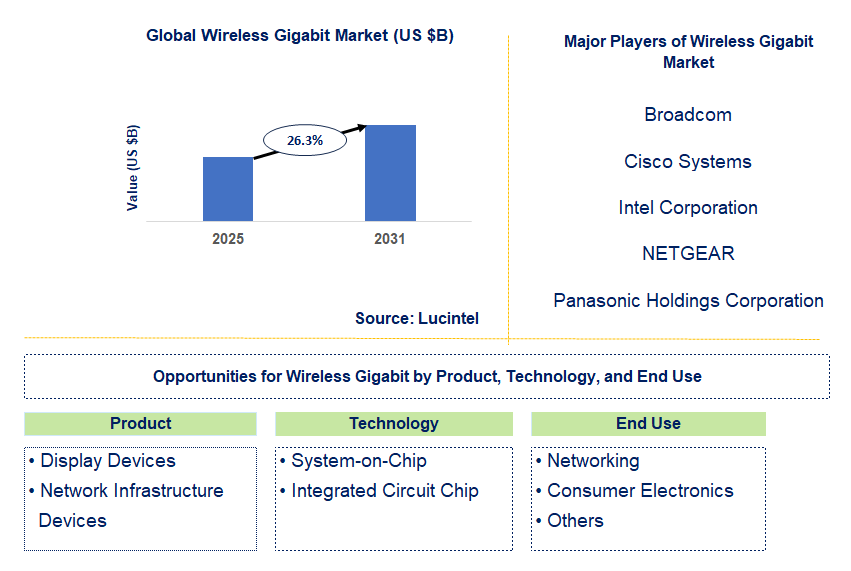
Key data points: The growth forecast = 26.3% annually for the next 7 years. Scroll below to get more insights. This market report covers trends, opportunities and forecasts in wireless gigabit market to 2031 by product (display devices and network infrastructure devices), technology (system-on-chip and integrated circuit chip), end use (networking, consumer electronics, and others), and region (North America, Europe, Asia Pacific, and the Rest of the World)
We'll send your sample report shortly.
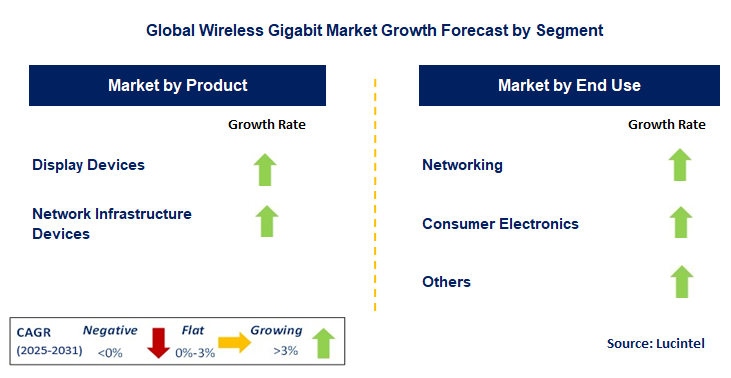
• Lucintel forecasts that, within the product category, network infrastructure device will remain a larger segment over the forecast period.
• Within the end use category, networking is expected to witness higher growth.
• In terms of region, North America is expected to witness the highest growth over the forecast period. Gain valuable insights for your business decisions with our comprehensive 150+ page report. Sample figures with some insights are shown below.
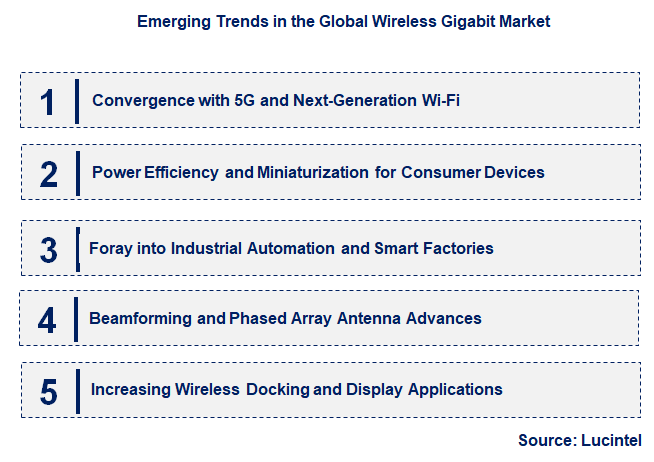
• Convergence with 5G and Next-Generation Wi-Fi: An important future trend is the deeper convergence of wireless gigabit (Wi Gig) technology with 5G networks and the new Wi-Fi standards such as Wi-Fi 6E and Wi-Fi 7. Wi Gig serves as a vital complement, delivering ultra-high-speed, short-range data offloading for 5G small cells and gigabit speeds for local area networks in Wi-Fi ecosystems. This convergence will offer an end-to-end wireless experience with high-capacity short-range transmission through Wi Gig, drawing on the larger coverage area of 5G and regular Wi-Fi, further optimizing overall network efficiency.
• Power Efficiency and Miniaturization for Consumer Devices: A further major trend is the continued miniaturization of Wi Gig components and power efficiency improvements. This allows Wi Gig modules to be integrated into an increasingly broad range of consumer electronics, such as thinner smartphones, laptops, wearable devices, and virtual/augmented reality (VR/AR) headsets. Lower power usage is especially important for battery-driven applications, prolonging their operating time and making high-speed wireless functionality more viable for everyday devices, hence fueling wider market take-up within the consumer space.
• Foray into Industrial Automation and Smart Factories: The Wireless Gigabit market is growing increasingly into industrial automation and smart factory use cases. Wi Gig's low latency and high-bandwidth capability are well-suited to transmission of real-time data between networked machines, sensors, and control systems in Industry 4.0 settings. It supports such use cases as wireless control of robots, high-speed machine vision, and real-time analytics for predictive maintenance, making operations more efficient and enhancing performance in manufacturing and logistics. This trend represents a dramatic diversification away from common consumer applications.
• Beamforming and Phased Array Antenna Advances: Major advancements in phased array antenna and beamforming technologies are a growing trend. These technologies allow Wi Gig signals to be steered accurately towards the receiving devices, dispelling the problem of limited range and vulnerability to obstructions at 60 GHz. Enhanced beamforming increases signal strength, trustworthiness, and supports the ability to communicate with many devices at once, increasing network capacity and performance in dense user environments. This is essential to increase Wi Gig's realistic deployment contexts and enhance user experience.
• Increasing Wireless Docking and Display Applications: Growing use of Wireless Gigabit for wireless display and docking applications is a leading trend. Wi Gig provides the bandwidth required to wirelessly link laptops, tablets, and smartphones to external monitors, storage devices, and peripherals, and enables uncluttered workspaces. The trend addresses the expanding need for mobility and flexibility in home and office settings with instant high-speed data transfer and display mirroring, hence improving productivity and user convenience. These nascent trends are radically transforming the wireless gigabit market. Synergistic integration with 5G and future Wi-Fi is building an enhanced and more complete wireless ecosystem. Miniaturization and power efficiency are driving wider consumer device adoption, and industrial automation expansion showcases new high-value use cases. Technical limitations are being overcome by advancements in beamforming, and increasing usage in wireless docking is transforming productivity connectivity. Together, these trends are propelling Wi Gig to ubiquitous high-speed, short-range wireless communication.
• Improvements in IEEE 802.11ay Standard for Extended Range and Reliability: One major recent advance is the ongoing improvement and accelerating adoption of the IEEE 802.11ay standard. This generation of Wi Gig technology emphasizes enhancing reliability, pushing the range of communications past the very short range of its antecedents, and optimizing multi-user functionality. All these advancements are essential for broader deployment in enterprise settings, outdoor fixed wireless access, and even certain smart city uses, making Wi Gig an increasingly viable and powerful high-speed wireless solution outside of strictly line-of-sight applications.
• Greater Integration in High-end Consumer Electronics and Peripherals: There has been a significant increase in the adoption of Wireless Gigabit technology in high-end consumer electronics and peripherals. It comes in the form of high-end laptops for wireless docking applications, VR/AR headsets for wireless immersive experiences, and high-resolution displays for wireless video streaming. This trend represents increasing consumer demand for wireless, high-performance connectivity, prompting manufacturers to integrate Wi Gig capabilities directly into their products, spreading its reach in the mainstream market.
• Creation of Fixed Wireless Access (FWA) Solutions for Last-Mile Access: Recent advances indicate increased use of Wireless Gigabit in Fixed Wireless Access (FWA) solutions, particularly for last-mile access. Leveraging the relatively uncongested 60 GHz frequency band, Wi Gig provides a fiber-sparing alternative to fiber deployment in some urban and suburban locations, providing multi-gigabit speeds to homes and businesses directly. This advancement is also vital to plug the digital gap and deliver high-speed broadband connectivity where there is wireline infrastructure either difficult or costly to deploy, greatly increasing market reach.
• Cooperation and Alliances between Chipset Companies and Device Manufacturers: One such milestone is the emergence of strategic partnerships and alliances between device manufacturers and Wireless Gigabit chipset vendors. These partnerships will catalyze the development, standardization, and interoperability of products with Wi Gig functionality. Companies can collaborate to design chips for particular applications, have third-party devices verified for compatibility, and simplify the integration process, which is critical for enabling a strong ecosystem and achieving mass adoption of the technology.
• 60 GHz Backhaul Solutions for 5G Small Cells Emergence: The advent of 60 GHz backhaul solutions for 5G small cells is an important recent development. As more small cells are deployed by 5G networks to increase capacity and coverage, these cells need to have high-bandwidth access to the core network. Wi Gig offers a perfect wireless backhaul solution with its multi-gigabit speed and small size, allowing quick and flexible deployment of 5G infrastructure, particularly in high-density urban areas where fiber installation is expensive or impossible, thus facilitating the wider 5G rollout. These advancements are significantly influencing the wireless gigabit space by improving its performance and broadening its applications beyond early projections. Advances in the 802.11ay standard and deeper integration in consumer products are fueling wider adoption. The advent of FWA solutions and 60 GHz backhaul for 5G indicates the key position of Wi Gig in next-generation network infrastructure, and industry collaborations are creating a more unified ecosystem, together propelling the growth and integration of the market into various technological environments.
• Consumer Electronics: Wireless Video Streaming and Gaming: The consumer electronics market provides substantial strategic opportunities for growth, especially in wireless video streaming and gaming. With the rise of 4K/8K content and immersive gaming, there is an increasing need for multi-gigabit wireless speeds. Wi Gig provides unbroken, uncompressed video streaming to big screens and ultra-low-latency links for gaming peripherals, removing cables and adding user value. Opportunities exist in embedding Wi Gig natively into TVs, gaming consoles, and VR/AR headsets, extending its home entertainment role.
• Enterprise and Commercial: High-Speed Connectivity and Wireless Docking: The commercial and enterprise markets are a compelling strategic growth area, mainly for high-speed in-office connectivity and wireless docking. Companies desire tidy, flexible work environments where workers can connect their laptops instantly to monitors, keyboards, and other devices without cables. Wi Gig gives them the amount of bandwidth to do so, supporting unfettered data transfer and display. Opportunities include creating enterprise-level Wi Gig docking solutions, integrated conference room access points, and in-office high-speed point-to-point connections.
• Smart Factories and Industrial Automation: Real-Time Data Communication: Industrial automation and smart factories offer a growing strategic expansion opportunity for Wireless Gigabit. The Industry 4.0 concept demands low-latency, real-time data communication among robots, sensors, and control systems on the production floor. Wi Gig can offer the secure, high-bandwidth wireless infrastructure for uses such as wireless machine vision, automated guided vehicles (AGVs), and predictive maintenance. This helps to optimize operations more efficiently, minimize wiring hassles, and support manufacturing flexibility.
• Virtual Reality and Augmented Reality Devices: Decoupled Experiences; The fast-growing Virtual Reality (VR) and Augmented Reality (AR) market represents an exciting strategic growth opportunity. Wi Gig is essential to facilitating wireless, wire-replaceable VR/AR experiences by wireless transmission of high-resolution visual information with unnoticeable latency, removing heavy cables that limit user mobility. Applications exist in creating small, low-power Wi Gig modules for future headsets, facilitating immersive and genuinely mobile VR/AR solutions in gaming, training, and professional applications.
• Fixed Wireless Access and 5G Backhaul: One of the most important strategic growth opportunities is the utilization of Wireless Gigabit for Fixed Wireless Access (FWA) and 5G backhaul. Where fiber deployment is difficult or expensive, Wi Gig can deliver multi-gigabit wireless broadband to residences and businesses. In addition, with its high capacity over the 60 GHz band, it is a perfect solution for wireless backhaul between 5G small cells and the core network. This fills essential infrastructural gaps and enables widespread deployment of 5G services, providing a cost-efficient and fast deployment scenario. These growth opportunities through strategy are significantly influencing the wireless gigabit market by expanding its base of applications and fostering technology advancements. Through focus on consumer electronics, enterprise applications, industrial automation, VR/AR, and fixed wireless access, Wi Gig is solidifying its position as a ubiquitous and critical high-speed wireless technology. These application-specific areas allow market participants to create custom solutions, increase market penetration, and boost overall growth of the wireless gigabit ecosystem.
• Broadcom
• Cisco Systems
• Intel Corporation
• NETGEAR
• Panasonic Holdings Corporation
• PERASO TECHNOLOGIES
• Qualcomm Technologies
• Samsung
• Tensorcom
• Ubiquiti
• Display Devices
• Network Infrastructure Devices
• System-on-Chip
• Integrated Circuit Chip
• North America
• Europe
• Asia Pacific
• The Rest of the World
• United States: The US wireless gigabit market is driving strong growth, driven by strong consumer appetite for next-generation wireless technology, widespread smart device penetration, and heavy investment in 5G and Internet of Things (IoT) infrastructure. Trends involve the rising adoption of Wi Gig in high-end consumer devices such as laptops and smartphones, and its expanding use in enterprise networking to support high-bandwidth data transfer and wireless docking, especially in data-intensive settings.
• China: China's gigabit wireless market is rapidly expanding with the help of China's widespread digitalization, growing interest in online gaming, and thriving IoT ecosystem. Latest trends point to a heavy focus on network devices infrastructure for managing burgeoning data traffic. The convergence of Wi Gig with 5G networks is also a major area of focus, with an aim to extend last-mile connectivity and offer blazing fast wireless experiences to a huge and increasingly growing digital population.
• Germany: Germany's wireless gigabit market is growing steadily, spurred by strong national momentum for digital infrastructure development, such as comprehensive gigabit plans for nationwide fiber-optic and next-generation mobile communications technologies. Activity includes rising use in enterprise environments for optimized data transfer and embedding Wi Gig into smart home and industrial automation technologies. The market also focuses on secure and dependable wireless high-speed connectivity to enable Germany's strong industry sector and digitalization initiatives.
• India: India's wireless gigabit market is experiencing tremendous growth, driven by fast-paced digitalization, rising internet penetration, and a growing smart device ecosystem. Recent trends include a strong demand for network infrastructure devices to enable high-speed wireless connectivity in urban as well as emerging Tier 2 and Tier 3 cities. There is also a significant increase in the adoption of Wi Gig in consumer devices and business environments such as smart offices due to the growing consumption of high-definition content and cloud services.
• Japan: Japan's gigabit wireless market is progressing with emphasis on leading-edge technology integration and application in high-density usage. This includes recent advancements such as the strategic use of Wi Gig for 5G backhaul deployments and more robust connectivity in urban areas. Adoption is also witnessed in focused use cases like high-definition multimedia streaming, virtual reality, and augmented reality, utilizing Wi Gig's low-latency and high-bandwidth features to enable immersive applications.


• Broadcom
• Cisco Systems
• Intel Corporation
• NETGEAR
• Panasonic Holdings Corporation
• PERASO TECHNOLOGIES
• Qualcomm Technologies
• Samsung
• Tensorcom
• Ubiquiti Q5. Which wireless gigabit market segment will be the largest in future? Answer: Lucintel forecasts that, within the product category, network infrastructure device will remain a larger segment over the forecast period. Q6. In wireless gigabit market, which region is expected to be the largest in next 5 years? Answer: In terms of region, North America is expected to witness the highest growth over the forecast period. Q7. Do we receive customization in this report? Answer: Yes, Lucintel provides 10% customization without any additional cost.


Choose a license that fits your team. Instant PDF delivery.
Prices exclude taxes. Instant delivery. Custom licensing available on request.
Market Report · July 22, 2026
Market Report · July 17, 2026
Market Report · July 17, 2026
Trusted partner for strategic intelligence and business growth


Receive a complimentary market analysis tailored to your industry. Our analysts will identify key growth opportunities and competitive dynamics specific to your business.

Market size, growth rate, and key trend analysis for your specific sector.

Top competitor positioning and market share analysis.

Strategic recommendations backed by data-driven insights.
Get curated market intelligence and competitive moves straight to your inbox.
By subscribing, you agree to receive our monthly insights. Unsubscribe anytime.
Receive a complimentary market analysis tailored to your industry. Our analysts will identify key growth opportunities and competitive dynamics specific to your business.
Market size, growth rate, and key trend analysis for your specific sector.
Top competitor positioning and market share analysis.
Strategic recommendations backed by data-driven insights.
Get curated market intelligence, emerging trends, and competitive moves straight to your inbox each month.
By subscribing, you agree to receive our monthly insights. Unsubscribe anytime.
We'll send your sample report shortly.