Wireless Electric Vehicle (EV) Charging System Market Report: Trends, Forecast and Competitive Analysis to 2035

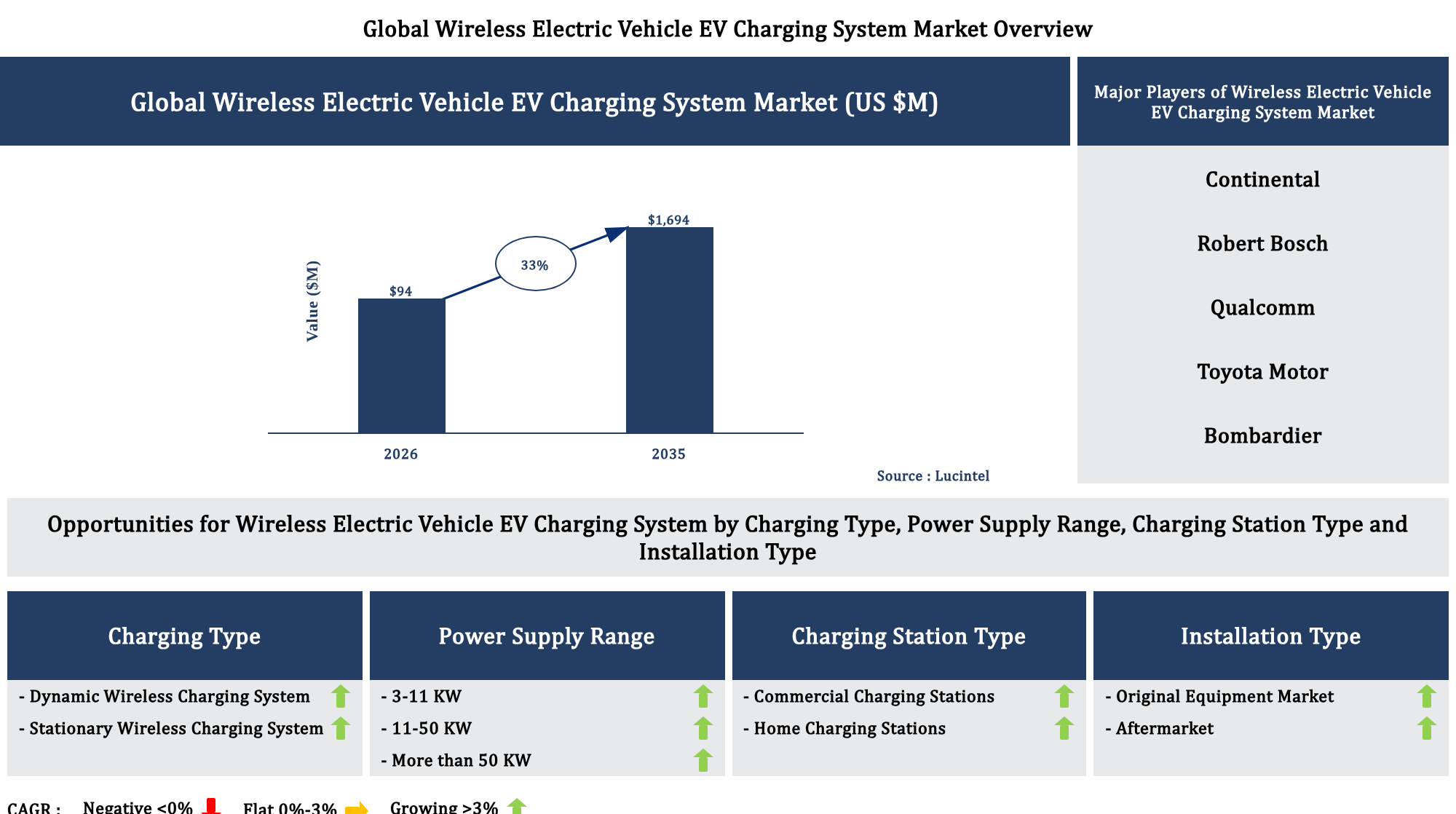
Key data points: The market size in 2035 = $1694 million, growth forecast = 33% annually for the next 9 years. Scroll below to get more insights. This market report covers trends, opportunities, and forecasts in the global wireless electric vehicle (EV) charging system market to 2035 by charging type (dynamic wireless charging system and stationary wireless charging system), power supply range (3-11 KW, 11-50 KW and more than 50 KW), charging station type (commercial charging stations and home charging stations), installation type (original equipment market and aftermarket), component (base charging pad, power control unit and vehicle charging pad), propulsion type (battery electric vehicle (BEV) and plug-in hybrid electric vehicle (PHEV)), end use (electric passenger cars, electric commercial vehicle and electric two wheeler), and region (North America, Europe, Asia Pacific, and the Rest of the World)

Publisher: Lucintel Last Updated: July 2026
See Pricing

Download Sample Report

| ✨ New Download Sample report — Get instant insights! | ✨ New Download Sample report — Get instant insights!

Wireless Electric Vehicle (EV) Charging System Market Report: Trends, Forecast and Competitive Analysis to 2035

Wireless Electric Vehicle (EV) Charging System Market


The future of the global wireless electric vehicle (EV) charging system market looks promising with opportunities in the electric passenger cars, electric commercial vehicle and electric two wheeler markets. The global wireless electric vehicle (EV) charging system market is expected to reach an estimated $1694 million by 2035 with a CAGR of 33% from 2026 to 2035. The major drivers for this market are the increasing ev adoption boosting charging demand, the rising smart mobility driving wireless charging growth and the growing infrastructure supporting ev charging expansion.

• Lucintel forecasts that, within the charging type category, none will remain the largest segment over the forecast period as the rising smart mobility trends supporting wireless charging system growth.

• Within the end use category, electric passenger cars will remain the largest segment due to the the growing charging infrastructure enhancing passenger car deployment.

• In terms of regions, APAC will remain the largest region over the forecast period due to the the increasing ev adoption boosting wireless charging demand.

Gain valuable insights for your business decisions with our comprehensive 150+ page report.
Wireless Electric Vehicle (EV) Charging System Market

Emerging Trends in the Wireless Electric Vehicle (EV) Charging System Market

The wireless electric vehicle (EV) charging system market is evolving rapidly as automakers, utilities, and technology providers seek more convenient, automated, and efficient charging solutions. Growing EV adoption, urban congestion, and the need for seamless user experiences are accelerating investment in inductive charging pads, dynamic charging lanes, and intelligent grid integration. Standardization efforts and pilot deployments in public, residential, and commercial settings are moving the technology from proof-of-concept to scalable business models. These emerging trends are reshaping how drivers refuel, how cities manage energy flows, and how infrastructure is planned, ultimately supporting broader decarbonization and smart mobility objectives worldwide.
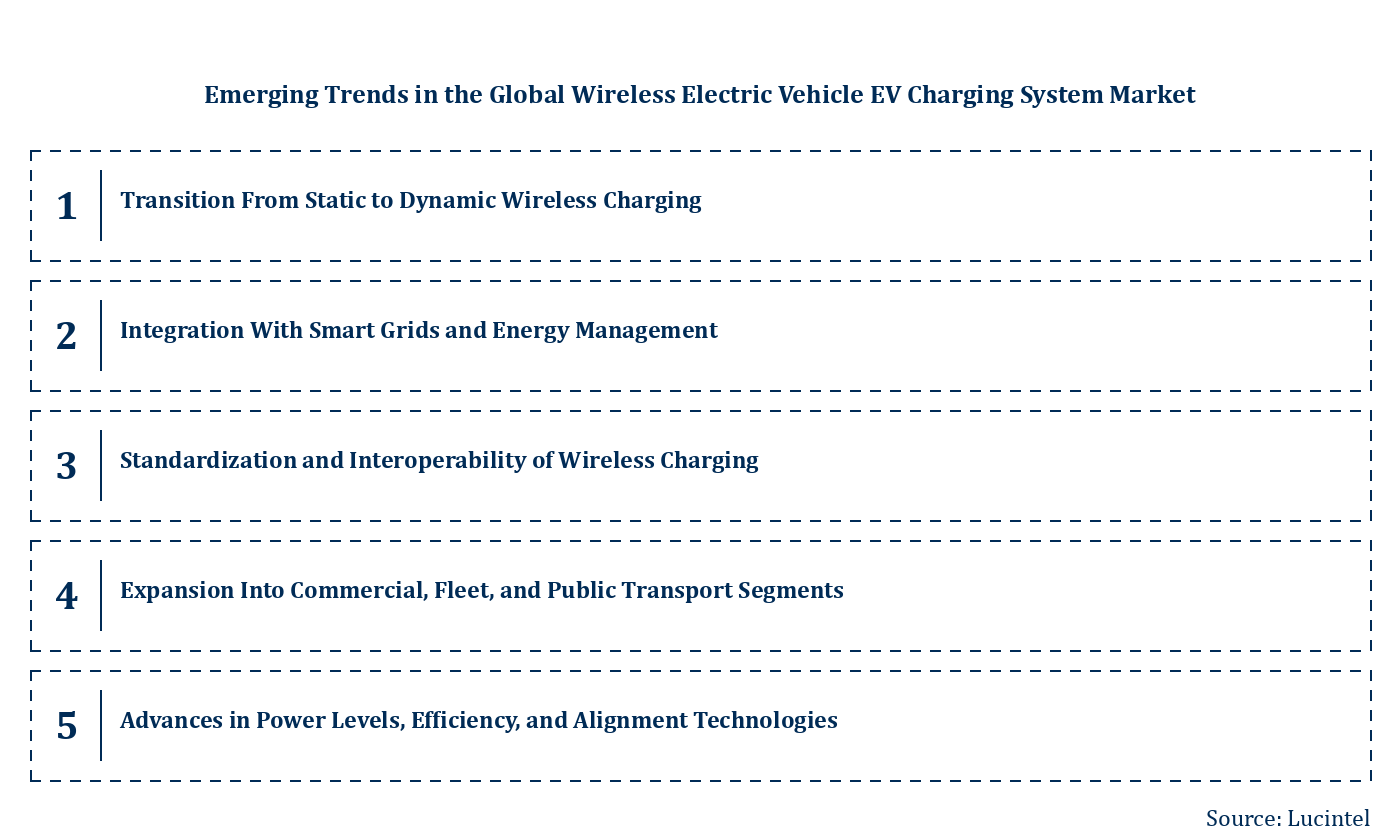
  • Transition from Static To Dynamic Wireless Charging: The wireless electric vehicle (EV) charging system market is seeing a major shift from static charging pads in parking spots to dynamic systems embedded in roads that charge vehicles while driving. Dynamic wireless charging extends vehicle range, reduces battery size requirements, and lowers range anxiety, especially for fleets and public transport. Pilot projects on dedicated bus corridors and highways are validating technical feasibility, interoperability, and safety. As deployment costs fall and road retrofitting techniques improve, dynamic charging is expected to become a key enabler of high-utilization EV operations and more efficient use of public infrastructure.
  • Integration with Smart Grids and Energy Management: A critical trend in the wireless electric vehicle (EV) charging system market is deep integration with smart grids, enabling real-time control of charging loads and bidirectional power flows. Advanced software platforms coordinate wireless chargers with renewable generation, time-of-use tariffs, and local storage to optimize energy costs and grid stability. Vehicle-to-grid and vehicle-to-building capabilities are being tested with inductive systems, allowing parked EVs to act as flexible energy assets. This trend improves grid resilience, supports higher renewable penetration, and creates new revenue streams for fleet operators, utilities, and charging service providers.
  • Standardization and Interoperability of Wireless Charging: The wireless electric vehicle (EV) charging system market is moving toward global standards that ensure interoperability between vehicles and charging infrastructure from different vendors. Organizations are defining common frequencies, coil configurations, alignment tolerances, and communication protocols to simplify deployment and reduce technical risk for buyers. Automakers are increasingly designing vehicles to meet emerging standards, enabling cross-brand compatibility in public and private installations. Standardization reduces costs through scale, accelerates certification, and builds user confidence, which in turn encourages investments by municipalities, commercial real estate owners, and fleet operators in wireless charging solutions.
  • Expansion Into Commercial, Fleet, and Public Transport Segments: The wireless electric vehicle (EV) charging system market is rapidly expanding beyond private passenger cars into commercial fleets, logistics hubs, taxis, and public buses. Operators value the operational efficiency of automated charging that eliminates cable handling, reduces downtime, and supports frequent opportunity charging during short stops. Depot and terminal installations with embedded pads allow high-throughput charging without complex cabling systems. This trend is particularly impactful for buses, last-mile delivery vehicles, and shared mobility fleets, where predictable routes and centralized management make wireless systems economically attractive and operationally simple to scale.
  • Advances in Power Levels, Efficiency, and Alignment Technologies: Technological innovation is pushing the wireless electric vehicle (EV) charging system market toward higher power transfer levels, improved efficiency, and more flexible vehicle alignment. New coil designs, resonant topologies, and power electronics enable fast-charging capabilities that approach or match wired DC systems, while minimizing energy loss and heat generation. Enhanced alignment systems using cameras, sensors, and automated parking assistance help drivers position vehicles accurately over pads or even charge effectively with moderate misalignment. These advances reduce charging times, improve user satisfaction, and strengthen the competitiveness of wireless solutions against conventional plug-in charging.

Wireless Electric Vehicle (EV) Charging System Market by country

Recent Developments in the Wireless Electric Vehicle (EV) Charging System Market

The wireless electric vehicle (EV) charging system market is evolving rapidly as automakers, utilities, and technology providers work to remove friction from EV ownership and enable more seamless energy management. Growing EV adoption, urbanization, and fleet electrification are accelerating investment in wireless charging technologies that can operate in homes, workplaces, public spaces, and depots. Recent developments span standardization efforts, infrastructure pilots, component miniaturization, and integration with smart grids and autonomous driving. Together, these advances are improving efficiency, lowering total cost of ownership, and expanding use cases, positioning wireless charging as a critical enabler of next‑generation electric mobility worldwide.

  • Emergence of Interoperable Standards: Industry alliances and standards bodies are converging on common wireless charging protocols and frequencies that allow different EV brands and charging pads to work together seamlessly. This interoperability reduces vendor lock-in for fleet operators and consumers, encourages wider infrastructure deployment, and supports economies of scale in hardware manufacturing. As vehicles and chargers become certified to the same standards, reliability and safety improve, while software updates can unlock new functionality, such as power sharing and dynamic load management across mixed-brand EV fleets.
  • Scaling of Public and Fleet Pilot Projects: Municipalities, logistics providers, and transit agencies are launching large-scale pilots of wireless EV charging systems in taxi ranks, bus stops, last-mile delivery depots, and curbside parking. These projects validate real-world performance metrics such as charging efficiency, alignment tolerance, uptime, and maintenance costs under diverse weather and usage conditions. Data from pilots is informing infrastructure design, incentives, and procurement criteria, while demonstrating to policymakers and investors that wireless systems can increase vehicle availability, reduce dwell times, and simplify operations for high-utilization fleets.
  • Advances in Power Electronics and Coil Design: Suppliers are introducing next-generation inverters, resonant converters, and high-frequency coils that increase wireless charging efficiency and power density while shrinking system size. Improved thermal management and magnetic shielding are reducing energy losses and electromagnetic interference, helping systems comply with stringent safety regulations. Higher power levels now support rapid charging for passenger cars and light commercial vehicles without excessively large pads. These hardware innovations lower bill-of-materials costs, enable easier retrofits, and make it feasible to embed wireless chargers into pavement and compact residential parking spaces.
  • Integration with Smart Grids and Energy Management: Wireless EV charging is being tightly coupled with energy management platforms that can time charging sessions and modulate power based on grid conditions, renewable generation, and dynamic pricing. Bi-directional wireless systems under development will eventually support vehicle-to-grid and vehicle-to-building services, turning parked EVs into distributed energy resources. Software orchestrates when and how vehicles charge without driver interaction, aligning energy demand with off-peak periods or surplus solar and wind. This integration improves grid stability, reduces infrastructure strain, and opens new revenue streams for utilities and fleet operators.
  • Support for Autonomous and Automated Parking Solutions: Automakers and technology firms are combining wireless charging with automated parking and autonomous driving capabilities so vehicles can park themselves over charging pads without manual intervention. Precise positioning algorithms and communication between the vehicle and ground infrastructure ensure optimal alignment to maintain high transfer efficiency. This development is particularly impactful for robotaxis, shared mobility services, and driverless delivery fleets that require frequent unattended charging. By removing cables and manual plug-in steps, wireless systems enhance safety, reduce wear on connectors, and support continuous 24/7 operation of autonomous EV fleets.

Strategic Growth Opportunities in the Wireless Electric Vehicle (EV) Charging System Market

The wireless electric vehicle (EV) charging system market is entering a pivotal expansion phase as automakers, fleets, and infrastructure providers seek more convenient and automated charging solutions. Wireless charging unlocks new use cases, from seamless residential charging to dynamic in-motion power transfer on highways and bus lanes. Across passenger vehicles, commercial fleets, public transit, shared mobility, and smart city infrastructure, applications are converging around efficiency, user experience, and grid integration. As standards mature and costs decline, strategic opportunities are emerging for technology vendors, utilities, and mobility operators to build differentiated offerings and long-term revenue models.

  • Residential and Workplace Charging: Growing adoption of EVs among homeowners and corporate fleets is creating demand for cable-free, parking-based wireless charging at homes, apartments, and offices. This application offers strong recurring hardware, software, and service revenues by integrating with energy management systems, solar, and storage, while boosting user convenience and charging compliance. Partnerships with property developers, facility managers, and employers can lock in long-term installed bases and enable subscription models for managed charging, predictive maintenance, and over-the-air feature upgrades.
  • Public and Destination Parking: Airports, shopping centers, hotels, and municipal lots represent attractive nodes for wireless charging deployment that can monetize dwell time and attract high-value EV users. Operators can differentiate their locations with premium, hands-free charging experiences while leveraging dynamic pricing, loyalty programs, and interoperability with multiple charging networks. This application also supports data-driven asset management, integrating occupancy analytics and payment platforms to optimize utilization, reduce operational costs, and open advertising and cross-selling opportunities.
  • Fleet and Last-Mile Logistics: Commercial delivery, ride-hailing, and service fleets gain significant value from wireless charging systems embedded in depots, loading bays, and curbside zones. Automated alignment and hands-free operation reduce downtime, labor requirements, and connector wear, improving total cost of ownership. Continuous top-up charging during short stops helps right-size battery packs, increase asset utilization, and support stringent delivery schedules. Scalable fleet platforms combining telematics, routing, and wireless charging management create high-margin software and service revenue streams.
  • Public Transit and Shared Mobility: Electric buses, shuttles, and shared vehicles benefit from opportunity charging at stops, terminals, and layover points via high-power wireless pads. This application enables smaller batteries, longer service hours, and higher route flexibility while avoiding mechanical pantographs and complex overhead infrastructure. Transit agencies and shared mobility operators can enhance reliability and passenger satisfaction, while accessing green financing and public funding for low-emission transport. Long-term service contracts and performance-based agreements create predictable revenue for technology providers.
  • Dynamic and Smart Road Infrastructure: Integrating wireless charging coils into roadways, taxi lanes, and dedicated freight corridors presents a transformative growth avenue for the wireless electric vehicle (EV) charging system market. Dynamic in-motion charging can significantly extend driving range, reduce battery size, and support heavy-duty vehicles that are hard to electrify with static charging alone. Collaboration with governments, construction firms, and utilities enables large-scale infrastructure projects, unlocking new concession models, usage-based billing, and integration with intelligent transport systems and grid services.

Wireless Electric Vehicle (EV) Charging System Market Drivers and Challenges

The global wireless electric vehicle (EV) charging system market is shaped by a complex interplay of technological innovation, economic viability, infrastructure evolution, and regulatory direction. Growing EV adoption, the push for decarbonization, and the need for more convenient charging experiences are accelerating interest in wireless solutions. At the same time, high development costs, interoperability concerns, and safety regulations create meaningful barriers. Understanding how these drivers and challenges interact is critical for automakers, technology vendors, utilities, and policymakers aiming to scale wireless charging from pilot deployments to mass-market adoption while ensuring reliability, safety, and long-term commercial sustainability.

The factors responsible for driving the wireless electric vehicle (EV) charging system market include:

  • Technological Innovation in Wireless Power Transfer: Continuous progress in inductive and resonant magnetic coupling technologies is increasing power transfer efficiency, charging speed, and alignment flexibility for wireless EV systems. Advances in power electronics, coil design, thermal management, and communication protocols are reducing energy losses and improving system reliability, making wireless charging more competitive with wired options. These innovations enable dynamic charging embedded in roadways and high-power stationary pads, opening new use cases for passenger cars, buses, and commercial fleets. As technology matures and performance benchmarks improve, user confidence and OEM willingness to integrate wireless solutions into new vehicle platforms strengthen significantly.
  • Rising Global Adoption of Electric Vehicles: Rapid growth in EV sales worldwide is creating a larger addressable base for complementary charging technologies, including wireless systems. Consumers and fleet operators increasingly seek charging solutions that minimize inconvenience, reduce cable handling, and integrate seamlessly into daily routines. Wireless charging addresses these needs by enabling plugless, automated energy transfer at homes, workplaces, public parking, and depots. As more countries set ambitious EV adoption targets and phase out internal combustion vehicles, demand for differentiated charging experiences grows. This expanding EV ecosystem encourages automakers and infrastructure providers to invest in wireless solutions as a premium feature and a competitive differentiator.
  • Demand for Convenience and Seamless User Experience: End users value charging solutions that integrate effortlessly into parking behaviors and reduce friction compared with conventional plug-in chargers. Wireless EV charging eliminates the need to connect and disconnect cables, which is particularly attractive in adverse weather conditions, tight parking spaces, and high-traffic fleet depots. Automated alignment assistance, vehicle-to-pad communication, and integration with mobile apps or in-vehicle systems further enhance usability. For ride-hailing fleets, autonomous shuttles, and logistics vehicles, wireless charging supports unattended or robotic operations, reducing labor and downtime. This strong focus on convenience and automation is a major psychological and operational driver for wireless charging adoption across multiple use segments.
  • Supportive Sustainability Policies and Smart City Initiatives: Governments and municipalities are promoting low-emission transportation and smart infrastructure, which naturally aligns with wireless EV charging deployments. Policy instruments such as emissions regulations, carbon reduction targets, green public procurement, and funding for pilot projects encourage the exploration of advanced charging concepts. Smart city programs frequently prioritize integrated mobility solutions, where wireless charging pads in taxi ranks, bus lanes, and public parking can reduce visual clutter and enhance urban aesthetics compared with conventional charging posts. Utility incentives and grid modernization efforts further support vehicle-to-grid and demand-response capabilities, making wireless charging attractive as part of broader energy management strategies.
  • Growth of Autonomous and Shared Mobility Models: The emergence of autonomous vehicles, robo-taxis, and shared mobility fleets is driving interest in charging technologies that minimize human intervention. Wireless EV charging suits these models by enabling automated charging cycles whenever vehicles park over embedded pads, without human operators handling plugs. This capability is crucial for keeping self-driving fleets in constant operation and ensuring predictable, repeatable charging behavior. Fleet operators benefit from improved asset utilization, lower operational complexity, and reduced wear on mechanical connectors. As pilot programs for autonomous shuttles and robo-taxis expand, wireless charging becomes a strategic enabler of fully automated, always-on mobility ecosystems.

The challenges in the wireless electric vehicle (EV) charging system market are:

  • High System Costs and Complex Business Models: Wireless EV charging solutions require specialized hardware, precise installation, and integration with vehicles and grid systems, leading to higher upfront costs than conventional chargers. Ground pads, vehicle receivers, power conditioning units, and civil works contribute to elevated capital expenditure, particularly for dynamic on-road systems. These economics make it difficult to build compelling payback cases without subsidies, premium pricing, or strong fleet-use intensity. Additionally, stakeholders must align on ownership, pricing, and maintenance models between automakers, infrastructure providers, property owners, and utilities, which slows decision-making and market scaling.
  • Interoperability, Standardization, and Safety Concerns: The market is constrained by fragmented standards and differing technical approaches among vendors, which can limit cross-compatibility between vehicles and charging pads. Without widely adopted global standards for power levels, alignment tolerances, communication protocols, and electromagnetic exposure limits, large-scale deployments remain risky for both OEMs and infrastructure investors. Safety concerns related to electromagnetic fields, foreign object detection, and operation near pedestrians or animals demand rigorous testing and certification, adding time and cost. Slow progress on standardization can deter early adopters who fear technology lock-in or stranded assets as the regulatory and technical landscape evolves.
  • Infrastructure Deployment Challenges and Grid Integration: Installing wireless charging infrastructure involves civil engineering, site surveys, and coordination with local authorities and utilities, especially when embedding pads in roadways or public parking. These processes can be slower and more disruptive than installing conventional chargers, discouraging rapid rollout. Moreover, clustering high-power wireless chargers in depots or urban centers can stress local distribution networks if not carefully planned with load management and energy storage. Ensuring reliable grid integration, managing peak demand, and aligning with renewable generation require sophisticated planning tools and collaborative frameworks, which many cities and operators are still developing.

The global wireless electric vehicle (EV) charging system market is propelled by advances in wireless power technology, accelerating EV penetration, and the search for frictionless, automated charging experiences within smart and autonomous mobility ecosystems. At the same time, elevated costs, limited standardization, safety requirements, and infrastructure complexity restrain faster commercialization and scale. Stakeholders that effectively navigate these drivers and challenges through collaborative standards development, targeted subsidies, focused fleet applications, and integrated grid planning are best positioned to unlock sustainable growth. Over time, progress on these fronts will determine whether wireless charging becomes a mainstream option or remains a niche premium feature.

List of Wireless Electric Vehicle (EV) Charging System Market Companies

Companies in the market compete on the basis of product quality offered. Major players in this market focus on expanding their manufacturing facilities, R&D investments, infrastructural development, and leverage integration opportunities across the value chain. Through these strategies wireless electric vehicle (EV) charging system market companies cater increasing demand, ensure competitive effectiveness, develop innovative products & technologies, reduce production costs, and expand their customer base. Some of the wireless electric vehicle (EV) charging system market companies profiled in this report include-

  • Continental
  • Robert Bosch
  • Qualcomm
  • Toyota Motor
  • Bombardier
  • WiTricity
  • Hella
  • Evatran Group
  • Toshiba
  • ZTE Corporation

Wireless Electric Vehicle (EV) Charging System Market by Segment

The study includes a forecast for the global wireless electric vehicle (EV) charging system market by charging type, power supply range, charging station type, installation type, component, propulsion type, end use, and region.

  • Wireless Electric Vehicle (EV) Charging System Market by Charging Type [Value ($M) from 2019 to 2035]:
    • Dynamic Wireless Charging System
    • Stationary Wireless Charging System
  • Wireless Electric Vehicle (EV) Charging System Market by Power Supply Range [Value ($M) from 2019 to 2035]:
    • 3-11 KW
    • 11-50 KW
    • More than 50 KW
  • Wireless Electric Vehicle (EV) Charging System Market by Charging Station Type [Value ($M) from 2019 to 2035]:
    • Commercial Charging Stations
    • Home Charging Stations
  • Wireless Electric Vehicle (EV) Charging System Market by Installation Type [Value ($M) from 2019 to 2035]:
    • Original Equipment Market
    • Aftermarket
  • Wireless Electric Vehicle (EV) Charging System Market by Component [Value ($M) from 2019 to 2035]:
    • Base Charging Pad
    • Power Control Unit
    • Vehicle Charging Pad
  • Wireless Electric Vehicle (EV) Charging System Market by Propulsion Type [Value ($M) from 2019 to 2035]:
    • Battery Electric Vehicle (BEV)
    • Plug-In Hybrid Electric Vehicle (PHEV)
  • Wireless Electric Vehicle (EV) Charging System Market by End Use [Value ($M) from 2019 to 2035]:
    • Electric Passenger Cars
    • Electric Commercial Vehicle
    • Electric Two Wheeler
  • Wireless Electric Vehicle (EV) Charging System Market by Region [Value ($M) from 2019 to 2035]:
    • North America
    • Europe
    • Asia Pacific
    • The Rest of the World

Country Wise Outlook for the Wireless Electric Vehicle (EV) Charging System Market

The wireless electric vehicle (EV) charging system market is progressing from pilot projects to early commercialization, driven by the need for convenient, autonomous, and high‑utilization charging infrastructure. Advances in power electronics, coil design, communication protocols, and vehicle integration are enabling higher transfer efficiencies and dynamic charging at low and moderate speeds. Automakers, utilities, and technology suppliers are increasingly collaborating to standardize interfaces and test interoperability across platforms. Regulatory interest is growing around safety, electromagnetic compatibility, and metering. Recent developments in the United States, China, Germany, India, and Japan highlight distinct strategic priorities and innovation paths in this emerging segment.

  • United States: The United States is moving from demonstration projects to larger pilots of wireless EV charging, particularly for fleets and public transit buses. Companies are deploying high-power inductive charging pads at depots and along fixed routes to enable opportunity charging and extend vehicle range. The SAE J2954 standard adoption is accelerating interoperability work between automakers and infrastructure providers. Funding from federal and state programs supports R&D on dynamic wireless charging on highways and curbside urban installations. Utilities and cities are testing vehicle-to-grid (V2G) capable wireless systems to integrate EVs into distributed energy and demand response programs.
  • China: China is leveraging its dominant EV ecosystem to scale wireless charging pilots in both passenger and commercial segments. Municipalities are trialing wireless systems for electric taxis, logistics vans, and autonomous shuttles in smart city zones. Domestic suppliers are advancing compact coil designs and integrated power modules targeting high-volume deployment in parking lots and residential complexes. National and provincial programs are backing standards development and safety testing to align with existing fast-charging regulations. Chinese automakers are beginning to offer factory-prepared models with optional wireless charging receivers, positioning the country for rapid uptake once cost declines further.
  • Germany: Germany is focusing wireless EV charging efforts on premium passenger vehicles, public transport, and industry-linked R&D. Major German automakers are testing factory-integrated inductive receivers, emphasizing high efficiency, precise alignment, and secure communication for billing and authentication. Several cities are running pilot deployments for electric buses and taxis with embedded pads at stops and depots. Government-funded consortia and EU projects are exploring dynamic charging lanes and integration with renewable-heavy grids. Standardization work in Germany stresses interoperability across brands and suppliers, as well as rigorous safety, cybersecurity, and data privacy requirements.
  • India: India is exploring wireless EV charging primarily through pilot projects focused on two- and three-wheelers, shared mobility fleets, and buses in urban corridors. Startups and research institutions are developing cost-optimized inductive systems tailored to constrained urban parking and informal charging locations. Public agencies are evaluating wireless solutions for bus rapid transit systems to reduce charging downtime and depot congestion. Policy discussions are emerging around including wireless options within national EV infrastructure guidelines. Collaboration between automotive OEMs, utilities, and smart city missions is growing to assess scalable, grid-resilient models that suit India’s price-sensitive and high-density market.
  • Japan: Japan is advancing wireless EV charging with a strong emphasis on precision engineering, safety, and integration with autonomous and robotic mobility. Japanese automakers and electronics companies are testing high-frequency systems that support compact hardware and high efficiency for both passenger cars and small commercial vehicles. Pilot projects in residential complexes and commercial buildings aim to enable seamless park-and-charge experiences without cables. Research programs are investigating dynamic wireless charging for highways and dedicated lanes, aligned with Japan’s goals for automated driving. Government-backed initiatives support standardization and compatibility with existing smart grid and vehicle-to-home ecosystems.

Features of the Wireless Electric Vehicle (EV) Charging System Market

  • Market Size Estimates: Wireless electric vehicle (EV) charging system market size estimation in terms of value ($M).
  • Trend and Forecast Analysis: Market trends (2019 to 2025) and forecast (2026 to 2035) by various segments and regions.
  • Segmentation Analysis: Wireless electric vehicle (EV) charging system market size by various segments, such as by charging type, power supply range, charging station type, installation type, component, propulsion type, end use and region in terms of value ($M).
  • Regional Analysis: Wireless electric vehicle (EV) charging system market breakdown by North America, Europe, Asia Pacific, and the Rest of the World.
  • Growth Opportunities: Analysis of growth opportunities in different charging type, power supply range, charging station type, installation type, component, propulsion type, end use and regions for the wireless electric vehicle (EV) charging system market.
  • Strategic Analysis: This includes M&A, new product development, and competitive landscape of the wireless electric vehicle (EV) charging system market.
  • Analysis of competitive intensity of the industry based on Porter's Five Forces model.

Article

Wireless Electric Vehicle (EV) Charging System Market: Which Forces Are Quietly Redrawing the EV Landscape?

Dallas, July 21, 2026 – The wireless electric vehicle (EV) charging system market is moving from futuristic concept to commercial reality, reshaping how drivers think about energy access, how cities plan infrastructure, and how automakers design next-generation platforms. As EV adoption accelerates and pressure mounts to simplify charging, wireless solutions are emerging as a strategic inflection point, with resonant inductive and magnetic field technologies enabling charge pads in garages, parking lots, depots, and eventually roadways. This market is now defined by rapid experimentation, high-stakes standardization battles, and a race to prove bankable business models that extend far beyond passenger cars.

What Core Technology and Business Trends Are Defining the Wireless EV Charging System Market?

The wireless EV charging system market is being reshaped by a cluster of interlocking trends in hardware, software, and business design rather than a single breakthrough. A key trend is the shift from low-power demonstration systems to higher-power solutions targeting daily operational use for both consumer and commercial fleets. Vendors are pushing beyond 3.7 to 7 kW residential pads toward 11, 22, and even 50 kW wireless systems, with pilot projects exploring megawatt-class charging for heavy-duty applications. Another defining trend is the convergence of wireless charging with vehicle connectivity, where cloud platforms manage authentication, billing, and load balancing across distributed charging pads as part of integrated energy and mobility ecosystems. Increasingly, wireless EV charging is positioned not just as a convenience feature but as a software-defined service woven into broader smart grid and smart city architectures.

How Is Wireless EV Charging Transforming User Experience and Daily Charging Behavior?

Behavioral change sits at the heart of this market’s disruption potential. Wireless EV charging removes the visible ritual of plug-in connections and replaces it with near-invisible energy transfer, which could dramatically increase compliance with charging routines for both private drivers and fleet operators. By turning parking time into charging time with no manual intervention, these systems aim to mitigate range anxiety, reduce dwell time requirements at public chargers, and support higher vehicle utilization. Over time, vehicles could opportunistically top up in office garages, retail parking lots, taxi stands, and logistics depots, shifting the mental model of charging from episodic, high-intensity events to continuous, background replenishment. This transition demands reliable alignment, high energy transfer efficiency, and user interfaces that make charging status transparent despite the absence of visible cables and connectors.

Where Will the Strongest Market Impact and Disruption Be Felt Across Mobility Segments?

Disruption will not be uniform across all EV segments, with certain markets poised to realize outsized benefits. Commercial and municipal fleets represent one of the most attractive early markets because they operate on predictable routes and in controlled environments where charging pads can be deployed systematically. Transit buses, last-mile delivery vans, ride-hail fleets, and autonomous shuttle services can achieve high utilization by installing wireless charging pads at depots, layover stops, or key route nodes, thereby cutting idle refueling time and increasing asset productivity. Passenger vehicles in urban and suburban settings will also experience meaningful impact, particularly for drivers without dedicated home charging access, if cities and property owners retrofit parking infrastructure with embedded pads. Over time, logistics yards, ports, airports, and industrial campuses are expected to adopt wireless charging to reduce cable clutter and safety risks in high-traffic operational areas.

Why Is Dynamic (On-the-Move) Wireless Charging Seen as a Strategic Game Changer?

One of the most ambitious trajectories for the wireless EV charging system market is dynamic charging, in which vehicles receive power while moving along equipped road segments. Although still largely in pilot and early demonstration phases, dynamic wireless charging carries the potential to structurally change EV design constraints by enabling smaller onboard batteries, longer effective range, and reduced charging stops. Strategic corridors for freight transport, bus rapid transit lanes, and high-density commuter routes are under evaluation for such deployments. If cost and standardization challenges can be resolved, dynamic charging could tilt the economics of long-distance electrified logistics and intercity travel, with knock-on effects for battery supply chains, energy storage business models, and highway infrastructure planning.

How Are Interoperability, Standards, and Ecosystems Shaping Competitive Advantage?

Interoperability has become a central strategic battleground. Industry alliances, standards bodies, and consortia are working toward common specifications for power transfer levels, frequency bands, alignment tolerance, and communication protocols between vehicle receivers and ground transmitters. Automakers, charger manufacturers, semiconductor firms, and utilities are all seeking influence over these emerging standards to ensure compatibility and protect future option value. Companies that deliver robust, standards-compliant systems which work seamlessly across multiple vehicle brands and charging operators will be best positioned to scale, while proprietary, closed approaches risk isolation. The ability to integrate wireless charging data into mobility platforms, fleet management systems, and utility demand response programs is evolving into a competitive differentiator that extends beyond the hardware into software and services.

Which Key Challenges Could Slow Adoption of Wireless EV Charging Systems?

  • High capital costs for infrastructure deployment and vehicle integration remain a significant hurdle for fleet operators, municipalities, and property developers evaluating wireless charging investments.
  • Energy transfer efficiency losses compared with state-of-the-art wired fast chargers raise concerns among utilities and regulators focused on grid efficiency and emissions reduction outcomes.
  • Standardization gaps and uncertainty regarding long-term compatibility make some automakers and investors wary of committing to specific technologies or ecosystem partners.
  • Installation complexity for embedded pads in existing urban environments or roadways can be disruptive and expensive, particularly in dense or aging infrastructure contexts.
  • Safety, electromagnetic field exposure, and interoperability testing requirements add layers of regulatory scrutiny that can slow certification and commercialization timelines.

Where Do the Most Attractive Opportunities Emerge for Innovators and Investors?

  • Integrated fleet solutions that combine wireless charging hardware with energy management software, predictive maintenance, and financing services offer compelling value propositions to commercial operators.
  • Smart parking and real estate upgrades that retrofit residential complexes, office buildings, and retail centers with wireless charging can differentiate properties and unlock new revenue streams.
  • Partnerships with utilities and grid operators enable wireless charging assets to participate in demand response, load shifting, and vehicle-to-grid use cases that monetize flexibility.
  • Semiconductor and power electronics innovations targeting higher power densities, improved coils, and advanced control algorithms create room for differentiated intellectual property.
  • Autonomous mobility platforms, from robo-taxis to automated warehouse vehicles, present greenfield opportunities where cable-free energy access is a foundational design assumption.

What Use Cases in the Technology Industry Are Accelerating Market Validation?

The technology industry is playing a pivotal role in validating and scaling wireless EV charging by embedding it into broader digital and automation solutions. One prominent use case is autonomous vehicle operations, where self-driving cars and shuttles require fully automated, human-free charging that wireless systems can uniquely provide. Cloud-connected fleet management platforms integrate wireless charging data to optimize routing, charging schedules, and energy procurement. In smart city projects, technology vendors are integrating wireless charging pads with sensors, computer vision, and edge computing devices to manage traffic, parking, and charging availability dynamically. Within large technology campuses and industrial sites, autonomous mobile robots and electric utility vehicles use wireless pads to maintain uptime without manual plug-in, providing a test bed for robust, high-cycle charging systems that can later extend to public roads and urban deployments.

How Are Recent Developments and Strategic Moves Signaling Market Maturity?

Recent developments indicate that the wireless EV charging system market is shifting from experimental pilots to commercially oriented rollouts. Automakers are announcing factory-fit wireless charging options for select premium models and are working with tier-one suppliers to integrate receivers into vehicle platforms at scale. Charging solution providers have begun to secure multi-year agreements with logistics companies, transit agencies, and property owners to deploy pads in depots, bus stops, and parking structures, often bundled with software and maintenance contracts. Alliances between technology companies and utilities are emerging to test time-of-use tariffs, grid-responsive charging algorithms, and integration with distributed energy resources such as rooftop solar and stationary storage. Regulators and standards bodies are also stepping up activity, with test protocols, safety guidelines, and interoperability frameworks progressing, which will reduce risk and support broader investment.

  • Several industry players have launched pilot corridors equipped with static and semi-dynamic wireless charging segments for buses and trucks, generating data on performance, maintenance needs, and user behavior.
  • Major semiconductor companies have introduced new power management integrated circuits and controllers specifically optimized for wireless EV power transfer, focusing on efficiency and bidirectional communication.
  • Real estate developers and smart parking operators have initiated projects to integrate wireless charging with digital reservation, access control, and payment platforms to create bundled mobility services for tenants.
  • Automotive suppliers have showcased modular receiver units designed to be integrated across multiple vehicle platforms, lowering design complexity and supporting standardization goals.
  • Venture capital and corporate investors have increased funding for startups working on high-frequency resonant systems, alignment technologies, and embedded roadway solutions, signaling growing confidence in the long-term addressable market.

What Strategic Questions Should Stakeholders Be Asking Now?

As the wireless EV charging system market advances toward broader commercialization, stakeholders across the value chain face critical timing and positioning decisions. Automakers must determine how aggressively to embed wireless receivers into new platforms and whether to treat wireless charging as a premium feature or a foundational capability. Fleet operators need to quantify lifetime cost and productivity gains from automated charging and weigh them against upfront capital and infrastructure disruption. Utilities must assess the grid implications of highly distributed, often invisible charging loads, while equipment vendors decide where to place bets between static pad systems and more ambitious dynamic roadway deployments. Those who align technology roadmaps, partnerships, and capital allocation with the most promising use cases in fleets, property infrastructure, and autonomous mobility stand to benefit as wireless EV charging moves from niche innovation to mainstream element of the electrified transport ecosystem.

Top 5 Companies

1. Continental

  • Headquarters: Hanover, Germany
  • Website: https.www.continental.com
  • Total Revenue: $46.72 Billion (2023)
  • Establishment Year: 1871

Continental is a Germany-based technology company with a strong position in automotive systems, including emerging solutions for wireless electric vehicle (EV) charging systems. Headquartered in Hanover and established in 1871, the company employs more than 200,000 people across Europe, North America, Asia-Pacific, and other regions, supporting a broad geographic presence in major automotive manufacturing hubs. Continental’s portfolio in and around the wireless EV charging system market spans power electronics, intelligent charging control units, sensors, connectivity modules, and software platforms that enable automated alignment, communication, and billing for inductive charging. The company collaborates with automakers and infrastructure providers to integrate wireless charging coils and vehicle-side receivers into next-generation EV platforms, focusing on safety, efficiency, and interoperability with smart grids. Continental has been involved in pilot projects and testbeds in Europe and North America to validate automatic wireless charging in urban parking, fleets, and residential environments. Its broader electrification strategy includes high-voltage components, battery management systems, and thermal management that complement wireless charging deployments. While Continental has not publicly announced large-scale mergers or acquisitions dedicated solely to wireless EV charging, it has pursued technology partnerships and selective investments in e-mobility and software firms to enhance its competencies in power transfer, positioning systems, and over-the-air update capabilities. These moves strengthen the company’s role as a system integrator for advanced charging technologies, including static and potential dynamic wireless charging segments.

2. Robert Bosch

  • Headquarters: Gerlingen, Germany
  • Website: https.www.bosch.com
  • Total Revenue: $95.01 Billion (2023)
  • Establishment Year: 1886

Robert Bosch GmbH is a diversified engineering and technology company headquartered in Gerlingen, Germany, with more than 400,000 employees and operations in over 60 countries. Bosch is a key supplier to global automakers and has been expanding its electrification and charging solutions portfolio, including technologies relevant to the wireless electric vehicle (EV) charging system market. The company develops power electronics, on-board chargers, control units, and software platforms that can be integrated with inductive charging pads and vehicle receiver units. Bosch’s expertise in sensors, radar, cameras, and automated parking systems allows it to offer integrated solutions that assist vehicles in precisely positioning over wireless charging pads, enabling efficient energy transfer and user-friendly experiences for both private and fleet customers. The company is active in collaborations and pilot programs in Europe, North America, and Asia involving wireless charging for passenger cars, commercial vehicles, and autonomous shuttles. Bosch’s global manufacturing and R&D footprint, including centers in Germany, the United States, China, India, and Japan, supports development and localization of wireless charging components and control software. Bosch has engaged in multiple partnerships and minority investments in e-mobility startups and software companies, some of which involve intelligent charging and energy management capabilities that are complementary to wireless charging. While there have been no headline-grabbing acquisitions focused purely on wireless EV charging, Bosch’s strategic moves in electrification, connectivity, and mobility services reinforce its positioning as a solutions provider capable of bundling wired and wireless charging offerings for automotive OEMs and infrastructure operators worldwide.

3. Qualcomm

  • Headquarters: San Diego, California, USA
  • Website: https.www.qualcomm.com
  • Total Revenue: $36.33 Billion (2023)
  • Establishment Year: 1985

Qualcomm, headquartered in San Diego, California, is a global leader in wireless communications and semiconductor technologies with more than 50,000 employees and operations spanning North America, Europe, and Asia. The company has played an important pioneering role in wireless electric vehicle (EV) charging through its Qualcomm Halo technology, which focused on inductive power transfer for passenger cars and high-performance vehicles. Qualcomm’s wireless EV charging activities combined power electronics, resonant inductive coils, communication protocols, and position detection to enable convenient charging without physical cables. Its technology demonstrations and pilot projects in Europe and the United States showcased both static and limited dynamic wireless charging, supporting charging while parked and, in some trials, while vehicles moved along specially equipped road segments. To scale commercialization, Qualcomm licensed its Halo wireless charging technology and related intellectual property to industry players, most notably through an agreement where the IP and commercialization rights were transferred to WiTricity, allowing an ecosystem around standard-based wireless charging to emerge. This transaction, while not an acquisition of Qualcomm itself, represented a major strategic move that shaped the structure of the wireless EV charging market, consolidating key patents under a focused charging specialist while Qualcomm continued to benefit from licensing. Qualcomm’s broader automotive portfolio, including telematics, connectivity, and in-vehicle computing platforms, positions the company as an enabler of integrated charging, connectivity, and data services. Its geographic presence in key automotive markets such as the United States, Germany, China, Japan, and South Korea supports ongoing collaboration with automakers and Tier 1 suppliers working on advanced wireless charging solutions aligned with global standards.

4. WiTricity

  • Headquarters: Watertown, Massachusetts, USA
  • Website: https.www.witricity.com
  • Total Revenue: -
  • Establishment Year: 2007

WiTricity, headquartered in Watertown, Massachusetts, is a specialized technology company focused on wireless power transfer and is one of the most prominent pure-play participants in the wireless electric vehicle (EV) charging system market. Established in 2007 as a spin-out from research at the Massachusetts Institute of Technology, the company has a relatively small but highly technical workforce and collaborates extensively with global automotive manufacturers and Tier 1 suppliers rather than relying on large in-house manufacturing. WiTricity’s core portfolio includes resonant inductive wireless charging platforms for passenger vehicles, fleets, and micro-mobility solutions, covering both vehicle-side receiver systems and ground-side transmit pads. The company offers reference designs, licensing programs, and engineering support to enable automakers to integrate interoperable wireless charging capabilities that align with emerging standards. WiTricity has established partnerships and pilot deployments across North America, Europe, and Asia, working with OEMs and city authorities to deploy residential, commercial, and public wireless charging infrastructure. A pivotal step in the company’s growth was its acquisition of Qualcomm Halo-related patents and technology rights for wireless EV charging, which significantly expanded its intellectual property portfolio and consolidated key foundational IP under WiTricity’s control. This transaction strengthened WiTricity’s position as a licensing and technology hub for the market. The company continues to explore geographic expansion through agreements in China, Europe, and the Middle East, targeting passenger vehicles, taxis, and autonomous shuttles. WiTricity’s business model centers on technology development, standardization, and licensing rather than mass production, positioning it as a critical enabler for multiple automotive brands seeking to commercialize wireless EV charging solutions globally.

5. Evatran Group

  • Headquarters: Richmond, Virginia, USA
  • Website: https.www.pluglesspower.com
  • Total Revenue: -
  • Establishment Year: 2009

Evatran Group, based in Richmond, Virginia, is a company dedicated to wireless electric vehicle (EV) charging solutions, best known under its Plugless Power brand. Founded in 2009, Evatran focuses on aftermarket and retrofit wireless charging systems for existing EV models, serving individual consumers, fleets, and commercial operators. The company’s product portfolio includes vehicle adapter kits and ground-based charging pads that enable inductive charging without cables, typically offering power levels suitable for overnight home charging and workplace or fleet applications. Evatran has developed systems compatible with multiple EV models from major automakers and has worked with dealers and installation partners across North America to expand adoption. Its technology integrates coil assemblies, alignment aids, and safety interlocks, as well as communication interfaces that coordinate with vehicle charging systems and user interfaces. The company maintains a regional presence in the United States and has explored partnerships to reach customers in Canada and selected international markets. Evatran has engaged in collaboration agreements and strategic investments, including partnerships with automotive and industrial groups that provided capital and manufacturing support to refine its Plugless platform and scale production. While there have not been widely publicized large-scale mergers or acquisitions centered solely on Evatran, the company’s capital infusions and technology alliances with automotive ecosystem participants have been important to its evolution. Evatran continues to position itself as a practical, user-focused provider of wireless charging upgrades, complementing OEM-integrated wireless solutions and contributing to the broader growth and visibility of wireless EV charging technologies.

Table of Contents

1. Executive Summary
18.1 Competitive Analysis

List of Figures

Figure 12.1: Trends and Forecast for the North America Wireless Electric Vehicle (EV) Charging System Market in (2019-2035) Figure 12.2: North America Wireless Electric Vehicle (EV) Charging System Market by Charging Type in 2019, 2025, and 2035 Figure 12.3: Trends of the North America Wireless Electric Vehicle (EV) Charging System Market ($M) by Charging Type (2019-2025) Figure 12.4: Forecast for the North America Wireless Electric Vehicle (EV) Charging System Market ($M) by Charging Type (2026-2035) Figure 12.5: North America Wireless Electric Vehicle (EV) Charging System Market by Power Supply Range in 2019, 2025, and 2035 Figure 12.6: Trends of the North America Wireless Electric Vehicle (EV) Charging System Market ($M) by Power Supply Range (2019-2025) Figure 12.7: Forecast for the North America Wireless Electric Vehicle (EV) Charging System Market ($M) by Power Supply Range (2026-2035) Figure 12.8: North America Wireless Electric Vehicle (EV) Charging System Market by Charging Station Type in 2019, 2025, and 2035 Figure 12.9: Trends of the North America Wireless Electric Vehicle (EV) Charging System Market ($M) by Charging Station Type (2019-2025) Figure 12.10: Forecast for the North America Wireless Electric Vehicle (EV) Charging System Market ($M) by Charging Station Type (2026-2035) Figure 12.11: North America Wireless Electric Vehicle (EV) Charging System Market by Installation Type in 2019, 2025, and 2035 Figure 12.12: Trends of the North America Wireless Electric Vehicle (EV) Charging System Market ($M) by Installation Type (2019-2025) Figure 12.13: Forecast for the North America Wireless Electric Vehicle (EV) Charging System Market ($M) by Installation Type (2026-2035) Figure 12.14: North America Wireless Electric Vehicle (EV) Charging System Market by Component in 2019, 2025, and 2035 Figure 12.15: Trends of the North America Wireless Electric Vehicle (EV) Charging System Market ($M) by Component (2019-2025) Figure 12.16: Forecast for the North America Wireless Electric Vehicle (EV) Charging System Market ($M) by Component (2026-2035) Figure 12.17: North America Wireless Electric Vehicle (EV) Charging System Market by Propulsion Type in 2019, 2025, and 2035 Figure 12.18: Trends of the North America Wireless Electric Vehicle (EV) Charging System Market ($M) by Propulsion Type (2019-2025) Figure 12.19: Forecast for the North America Wireless Electric Vehicle (EV) Charging System Market ($M) by Propulsion Type (2026-2035) Figure 12.20: North America Wireless Electric Vehicle (EV) Charging System Market by End Use in 2019, 2025, and 2035 Figure 12.21: Trends of the North America Wireless Electric Vehicle (EV) Charging System Market ($M) by End Use (2019-2025) Figure 12.22: Forecast for the North America Wireless Electric Vehicle (EV) Charging System Market ($M) by End Use (2026-2035)
Figure 13.1: Trends and Forecast for the Europe Wireless Electric Vehicle (EV) Charging System Market in (2019-2035) Figure 13.2: Europe Wireless Electric Vehicle (EV) Charging System Market by Charging Type in 2019, 2025, and 2035 Figure 13.3: Trends of the Europe Wireless Electric Vehicle (EV) Charging System Market ($M) by Charging Type (2019-2025) Figure 13.4: Forecast for the Europe Wireless Electric Vehicle (EV) Charging System Market ($M) by Charging Type (2026-2035) Figure 13.5: Europe Wireless Electric Vehicle (EV) Charging System Market by Power Supply Range in 2019, 2025, and 2035 Figure 13.6: Trends of the Europe Wireless Electric Vehicle (EV) Charging System Market ($M) by Power Supply Range (2019-2025) Figure 13.7: Forecast for the Europe Wireless Electric Vehicle (EV) Charging System Market ($M) by Power Supply Range (2026-2035) Figure 13.8: Europe Wireless Electric Vehicle (EV) Charging System Market by Charging Station Type in 2019, 2025, and 2035 Figure 13.9: Trends of the Europe Wireless Electric Vehicle (EV) Charging System Market ($M) by Charging Station Type (2019-2025) Figure 13.10: Forecast for the Europe Wireless Electric Vehicle (EV) Charging System Market ($M) by Charging Station Type (2026-2035) Figure 13.11: Europe Wireless Electric Vehicle (EV) Charging System Market by Installation Type in 2019, 2025, and 2035 Figure 13.12: Trends of the Europe Wireless Electric Vehicle (EV) Charging System Market ($M) by Installation Type (2019-2025) Figure 13.13: Forecast for the Europe Wireless Electric Vehicle (EV) Charging System Market ($M) by Installation Type (2026-2035) Figure 13.14: Europe Wireless Electric Vehicle (EV) Charging System Market by Component in 2019, 2025, and 2035 Figure 13.15: Trends of the Europe Wireless Electric Vehicle (EV) Charging System Market ($M) by Component (2019-2025) Figure 13.16: Forecast for the Europe Wireless Electric Vehicle (EV) Charging System Market ($M) by Component (2026-2035) Figure 13.17: Europe Wireless Electric Vehicle (EV) Charging System Market by Propulsion Type in 2019, 2025, and 2035 Figure 13.18: Trends of the Europe Wireless Electric Vehicle (EV) Charging System Market ($M) by Propulsion Type (2019-2025) Figure 13.19: Forecast for the Europe Wireless Electric Vehicle (EV) Charging System Market ($M) by Propulsion Type (2026-2035) Figure 13.20: Europe Wireless Electric Vehicle (EV) Charging System Market by End Use in 2019, 2025, and 2035 Figure 13.21: Trends of the Europe Wireless Electric Vehicle (EV) Charging System Market ($M) by End Use (2019-2025) Figure 13.22: Forecast for the Europe Wireless Electric Vehicle (EV) Charging System Market ($M) by End Use (2026-2035)
Figure 14.1: Trends and Forecast for the APAC Wireless Electric Vehicle (EV) Charging System Market in (2019-2035) Figure 14.2: APAC Wireless Electric Vehicle (EV) Charging System Market by Charging Type in 2019, 2025, and 2035 Figure 14.3: Trends of the APAC Wireless Electric Vehicle (EV) Charging System Market ($M) by Charging Type (2019-2025) Figure 14.4: Forecast for the APAC Wireless Electric Vehicle (EV) Charging System Market ($M) by Charging Type (2026-2035) Figure 14.5: APAC Wireless Electric Vehicle (EV) Charging System Market by Power Supply Range in 2019, 2025, and 2035 Figure 14.6: Trends of the APAC Wireless Electric Vehicle (EV) Charging System Market ($M) by Power Supply Range (2019-2025) Figure 14.7: Forecast for the APAC Wireless Electric Vehicle (EV) Charging System Market ($M) by Power Supply Range (2026-2035) Figure 14.8: APAC Wireless Electric Vehicle (EV) Charging System Market by Charging Station Type in 2019, 2025, and 2035 Figure 14.9: Trends of the APAC Wireless Electric Vehicle (EV) Charging System Market ($M) by Charging Station Type (2019-2025) Figure 14.10: Forecast for the APAC Wireless Electric Vehicle (EV) Charging System Market ($M) by Charging Station Type (2026-2035) Figure 14.11: APAC Wireless Electric Vehicle (EV) Charging System Market by Installation Type in 2019, 2025, and 2035 Figure 14.12: Trends of the APAC Wireless Electric Vehicle (EV) Charging System Market ($M) by Installation Type (2019-2025) Figure 14.13: Forecast for the APAC Wireless Electric Vehicle (EV) Charging System Market ($M) by Installation Type (2026-2035) Figure 14.14: APAC Wireless Electric Vehicle (EV) Charging System Market by Component in 2019, 2025, and 2035 Figure 14.15: Trends of the APAC Wireless Electric Vehicle (EV) Charging System Market ($M) by Component (2019-2025) Figure 14.16: Forecast for the APAC Wireless Electric Vehicle (EV) Charging System Market ($M) by Component (2026-2035) Figure 14.17: APAC Wireless Electric Vehicle (EV) Charging System Market by Propulsion Type in 2019, 2025, and 2035 Figure 14.18: Trends of the APAC Wireless Electric Vehicle (EV) Charging System Market ($M) by Propulsion Type (2019-2025) Figure 14.19: Forecast for the APAC Wireless Electric Vehicle (EV) Charging System Market ($M) by Propulsion Type (2026-2035) Figure 14.20: APAC Wireless Electric Vehicle (EV) Charging System Market by End Use in 2019, 2025, and 2035 Figure 14.21: Trends of the APAC Wireless Electric Vehicle (EV) Charging System Market ($M) by End Use (2019-2025) Figure 14.22: Forecast for the APAC Wireless Electric Vehicle (EV) Charging System Market ($M) by End Use (2026-2035)
Figure 15.1: Trends and Forecast for the ROW Wireless Electric Vehicle (EV) Charging System Market in (2019-2035) Figure 15.2: ROW Wireless Electric Vehicle (EV) Charging System Market by Charging Type in 2019, 2025, and 2035 Figure 15.3: Trends of the ROW Wireless Electric Vehicle (EV) Charging System Market ($M) by Charging Type (2019-2025) Figure 15.4: Forecast for the ROW Wireless Electric Vehicle (EV) Charging System Market ($M) by Charging Type (2026-2035) Figure 15.5: ROW Wireless Electric Vehicle (EV) Charging System Market by Power Supply Range in 2019, 2025, and 2035 Figure 15.6: Trends of the ROW Wireless Electric Vehicle (EV) Charging System Market ($M) by Power Supply Range (2019-2025) Figure 15.7: Forecast for the ROW Wireless Electric Vehicle (EV) Charging System Market ($M) by Power Supply Range (2026-2035) Figure 15.8: ROW Wireless Electric Vehicle (EV) Charging System Market by Charging Station Type in 2019, 2025, and 2035 Figure 15.9: Trends of the ROW Wireless Electric Vehicle (EV) Charging System Market ($M) by Charging Station Type (2019-2025) Figure 15.10: Forecast for the ROW Wireless Electric Vehicle (EV) Charging System Market ($M) by Charging Station Type (2026-2035) Figure 15.11: ROW Wireless Electric Vehicle (EV) Charging System Market by Installation Type in 2019, 2025, and 2035 Figure 15.12: Trends of the ROW Wireless Electric Vehicle (EV) Charging System Market ($M) by Installation Type (2019-2025) Figure 15.13: Forecast for the ROW Wireless Electric Vehicle (EV) Charging System Market ($M) by Installation Type (2026-2035) Figure 15.14: ROW Wireless Electric Vehicle (EV) Charging System Market by Component in 2019, 2025, and 2035 Figure 15.15: Trends of the ROW Wireless Electric Vehicle (EV) Charging System Market ($M) by Component (2019-2025) Figure 15.16: Forecast for the ROW Wireless Electric Vehicle (EV) Charging System Market ($M) by Component (2026-2035) Figure 15.17: ROW Wireless Electric Vehicle (EV) Charging System Market by Propulsion Type in 2019, 2025, and 2035 Figure 15.18: Trends of the ROW Wireless Electric Vehicle (EV) Charging System Market ($M) by Propulsion Type (2019-2025) Figure 15.19: Forecast for the ROW Wireless Electric Vehicle (EV) Charging System Market ($M) by Propulsion Type (2026-2035) Figure 15.20: ROW Wireless Electric Vehicle (EV) Charging System Market by End Use in 2019, 2025, and 2035 Figure 15.21: Trends of the ROW Wireless Electric Vehicle (EV) Charging System Market ($M) by End Use (2019-2025) Figure 15.22: Forecast for the ROW Wireless Electric Vehicle (EV) Charging System Market ($M) by End Use (2026-2035)

List of Tables

Table 12.1: Trends of the North America Wireless Electric Vehicle (EV) Charging System Market (2019-2025) Table 12.2: Forecast for the North America Wireless Electric Vehicle (EV) Charging System Market (2026-2035) Table 12.3: Market Size and CAGR of Various Charging Type in the North America Wireless Electric Vehicle (EV) Charging System Market by Value (2019-2025) Table 12.4: Market Size and CAGR of Various Charging Type in the North America Wireless Electric Vehicle (EV) Charging System Market by Value (2026-2035) Table 12.5: Market Size and CAGR of Various Power Supply Range in the North America Wireless Electric Vehicle (EV) Charging System Market by Value (2019-2025) Table 12.6: Market Size and CAGR of Various Power Supply Range in the North America Wireless Electric Vehicle (EV) Charging System Market by Value (2026-2035) Table 12.7: Market Size and CAGR of Various Charging Station Type in the North America Wireless Electric Vehicle (EV) Charging System Market by Value (2019-2025) Table 12.8: Market Size and CAGR of Various Charging Station Type in the North America Wireless Electric Vehicle (EV) Charging System Market by Value (2026-2035) Table 12.9: Market Size and CAGR of Various Installation Type in the North America Wireless Electric Vehicle (EV) Charging System Market by Value (2019-2025) Table 12.10: Market Size and CAGR of Various Installation Type in the North America Wireless Electric Vehicle (EV) Charging System Market by Value (2026-2035) Table 12.11: Market Size and CAGR of Various Component in the North America Wireless Electric Vehicle (EV) Charging System Market by Value (2019-2025) Table 12.12: Market Size and CAGR of Various Component in the North America Wireless Electric Vehicle (EV) Charging System Market by Value (2026-2035) Table 12.13: Market Size and CAGR of Various Propulsion Type in the North America Wireless Electric Vehicle (EV) Charging System Market by Value (2019-2025) Table 12.14: Market Size and CAGR of Various Propulsion Type in the North America Wireless Electric Vehicle (EV) Charging System Market by Value (2026-2035) Table 12.15: Market Size and CAGR of Various End Use in the North America Wireless Electric Vehicle (EV) Charging System Market by Value (2019-2025) Table 12.16: Market Size and CAGR of Various End Use in the North America Wireless Electric Vehicle (EV) Charging System Market by Value (2026-2035)
Table 13.1: Trends of the Europe Wireless Electric Vehicle (EV) Charging System Market (2019-2025) Table 13.2: Forecast for the Europe Wireless Electric Vehicle (EV) Charging System Market (2026-2035) Table 13.3: Market Size and CAGR of Various Charging Type in the Europe Wireless Electric Vehicle (EV) Charging System Market by Value (2019-2025) Table 13.4: Market Size and CAGR of Various Charging Type in the Europe Wireless Electric Vehicle (EV) Charging System Market by Value (2026-2035) Table 13.5: Market Size and CAGR of Various Power Supply Range in the Europe Wireless Electric Vehicle (EV) Charging System Market by Value (2019-2025) Table 13.6: Market Size and CAGR of Various Power Supply Range in the Europe Wireless Electric Vehicle (EV) Charging System Market by Value (2026-2035) Table 13.7: Market Size and CAGR of Various Charging Station Type in the Europe Wireless Electric Vehicle (EV) Charging System Market by Value (2019-2025) Table 13.8: Market Size and CAGR of Various Charging Station Type in the Europe Wireless Electric Vehicle (EV) Charging System Market by Value (2026-2035) Table 13.9: Market Size and CAGR of Various Installation Type in the Europe Wireless Electric Vehicle (EV) Charging System Market by Value (2019-2025) Table 13.10: Market Size and CAGR of Various Installation Type in the Europe Wireless Electric Vehicle (EV) Charging System Market by Value (2026-2035) Table 13.11: Market Size and CAGR of Various Component in the Europe Wireless Electric Vehicle (EV) Charging System Market by Value (2019-2025) Table 13.12: Market Size and CAGR of Various Component in the Europe Wireless Electric Vehicle (EV) Charging System Market by Value (2026-2035) Table 13.13: Market Size and CAGR of Various Propulsion Type in the Europe Wireless Electric Vehicle (EV) Charging System Market by Value (2019-2025) Table 13.14: Market Size and CAGR of Various Propulsion Type in the Europe Wireless Electric Vehicle (EV) Charging System Market by Value (2026-2035) Table 13.15: Market Size and CAGR of Various End Use in the Europe Wireless Electric Vehicle (EV) Charging System Market by Value (2019-2025) Table 13.16: Market Size and CAGR of Various End Use in the Europe Wireless Electric Vehicle (EV) Charging System Market by Value (2026-2035)
Table 14.1: Trends of the APAC Wireless Electric Vehicle (EV) Charging System Market (2019-2025) Table 14.2: Forecast for the APAC Wireless Electric Vehicle (EV) Charging System Market (2026-2035) Table 14.3: Market Size and CAGR of Various Charging Type in the APAC Wireless Electric Vehicle (EV) Charging System Market by Value (2019-2025) Table 14.4: Market Size and CAGR of Various Charging Type in the APAC Wireless Electric Vehicle (EV) Charging System Market by Value (2026-2035) Table 14.5: Market Size and CAGR of Various Power Supply Range in the APAC Wireless Electric Vehicle (EV) Charging System Market by Value (2019-2025) Table 14.6: Market Size and CAGR of Various Power Supply Range in the APAC Wireless Electric Vehicle (EV) Charging System Market by Value (2026-2035) Table 14.7: Market Size and CAGR of Various Charging Station Type in the APAC Wireless Electric Vehicle (EV) Charging System Market by Value (2019-2025) Table 14.8: Market Size and CAGR of Various Charging Station Type in the APAC Wireless Electric Vehicle (EV) Charging System Market by Value (2026-2035) Table 14.9: Market Size and CAGR of Various Installation Type in the APAC Wireless Electric Vehicle (EV) Charging System Market by Value (2019-2025) Table 14.10: Market Size and CAGR of Various Installation Type in the APAC Wireless Electric Vehicle (EV) Charging System Market by Value (2026-2035) Table 14.11: Market Size and CAGR of Various Component in the APAC Wireless Electric Vehicle (EV) Charging System Market by Value (2019-2025) Table 14.12: Market Size and CAGR of Various Component in the APAC Wireless Electric Vehicle (EV) Charging System Market by Value (2026-2035) Table 14.13: Market Size and CAGR of Various Propulsion Type in the APAC Wireless Electric Vehicle (EV) Charging System Market by Value (2019-2025) Table 14.14: Market Size and CAGR of Various Propulsion Type in the APAC Wireless Electric Vehicle (EV) Charging System Market by Value (2026-2035) Table 14.15: Market Size and CAGR of Various End Use in the APAC Wireless Electric Vehicle (EV) Charging System Market by Value (2019-2025) Table 14.16: Market Size and CAGR of Various End Use in the APAC Wireless Electric Vehicle (EV) Charging System Market by Value (2026-2035)
Table 15.1: Trends of the ROW Wireless Electric Vehicle (EV) Charging System Market (2019-2025) Table 15.2: Forecast for the ROW Wireless Electric Vehicle (EV) Charging System Market (2026-2035) Table 15.3: Market Size and CAGR of Various Charging Type in the ROW Wireless Electric Vehicle (EV) Charging System Market by Value (2019-2025) Table 15.4: Market Size and CAGR of Various Charging Type in the ROW Wireless Electric Vehicle (EV) Charging System Market by Value (2026-2035) Table 15.5: Market Size and CAGR of Various Power Supply Range in the ROW Wireless Electric Vehicle (EV) Charging System Market by Value (2019-2025) Table 15.6: Market Size and CAGR of Various Power Supply Range in the ROW Wireless Electric Vehicle (EV) Charging System Market by Value (2026-2035) Table 15.7: Market Size and CAGR of Various Charging Station Type in the ROW Wireless Electric Vehicle (EV) Charging System Market by Value (2019-2025) Table 15.8: Market Size and CAGR of Various Charging Station Type in the ROW Wireless Electric Vehicle (EV) Charging System Market by Value (2026-2035) Table 15.9: Market Size and CAGR of Various Installation Type in the ROW Wireless Electric Vehicle (EV) Charging System Market by Value (2019-2025) Table 15.10: Market Size and CAGR of Various Installation Type in the ROW Wireless Electric Vehicle (EV) Charging System Market by Value (2026-2035) Table 15.11: Market Size and CAGR of Various Component in the ROW Wireless Electric Vehicle (EV) Charging System Market by Value (2019-2025) Table 15.12: Market Size and CAGR of Various Component in the ROW Wireless Electric Vehicle (EV) Charging System Market by Value (2026-2035) Table 15.13: Market Size and CAGR of Various Propulsion Type in the ROW Wireless Electric Vehicle (EV) Charging System Market by Value (2019-2025) Table 15.14: Market Size and CAGR of Various Propulsion Type in the ROW Wireless Electric Vehicle (EV) Charging System Market by Value (2026-2035) Table 15.15: Market Size and CAGR of Various End Use in the ROW Wireless Electric Vehicle (EV) Charging System Market by Value (2019-2025) Table 15.16: Market Size and CAGR of Various End Use in the ROW Wireless Electric Vehicle (EV) Charging System Market by Value (2026-2035)

Methodology

Lucintel has been in the business of market research and management consulting since 2000 and has published over 1000 market intelligence reports in various markets / applications and served over 1,000 clients worldwide. This study is a culmination of four months of full-time effort performed by Lucintel's analyst team. The analysts used the following sources for the creation and completion of this valuable report:

  • In-depth interviews of the major players in this market
  • Detailed secondary research from competitors' financial statements and published data
  • Extensive searches of published works, market, and database information pertaining to industry news, company press releases, and customer intentions
  • A compilation of the experiences, judgments, and insights of Lucintel's professionals, who have analyzed and tracked this market over the years.

Extensive research and interviews are conducted across the supply chain of this market to estimate market share, market size, trends, drivers, challenges, and forecasts. Below is a brief summary of the primary interviews that were conducted by job function for this report.

Lucintel's methodology for market research

Thus, Lucintel compiles vast amounts of data from numerous sources, validates the integrity of that data, and performs a comprehensive analysis. Lucintel then organizes the data, its findings, and insights into a concise report designed to support the strategic decision-making process. The figure below is a graphical representation of Lucintel's research process.

Primary interviews by job function

Buy Now

Choose a license that fits your team. Instant PDF delivery.

Market Report

1 User PDF

$4,850
Buy Now

Market Report

2-5 Users PDF

$6,700
Buy Now

Market Report

Corporate PDF

$8,850
Buy Now

Market Report

Global PDF

$10,000
Buy Now

Prices exclude taxes. Instant delivery. Custom licensing available on request.

Frequently Asked Questions

What is the Wireless Electric Vehicle (EV) Charging System Market size?
The global Wireless Electric Vehicle (EV) Charging System Market is expected to reach an estimated $1694 million by 2035.
What is the growth forecast for Wireless Electric Vehicle (EV) Charging System Market?
The global Wireless Electric Vehicle (EV) Charging System Market is expected to grow with a CAGR of 33% from 2026 to 2035.
What are the major drivers influencing the growth of the Wireless Electric Vehicle (EV) Charging System Market?
The major drivers for this market are the increasing ev adoption boosting charging demand, the rising smart mobility driving wireless charging growth and the growing infrastructure supporting ev charging expansion.
What are the major segments for Wireless Electric Vehicle (EV) Charging System Market?
The future of the Wireless Electric Vehicle (EV) Charging System Market looks promising with opportunities in the Electric Passenger Cars, Electric Commercial Vehicle, and Electric Two Wheeler markets.
Who are the key Wireless Electric Vehicle (EV) Charging System Market companies?
Some of the key Wireless Electric Vehicle (EV) Charging System Market companies are as follows: • Continental • Robert Bosch • Qualcomm • Toyota Motor • Bombardier • WiTricity • Hella • Evatran Group • Toshiba • ZTE Corporation
Which Wireless Electric Vehicle (EV) Charging System Market segment will be the largest in future?
Lucintel forecasts that, within the Charging Type category, None will remain the largest segment over the forecast period.
In Wireless Electric Vehicle (EV) Charging System Market, which region is expected to be the largest in next 9 years?
In terms of region, APAC is expected to witness the highest growth over the forecast period.
Do we receive customization in this report?
Yes, Lucintel provides 10% customization without any additional cost.

Key Questions

  • What are some of the most promising, high-growth opportunities for the Wireless Electric Vehicle (EV) Charging System Market by Charging Type (Dynamic Wireless Charging System and Stationary Wireless Charging System), Power Supply Range (3-11 KW, 11-50 KW, and More than 50 KW), Charging Station Type (Commercial Charging Stations and Home Charging Stations), Installation Type (Original Equipment Market and Aftermarket), Component (Base Charging Pad, Power Control Unit, and Vehicle Charging Pad), Propulsion Type (Battery Electric Vehicle (BEV) and Plug-In Hybrid Electric Vehicle (PHEV)), End Use (Electric Passenger Cars, Electric Commercial Vehicle, and Electric Two Wheeler), and region (North America, Europe, Asia Pacific, and the Rest of the World)?
  • Which segments will grow at a faster pace and why?
  • Which region will grow at a faster pace and why?
  • What are the key factors affecting market dynamics? What are the key challenges and business risks in this market?
  • What are the business risks and competitive threats in this market?
  • What are the emerging trends in this market and the reasons behind them?
  • What are some of the changing demands of customers in the market?
  • What are the new developments in the market? Which companies are leading these developments?
  • Who are the major players in this market? What strategic initiatives are key players pursuing for business growth?
  • What are some of the competing products in this market and how big of a threat do they pose for loss of market share by material or product substitution?
  • What M&A activity has occurred in the last 9 years, and what has its impact been on the industry?
Why Choose Us

The Lucintel Advantage

Trusted partner for strategic intelligence and business growth

25+ Years Excellence

25+ Years Excellence

Quarter century of proven expertise in management consulting and market research across global markets.
Game-Changer Ideas

Game-Changer Ideas

Innovative strategies and actionable insights that help clients become the smartest in their industry.
Global Reach

Global Reach

Extensive coverage across 50+ industries and markets worldwide with localized expertise.
Start Your Growth Journey

Get Your Free
Market Intelligence
Briefing

Receive a complimentary market analysis tailored to your industry. Our analysts will identify key growth opportunities and competitive dynamics specific to your business.

Custom Market Snapshot

Market size, growth rate, and key trend analysis for your specific sector.

Competitive Landscape Overview

Top competitor positioning and market share analysis.

Growth Opportunity Identification

Strategic recommendations backed by data-driven insights.

Subscribe

Subscribe to our Newsletter

Get curated market intelligence and competitive moves straight to your inbox.

By subscribing, you agree to receive our monthly insights. Unsubscribe anytime.

Industry Trends Market Signals Opportunities Competitor Moves