
Market Report · July 20, 2026

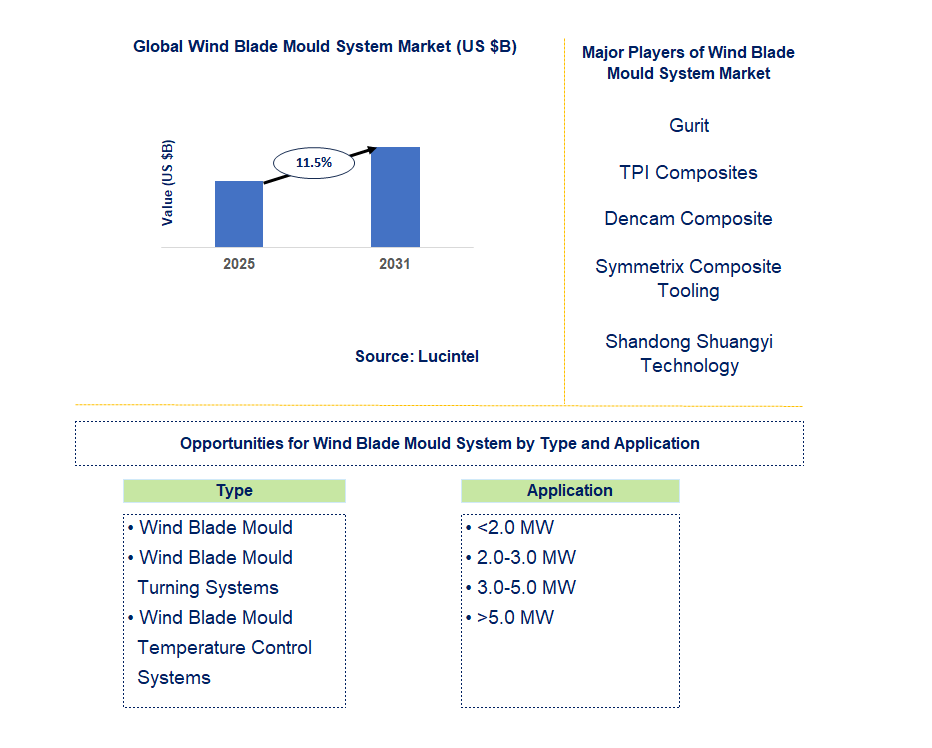
Key data points: The growth forecast = 11.5% annually for the next 7 years. Scroll below to get more insights. This market report covers Trends, opportunities and forecasts in wind blade mould system market to 2031 by type (wind blade mould, wind blade mould turning systems, and wind blade mould temperature control systems), application (<2.0 MW, 2.0-3.0 MW, 3.0-5.0 MW, and >5.0 MW), and region (North America, Europe, Asia Pacific, and the Rest of the World)
We'll send your sample report shortly.
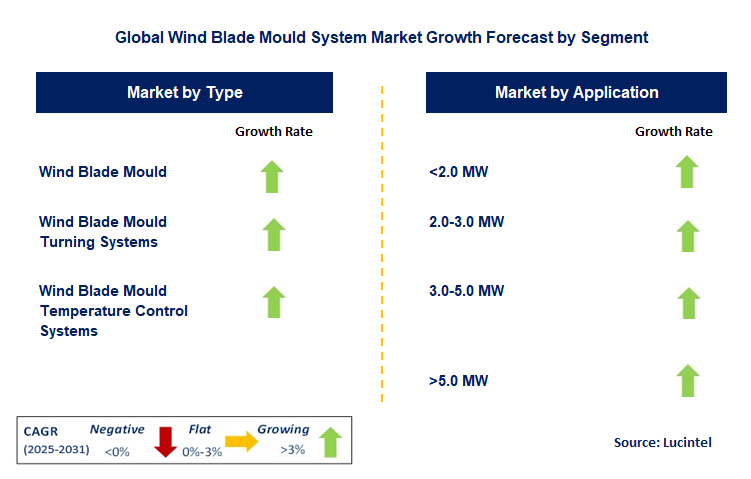
• Lucintel forecasts that, within the type category, wind blade mould is expected to witness the highest growth over the forecast period due to the rising demand for durable wind blade manufacturing systems.
• Within the application category, >5.0 MW is expected to witness the highest growth due to the growing demand for large-scale wind turbines.
• In terms of region, APAC is expected to witness the highest growth over the forecast period due to the increasing investment in wind energy projects.
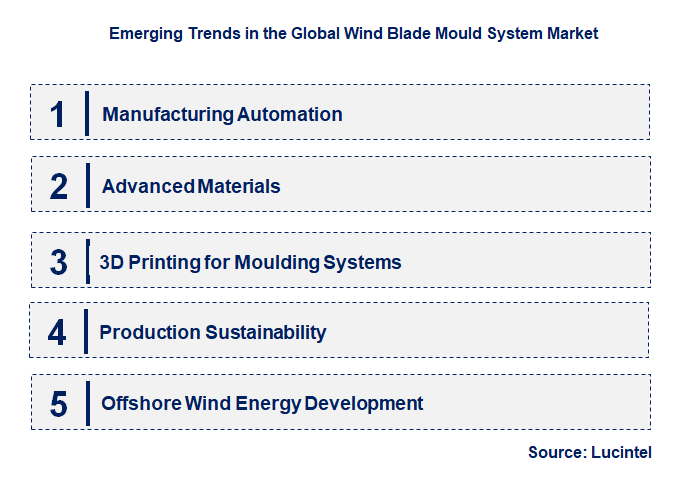
• Manufacturing Automation: Automation is emerging as a prevalent trend in the wind blade mould system market, allowing manufacturers to decrease production time and cost while enhancing accuracy. Robotic systems and automated moulding are improving the speed and efficiency of wind blade production. This trend is especially significant as the need for bigger blades and greater production volumes increases. Automation also minimizes human error, resulting in more uniform product quality and reliability.
• Advanced Materials: The application of advanced materials within wind blade mould systems is the force behind innovation in the market. Carbon fiber, composite resins, and high-performance plastics are some of the materials being utilized to produce stronger and more resilient blades. These materials are stronger, lighter, and have greater wear and tear resistance, improving the lifespan and effectiveness of wind blades. The incorporation of these advanced materials into moulding systems enables mass production of large and efficient blades, especially for offshore wind farms.
• 3D Printing for Moulding Systems: 3D printing technology is transforming the wind blade mould system market by facilitating more accurate and intricate mould designs. Through 3D printing, rapid prototyping and customized mould production are possible to achieve particular design specifications. 3D printing saves lead times and costs for conventional moulding techniques, which is a cost-effective option for manufacturers. It is also possible to create complex moulds with better precision, which results in higher-quality wind blades, and this improves the performance of the turbine.
• Production Sustainability: Sustainability is gaining importance in the wind blade mould system market, as companies look to minimize the environmental footprint of production activities. The use of eco-friendly materials, energy-efficient manufacturing techniques and recyclable moulds is gaining support. These are part of the general trend towards sustainability in the renewable energy industry and are essential in cutting the carbon footprint of wind energy generation. Sustainable manufacturing practices are also useful in fulfilling regulatory compliance and appealing to green-oriented consumers.
• Offshore Wind Energy Development: Offshore wind energy is propelling the demand for larger, stronger wind blades, and consequently, this is affecting the wind blade mould system market. Offshore wind farms need blades that can resist more aggressive environmental conditions, including high wind and saltwater exposure. In order to fulfill these requirements, mould systems are transforming to support the manufacturing of larger blades with greater strength and durability. This trend is bound to persist with nations investing heavily in offshore wind power projects, thus creating high demand for advanced mould systems. These emerging trends are reshaping the wind blade mould system market by enabling manufacturers to produce more efficient, durable, and environmentally friendly wind blades. Automation, advanced materials, 3D printing, sustainability, and offshore wind energy development are all playing crucial roles in driving innovation and growth in the market. As these trends continue to evolve, the Wind Blade Mould System market will see significant advancements, helping to meet the global demand for clean, renewable energy.
• Integration of Automation Technologies: Integration of automation technologies is one of the major developments in the wind blade mould system market. Manufacturers are now more commonly applying robotic systems and automated processes to enhance the efficiency of wind blade manufacturing. Automation saves time and labor in making each blade, resulting in cost savings and enhanced production capacity. This trend is necessary because demand for bigger and more wind blades keeps rising, particularly with the increase in offshore wind energy projects.
• Development in Material Technologies: Developments in materials for wind blade moulds are a major development in the market. High-performance composites, carbon fibre, and other advanced materials, which are stronger, lighter, and more resistant compared to traditional materials, are being applied by companies. Such innovations enable them to produce blades that are not only more efficient but also more durable, especially in extreme offshore conditions. The capacity to integrate sophisticated materials within mould systems is making it possible for manufacturers to keep up with increasing demand for larger, stronger wind blades.
• 3D Printing as a New Entrant in Mould Design: The use of 3D printing in mould design and manufacturing has emerged as a major breakthrough in the wind blade mould system market. This technology enables the production of complex and accurate moulds at a faster and lower cost compared to the conventional methods. 3D printing also supports rapid prototyping, which cuts lead time for new designs and guarantees that moulds meet precise design specifications. This innovation is revolutionizing wind blade mould production, enhancing the quality and performance of blades being produced.
• Emphasis on Sustainable Manufacturing Practices: Sustainable manufacturing practices have been one of the key advancements in the wind blade mould system market. Businesses are putting more emphasis on minimizing the environmental footprint of wind blade manufacturing by adopting recyclable materials, minimizing waste, and energy-efficient manufacturing processes. This emphasis on sustainability is part of the larger trend in the renewable energy industry towards reducing carbon footprints and encouraging green production practices. These initiatives not only contribute to lowering environmental impact but also help meet increasingly stringent regulations.
• Offshore Wind Energy Growth: The quick expansion of offshore wind energy projects is creating demand for stronger and larger wind blades, and therefore, advanced wind blade mould systems. Blades used in offshore wind farms must be able to endure tough environmental conditions, such as high winds and exposure to saltwater. As nations increasingly invest in offshore wind power, blade manufacturers are producing larger, more durable blades, and with that, new developments in mould systems to create the blades have arisen. This trend is likely to continue as offshore wind power plays an increasing role in the global energy mix. These new advances are revolutionizing the wind blade mould system market by allowing for the manufacturing of more efficient, long-lasting, and environmentally friendly wind blades. Automation, innovative materials, 3D printing, and offshore wind energy focus are leading to innovation, while sustainability measures are reducing the environmental footprint of wind energy generation. As the market develops further, these advances will be essential to satisfy the increasing worldwide demand for renewable energy.
• Offshore Wind Energy Development: Offshore wind energy development is a large growth potential for the wind blade mould system market. With offshore wind farms needing bigger and stronger blades to handle extreme environmental conditions, there is a growing demand for superior mould systems. The mould systems need to be able to deliver bigger blades with greater strength and durability, which opens up room for manufacturers to innovate and upgrade their capabilities in the offshore wind energy industry.
• Wind Blade Automation: Adoption of wind blade automation is one of the major growth opportunities in the market. Automated solutions are boosting production efficiency, cutting labor expenses, and enhancing product quality. This trend holds high significance as the demand for big-sized wind blades keeps growing. Automation also enables more accurate moulding, which is essential for making high-performing wind blades. This application will keep expanding as producers try to address the growing demand for wind power.
• Sustainable Manufacturing Processes: Sustainability is an increasing issue in the wind blade mould system market, and organizations that invest in environmentally friendly manufacturing processes will gain from enormous growth prospects. Recycling materials, energy-efficient manufacturing, and minimizing waste are increasingly becoming a major differentiator for producers. With the world now focusing on decreasing carbon footprints and lessening the impact on the environment, there is increasing need for green wind blade manufacturing processes that meet environmental objectives.
• 3D Printing for Custom Moulds: The application of 3D printing for custom moulding is an exciting growth prospect. 3D printing offers quick prototyping, and manufacturers are able to rapidly prototype and test new designs. The technology can be applied to fabricate highly detailed and accurate moulds, crucial in the production of high-grade wind blades. As the trend of more tailor-made blade design gathers momentum, 3D printing provides a cheap and viable means of manufacturing moulds.
• Emerging Market Growth: The emerging markets of Asia and Africa pose a promising growth opportunity for the wind blade mould system market. With these regions increasing their investment in renewable energy, the demand for wind turbines as well as their components will increase. The growth can be leveraged by manufacturers through increasing their presence in these regions and providing customized solutions for regional markets. Government policies and incentives supporting renewable energy are also providing a positive environment for market growth. These growth opportunities represent the key sectors where the wind blade mould system market is expected to grow. Offshore wind power, automation, sustainability, 3D printing, and developing markets are all fueling the demand for sophisticated mould systems. As these applications keep evolving, companies will be able to innovate and address the increasing demand for more efficient, reliable, and eco-friendly wind blades.
• Gurit
• TPI Composites
• Dencam Composite
• Symmetrix Composite Tooling
• Shandong Shuangyi Technology
• Beijing Composite Materials
• Titan Wind
• Jiangyin Kecheng Technology
• Tien Li Offshore Wind Technology
• Suzhou AODE Machinery
• Wind Blade Mould
• Wind Blade Mould Turning Systems
• Wind Blade Mould Temperature Control Systems
• <2.0 MW
• 2.0-3.0 MW
• 3.0-5.0 MW
• >5.0 MW
• North America
• Europe
• Asia Pacific
• The Rest of the World
• United States: In the United States, recent trends in the wind blade mould system market have been focused on increasing the efficiency of production and minimizing the costs. Organizations have been spending on cutting-edge moulding techniques, including automated fiber placement and 3D printing, to enhance the accuracy and scalability of wind blade production. Additionally, with the U.S. government‘s immense backing of clean energy and increased emphasis on offshore wind farms, there is increasing demand for longer, tougher wind blades, promoting innovation in moulding systems. This is likely to further increase the expansion of the U.S. wind blade mould system market.
• China: China, being one of the globe‘s biggest wind turbine producers, is witnessing speedy developments in wind blade mould system technology. The wind energy industry in China is growing at a blistering pace, and to cope with growing demands, Chinese manufacturers are embracing state-of-the-art materials and moulding technologies. The durability of wind blade moulds has seen some notable improvements, which are necessary for manufacturing longer-lasting blades. Moreover, China‘s drive for offshore wind farms has hastened the demand for superior mould systems for manufacturing bigger and more intricate blades for offshore wind farms.
• Germany: Germany, a renewable energy leader, has been concerned with improving the efficiency and quality of wind blade mould systems. In line with its energy transition (Evergreened) initiative, Germany is investing in leading-edge technologies such as automated moulding and renewable materials to make production cheaper and enhance the durability of wind blades. German manufacturers are also joining forces with international players to come up with innovations in mould design to address the needs of more massive wind turbines. The German market for wind blade mould systems is fueled by a strong demand for technological innovation and sustainability in the energy industry.
• India: India is also making sizeable leaps in the wind blade mould system market, fueled by its expanding wind power capacity and government backing for renewable energy. In order to achieve the country‘s ambitious renewable energy targets, Indian manufacturers are more and more turning to automated moulding methods and innovative materials for wind blades. The emphasis is on enhancing manufacturing efficiency and lowering the cost of wind energy. Research and development investments in India are also aimed at increasing the lifespan and efficiency of wind blades, which is fueling demand for advanced and longer-lasting mould systems.
• Japan: Japan‘s wind blade mould system industry is changing fast with emphasis on precision manufacturing and innovation in materials. Japan‘s initiative towards renewable power and its aspiration to decrease dependence on fossil fuels has resulted in more investments being made in wind power, such as offshore wind farms. The demand for high-capacity and efficient wind blades has increased because of this, and manufacturers are being compelled to use advanced moulding systems. Japan is also looking at the application of new materials and technologies, like carbon fiber-strengthened moulds, to enhance the strength and lifespan of wind blades, especially for offshore use.


• Gurit
• TPI Composites
• Dencam Composite
• Symmetrix Composite Tooling
• Shandong Shuangyi Technology
• Beijing Composite Materials
• Titan Wind
• Jiangyin Kecheng Technology
• Tien Li Offshore Wind Technology
• Suzhou AODE Machinery Q5. Which wind blade mould system market segment will be the largest in future? Answer: Lucintel forecasts that, within the type category, wind blade mould is expected to witness the highest growth over the forecast period due to the rising demand for durable wind blade manufacturing systems. Q6. In wind blade mould system market, which region is expected to be the largest in next 5 years? Answer: In terms of region, APAC is expected to witness the highest growth over the forecast period due to the increasing investment in wind energy projects. Q7. Do we receive customization in this report? Answer: Yes, Lucintel provides 10% customization without any additional cost.


Choose a license that fits your team. Instant PDF delivery.
Prices exclude taxes. Instant delivery. Custom licensing available on request.
Market Report · July 20, 2026
Market Report · July 20, 2026
Market Report · July 20, 2026
Trusted partner for strategic intelligence and business growth


Receive a complimentary market analysis tailored to your industry. Our analysts will identify key growth opportunities and competitive dynamics specific to your business.

Market size, growth rate, and key trend analysis for your specific sector.

Top competitor positioning and market share analysis.

Strategic recommendations backed by data-driven insights.
Get curated market intelligence and competitive moves straight to your inbox.
By subscribing, you agree to receive our monthly insights. Unsubscribe anytime.
Receive a complimentary market analysis tailored to your industry. Our analysts will identify key growth opportunities and competitive dynamics specific to your business.
Market size, growth rate, and key trend analysis for your specific sector.
Top competitor positioning and market share analysis.
Strategic recommendations backed by data-driven insights.
Get curated market intelligence, emerging trends, and competitive moves straight to your inbox each month.
By subscribing, you agree to receive our monthly insights. Unsubscribe anytime.
We'll send your sample report shortly.