
Market Report · July 15, 2026

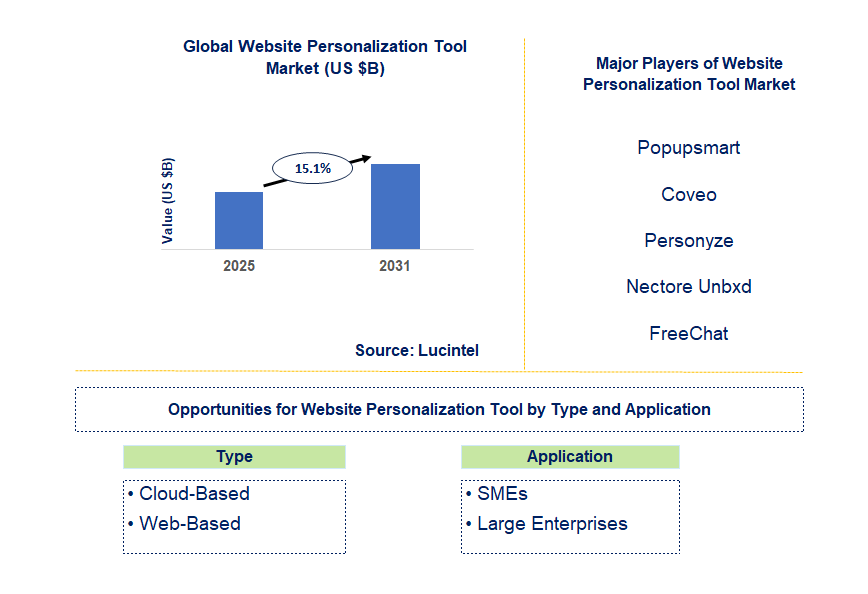
Key data points: The growth forecast = 15.1% annually for the next 7 years. Scroll below to get more insights. This market report covers Trends, opportunity and forecast in website personalization tool market to 2031 by type (cloud-based and web-based), application (SMEs and large enterprises), and region (North America, Europe, Asia Pacific, and the Rest of the World)
We'll send your sample report shortly.
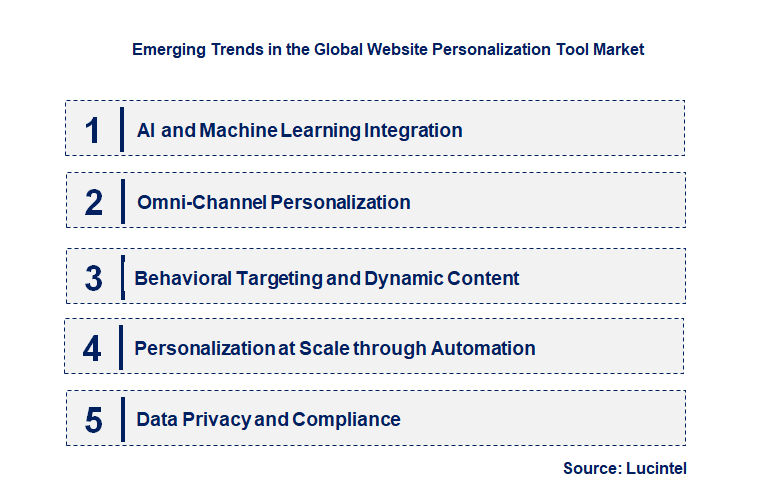
• AI and Machine Learning Integration: AI and machine learning technologies are at the heart of modern website personalization tools. These technologies enable websites to adapt in real-time to user behavior, offering dynamic content and personalized recommendations based on past interactions. AI-driven tools can predict user preferences, helping businesses deliver highly relevant experiences that increase engagement and conversion rates. Machine learning models improve with time, and personalization efforts become more accurate and effective, leading to increased customer loyalty and satisfaction.
• Omni-Channel Personalization: Omni-channel personalization is becoming popular as companies try to create seamless experiences across websites, mobile apps, and social media. This trend focuses on delivering consistent and personalized messaging and offers across all touchpoints, ensuring a unified customer experience. This can track a customer journey across the whole ecosystem to deliver relevant, personalized experiences on the basis of whether the customer interacts with the brand online, in-store, or via a mobile app. Therefore, the engagement and retention can improve overall.
• Behavioral Targeting and Dynamic Content: Behavioral targeting is one of the key trends, which uses dynamic content to focus on the activities of users with real-time analysis of data. Businesses can deliver highly personalized content and offers based on user actions such as clicks, page views, and past purchases. Dynamic content generation, where website elements change based on user behavior, allows for customized experiences that drive higher engagement. This trend enhances user satisfaction by providing timely and relevant content, leading to better conversion rates and improved customer loyalty.
• Personalization at Scale through Automation: With increasing demand for personalized content, organizations are using automation to scale up personalization activities. Automated personalization tools allow companies to tailor content that appears on the website to different segments of users so the right message arrives at the right time without necessarily having someone do it by hand. These tools employ sophisticated algorithms to determine the best type of content, product recommendation, or promotional offer for each visitor. This trend helps more customers be exposed to customized experience while depressing a burden on marketing teams.
• Data Privacy and Compliance: Personalization tools collect and analyze huge amounts of data regarding the user, making data privacy and regulation compliance crucial. Consumers increasingly care about the privacy of their data, and business houses have to come up with highly transparent and secure personalization approaches to help comply with regulations from places like GDPR, CCPA and others. The trend toward privacy-conscious personalization is driving the development of tools that ensure compliance with regulations while still delivering highly personalized experiences, balancing the need for personalization with consumer rights to privacy. The latest emerging trends are shifting the website personalization tool market by enhancing personalization capabilities and ensuring that businesses can scale these efforts proficiently. Using AI and machine learning as drivers of automation, mainstream adoption of omni-channel strategies, and growing data privacy concerns, website personalization tools are advancing to form improved relevance and appropriately tailor customer experiences.
• AI-Powered Personalization: One of the most major developments in this market is that AI is becoming integrated into the personalization tool for websites. AI-powered systems allow businesses to deliver personalized content and recommendations using real-time data analysis and tracking of user behavior. AI can forecast user intentions with these analyzed patterns and preferences, tailoring experiences to ensure better engagement and conversion rates. AI also lets continuous improvement of personalization efforts, making it a game-changer for companies that want to make more personalized digital experiences more dynamic.
• Integration with E-commerce Platforms: Website personalization tools are increasingly integrating themselves with e-commerce platforms like Shopify, Magento, and WooCommerce in order to provide really highly personalized shopping experiences. The integration of product recommendations with personalized discounts along with dynamic content using e-commerce data helps bring together a great shopping experience from a business and provides customers an effortless, fun experience while searching for products from a business. Companies benefit by targeting and showing offers to users personalized according to history, browsing behaviors, and likes.
• Behavioral Analytics and User Segmentation: Advances in the design of more advanced behavioral analytics tools allow businesses to segment users by the behavior associated with websites. Tracking clicks, time spent on pages, and other behavioral signals help businesses develop detailed user profiles and then deliver targeted, personalized content to their different segments. The development provides a more precise and effective form of personalization strategies that will increase customer experience as well as improve conversion rates. Delivering offers and recommendations based on particular customer segments also requires proper user segmentation.
• Mobile-First Personalization: With the rapid rise of mobile commerce, website personalization tools are increasingly optimized for mobile users. Businesses are focusing on delivering personalized experiences on mobile devices, with features such as push notifications, personalized app content, and location-based offers. Mobile-first personalization is crucial for reaching today’s on-the-go consumers and providing them with seamless, relevant experiences across different devices. As mobile commerce continues to grow, businesses are prioritizing mobile-specific personalization strategies to stay competitive.
• Cross-Channel Personalization: Cross-channel personalization, whereby businesses deliver personalized experiences across multiple touchpoints, is turning out to be one of the most important emerging trends in the website personalization tool market. Firms are merging website personalization tools with email marketing, social media, and mobile apps in order to build a cohesive, integrated, and personalized customer experience. This enables businesses to track customer journey across various channels; thus, ensuring relevant content is served, suitable promotions and product offers, and then creating a similar and engaging user experience wherever there is interaction by the user. Developments in recent times in the website personalization tool market portray the increasing desire for more specific, dynamic, and scalable experiences for users. In all these, businesses are using the benefits that come with integration of AI with the website personalization tool to optimize their online presence and build better customer interactions.
• E-commerce Personalization: E-commerce is one of the largest growth areas for website personalization tools and remains one area where businesses should focus on more. Tailor-made product recommendations, individualized shopping experience, and dynamic content boost conversion rates, customer loyalty, and retention among customers. Optimize the Customer Journey Personalized homepages or targeted promotions improve the shopping experience, driving more sales and improving customer retention while using personalization tools on the e-commerce websites.
• Personalized Marketing Campaigns: Personalized marketing campaigns are a big growth opportunity for website personalization tools. By integrating personalization tools with email marketing and social media platforms, businesses can deliver highly relevant content and offers to specific customer segments. This approach not only increases engagement but also boosts conversion rates by ensuring that customers receive the right message at the right time, driving higher ROI on marketing efforts.
• Customer Support Personalization: Website personalization tools enhance customer support by offering customized solutions and content based on user behavior and history. The experiences of personalized customer service can include dynamic FAQ sections, AI-powered chatbots, and customized support content, leading to improved user satisfaction and decreased support costs. Providing personalized support at scale is a key growth area for businesses aiming to improve customer experience and operational efficiency.
• Mobile App Personalization: With the rise of mobile apps, personalized experiences on mobile platforms offer a significant growth opportunity. Businesses can use website personalization tools to deliver customized content, offers, and notifications through their apps, enhancing user engagement and retention. This trend is particularly important for industries like retail, entertainment, and travel, where personalized mobile experiences can significantly drive conversions and improve customer loyalty.
• B2B Personalization: Personalization is not only for B2C industries; B2B businesses can also use personalization tools to tailor experiences for clients and prospects. Personalized content, product recommendations, and dynamic offers based on user behavior and company profiles can improve lead generation, conversion, and customer relationships. The B2B market represents a growing opportunity as businesses increasingly adopt personalized strategies to optimize their digital marketing and sales efforts. Strategic growth opportunities in the website personalization tool market are abundant across e-commerce, marketing, customer support, mobile apps, and B2B sectors. By capitalizing on these opportunities, businesses can drive better customer experiences, enhance engagement, and improve conversion rates in an increasingly personalized digital landscape.
• Popupsmart
• Coveo
• Personyze
• Nectore Unbxd
• FreeChat
• VWO
• Dynamic Yield
• Barilliance
• Pureclarity
• Unless
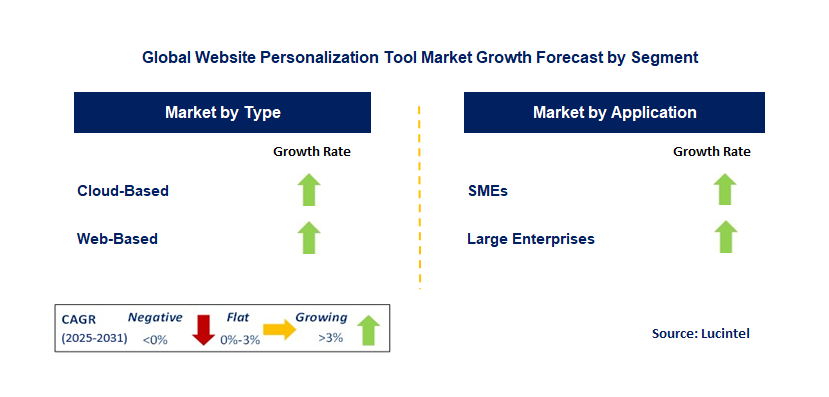
• Cloud-Based
• Web-Based
• SMEs
• Large Enterprises
• North America
• Europe
• Asia Pacific
• The Rest of the World
• United States: The United States leads the pack of website personalization tool. It is propelled by growing data analytics and AI adoption in e-commerce, digital marketing, and content management. Many U.S.-based companies are integrating advanced personalization tools into their websites to deliver more tailored shopping experiences, targeted content, and dynamic recommendations. Additionally, AI-powered chatbots and automated customer service solutions are gaining traction in enhancing personalized interactions. As consumer expectations for seamless, personalized experiences grow, U.S. companies are prioritizing investments in website personalization technology to drive engagement, optimize marketing efforts, and boost conversion rates.
• China: In China, the market is rapidly expanding into website personalization tools because it has the tremendous e-commerce and advanced digital structure. Retail as well as in technology sectors business houses in Chinese are using high personalization techniques to connect with the betterment of targeted consumers through such localized content personal product recommendations for them, and highly individualized offers. Data-driven insights come from using AI and big data, propelling the advancement of the experience intended to give companies a hyper-personalized view for their customers. Such tools are particularly being integrated with social media platforms, mobile apps, and e-commerce sites to maximize reach and effectiveness in the mobile-first environment that has characterized the market in China.
• Germany: The German website personalization tool market grows steadily, with strict emphasis on data privacy regulations under GDPR. They use personalization tools to have a better interaction with users within the framework of legal restrictions imposed over stringent privacy laws of Germany. All these factors work together to utilize AI, ML, and BD analytics to discover customer preferences as well as actual behavior, eventually making it a basis for more precise and customized website presentation. Those such as automotive, healthcare, and finance are big adopters that get significant improvements in personalization for more engagement with their customers and optimum sales funnels, while providing maximum security and privacy.
• India: Website personalization tools in India are gathering pace, though businesses, and now particularly in the e-commerce sector and digital marketers, look towards the bettering the engagement of its users and subsequent conversion rates. With a fast-growing digital user base and high internet penetration, Indian companies are increasingly focusing on the use of personalization technologies to cater to a diverse and dynamic audience. Businesses are taking up tools that enable dynamic content customization, personalized product recommendations, and targeted marketing messages. This trend is also being driven by the rise in mobile commerce, as many companies optimize their personalization strategies for mobile-first users in the region.
• Japan: The website personalization tool market in Japan is changing as more and more companies strive to present the most relevant and localized content to their users. Japanese firms increasingly use AI and machine learning for more personalized recommendation, targeted messaging, and localized promotion-areas especially found in e-commerce and retail industries. It's also on top of other lists in terms of automotive and technology. There are various expectations from the Japanese consumers. The businesses use these tools in order to get closer to customers, so as to engage them more for the websites as well as mobile platforms. Privacy concerns also drive the evolution of more secure and transparent personalization solutions.


• Popupsmart
• Coveo
• Personyze
• Nectore Unbxd
• FreeChat
• VWO
• Dynamic Yield
• Barilliance
• Pureclarity
• Unless Q5. Which website personalization tool market segment will be the largest in future? Answer: Lucintel forecasts that, within the type category, cloud-based is expected to witness higher growth over the forecast period due to cost-effectiveness and maintenance, ease of access and collaboration. Q6. In website personalization tool market, which region is expected to be the largest in next 5 years? Answer: In terms of region, North America is expected to witness the highest growth over the forecast period. Q7. Do we receive customization in this report? Answer: Yes, Lucintel provides 10% customization without any additional cost.


Choose a license that fits your team. Instant PDF delivery.
Prices exclude taxes. Instant delivery. Custom licensing available on request.
Market Report · July 15, 2026
Market Report · June 26, 2026
Market Report · June 24, 2026
Trusted partner for strategic intelligence and business growth


Receive a complimentary market analysis tailored to your industry. Our analysts will identify key growth opportunities and competitive dynamics specific to your business.

Market size, growth rate, and key trend analysis for your specific sector.

Top competitor positioning and market share analysis.

Strategic recommendations backed by data-driven insights.
Get curated market intelligence and competitive moves straight to your inbox.
By subscribing, you agree to receive our monthly insights. Unsubscribe anytime.
Receive a complimentary market analysis tailored to your industry. Our analysts will identify key growth opportunities and competitive dynamics specific to your business.
Market size, growth rate, and key trend analysis for your specific sector.
Top competitor positioning and market share analysis.
Strategic recommendations backed by data-driven insights.
Get curated market intelligence, emerging trends, and competitive moves straight to your inbox each month.
By subscribing, you agree to receive our monthly insights. Unsubscribe anytime.
We'll send your sample report shortly.