
Market Report · July 15, 2026

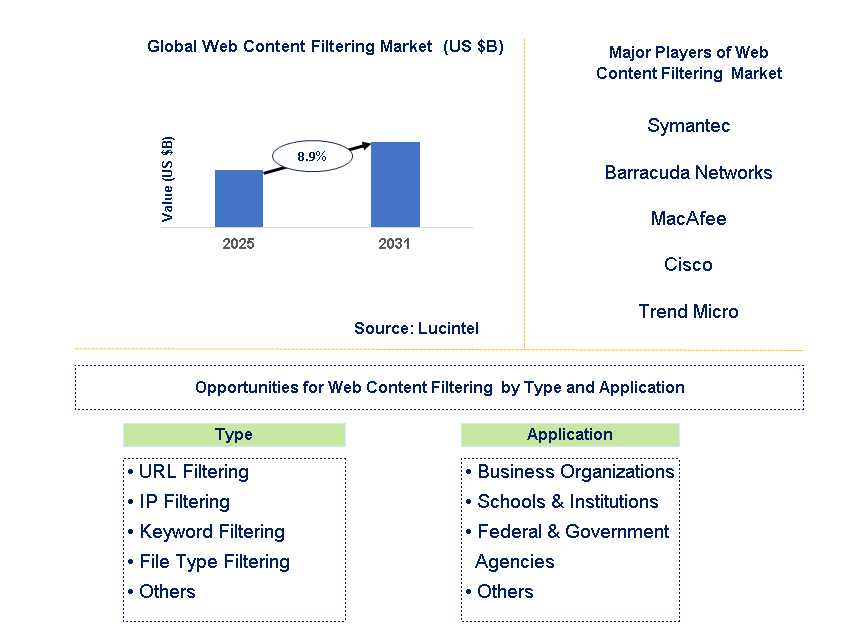
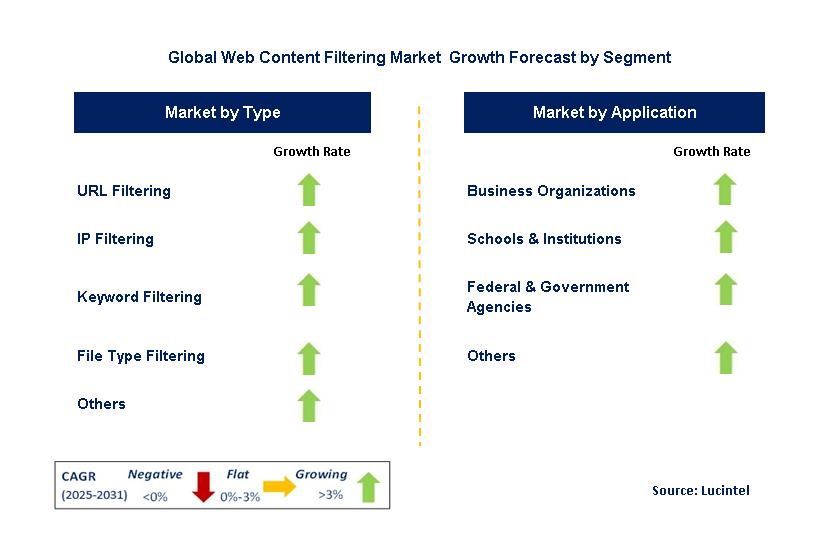
Key data points: The growth forecast = 8.9% annually for the next 7 years. Scroll below to get more insights. This market report covers Trends, opportunity and forecast in web content filtering market to 2031 by type (URL filtering, IP filtering, keyword filtering, file type filtering, and others), application (business organizations, schools & institutions, federal & government agencies, and others), and region (North America, Europe, Asia Pacific, and the Rest of the World)
We'll send your sample report shortly.
• AI and Machine Learning-Based Filtering: AI and machine learning are changing the face of web content filtering solutions. These technologies make them more accurate and adaptive. The AI and machine learning-oriented web filters can automatically detect and block inappropriate content, based on a real-time analysis of web traffic. This way, they are much more effective at detecting phishing, malware, and malicious websites. AI-based filtering learns from newer data and updates its detection regularly, thus the filtering is way more dynamic and can be even more effective to filter out a threat. Especially for enterprises and schools, they need real-time protection against a changing threat.
• Cloud-based Web Filtering Solution: Cloud-based web filtering solutions are gaining grounds because of the flexibility, scalability, and affordability of the services. These solutions enable organizations to deploy filtering tools across multiple devices and locations without the need for extensive on-site infrastructure. Cloud-based filters can be accessed remotely and are ideal for businesses with distributed networks or remote workers. This trend is particularly growing in sectors like healthcare, finance, and education, where protecting sensitive data and ensuring compliance with data privacy regulations are priorities. Cloud solutions also provide faster updates and higher flexibility towards new threats.
• Real-Time Content Monitoring and Reporting: The need for real-time monitoring and reporting is increasing in the web content filtering market. Organizations require the identification of security threats, inappropriate content, or productivity issues in real-time. With real-time content monitoring, administrators can track user activity, block harmful content immediately, and generate reports for compliance and auditing purposes. This trend is especially popular in sectors like education and enterprise, where ensuring online safety and productivity is essential. Real-time data also enables quicker response to cyber threats, enhancing overall cybersecurity posture.
• Privacy and Data Protection Compliance: As governments worldwide implement stricter data privacy regulations, web content filtering solutions are evolving to ensure compliance with these laws. More common features nowadays are data anonymization, encryption, and secure filtering mechanisms. Germany market, under GDPR, calls for strict data protection; filtering solutions prevent personal data from unauthorized access, hence propelling the industry towards creating even safer and more compliant filtering technologies. Organizations have been forced to become compliant to worldwide and regional privacy requirements.
• Unified Endpoint Management Integration: Web content filtering solutions are increasingly being integrated with Unified Endpoint Management (UEM) systems. UEM platforms allow businesses to manage and secure a wide range of devices, from desktops to mobile phones. By integrating content filtering with UEM, organizations can ensure that their security protocols are consistent across all endpoints. This integration delivers high security and productivity since dangerous sites are blocked no matter what the medium is. It gives businesses a central management console to monitor and enforce policies of web usage.
Trends in the form of AI-based filtration, cloud-based solutions, real-time monitoring, and privacy compliance are reshaping the web content filtering market. These innovations are making web filtering systems more effective, scalable, and secure, thus enabling organizations to better protect their networks, ensure compliance, and respond to emerging online threats. These trends are helping make web content filtering more adaptable, comprehensive, and proactive in meeting the evolving needs of businesses, educational institutions, and government organizations.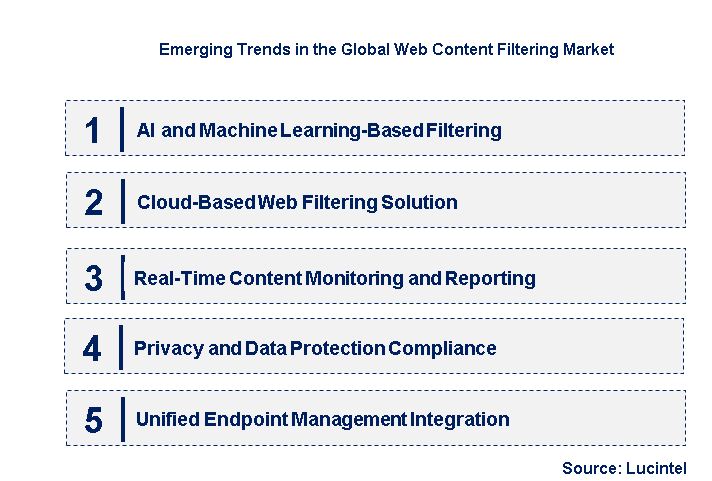
• Increased use of AI-based Web Filtering solutions: AI-driven web filtering solutions have gained traction since they improve the accuracy and efficiency of content blocking. Machine learning enables these systems to rapidly process huge amounts of data to detect threats, including malware, ransomware, or phishing websites. AI-powered filters are also in a constant process of evolution to keep up with new trends and emerging threats. This development especially holds importance in banking and healthcare industries as these include data privacy and secure surfing. AI-based filters help an organization be at the cutting edge of possible security risks by constantly making available real-time automated updates about their filtering systems.
• Cloud-Based Filtering for Distributed Workforces: Cloud-based solutions for web content filtering are gaining popularity, especially in the case of distributed workforces. These solutions offer flexibility, ease of deployment, and scalability, allowing businesses to manage web filtering for remote employees or multiple branch offices. As companies shift toward hybrid or remote work environments, cloud-based filtering becomes an essential tool for protecting employees from harmful online content and ensuring productivity. With cloud solutions, updates are automatically pushed, and protection is consistently maintained across all devices, regardless of location.
• Compliance and Privacy Regulations are now more prominent than ever: With the increase in strict global privacy and data protection regulations, web content filtering solutions are now designed to adapt to these new demands. Companies are now responsible for ensuring that their filtering systems protect personal data and comply with the privacy laws such as GDPR and CCPA. Most of the current filtering solutions integrate functionalities like encryption, safe handling of data, and monitoring facilities to assist the organization to fulfill the said obligations.
• Better user experience through filters customized: Customization of web content filtering solutions has improved significantly and allows businesses and educational institutions to tailor the filters to their needs. This makes it possible for organizations to use different filtering rules depending on the user role: administrator, employee, or student. More granular control over access to the web allows organizations to block unwanted types of content -- for instance, gambling sites, adult content -- while being open to other valuable online resources. This is a customization feature that usually improves user experience by giving more flexibility on actual filter alignment towards organizational policies and goals.
• Integration into Broader Security Ecosystems: Web content filtering solutions increasingly integrate with other cybersecurity tools into more comprehensive security ecosystems. As such, through integration, it ensures that the web content filter works hand-in-hand with a firewall, antivirus software, intrusion detection systems for multi-layer protection. It combines security measures toward better visibility into your security posture to respond to a threat much more quickly. Therefore, integrating web filtering with security systems mostly benefits organizations in the finance and finance-related industries as security systems and compliance coexist as crucial elements in such fields.
New Developments in web content filtering market through AI-driven solutions, Cloud adoption, privacy compliance, customised filters and further integrations into security would give rise to a safer, dynamic, web-filtering world for businesses, institutions, and governmental entities.• Education Sector: This can be achieved if the growth area for web content filtering solutions was in the educational sector, such as how numerous students would rely on the web for studying or learning, resulting in a tremendous need by these schools and higher learning institutions for robust protection and safe interactions when online. Filter web content based on blocking unwanted, inappropriate, etc., while still tracking activities based on regulatory compliance. Educational institutions are increasingly adopting these solutions to ensure that digital resources remain safe, productive, and educational for students. This growth opportunity is especially important in K-12 and higher education, where online safety is a major concern.
• Corporate and Enterprise Market: The corporate and enterprise market represents a significant opportunity for web content filtering providers. With more employees working remotely or in distributed teams, businesses need filtering solutions to ensure that employees are accessing safe, secure, and productive content. Filtering solutions can block harmful websites, control social media use, and protect corporate networks from malware and phishing attacks. Enterprises are investing in these systems to improve employee productivity and maintain secure, compliant online environments. The demand for such filtering solutions is fueled by the hybrid work model.
• Healthcare and Healthcare Providers: Healthcare organizations require much stricter rules about protection of confidential patient data as well as that no harmful content reaches employees or patients via the web. Filtering of web content becomes inevitable in safeguarding the patient's privacy as well as abiding by HIPAA guidelines regarding the protection of patient privacy in the health care industry. Cyber attacks, data thefts, phishing, and more in this area have increased drastically lately. As healthcare providers continue to embrace digital technologies, the demand for comprehensive web filtering solutions is increasing.
• Government and Public Sector: Governments and public sector organizations are investing more in web content filtering solutions to safeguard sensitive information, block access to prohibited websites, and ensure national regulations compliance. Government bodies need web filtering to protect employees from cyber threats as digitalization and remote working become more prevalent. Governments can be assured that internet usage is secure, compliant with regulations, and free from inappropriate content that could harm citizens or their reputation by adopting web content filtering.
• Consumer Markets and Home Use: The consumer market for home-use web content filtering grows with increasing anxieties over internet safety, more so for kids. Families have begun to make investments in the filtering software on their computers to restrict inappropriate content from entering their machines, limit access to screens for too long a time, and monitor their kids' online activities. As the count of connected devices within homes surges, easy-to-use, reasonably priced filtering solutions for personal devices are in more demand. This growing demand in consumer-level web content filtering would represent a high growth opportunity for developers to develop intuitive, reliable solutions that match the needs of households.
Strategic growth opportunities in the web content filtering market exist in several industries, including education, corporate enterprises, healthcare, government, and consumer markets. Since organizations and individuals pursue security, confidentiality, and regulatory compliance, web filtering solutions offer numerous benefits. Companies that take advantage of these opportunities improve their market position and address the growing need for safe and secure online spaces that are productive for individuals to do their work.• Symantec
• Barracuda Networks
• MacAfee
• Cisco
• Trend Micro
• Websense
• Contentkeeper Technologies
• Forcepoint
• Trustwave
• Fortinet
• URL Filtering
• IP Filtering
• Keyword Filtering
• File Type Filtering
• Others
• Business Organizations
• Schools & Institutions
• Federal & Government Agencies
• Others
• North America
• Europe
• Asia Pacific
• The Rest of the World
• United States: In the United States, the web content filtering market is doing well due to increased demand for cybersecurity solutions in both private and public sectors. Growing malware and phishing attacks are the reason for web filtering tools being adopted to prevent such dangers. The U.S. also witnesses a rising demand from educational institutions and businesses that need to protect employees and students from harmful content. There is also an increasing trend toward cloud-based filtering solutions, which provide enhanced flexibility and scalability for users, with companies embracing hybrid filtering systems to better manage internet usage.
• China: The government's strict regulations on internet censorship and content control are what shape the web content filtering market in China. With its much-famed "Great Firewall," China has greatly invested in web filtering solutions to regulate online activity and limit access to foreign websites and services. This strict control over internet content, especially social media platforms and websites with politically sensitive information, has led to the development of advanced filtering technologies tailored to meet regulatory requirements. Local companies have dominated the market with increasing investments in AI-based content filtering and monitoring systems for compliance with government policies.
• Germany: Germany’s web content filtering market is primarily driven by data protection regulations, such as the General Data Protection Regulation (GDPR), which mandate strict controls over user privacy and content management. Companies operating in Germany are increasingly adopting web content filtering solutions to safeguard both personal and business data from potential breaches or misuse. The demand for filtering solutions is also increasing in schools and workplaces to ensure compliance with cybersecurity standards and prevent access to harmful content. Moreover, German consumers are becoming more aware of privacy issues, which is prompting a move toward more secure and transparent filtering technologies.
• India: In India, the market for Web Content Filtering is growing at a rapid pace with an increasing number of internet users and reliance on the internet for education, work, and entertainment. With a huge population of young internet users, the demand for web content filtering solutions in educational institutions and households is on the rise. Government regulations on online content, especially related to social media and online gaming, are also encouraging the use of filtering technologies. Indian businesses are also using web filtering tools to secure corporate networks and prevent access to harmful websites that may lead to data breaches or reduce productivity.
• Japan: The web content filtering market in Japan is developing as the country experiences a growing need for cybersecurity solutions to protect individuals and organizations from digital threats. As the economy is becoming increasingly digital, Japanese companies are using advanced web filtering systems to monitor online content and block malicious websites. Educational institutions are also adopting filtering solutions to ensure students are protected from inappropriate or harmful content. There is also growing demand in the Japanese market for solutions that integrate artificial intelligence to make filtering more accurate and efficient in line with both national regulations and international data protection standards.


• Symantec
• Barracuda Networks
• MacAfee
• Cisco
• Trend Micro
• Websense
• Contentkeeper Technologies
• Forcepoint
• Trustwave
• Fortinet
Q5. Which web content filtering market segment will be the largest in future?

Choose a license that fits your team. Instant PDF delivery.
Prices exclude taxes. Instant delivery. Custom licensing available on request.
Market Report · July 15, 2026
Market Report · June 26, 2026
Market Report · June 24, 2026
Trusted partner for strategic intelligence and business growth


Receive a complimentary market analysis tailored to your industry. Our analysts will identify key growth opportunities and competitive dynamics specific to your business.

Market size, growth rate, and key trend analysis for your specific sector.

Top competitor positioning and market share analysis.

Strategic recommendations backed by data-driven insights.
Get curated market intelligence and competitive moves straight to your inbox.
By subscribing, you agree to receive our monthly insights. Unsubscribe anytime.
Receive a complimentary market analysis tailored to your industry. Our analysts will identify key growth opportunities and competitive dynamics specific to your business.
Market size, growth rate, and key trend analysis for your specific sector.
Top competitor positioning and market share analysis.
Strategic recommendations backed by data-driven insights.
Get curated market intelligence, emerging trends, and competitive moves straight to your inbox each month.
By subscribing, you agree to receive our monthly insights. Unsubscribe anytime.
We'll send your sample report shortly.