
Market Report · July 15, 2026

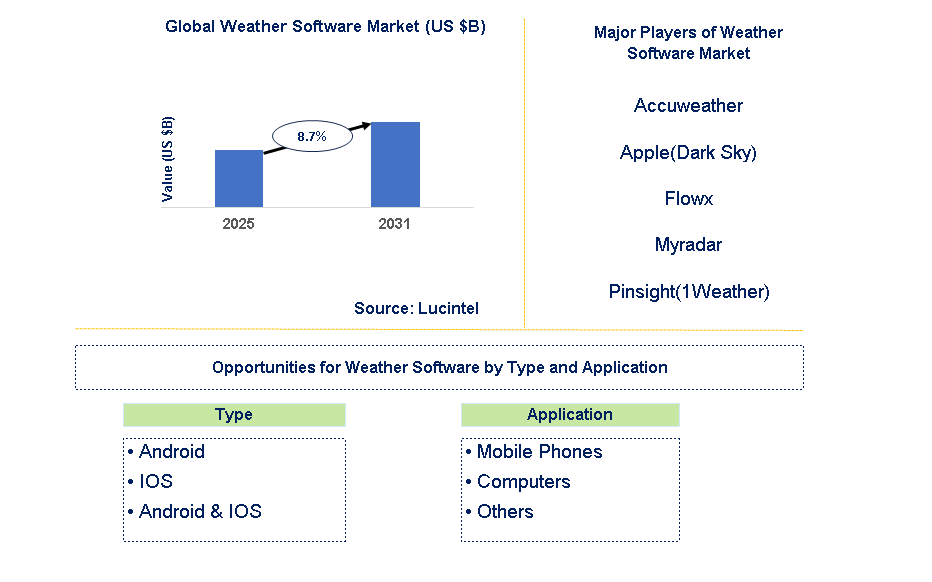
Key data points: The growth forecast = 8.7% annually for the next 7 years. Scroll below to get more insights. This market report covers Trends, opportunity and forecast in weather software market to 2031 by type (android, iOS, and android & iOS), application (mobile phones, computers, and others), and region (North America, Europe, Asia Pacific, and the Rest of the World)
We'll send your sample report shortly.
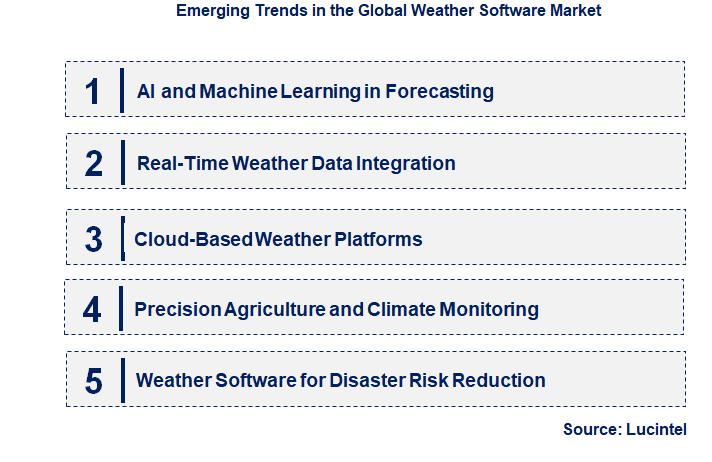
• AI and Machine Learning in Forecasting: The integration of artificial intelligence and machine learning is revolutionizing weather forecasting by enabling more accurate and timely predictions. These technologies analyze large datasets, identify patterns, and make predictions faster than traditional models. They help weather software providers enhance predictive accuracy, which is critical for sectors like agriculture, energy, and disaster management.
• Real-Time Weather Data Integration: With the increasing deployment of IoT devices and satellite sensors, real-time weather data is becoming more accessible than ever. This trend allows industries to integrate weather data into their decision-making processes in real time. Whether in agriculture, logistics, or emergency management, access to live weather information empowers stakeholders to respond proactively to changing conditions, minimizing risks and improving outcomes.
• Cloud-Based Weather Platforms: Cloud computing is becoming a critical component of modern weather software, offering the ability to process large volumes of data and provide scalable services. Cloud-based platforms allow businesses to access accurate weather data and analytics remotely, promoting collaboration, flexibility, and cost savings. The cloud infrastructure also facilitates data sharing, improving the efficiency of weather predictions across multiple sectors.
• Precision Agriculture and Climate Monitoring: As climate change accelerates, there is a growing focus on using weather software to optimize agricultural practices and monitor climate conditions. Advanced weather models and real-time data help farmers better predict weather patterns, manage irrigation, and reduce crop loss. This trend has led to the rise of specialized weather software designed for the agricultural sector, enabling farmers to make more informed, sustainable decisions.
• Weather Software for Disaster Risk Reduction: Increasingly extreme weather events due to climate change have prompted governments and businesses to invest in weather software for disaster risk reduction. Advanced weather systems now offer real-time alerts for hurricanes, floods, and wildfires, giving authorities the ability to take preventive actions. The integration of predictive weather data with disaster response strategies has saved lives and reduced economic damage. These emerging trends are transforming the weather software market, enabling businesses and governments to respond more effectively to climate-related challenges. Technologies like AI, machine learning, and IoT are enhancing forecasting accuracy, while cloud-based platforms are improving accessibility and collaboration. These developments are making weather data more actionable, driving better decision-making, and increasing resilience against the effects of extreme weather.
• Integration of AI and Big Data: One of the most significant developments in weather software is the integration of artificial intelligence (AI) and big data analytics. By analyzing massive datasets, AI has enabled more accurate weather predictions and faster processing of weather models. This has resulted in improved forecasting for various industries such as agriculture, energy, and transportation, allowing them to plan more efficiently and mitigate risks.
• Satellite and IoT Data for Real-Time Monitoring: The expansion of satellite networks and IoT devices has enhanced the accuracy and timeliness of weather data. With real-time monitoring, weather software can provide more up-to-date forecasts, helping businesses and governments make informed decisions. The integration of these technologies also allows for better disaster management, especially in the wake of extreme weather events like hurricanes and floods.
• Cloud-Based Weather Solutions: Many weather software companies are now offering cloud-based solutions that enable easier access to weather data and more powerful computational resources. Cloud platforms allow users to store and process large datasets remotely, providing flexibility, scalability, and cost-effectiveness. This shift is improving collaboration across industries and enhancing the delivery of weather information to users worldwide.
• Customization for Sector-Specific Needs: Weather software providers are increasingly focusing on customizing their products to meet the unique needs of various sectors. For example, agriculture-focused weather software uses real-time data to help farmers optimize irrigation, while logistics companies use weather predictions to manage transportation routes. This specialization helps companies in diverse industries make more informed, context-specific decisions.
• Advances in Climate Modeling and Simulation: Advances in climate modeling and simulation are helping scientists and weather software developers better understand long-term climate patterns. Improved models allow for more accurate predictions of long-term weather trends, providing valuable insights for urban planning, infrastructure development, and environmental policy. This progress is also helping companies better prepare for the impacts of climate change. These recent developments in the weather software market are improving forecasting accuracy, enabling better disaster management, and enhancing the decision-making process for industries worldwide. The growing use of AI, big data, cloud computing, and satellite technology is transforming the way weather data is used and making it more accessible, efficient, and actionable for all sectors.
• Weather Software for Agriculture: The agricultural sector is one of the largest beneficiaries of advanced weather software. By using real-time weather data, farmers can optimize irrigation, plan planting and harvesting schedules, and reduce crop loss. As climate change continues to affect weather patterns, weather software that offers precise, location-specific forecasting is increasingly important for ensuring food security and improving agricultural productivity.
• Weather Software for Disaster Management: The growing frequency and intensity of extreme weather events have created a pressing need for advanced weather software in disaster management. Real-time monitoring, forecasting, and alert systems can help authorities respond more effectively to hurricanes, floods, and wildfires. Investments in weather software for disaster risk reduction are expected to continue rising, driven by the increasing need for preparedness and resilience.
• Weather Software for Renewable Energy: Weather software is playing a pivotal role in optimizing renewable energy production, particularly in wind and solar energy. Accurate weather predictions are essential for determining energy output and grid management. By integrating weather data into renewable energy systems, companies can increase efficiency and reduce energy waste, making the energy sector more sustainable and cost-effective.
• Weather Software for Transportation and Logistics: The transportation industry is using weather software to optimize route planning, reduce delays, and minimize risks associated with extreme weather events. Accurate weather forecasts allow logistics companies to plan transportation routes that avoid adverse weather conditions, ensuring timely deliveries and reducing fuel consumption. Weather software is essential for improving efficiency and safety in the logistics sector.
• Weather Software for Urban Planning: As cities grow, the need for advanced weather software for urban planning and infrastructure development becomes more critical. Weather data can inform decisions related to infrastructure resilience, energy usage, and disaster preparedness. By using weather software to simulate and model urban weather conditions, cities can better plan for climate change and improve urban resilience. These growth opportunities highlight the importance of weather software in optimizing operations, improving safety, and addressing the challenges posed by climate change. As the demand for accurate, real-time weather data continues to rise, weather software is becoming an indispensable tool for sectors ranging from agriculture to renewable energy, transportation, and urban planning.
• Accuweather
• Apple(Dark Sky)
• Flowx
• Myradar
• Pinsight(1Weather)
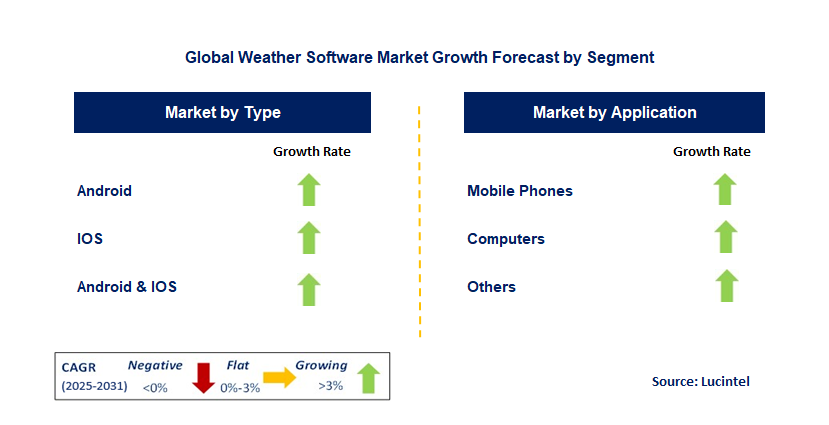
• Android
• Ios
• Android & Ios
• Mobile Phones
• Computers
• Others
• North America
• Europe
• Asia Pacific
• The Rest of the World
• United States: In the United States, the weather software market has witnessed the expansion of advanced predictive technologies, including the use of AI for more precise forecasting. The National Oceanic and Atmospheric Administration (NOAA) has been integrating new AI algorithms into its weather forecasting models. These innovations have enabled quicker and more accurate weather predictions, helping to improve response strategies for severe weather events like hurricanes and wildfires. The focus has also shifted to integrating weather data with other sectors such as agriculture and transportation for better risk management.
• China: China has made substantial investments in weather software as part of its national climate initiatives. The government has supported the development of supercomputing platforms to handle vast amounts of meteorological data from satellites and ground stations. These advancements have improved the country’s weather prediction capabilities, particularly for urban areas and agriculture. China’s weather software market also focuses on providing real-time data for disaster management, helping mitigate the impact of extreme weather conditions like flooding and storms, which are becoming more frequent due to climate change.
• Germany: In Germany, weather software has been increasingly integrated into industries such as energy, transportation, and agriculture. The country is leveraging data from weather satellites and IoT devices to optimize energy production, particularly in wind and solar energy sectors. Additionally, Germany has been at the forefront of utilizing machine learning to enhance the precision of short-term weather forecasts, allowing for better management of transportation networks and agricultural planning. Germany's commitment to environmental sustainability further drives the need for accurate weather predictions to mitigate the effects of climate change.
• India: India has been making strides in weather software to address the challenges posed by its monsoon season and climate vulnerability. The Indian Meteorological Department (IMD) has been upgrading its forecasting systems using advanced satellite data and machine learning algorithms. This has led to improved early warnings for natural disasters like cyclones and floods, which can have devastating impacts in the region. Additionally, India is using weather software to optimize agricultural practices, ensuring food security amidst increasingly erratic weather patterns due to global warming.
• Japan: Japan continues to invest in weather software to enhance its disaster preparedness, particularly in relation to earthquakes and typhoons. The Japan Meteorological Agency (JMA) has developed advanced systems to provide real-time, accurate weather data. These systems are used in disaster management, where timely weather forecasts can help minimize loss of life and property. Japan also focuses on integrating weather software into smart city infrastructure to improve urban resilience and optimize energy usage in response to changing weather conditions.


• Accuweather
• Apple(Dark Sky)
• Flowx
• Myradar
• Pinsight(1Weather) Q5. Which weather software market segment will be the largest in future? Answer: Lucintel forecasts that Android is expected to witness the highest growth over the forecast period. Q6. In weather software market, which region is expected to be the largest in next 5 years? Answer: APAC is expected to witness the highest growth over the forecast period. Q7. Do we receive customization in this report? Answer: Yes, Lucintel provides 10% customization without any additional cost.


Choose a license that fits your team. Instant PDF delivery.
Prices exclude taxes. Instant delivery. Custom licensing available on request.
Market Report · July 15, 2026
Market Report · June 26, 2026
Market Report · June 24, 2026
Trusted partner for strategic intelligence and business growth


Receive a complimentary market analysis tailored to your industry. Our analysts will identify key growth opportunities and competitive dynamics specific to your business.

Market size, growth rate, and key trend analysis for your specific sector.

Top competitor positioning and market share analysis.

Strategic recommendations backed by data-driven insights.
Get curated market intelligence and competitive moves straight to your inbox.
By subscribing, you agree to receive our monthly insights. Unsubscribe anytime.
Receive a complimentary market analysis tailored to your industry. Our analysts will identify key growth opportunities and competitive dynamics specific to your business.
Market size, growth rate, and key trend analysis for your specific sector.
Top competitor positioning and market share analysis.
Strategic recommendations backed by data-driven insights.
Get curated market intelligence, emerging trends, and competitive moves straight to your inbox each month.
By subscribing, you agree to receive our monthly insights. Unsubscribe anytime.
We'll send your sample report shortly.