Wave And Tidal Energy Market Report: Trends, Forecast and Competitive Analysis to 2035

Key data points: The market size in 2035 = $1,912 million, growth forecast = 9.5% annually for the next 9 years. Scroll below to get more insights. This market report covers trends, opportunities and forecasts in wave and tidal energy market to 2035 by type (wave energy and tidal energy), technology (tidal stream generator, oscillating water columns, tidal turbines, tidal barrages, and tidal fences), application (power generation and desalination), and region (North America, Europe, Asia Pacific, and the Rest of the World)

Publisher: Lucintel Last Updated: July 2026
See Pricing

Download Sample Report

| ✨ New Download Sample report — Get instant insights! | ✨ New Download Sample report — Get instant insights!

Wave And Tidal Energy Market Report: Trends, Forecast and Competitive Analysis to 2035

Wave And Tidal Energy Market

The future of the global wave and tidal energy market looks promising with opportunities in the power generation and desalination markets. The global wave and tidal energy market is expected to reach an estimated $1,912 million by 2035 with a CAGR of 9.5% from 2026 to 2035. The major drivers for this market are the increasing demand for renewable energy sources, the rising investment in ocean energy projects, and the growing adoption of sustainable power generation technologies.

  • Lucintel forecasts that, within the type category, wave energy will remain a larger segment over the forecast period due to the increasing investment in wave energy projects.
  • Within the application category, power generation will remain the largest segment due to the rising demand for clean power generation.
  • In terms of regions, North America will remain the largest region over the forecast period due to the growing renewable energy infrastructure development.

Gain valuable insights for your business decisions with our comprehensive 150+ page report. Sample figures with some insights are shown below.
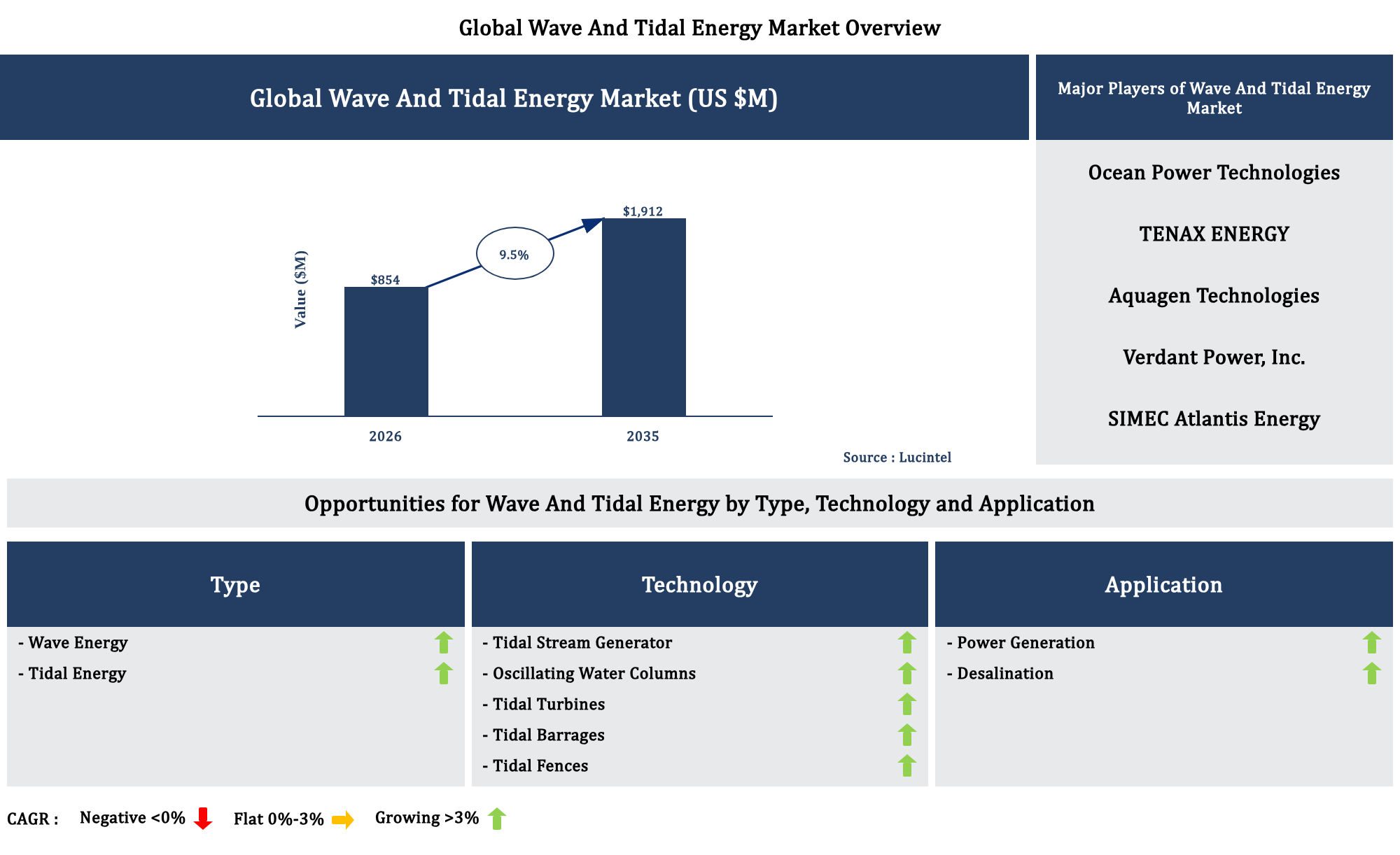
Wave And Tidal Energy Market

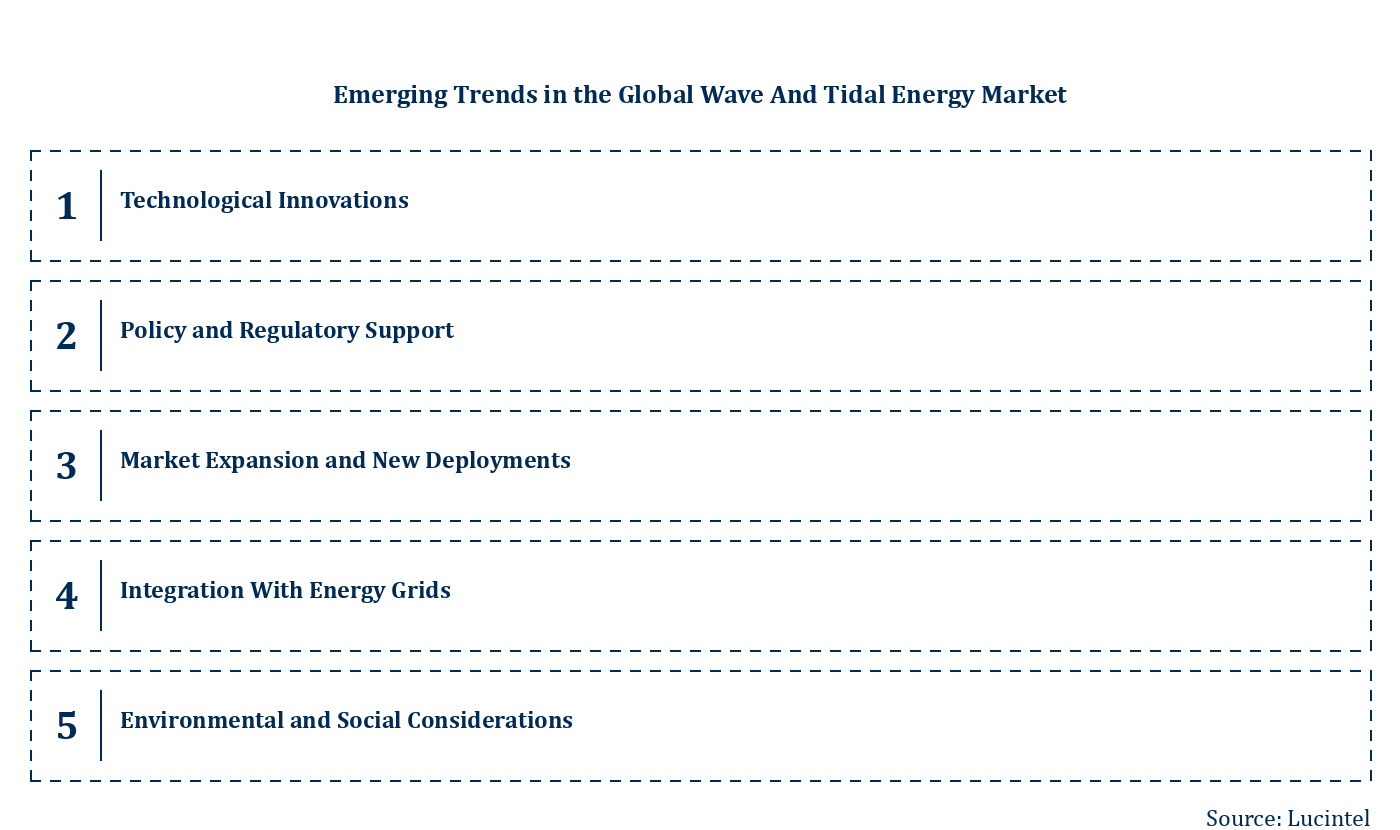
Emerging Trends in the Wave And Tidal Energy Market

The wave and tidal energy market is experiencing rapid growth driven by increasing global demand for renewable energy sources and technological advancements. As countries seek sustainable solutions to reduce carbon emissions, wave and tidal energy are emerging as promising options due to their predictability and high energy density. Innovations in turbine design, floating platforms, and grid integration are accelerating deployment. Additionally, supportive policies and investments are fostering market expansion. These developments are transforming the energy landscape, making wave and tidal power more viable and competitive with traditional energy sources. The following key trends highlight the market's evolving dynamics and future potential.

  • Technological Innovations: Advancements in turbine efficiency and floating platform designs are enhancing energy capture and reducing costs. New materials and engineering solutions improve durability and performance in harsh marine environments. These innovations enable larger-scale deployments and increase energy output, making wave and tidal energy more economically viable. As technology matures, the cost of energy from these sources is expected to decrease, attracting more investments and project developments. This trend is crucial for overcoming technical barriers and expanding market reach.
  • Policy and Regulatory Support: Governments worldwide are implementing supportive policies, incentives, and regulatory frameworks to promote marine renewable energy. Initiatives such as feed-in tariffs, tax credits, and research grants encourage project development and innovation. Strategic planning and marine spatial planning facilitate site selection and environmental assessments. These policies reduce investment risks and foster public-private partnerships. As regulatory environments become more favorable, market growth accelerates, attracting new players and increasing project pipelines.
  • Market Expansion and New Deployments: Increasing project installations in regions like Europe, North America, and Asia-Pacific are driving market growth. Pilot projects are transitioning into commercial-scale operations, demonstrating viability and attracting further investments. Emerging markets are exploring tidal stream and wave energy farms, expanding the geographic footprint. Large-scale projects and offshore deployments are becoming more common, contributing significantly to renewable energy portfolios. This expansion is creating new opportunities for technology providers, developers, and investors, fueling overall market development.
  • Integration with Energy Grids: Innovations in grid integration and energy storage are enabling better management of intermittent wave and tidal power. Hybrid systems combining marine energy with wind or solar are enhancing reliability and stability. Smart grid technologies facilitate efficient transmission and distribution, reducing losses and balancing supply and demand. These advancements improve the economic feasibility of marine energy projects and support grid decarbonization goals. As integration becomes more seamless, wave and tidal energy can play a more substantial role in national and regional energy mixes.
  • Environmental and Social Considerations: Increasing focus on environmental impact assessments and community engagement is shaping project development. Technologies are being designed to minimize ecological disturbances, such as impacts on marine life and habitats. Stakeholder involvement ensures social acceptance and addresses concerns related to marine activities. Monitoring and mitigation strategies are improving, reducing environmental risks. This trend promotes sustainable development and helps secure regulatory approvals, fostering a positive public perception. Responsible practices are essential for long-term market sustainability and community support.

These trends are collectively reshaping the wave and tidal energy market by making it more innovative, supportive, expansive, integrated, and sustainable. As technological, policy, and environmental factors align, the market is poised for significant growth, contributing to a diversified and resilient renewable energy landscape.
Wave And Tidal Energy Market by country

Recent Developments in the Wave And Tidal Energy Market

The wave and tidal energy market is experiencing rapid growth driven by technological advancements, increasing demand for renewable energy sources, and supportive government policies worldwide. As the world shifts towards sustainable solutions, wave and tidal energy offer significant potential for clean power generation. Recent developments are shaping the future landscape of this industry, creating new opportunities for investors, developers, and policymakers to harness the vast energy potential of oceans and tides.

  • Technological Innovations in Wave and Tidal Devices: The development of more efficient, durable, and cost-effective turbines and converters is revolutionizing the market. Breakthroughs in materials and design have increased energy capture efficiency and reduced maintenance costs. These innovations enable larger-scale deployments and improve economic viability, attracting more investments. As a result, the industry is poised for accelerated growth, with increased project success rates and expanded market reach across coastal regions globally.
  • Government Policies and Incentives: Governments worldwide are implementing supportive policies, subsidies, and tax incentives to promote wave and tidal energy projects. Regulatory frameworks are being streamlined to facilitate project approvals and grid integration. These measures reduce financial risks and encourage private sector participation. Enhanced policy support is expected to accelerate project development, increase capacity additions, and foster innovation, making wave and tidal energy a more competitive and attractive renewable energy option.
  • Strategic Partnerships and Collaborations: Industry players are forming strategic alliances with technology providers, research institutions, and financial institutions to accelerate development. Collaborations focus on pilot projects, technology testing, and scaling up deployment. These partnerships facilitate knowledge sharing, reduce costs, and improve project feasibility. As a result, the market benefits from increased innovation, faster commercialization, and expanded geographic reach, especially in emerging markets with high energy demands.
  • Growing Investment and Funding: Investment in wave and tidal energy projects is rising, driven by venture capital, government grants, and private equity. Funding supports research, pilot projects, and commercial-scale deployments. Increased financial backing enhances project viability and reduces risks associated with early-stage technologies. This influx of capital is crucial for overcoming technical and economic challenges, ultimately leading to more widespread adoption and commercialization of wave and tidal energy solutions.
  • Expansion of Sub-segments and Market Applications: The market is diversifying with new sub-segments such as hybrid systems combining wave and tidal energy, and applications in remote and island communities. These segments offer tailored solutions for specific needs, expanding market reach. Additionally, integration with other renewable sources enhances grid stability and energy security. The growth of these sub-segments broadens the market scope, creates new revenue streams, and accelerates the transition to sustainable energy systems worldwide.

The overall impact of these developments is a more robust, innovative, and economically viable wave and tidal energy market. Increased technological progress, supportive policies, strategic collaborations, and rising investments are driving faster deployment and wider adoption. These factors collectively position wave and tidal energy as a key component of the global renewable energy portfolio, contributing significantly to reducing carbon emissions and achieving energy security.

Strategic Growth Opportunities in the Wave And Tidal Energy Market

The wave and tidal energy market is poised for significant expansion driven by increasing demand for renewable energy sources, technological advancements, and supportive government policies. As global focus shifts toward sustainable solutions, investments in wave and tidal power projects are expected to grow, creating new opportunities across various applications. This market growth will not only enhance energy security but also contribute to reducing carbon emissions, fostering economic development, and encouraging innovation in marine energy technologies.

  • Expansion of Marine Energy Infrastructure: The development of dedicated wave and tidal energy farms in coastal regions offers substantial growth potential. Strategic investments in infrastructure, including underwater turbines and grid integration systems, will enable efficient harnessing of ocean energy. This expansion will facilitate increased energy generation capacity, attract private investments, and promote regional economic development, especially in areas with high tidal ranges and strong wave activity.
  • Technological Innovations in Wave and Tidal Devices: Advancements in turbine design, materials, and control systems are critical for improving efficiency and durability. Innovations such as floating platforms, subsea turbines, and smart grid integration will reduce costs and enhance performance. These technological improvements will make wave and tidal energy more competitive with traditional power sources, encouraging wider adoption and deployment across diverse geographic locations.
  • Growing Adoption in Remote and Island Communities: Wave and tidal energy offer reliable, renewable power solutions for isolated regions with limited grid connectivity. Deployment of small-scale, modular systems can provide sustainable electricity, reduce dependence on fossil fuels, and lower operational costs. This opportunity is particularly significant for island nations and remote coastal communities seeking energy independence and resilience against climate change impacts.
  • Policy Support and Regulatory Frameworks: Governments worldwide are implementing policies, incentives, and subsidies to promote marine renewable energy. Favorable regulatory environments, including streamlined permitting processes and financial incentives, will accelerate project development. These supportive frameworks will attract investments, foster public-private partnerships, and facilitate the commercialization of wave and tidal technologies on a larger scale.
  • Market Diversification Through Sub-segment Applications: The wave and tidal energy market can expand into various applications such as desalination, hydrogen production, and grid stabilization. Integrating marine energy with other sectors will diversify revenue streams and enhance overall market resilience. Developing hybrid systems and exploring new use cases will open additional revenue channels, broadening the scope of wave and tidal energy deployment globally.

These growth opportunities will significantly influence the wave and tidal energy market by fostering technological progress, expanding infrastructure, and enabling broader application. As stakeholders capitalize on these prospects, the market will experience accelerated growth, contributing to a sustainable energy future and supporting global climate goals.

Wave And Tidal Energy Market Drivers and Challenges

The wave and tidal energy market is influenced by a variety of technological, economic, and regulatory factors that shape its growth trajectory. Advances in renewable energy technology, government policies promoting clean energy, and increasing environmental awareness are key drivers. However, the market also faces challenges such as high capital costs, technological uncertainties, and regulatory hurdles that can impede progress. Understanding these drivers and challenges is essential for stakeholders to navigate the evolving landscape effectively and capitalize on emerging opportunities in this sustainable energy sector.

The factors responsible for driving the wave and tidal energy market include:-

  • Technological Advancements: The continuous development of more efficient and durable wave and tidal energy conversion technologies has significantly enhanced the feasibility and attractiveness of harnessing ocean energy. Innovations such as improved turbine designs and energy storage solutions reduce costs and increase energy output, making projects more economically viable. These technological improvements also enable better integration with existing power grids, fostering wider adoption. As research progresses, the potential for large-scale deployment grows, attracting investments and encouraging market expansion.
  • Government Policies and Incentives: Governments worldwide are implementing policies, subsidies, and incentives to promote renewable energy sources, including wave and tidal energy. These regulatory frameworks aim to reduce carbon emissions and meet climate commitments, providing financial support and favorable conditions for project development. Such policies lower barriers to entry, attract private investments, and accelerate technological deployment. Additionally, regulatory support often includes streamlined permitting processes, which further facilitate project implementation and market growth.
  • Environmental and Social Benefits: Wave and tidal energy are clean, renewable sources that produce minimal environmental impact compared to fossil fuels. Their utilization helps reduce greenhouse gas emissions and dependence on non-renewable resources. Moreover, these energy sources can contribute to local economic development through job creation and infrastructure development. The increasing societal focus on sustainability and environmental conservation drives demand for ocean energy projects, positioning wave and tidal energy as vital components of future energy portfolios.
  • Rising Energy Demand and Depleting Fossil Fuels: The global surge in energy consumption, coupled with the finite nature of fossil fuels, underscores the need for alternative energy sources. Wave and tidal energy offer a reliable and predictable supply, complementing intermittent renewable sources like wind and solar. As countries seek to diversify their energy mix and ensure energy security, investments in ocean energy are gaining momentum. This rising demand creates a favorable environment for market growth, encouraging technological innovation and infrastructure development.
  • Strategic Collaborations and Investments: Increasing collaborations between governments, research institutions, and private companies are fostering innovation and reducing risks associated with wave and tidal energy projects. Public-private partnerships and international funding initiatives support research, pilot projects, and commercialization efforts. These strategic alliances facilitate knowledge sharing, technological advancements, and cost reductions, accelerating market penetration. As investment flows into the sector, the confidence in commercial viability grows, further propelling market expansion.

The challenges facing the wave and tidal energy market include:-

  • High Capital and Operational Costs: Wave and tidal energy projects require substantial initial investments for infrastructure, technology development, and deployment. The high costs associated with constructing and maintaining marine energy devices, coupled with the need for specialized equipment and skilled labor, pose significant financial barriers. These costs often result in longer payback periods, deterring investors and slowing market growth. Additionally, operational expenses related to maintenance in harsh marine environments further impact project profitability, necessitating innovative cost-reduction strategies.
  • Technological Uncertainties and Reliability Issues: Despite advancements, wave and tidal energy technologies are still evolving, with some systems facing reliability and efficiency challenges. Marine conditions such as storms, corrosion, and biofouling can impair device performance and lifespan. The lack of standardized testing protocols and limited operational data hinder confidence among investors and developers. Overcoming these technological uncertainties requires extensive research, testing, and iterative improvements, which can delay commercialization and increase project risks.
  • Regulatory and Environmental Challenges: Navigating complex regulatory frameworks and obtaining necessary permits can be time-consuming and costly. Marine spatial planning, environmental impact assessments, and stakeholder consultations often involve lengthy processes, delaying project timelines. Additionally, concerns about potential impacts on marine ecosystems and navigation routes require careful mitigation strategies. Balancing environmental protection with energy development remains a critical challenge, necessitating clear policies and collaborative efforts among regulators, developers, and communities.

The wave and tidal energy market is driven by technological innovations, supportive policies, environmental benefits, rising energy demand, and strategic investments. However, high costs, technological uncertainties, and regulatory complexities pose significant hurdles. These factors collectively influence the pace and scale of market development. While opportunities for growth are substantial, addressing these challenges through technological, financial, and regulatory solutions is essential for realizing the full potential of ocean energy. The market's future will depend on how effectively stakeholders can leverage drivers and mitigate challenges to foster sustainable and scalable ocean energy solutions.

List of Wave And Tidal Energy Market Companies

Companies in the market compete on the basis of product quality offered. Major players in this market focus on expanding their manufacturing facilities, R&D investments, infrastructural development, and leverage integration opportunities across the value chain. Through these strategies wave and tidal energy market companies cater increasing demand, ensure competitive effectiveness, develop innovative products & technologies, reduce production costs, and expand their customer base. Some of the wave and tidal energy market companies profiled in this report include-

  • Ocean Power Technologies
  • TENAX ENERGY
  • Aquagen Technologies
  • Verdant Power, Inc.
  • SIMEC Atlantis Energy
  • Corpower Ocean AB
  • Carnegie Wave Energy Ltd.
  • Eco Wave Power
  • Pelamis Wave Power
  • Ocean Renewable Power Company

Wave And Tidal Energy Market by Segment

The study includes a forecast for the global wave and tidal energy market by type, technology, application, and region.

  • Wave and Tidal Energy Market by Type [Value from 2019 to 2035]:
    • Wave Energy
    • Tidal Energy
  • Wave and Tidal Energy Market by Technology [Value from 2019 to 2035]:
    • Tidal Stream Generator
    • Oscillating Water Columns
    • Tidal Turbines
    • Tidal Barrages
    • Tidal Fences
  • Wave and Tidal Energy Market by Application [Value from 2019 to 2035]:
    • Power Generation
    • Desalination
  • Wave And Tidal Energy Market by Region [Value ($M) from 2019 to 2035]:
    • North America
    • Europe
    • Asia Pacific
    • The Rest of the World

Country Wise Outlook for the Wave And Tidal Energy Market

The wave and tidal energy market is experiencing rapid growth driven by increasing global demand for renewable energy sources, technological advancements, and supportive government policies. As countries seek sustainable solutions to reduce carbon emissions, investments in marine energy projects are expanding. Innovations in turbine design, energy storage, and grid integration are enhancing efficiency and feasibility. The market's development varies across regions, influenced by geographic, economic, and regulatory factors. Understanding these regional trends is crucial for stakeholders aiming to capitalize on emerging opportunities in this promising sector.

  • United States: The U.S. has seen significant investments in wave and tidal energy projects, with key developments in California, Oregon, and the Northeast. Technological innovations, such as improved turbine designs and grid integration solutions, are boosting project viability. Federal and state policies are providing incentives, fostering a conducive environment for research and commercialization. Several pilot projects are progressing toward commercial scale, and collaborations between government agencies and private firms are accelerating deployment.
  • China: China is rapidly advancing in marine energy, focusing on tidal power projects along its eastern coast. The government has prioritized renewable energy, including wave and tidal, as part of its broader energy transition strategy. Major investments are being made in research, infrastructure, and pilot projects, with a goal to reduce reliance on fossil fuels. Domestic companies are developing innovative turbine technologies, and international partnerships are fostering knowledge exchange and technology transfer.
  • Germany: Germany's focus on marine energy is primarily driven by its commitment to the European Union's renewable targets. The country is investing in pilot projects and research initiatives to harness tidal and wave energy potential in the North Sea. Regulatory frameworks and funding programs are supporting innovation and commercialization efforts. Germany is also exploring hybrid systems combining wave and tidal energy with other renewable sources to optimize energy output.
  • India: India is exploring wave and tidal energy as part of its broader renewable energy strategy to address energy security and reduce emissions. Coastal states like Gujarat and Tamil Nadu are conducting feasibility studies and pilot projects. The government is providing policy support and funding to develop marine energy infrastructure. Technological research is ongoing to adapt existing turbines for local conditions, with a focus on cost reduction and scalability.
  • Japan: Japan is actively developing wave and tidal energy projects, leveraging its extensive coastline and technological expertise. The country has launched pilot projects in regions like Fukushima and Nagasaki, aiming to commercialize marine energy. Japan's government and private sector are investing in innovative turbine designs and grid integration solutions. Post-Fukushima energy policies emphasize renewable sources, positioning marine energy as a key component of Japan's sustainable energy future.

Features of the Wave And Tidal Energy Market

  • Market Size Estimates: Wave and tidal energy market size estimation in terms of value ($M).
  • Trend and Forecast Analysis: Market trends (2019 to 2025) and forecast (2026 to 2035) by various segments and regions.
  • Segmentation Analysis: Wave and tidal energy market size by type, technology, application, and region in terms of value ($M).
  • Regional Analysis: Wave and tidal energy market breakdown by North America, Europe, Asia Pacific, and Rest of the World.
  • Growth Opportunities: Analysis of growth opportunities in different types, technology, applications, and regions for the wave and tidal energy market.
  • Strategic Analysis: This includes M&A, new product development, and competitive landscape of the wave and tidal energy market.
  • Analysis of competitive intensity of the industry based on Porter’s Five Forces model.

Top 5 Companies

  • Ocean Power Technologies
  • TENAX ENERGY
  • Aquagen Technologies
  • Verdant Power, Inc.
  • SIMEC Atlantis Energy

Table of Contents

1. Executive Summary
14.1 Competitive Analysis Overview

List of Figures

List of Tables

Methodology

Lucintel has been in the business of market research and management consulting since 2000 and has published over 1000 market intelligence reports in various markets / applications and served over 1,000 clients worldwide. This study is a culmination of four months of full-time effort performed by Lucintel's analyst team. The analysts used the following sources for the creation and completion of this valuable report:

  • In-depth interviews of the major players in this market
  • Detailed secondary research from competitors' financial statements and published data
  • Extensive searches of published works, market, and database information pertaining to industry news, company press releases, and customer intentions
  • A compilation of the experiences, judgments, and insights of Lucintel's professionals, who have analyzed and tracked this market over the years.

Extensive research and interviews are conducted across the supply chain of this market to estimate market share, market size, trends, drivers, challenges, and forecasts. Below is a brief summary of the primary interviews that were conducted by job function for this report.

Lucintel's methodology for market research

Thus, Lucintel compiles vast amounts of data from numerous sources, validates the integrity of that data, and performs a comprehensive analysis. Lucintel then organizes the data, its findings, and insights into a concise report designed to support the strategic decision-making process. The figure below is a graphical representation of Lucintel's research process.

Primary interviews by job function

Buy Now

Choose a license that fits your team. Instant PDF delivery.

Market Report

1 User PDF

$4,850
Buy Now

Market Report

2-5 Users PDF

$6,700
Buy Now

Market Report

Corporate PDF

$8,850
Buy Now

Market Report

Global PDF

$10,000
Buy Now

Prices exclude taxes. Instant delivery. Custom licensing available on request.

Frequently Asked Questions

What is the wave and tidal energy market size?
The global wave and tidal energy market is expected to reach an estimated $1,912 million by 2035.
What is the growth forecast for wave and tidal energy market?
The global wave and tidal energy market is expected to grow with a CAGR of 9.5% from 2026 to 2035.
What are the major drivers influencing the growth of the wave and tidal energy market?
The major drivers for this market are the increasing demand for renewable energy sources, the rising investment in ocean energy projects, and the growing adoption of sustainable power generation technologies.
What are the major segments for wave and tidal energy market?
The future of the wave and tidal energy market looks promising with opportunities in the power generation and desalination markets.
Who are the key wave and tidal energy market companies?

Some of the key wave and tidal energy companies are as follows:

  • Ocean Power Technologies
  • TENAX ENERGY
  • Aquagen Technologies
  • Verdant Power, Inc.
  • SIMEC Atlantis Energy
  • Corpower Ocean AB
  • Carnegie Wave Energy Ltd.
  • Eco Wave Power
  • Pelamis Wave Power
  • Ocean Renewable Power Company
Which wave and tidal energy market segment will be the largest in future?
Lucintel forecasts that, within the type category, wave energy will remain a larger segment over the forecast period.
In wave and tidal energy market, which region is expected to be the largest in next 9 years?
In terms of region, North America will remain the largest region over the forecast period.
Do we receive customization in this report?
Yes, Lucintel provides 10% customization without any additional cost.

Key Questions

  • What are some of the most promising, high-growth opportunities for the wave and tidal energy market by type (wave energy and tidal energy), technology (tidal stream generator, oscillating water columns, tidal turbines, tidal barrages, and tidal fences), application (power generation and desalination), and region (North America, Europe, Asia Pacific, and the Rest of the World)?
  • Which segments will grow at a faster pace and why?
  • Which region will grow at a faster pace and why?
  • What are the key factors affecting market dynamics? What are the key challenges and business risks in this market?
  • What are the business risks and competitive threats in this market?
  • What are the emerging trends in this market and the reasons behind them?
  • What are some of the changing demands of customers in the market?
  • What are the new developments in the market? Which companies are leading these developments?
  • Who are the major players in this market? What strategic initiatives are key players pursuing for business growth?
  • What are some of the competing products in this market and how big of a threat do they pose for loss of market share by material or product substitution?
  • What M&A activity has occurred in the last 6 years and what has its impact been on the industry?
Why Choose Us

The Lucintel Advantage

Trusted partner for strategic intelligence and business growth

25+ Years Excellence

25+ Years Excellence

Quarter century of proven expertise in management consulting and market research across global markets.
Game-Changer Ideas

Game-Changer Ideas

Innovative strategies and actionable insights that help clients become the smartest in their industry.
Global Reach

Global Reach

Extensive coverage across 50+ industries and markets worldwide with localized expertise.
Start Your Growth Journey

Get Your Free
Market Intelligence
Briefing

Receive a complimentary market analysis tailored to your industry. Our analysts will identify key growth opportunities and competitive dynamics specific to your business.

Custom Market Snapshot

Market size, growth rate, and key trend analysis for your specific sector.

Competitive Landscape Overview

Top competitor positioning and market share analysis.

Growth Opportunity Identification

Strategic recommendations backed by data-driven insights.

Subscribe

Subscribe to our Newsletter

Get curated market intelligence and competitive moves straight to your inbox.

By subscribing, you agree to receive our monthly insights. Unsubscribe anytime.

Industry Trends Market Signals Opportunities Competitor Moves