
Market Report · July 22, 2026

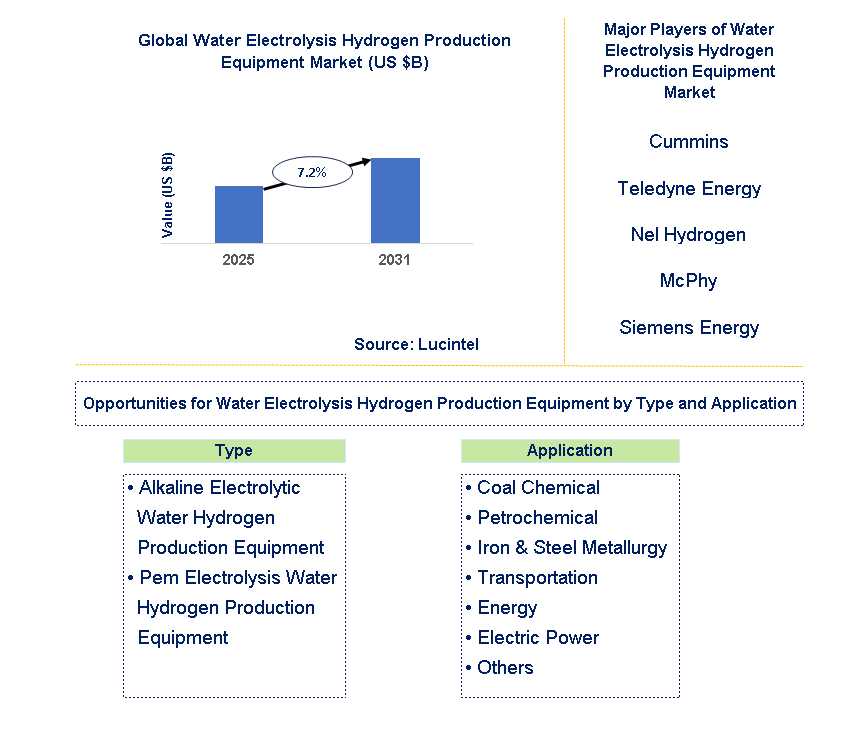
Key data points: The growth forecast = 7.2% annually for the next 7 years. Scroll below to get more insights. This market report covers Trends, opportunities and forecasts in water electrolysis hydrogen production equipment market to 2031 by type (alkaline electrolytic water hydrogen production equipment and PEM electrolysis water hydrogen production equipment), application (coal chemical, petrochemical, iron & steel metallurgy, transportation, energy, electric power, and others), and region (North America, Europe, Asia Pacific, and the Rest of the World)
We'll send your sample report shortly.
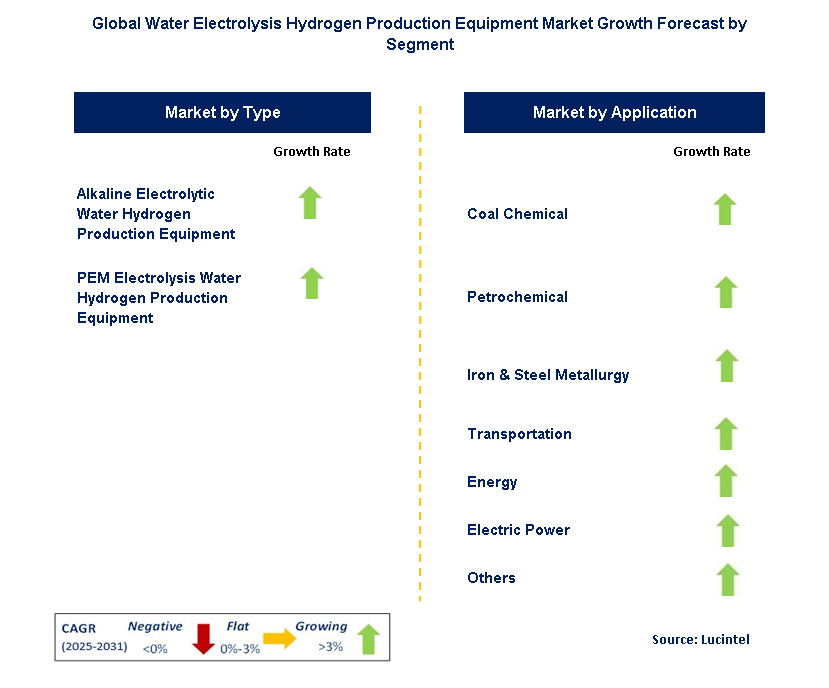
• Lucintel forecasts that, within the type category, PEM electrolysis water hydrogen production equipment is expected to witness higher growth over the forecast period.
• Within the application category, energy industry is expected to witness the highest growth due to increasing use as a clean fuel for power generation.
• In terms of region, Europe is expected to witness the highest growth over the forecast period due to the region's pioneering role in sustainable energy solutions.
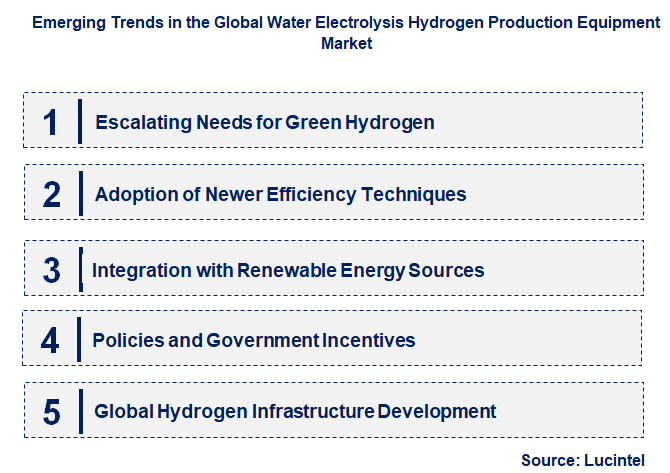
• Escalating Needs for Green Hydrogen : An increase in sustainability focus worldwide is increasing the need for green hydrogen made through water electrolysis. With governments trying to implement more aggressive cuts in emissions, there is higher demand to switch to cleaner energy sources. This trend has seen investment projects being set up to develop water electrolysis technologies to capture increasing demand, lower carbon emissions, and add hydrogen into power systems. Such demand is especially acute in the transportation, industrial, and power generation sectors.
• Adoption of Newer Efficiency Techniques: Innovations in the design, materials, and processes implemented in electrolyzes is making water electrolysis cheaper. With technological breakthroughs that create more effective systems, the price of electrolysis equipment is likely to decline. There is a primary focus of making electrolyzes more effective in lowering energy use and increasing their lifespan. These changes are necessary if green hydrogen is ever to become economically priced in competition with fossil fuel-based hydrogen.
• Integration with Renewable Energy Sources: Water electrolysis is being integrated alongside renewable energy resources optimally wind energy and solar power to produce energy for green hydrogen. The shift towards cheaper renewable energy has advanced the viability of electrolysis, which enables the generation of hydrogen without the use of fossil fuels. This development is crucial for the regions globally which have high renewable energy resources including the US, parts of Europe, and Asia. There is a movement in the intersection of renewable energy and electrolysis technology that will foster the development of sustainable hydrogen production ecosystems.
• Policies and Government Incentives: All around the world, governments are starting to issue new and more attractive policies and offer financial incentives which support the growth of water electrolysis technologies. These policies focus on effecting more rapid deployment of green hydrogen within the frameworks of national energy transition plans. The proliferation of grants, tax credits and subsidized funds is enabling businesses to undertake the scaling of electrolysis projects. The contribution from governments is set to increase especially for the development of hydrogen technologies.
• Global Hydrogen Infrastructure Development: In order to improve the adoption of hydrogen produced through water electrolysis, there is an increasing emphasis on developing the infrastructure for hydrogen, which includes pipelines, storage facilities, and distribution networks. Such infrastructure is important to ensure the use of hydrogen in various industries is done in an efficient manner. It is anticipated that international relationships will help develop the global infrastructure for hydrogen at an accelerated pace, so that hydrogen production, storage, and transportation will be done in a streamlined manner. These changing dynamics are likely to foster competition and cause innovations, lowered prices, and a greater feasibility of hydrogen as an energy source, and these trends are all changing the water electrolysis hydrogen production equipment market. It is rendering the use of hydrogen feasible as one of the primary aspects in the transition towards a global energy system.
• Technological Innovation in Electrolysis: The most recent developments in electrolyze technologies, including processes such as water electrolysis, proton exchange membrane (PEM) and anion exchange membrane (AEM) electrolyzes, are increasing the efficiency and effectiveness of electrolyzes. Efficiency improvements allow for a higher production of hydrogen while lowering energy expenditure and increasing system life. Siemens and Thyssenkrupp are spearheading the commercialization of such advanced electrolyzes, hence improving their suitability for use in extensive applications.
• Growth in Green Hydrogen Initiatives: There is a noticeable increase in global initiatives to implement green hydrogen projects that rely on water electrolysis. Many countries and regions are implementing electrolytic green hydrogen production projects for local consumptions as well as exports. For example, countries within the European Union and the Middle East are developing projects aimed at producing hydrogen for industrial and transport uses via water electrolysis with renewable energy. This is a clear sign that there is an emerging need for additional electrolysis capacity infrastructure.
• Partnerships and Collaborations: Many companies have begun forming strategic partnerships and joint ventures to strengthen their capacity in water electrolysis hydrogen production. Collaborations among oil and gas companies, technology vendors, and government agencies are speeding up the realization of integrated hydrogen megaprojects. The collaboration between Air Products and ACWA Power to construct a green hydrogen facility in Saudi Arabia is one such example of global partnership in the industry.
• Government Support and Investment: Investments by nations around the world on hydrogen technologies is on the rise. Substantial funding has been earmarked by the US and EU for hydrogen development which incorporates water electrolysis funding. This monetary assistance is growing, which in turn is propelling the market to be more favorable to other private investors to increase their production of hydrogen fuel. The existence of government subsidized funding or grants has minimized the losses expected from hydrogen projects, thus increasing the willingness of investors to support them.
• Expanding Electrolysis Capacity: There has been a focus on increasing electrolyze production capacity to match the global demand for hydrogen. Economies of scale are starting large-scale electrolyze manufacturing plants to produce these devices at higher quantities and lower prices. Nel Hydrogen, ITM Power, and other manufacturers are boosting their electrolyze production capacities to meet the increasing demand of green hydrogen. Achieving these targets will be essential for enabling greater hydrogen technology adoption. These initiatives are helping to overcome several barriers to entry in the market, such as the cost of water electrolysis hydrogen production equipment and scalability. These measures are progressing the market and facilitating the development of a global hydrogen economy.
• Integration of the Energy Sector: Integrating water electrolyzes technology into wind and solar energy sources is a major opportunity area. It permits the generation of hydrogen as an answer to excess renewable energy storage. With increasing production of renewable energy, the systems required for the full-scale production and storage of hydrogen will steadily rise since there will be greater need. This enhances the market scope for electrolyze manufacturers.
• Decarbonization of Industry: Industries, like steel, chemicals, and cement, are highly carbon loaded and water electrolysis offers change. These industries use hydrogen extensively in their processes and switching to green hydrogen derived from electrolysis means lower carbon emissions. Industries are looking to meet the stringent environmental regulations, thus, electrolyzes meant to produce high purity hydrogen for industrial use would see high demand.
• Transport Sector: There has been growing focus towards hydrogen solutions in the transport sector as is seen in the case of heavy-duty and long-haul trucks, buses, and ships. Electrolysis based hydrogen fuel cells is a preferred choice over conventional fuels. Clean transport has been made a priority by different governments and so has the need for infrastructure and equipment for hydrogen fuel production.
• Residential and Commercial Applications: The development of small water electrolysis units for residential and commercial use presents emerging prospects. These units can generate hydrogen for heating, power generation, and backup applications. With the increase in the residential clean energy solution market, electrolyze producers have an opportunity to focus on compact and cost-efficient systems for smaller-scale applications.
• Export of Green Hydrogen: Renewable Energy Powerhouses like the Middle East and Australia have the capacity to produce and export green hydrogen. The excess renewable energy can be converted into hydrogen for export markets using electrolyzes. This enables these countries to build hydrogen infrastructure and export systems, making them prominent competitors in the global hydrogen market. The strategic growth opportunities in the target hardware market of water electrolysis hydrogen production are significant since the opportunities are multi-faceted. These prospects will contribute to the innovative and market growth in the coming years.
• Cummins
• Teledyne Energy Systems
• Nel Hydrogen
• McPhy
• Siemens Energy
• Hygear
• Areva H2Gen
• Asahi Kasei
• Thyssenkrupp
• Idroenergy
• Alkaline Electrolytic Water Hydrogen Production Equipment
• PEM Electrolysis Water Hydrogen Production Equipment
• Coal Chemical
• Petrochemical
• Iron & Steel Metallurgy
• Transportation
• Energy
• Electric Power
• Others
• North America
• Europe
• Asia Pacific
• The Rest of the World
• US: The United States has been actively pursuing the advancement of hydrogen production via water electrolysis. The federal government is putting up clean hydrogen technology infrastructure funding opportunities and other aid programs to stimulate production. The Electrolyze systems also benefit from public and private sector funding due to IIJA’s clean hydrogen / electrolysis integration. There is a growing number of economical Plug Power and Nel Hydrogen pilot projects also taking place in California and Texas. Furthermore, electrolysis is now being considered for use with wind and solar energy generation for the purpose of producing green hydrogen.
• China: China is emerging as a heavyweight player in clean hydrogen production due to their spending on hydrogen infrastructure and technological development. Their government is promoting water electrolysis as part of a larger energy transition, and set national goals for production in 2023. Sinopec and State Grid are also leading the charge in hydrogen production, and construction of new large scale China electrolyze projects is underway. In addition, the government is concentrating efforts towards economically making green hydrogen by enhancing the efficiency and lowering the cost of electrolysis.
• Germany: Germany remains at the forefront of water electrolysis and hydrogen production because of its commemoration to become carbon neutral by 2045. The German government has recently adopted the National Hydrogen Strategy which aims at fostering the development of hydrogen production technologies such as water electrolysis. Projects like the Westchester 100 aim to utilize electrolysis by supplying green hydrogen to the industry as well as the transport sector. Alongside, Germany is also trying to increase electrolysis capacities and develop hydrogen infrastructure in Europe for wider inter-country trade of hydrogen.
• India: India has also started realizing the importance of water electrolysis as a means to achieve a low carbon emissions economy. The Indian government’s National Hydrogen Mission launched in 2021 seeks to advance the production of hydrogen using water electrolysis from both domestic and international sources. The nation also aims at implementing electrolysis into the decarbonization of the steel and fertilizer industries. Renew Power is one of the companies that is adopting electrolyzes in India’s renewable energy projects and thus aid the country’s green hydrogen strategy.
• Japan: Japan has worried about its energy security and decarbonization for a while now, which makes their investment in water electrolysis technology not shocking. The Japanese government aims to green the hydrogen economy and is putting considerable effort into developing water electrolysis technologies for domestic use and export. Toshiba, Mitsubishi Heavy Industries, and NTT are leading the development of various electrolyze projects aimed at supplying substantial hydrogen fuel for transport and industry. Japan is also looking to form international collaborations to create a global hydrogen supply chain.


• Cummins
• Teledyne Energy Systems
• Nel Hydrogen
• McPhy
• Siemens Energy
• Hygear
• Areva H2Gen
• Asahi Kasei
• Thyssenkrupp
• Idroenergy Q5. Which water electrolysis hydrogen production equipment market segment will be the largest in future? Answer: Lucintel forecasts that, within the type category, PEM electrolysis water hydrogen production equipment is expected to witness higher growth over the forecast period. Q6. In water electrolysis hydrogen production equipment market, which region is expected to be the largest in next 5 years? Answer: In terms of region, Europe is expected to witness the highest growth over the forecast period due to the region's pioneering role in sustainable energy solutions. Q7. Do we receive customization in this report? Answer: Yes, Lucintel provides 10% customization without any additional cost.


Choose a license that fits your team. Instant PDF delivery.
Prices exclude taxes. Instant delivery. Custom licensing available on request.
Market Report · July 22, 2026
Market Report · July 22, 2026
Market Report · July 17, 2026
Trusted partner for strategic intelligence and business growth


Receive a complimentary market analysis tailored to your industry. Our analysts will identify key growth opportunities and competitive dynamics specific to your business.

Market size, growth rate, and key trend analysis for your specific sector.

Top competitor positioning and market share analysis.

Strategic recommendations backed by data-driven insights.
Get curated market intelligence and competitive moves straight to your inbox.
By subscribing, you agree to receive our monthly insights. Unsubscribe anytime.
Receive a complimentary market analysis tailored to your industry. Our analysts will identify key growth opportunities and competitive dynamics specific to your business.
Market size, growth rate, and key trend analysis for your specific sector.
Top competitor positioning and market share analysis.
Strategic recommendations backed by data-driven insights.
Get curated market intelligence, emerging trends, and competitive moves straight to your inbox each month.
By subscribing, you agree to receive our monthly insights. Unsubscribe anytime.
We'll send your sample report shortly.