
Market Report · July 22, 2026

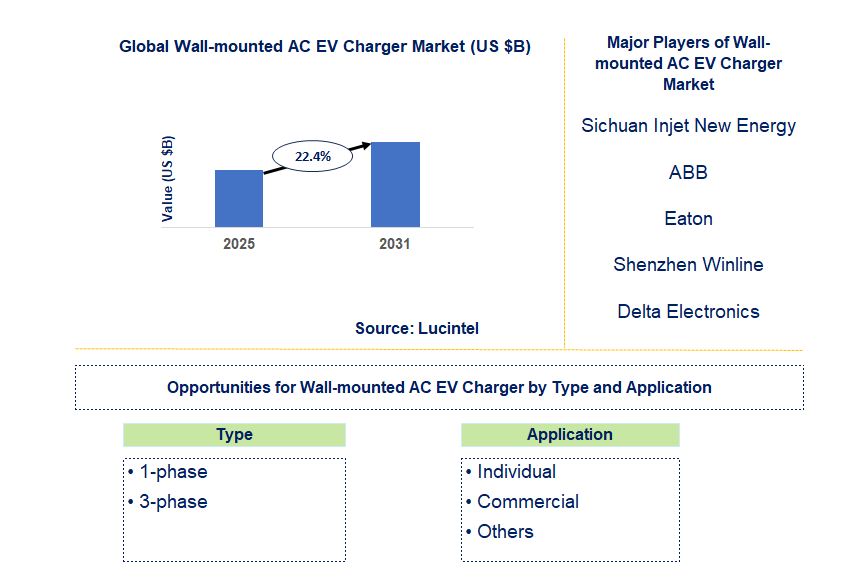
Key data points: The growth forecast = 22.4% annually for the next 7 years. Scroll below to get more insights. This market report covers Trends, opportunities and forecasts in wall-mounted AC EV charger market to 2031 by type (1-phase and 3-phase), application (individual, commercial, and others), and region (North America, Europe, Asia Pacific, and the Rest of the World)
We'll send your sample report shortly.
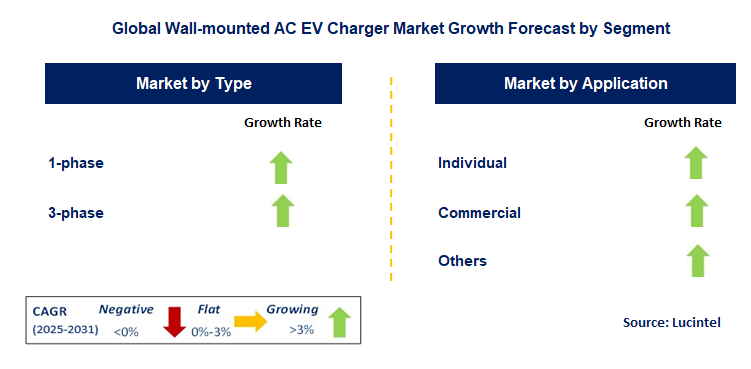
• Lucintel forecasts that, within the type category, 3-phase is expected to witness higher growth over the forecast period due to the increasing power requirements.
• Within the application category, commercial is expected to witness higher growth due to the rising demand for fleet charging solutions.
• In terms of region, APAC is expected to witness the highest growth over the forecast period due to the growing government incentives.
• Smart Home System Integration: Integration with smart home systems is a rapidly emerging trend in the wall-mounted AC EV charger market. With increasing consumers embracing smart home technology, the need for mobile app or voice assistant-controlled chargers is on the rise. Such chargers enable users to track and manage EV charging remotely, optimizing energy usage and saving money. Smart chargers can also be set to charge cars during off-peak times, when electricity prices are lower. The emergence of smart homes and the integration of IoT (Internet of Things) is driving the growth of smart wall-mounted chargers.
• Emphasis on Fast Charging Technology: While AC charging is conventional compared to DC fast charging, which takes longer, manufacturers are laying more emphasis on accelerating the speed of wall-mounted AC chargers. New technologies like greater-power chargers and sophisticated charging algorithms are decreasing charging times, which is drawing EV owners towards wall-mounted chargers. With quicker charging times, consumers get greater convenience and less downtime while their cars charge at home. The trend is likely to continue as electric car ownership becomes more widespread and quicker, more efficient charging is a growing concern for consumers.
• Wireless Charging Solutions: Wireless or inductive charging is becoming a viable substitute for conventional plug-in wall-mounted chargers. This technology does away with the physical connectors and provides a more hassle-free and convenient charging experience. Wireless charging options are becoming popular because they provide an effortless charging experience for EV drivers. Although the technology is new, it is likely to increase as electric vehicle models and charging stations include this feature, making more choices available for home-based EV charging.
• More Use of Renewable Energy: With the increasing momentum for sustainability, there is also an emerging trend of using renewable sources of energy, including solar power, with wall-mounted AC EV chargers. With many consumers looking to charge their electric vehicles with clean energy, solar panels are increasingly being used as a preferred option. Some companies provide charging units that are compatible with solar panels so that homeowners can use solar energy to power their EVs. This is not just environmentally friendly but also minimizes the carbon footprint from charging electric vehicles.
• Increased Safety Features: With increased EV and home charger adoption, safety features on wall-mounted AC chargers are becoming more important. Companies are placing greater emphasis on safety features to safeguard consumers and avoid accidents. Safety features like overcurrent protection, voltage surge protection, and thermal sensors are becoming the norm in newer models. These added safety features help ensure that wall-mounted chargers function safely in home settings, providing consumers with peace of mind. More advanced safety features are likely to be a main selling point for manufacturers competing in the EV charger market.
These new trends are transforming the Wall-mounted AC EV Charger market by making it more convenient, eco-friendly, and secure. Smart technology integration, quick charging capabilities, renewable energy technologies, wireless charging, and improved safety features are all converging to make home EV charging easier and more efficient. These trends will increasingly propel the usage of wall-mounted AC chargers, driving the growth of the electric vehicle industry globally.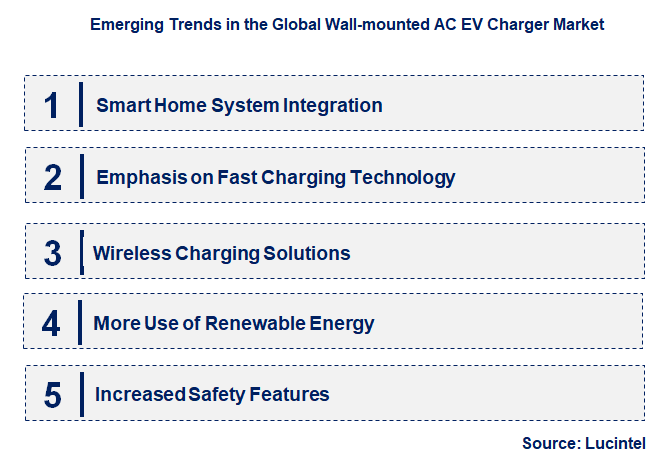
• Charging Speed Technological Innovations: Latest developments in technology have concentrated on increasing the charging speed of wall chargers. With the implementation of more powerful charging solutions and optimization of charging algorithm efficiency, charging speed is now achieved at the chargers. This is particularly critical for homeowners who own multiple EVs or those that need to have home charging as a source of replenishment of their cars. These advancements render wall-mounted chargers a more feasible and desirable choice for consumers requiring fast charging at home.
• Automaker-Charging Company Partnerships: One emerging trend in the market is collaborations between automakers and charging companies to offer integrated home charging solutions. Automakers such as Tesla and Rivian are collaborating with charging manufacturers to provide tailored charging solutions that support their electric vehicle models. These collaborations make charging easier for consumers and ensure chargers are optimized for certain vehicle types. As more auto manufacturers move into the EV market, we anticipate further growth in these collaborations that bolsters the wall-mounted AC charger market.
• Government Incentives and Regulations: Governments globally are increasingly providing incentives for installing EV chargers in homes, which in turn is increasing the demand for wall-mounted AC chargers. These incentives may be in the form of tax credits, rebates, and subsidies, reducing the cost of consumers to install home charging products. Additionally, governments are implementing regulations that mandate new constructions to incorporate EV charging facilities, driving the adoption of wall-mounted chargers. These regulations and incentives are important to fuel the development of the wall-mounted AC EV charger market.
• Emphasis on Sustainability and Reduction of Carbon Footprint: The emphasis on sustainability is fueling the creation of environmentally friendlier wall-mount AC chargers. Producers are adding functionalities such as solar panel inclusion, energy-saving charging algorithms, and lower carbon footprints in their manufacturing process for these chargers. Such green functionalities support initiatives worldwide to lower carbon emissions and adopt clean energy. As awareness of climate change among consumers grows, eco-friendly household charging solutions will continue to increase.
• EV Charging Network Expansion in Residential Spaces: There is increasing focus on the development of EV charging infrastructure in residential spaces. Along with public charging points, greater focus is being given to making home charging solutions more mainstream. Businesses are focusing on creating affordable, easy-to-use wall-mounted AC chargers that can be easily fitted in homes. As electric vehicles gain greater traction among consumers, making home charging solutions mainstream will be key to enabling the adoption of EVs.
These developments are profoundly impacting the Wall-mounted AC EV Charger market. From technological innovation to government support, these developments are contributing to more efficient, accessible, and sustainable home-based charging. The future is bright for the market, with these developments setting the stage for greater adoption of electric vehicles and charging infrastructure.• Residential Charging Solutions: With the increasing adoption of electric vehicles, there is also immense potential for the residential charging market to grow. Homeowners are looking for convenient, affordable options to charge their homes. Wall-mounted AC chargers find it easy to tap into this market because they are cheaper and easy to install. Innovative features like smart charging and solar integration can help firms grab a large pie from this market that is expanding.
• Integration with Solar Energy Systems: The combination of solar power systems with wall-mounted AC chargers offers a huge growth opportunity. Consumers are seeking options to charge their electric cars using renewable sources of energy, so solar-powered charging is very appealing. With the cooperation of solar companies or the provision of bundled packages, charging companies can ride on the increasing popularity of green energy solutions. The trend will be sustained as the call for sustainability increases.
• Commercial and Public Charging Infrastructure: Whereas home charging continues to be an important market, growth is also significant in public and commercial charging infrastructure. Enterprises, shopping sites, and municipalities are all becoming more frequent adopters of EV charging stations in order to satisfy increasing numbers of electric vehicle buyers. Offering easily scalable, reliable wall-mounted AC chargers to these sites has the potential to unlock new markets for manufacturers. With the increasing demand for greater numbers of public charging stations, this market is going to continue growing.
• Low-Cost Charging Solutions for Developing Markets: In developing economies like India and some areas of Africa, there is high demand for low-cost and efficient charging solutions. Wall-mounted AC chargers are appropriate for these markets because they are inexpensive and easy to install. Manufacturers can tap untapped markets by creating region-specific solutions that address local requirements and become a key driver in the global electrification of vehicles.
• Government Incentive and Partnership Programs: Governments around the globe are establishing regulations and incentives to support EV adoption and the installation of residential charging points. Companies can tap into these government programs to increase their market footprint. Governments and utilities, through partnerships, can provide discounts, subsidies, or tax breaks for the installation of wall-mounted AC chargers, providing great growth opportunities for businesses in the industry.
These opportunities for strategic growth are critical for firms hoping to grow their presence in the Wall-mounted AC EV Charger market. From residential-based solutions and solar integrations to commercial infrastructure and access to expanding markets, manufacturers can leverage these trends to facilitate growth. By positioning their strategies according to these opportunities, firms can position themselves to be leaders in the soon-to-arrive EV charging market.• Sichuan Injet New Energy
• ABB
• Eaton
• Shenzhen Winline Technology
• Delta Electronics
• Cord Power Technologies
• EVB
• Weidmüller
• EVESCO
• Lectron
• 1-phase
• 3-phase
• Individual
• Commercial
• Others
• North America
• Europe
• Asia Pacific
• The Rest of the World
• United States: The United States has witnessed a significant drive for EV charging infrastructure expansion, aided by federal and state incentives. Wall AC chargers are becoming more popular because they are inexpensive and easy to install. Numerous companies, such as Tesla, ChargePoint, and others, have rolled out new models with sophisticated features such as smart charging and app connectivity. Federal policies are promoting the installation of these chargers in residential complexes, with big investments being made to grow the EV network nationwide. These developments help to make EV ownership easier and more accessible.
• China: In China, the Wall-mounted AC EV charger market is expanding steadily as a result of the government's aggressive efforts to curb carbon emissions and encourage electric mobility. The nation has emerged as an international front-runner in EV manufacturing, and the use of wall-mounted chargers in residential settings is increasingly widespread. Producers such as BYD and NIO are at the forefront of the provision of charging solutions for use at home. The Chinese government has also established different policies supporting the subsidizing of home charging station installations to further promote their use in residential homes throughout China.
• Germany: Germany, known for its reliability on sustainability as well as its energy transition policies, has maintained a consistent boost in the market for Wall-mounted AC EV chargers. Being one of the top electric vehicle markets in Europe, Germany is working to make home charging more convenient and efficient. Key players like Siemens and Bosch in Germany are working to create advanced wall-mounted chargers that incorporate renewable energy and smart home systems. Government subsidies and incentives for domestic charging installations are increasing the demand for wall-mounted chargers in the nation, which is crucial in helping the nation achieve its EV targets.
• India: India, an emerging market for electric vehicles, is seeing a gradual increase in demand for domestic EV charging solutions, specifically wall-mounted AC chargers. Although EV uptake is in the nascent stage, government incentives, coupled with increasing environmental concerns, are fueling the market. The use of wall-mounted chargers is gaining traction in cities, particularly due to the popularity of electric two-wheelers and four-wheelers. Indian businesses such as Tata Power and others are making efforts to ramp up the EV charging network, focusing on affordable options such as wall-mounted chargers.
• Japan: Japan is another leader in the EV market, and wall-mounted AC chargers' demand is building as the government strives to embrace electric vehicle growth. Japanese motor companies like Nissan and Toyota are investing in in-home charging mechanisms that suit family homes. Further, government interventions and subsidies toward embracing EV are reducing the prices of home chargers. Japan's technological innovation in energy storage and integration is also driving the creation of innovative wall-mounted AC chargers that are efficient and easy to use.


• Sichuan Injet New Energy
• ABB
• Eaton
• Shenzhen Winline Technology
• Delta Electronics
• Cord Power Technologies
• EVB
• Weidmüller
• EVESCO
• Lectron
Q5. Which wall-mounted AC EV charger market segment will be the largest in future?

Choose a license that fits your team. Instant PDF delivery.
Prices exclude taxes. Instant delivery. Custom licensing available on request.
Market Report · July 22, 2026
Market Report · July 22, 2026
Market Report · July 17, 2026
Trusted partner for strategic intelligence and business growth


Receive a complimentary market analysis tailored to your industry. Our analysts will identify key growth opportunities and competitive dynamics specific to your business.

Market size, growth rate, and key trend analysis for your specific sector.

Top competitor positioning and market share analysis.

Strategic recommendations backed by data-driven insights.
Get curated market intelligence and competitive moves straight to your inbox.
By subscribing, you agree to receive our monthly insights. Unsubscribe anytime.
Receive a complimentary market analysis tailored to your industry. Our analysts will identify key growth opportunities and competitive dynamics specific to your business.
Market size, growth rate, and key trend analysis for your specific sector.
Top competitor positioning and market share analysis.
Strategic recommendations backed by data-driven insights.
Get curated market intelligence, emerging trends, and competitive moves straight to your inbox each month.
By subscribing, you agree to receive our monthly insights. Unsubscribe anytime.
We'll send your sample report shortly.