
Market Report · July 29, 2026

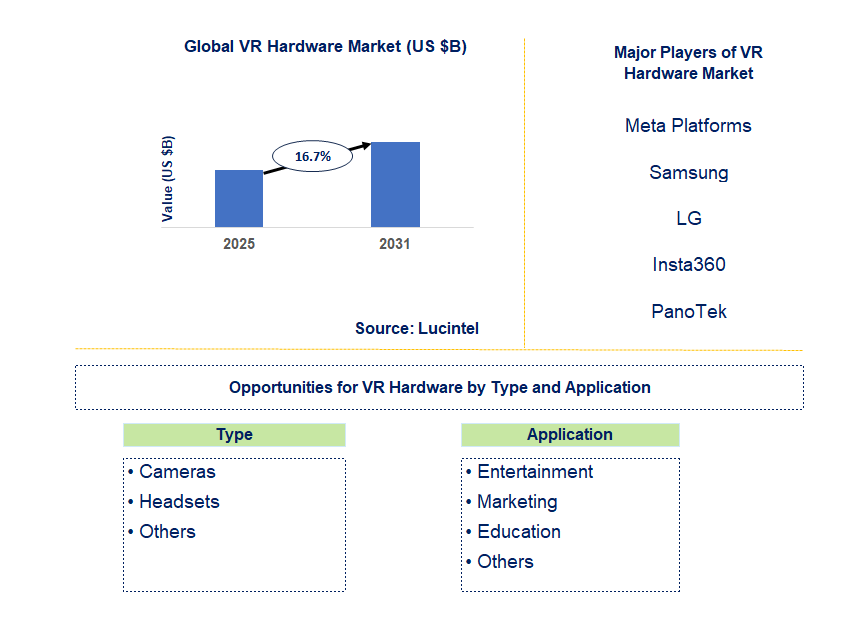
Key data points: The growth forecast = 16.7% annually for the next 7 years. Scroll below to get more insights. This market report covers Trends, opportunity and forecast in VR hardware market to 2031 by type (cameras, headsets, and others), application (entertainment, marketing, education, and others), and region (North America, Europe, Asia Pacific, and the Rest of the World)
We'll send your sample report shortly.
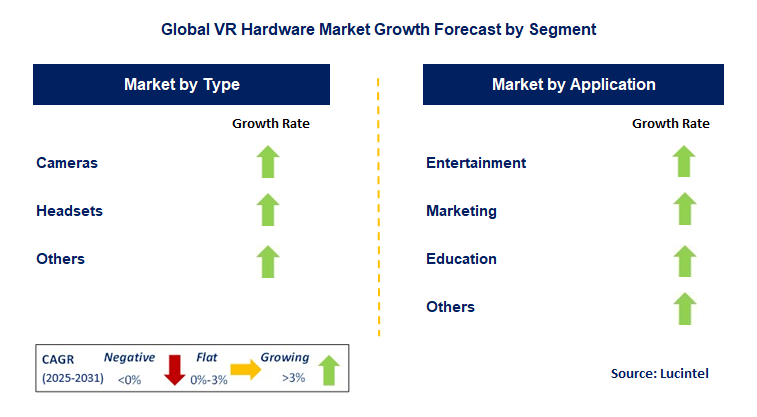
• Lucintel forecasts that, within the type category, the camera is expected to witness higher growth over the forecast period.
• Within the application category, entertainment is expected to witness the highest growth.
• In terms of region, APAC is expected to witness the highest growth over the forecast period. Gain valuable insights for your business decisions with our comprehensive 150+ page report. Sample figures with some insights are shown below.
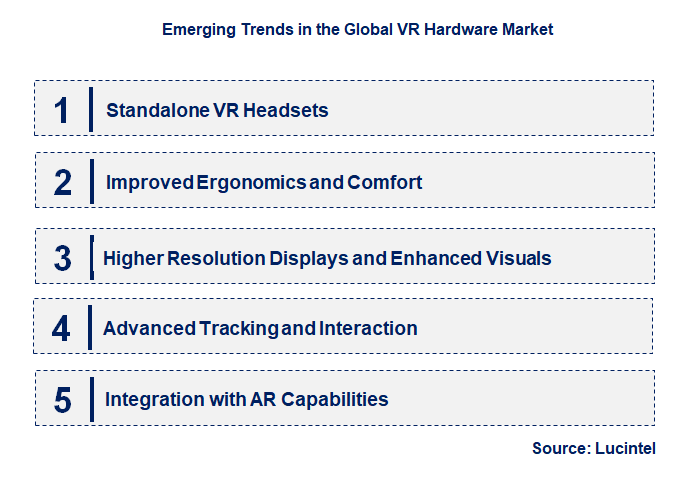
• Standalone VR Headsets: Standalone VR headsets, which don't require a connection to a PC or console, are becoming increasingly popular. These headsets offer greater portability and ease of use, making VR more accessible to a wider audience. This trend is driving innovation in mobile processing power, battery life, and display technology for VR devices.
• Improved Ergonomics and Comfort: Early VR headsets were often criticized for being bulky and uncomfortable. Recent developments focus on improving ergonomics, reducing weight, and enhancing comfort for extended use. This includes better weight distribution, adjustable straps, and breathable materials. Improved comfort is crucial for the wider adoption of VR, particularly for enterprise and professional applications.
• Higher Resolution Displays and Enhanced Visuals: The demand for more immersive and realistic VR experiences is driving advancements in display technology. Higher resolution displays, improved refresh rates, and wider fields of view are becoming more common. These enhancements create more believable and engaging virtual environments, enhancing the sense of presence and realism in VR.
• Advanced Tracking and Interaction: Precise and intuitive tracking is essential for realistic interaction in VR. Recent developments include improved hand tracking, eye tracking, and full-body tracking. These technologies allow users to interact with virtual objects and environments more naturally and intuitively, enhancing the sense of immersion and presence.
• Integration with AR Capabilities: The lines between VR and Augmented Reality (AR) are blurring, with some VR headsets incorporating AR capabilities. This allows users to blend virtual content with the real world, opening up new possibilities for applications in areas like design, training, and collaboration. This integration is creating a new category of mixed reality devices that offer the best of both worlds. These trends are fundamentally reshaping the VR hardware market, driving innovation, and creating a more diverse and accessible VR ecosystem. The focus on standalone headsets, improved ergonomics, enhanced visuals, advanced tracking, and AR integration is making VR more appealing to both consumers and businesses, paving the way for wider adoption and the development of new and innovative VR applications.
• Standalone Headsets with Enhanced Processing Power: Standalone VR headsets are becoming increasingly powerful, rivaling the performance of PC-tethered devices. Advancements in mobile processors, graphics chips, and battery technology enable richer and more complex VR experiences without needing a separate computer. This increased processing power drives the development of more sophisticated VR applications and games.
• Improved Display Technology: Display technology in VR headsets is constantly improving, with higher resolutions, faster refresh rates, and wider fields of view becoming more common. These enhancements create more immersive and realistic virtual environments, reducing the screen-door effect and improving the overall visual fidelity of VR experiences. This is crucial for enhancing the sense of presence and realism in VR.
• Advanced Tracking and Interaction Systems: Precise and intuitive tracking is essential for realistic interaction in VR. Recent developments include more accurate hand tracking, improved eye tracking, and the integration of haptic feedback. These technologies allow users to interact with virtual objects and environments more naturally and intuitively, enhancing the sense of immersion and presence.
• Focus on Comfort and Ergonomics: Early VR headsets were often criticized for being bulky and uncomfortable. Manufacturers are now prioritizing comfort and ergonomics, focusing on reducing weight, improving weight distribution, and using breathable materials. Adjustable straps and facial interfaces are also becoming more common, ensuring a comfortable fit for a wider range of users. Improved comfort is crucial for extended VR use, particularly in enterprise and professional settings.
• Integration of AR Capabilities: Some VR headsets are now incorporating Augmented Reality (AR) capabilities, blurring the lines between virtual and real worlds. This allows users to blend virtual content with their real-world surroundings, opening up new possibilities for applications in areas like design, training, and collaboration. This integration is creating a new category of mixed reality devices that offer the best of both VR and AR. These developments are significantly impacting the VR hardware market, driving innovation and creating a more diverse and accessible VR ecosystem. The focus on standalone headsets, improved displays, advanced tracking, enhanced comfort, and AR integration is making VR more appealing to both consumers and businesses, paving the way for broader adoption and the development of new and innovative VR applications across various industries.
• Enterprise Training and Simulation: VR offers a cost-effective and safe way to train employees in various industries, from manufacturing and healthcare to aviation and energy. VR simulations can replicate real-world scenarios, allowing employees to practice complex tasks and develop critical skills without real-world risks. This presents a significant opportunity for VR hardware vendors to offer robust and reliable solutions tailored for enterprise training applications.
• Healthcare and Rehabilitation: VR is being used in healthcare for pain management, rehabilitation, and therapy. VR can create immersive environments that help patients recover from injuries, manage chronic pain, and overcome phobias. This application presents a growth opportunity for VR hardware vendors to develop comfortable, easy-to-use, and clinically validated VR systems for healthcare settings.
• Education and Training: VR can transform education by creating engaging and interactive learning experiences. VR field trips, virtual dissections, and interactive simulations can bring learning to life, making complex concepts easier to understand. This presents an opportunity for VR hardware vendors to offer affordable and durable headsets for educational institutions, along with software and content tailored for educational purposes.
• Design and Manufacturing: VR is being used in design and manufacturing to create virtual prototypes, visualize products in 3D, and collaborate on designs in a shared virtual environment. This can streamline the design process, reduce costs, and improve product quality. This application creates a market for high-fidelity VR hardware with precise tracking and realistic visuals, catering to the needs of designers and engineers.
• Retail and Marketing: VR is being used in retail and marketing to create immersive product demonstrations, virtual store tours, and interactive brand experiences. This allows customers to experience products and services in a more engaging way, increasing brand awareness and driving sales. This presents an opportunity for VR hardware vendors offering portable and user-friendly VR solutions for retail and marketing applications. These growth opportunities are significantly impacting the VR hardware market, driving innovation and specialization. Vendors who can develop hardware solutions that meet the specific needs of these key applications, offering high performance, affordability, and ease of use, will be well-positioned for success in this rapidly expanding market.
• Meta Platforms
• Samsung
• LG
• Insta360
• PanoTek
• Nintendo
• HTC
• SONY
• Fujitsu
• Cameras
• Headsets
• Others
• Entertainment
• Marketing
• Education
• Others
• North America
• Europe
• Asia Pacific
• The Rest of the World
• United States: The US is a leading force in VR hardware development, with companies like Meta and HP innovating in both consumer and enterprise VR. Recent developments include advancements in standalone headsets, improved hand tracking, and a growing focus on creating more immersive and social VR experiences. The US market also sees significant investment in developing VR for training and simulation in various industries.
• China: The Chinese VR hardware market is rapidly expanding, with numerous domestic manufacturers producing competitive headsets. Recent developments include a focus on affordability, improved display quality, and integration with local content platforms. The Chinese market also sees a growing trend of VR arcades and experience centers, driving demand for robust and user-friendly VR hardware.
• Germany: The German VR market is characterized by a strong focus on industrial and professional applications. Recent developments include the development of high-fidelity VR headsets for design, manufacturing, and training, with an emphasis on precision and realism. The German market also sees increasing interest in VR for healthcare and rehabilitation.
• India: The Indian VR market is still emerging but has significant growth potential. Recent developments include the increasing availability of affordable VR headsets, growing interest in VR for education and entertainment, and the development of VR content tailored to the Indian market. The Indian market is also seeing increasing adoption of VR in training and simulation for various sectors.
• Japan: The Japanese VR market is characterized by a strong focus on entertainment and gaming. Recent developments include advancements in VR gaming peripherals, improved haptic feedback, and growing interest in VR for virtual tourism and cultural experiences. The Japanese market also sees increasing use of VR for remote collaboration and training in specific industries.


• Meta Platforms
• Samsung
• LG
• Insta360
• PanoTek
• Nintendo
• HTC
• SONY
• Fujitsu Q5. Which VR hardware market segment will be the largest in future? Answer: Lucintel forecasts that camera is expected to witness higher growth over the forecast period. Q6. In VR hardware market, which region is expected to be the largest in next 5 years? Answer: APAC is expected to witness the highest growth over the forecast period. Q7. Do we receive customization in this report? Answer: Yes, Lucintel provides 10% customization without any additional cost.


Choose a license that fits your team. Instant PDF delivery.
Prices exclude taxes. Instant delivery. Custom licensing available on request.
Market Report · July 29, 2026
Market Report · July 20, 2026
Market Report · July 20, 2026
Trusted partner for strategic intelligence and business growth


Receive a complimentary market analysis tailored to your industry. Our analysts will identify key growth opportunities and competitive dynamics specific to your business.

Market size, growth rate, and key trend analysis for your specific sector.

Top competitor positioning and market share analysis.

Strategic recommendations backed by data-driven insights.
Get curated market intelligence and competitive moves straight to your inbox.
By subscribing, you agree to receive our monthly insights. Unsubscribe anytime.
Receive a complimentary market analysis tailored to your industry. Our analysts will identify key growth opportunities and competitive dynamics specific to your business.
Market size, growth rate, and key trend analysis for your specific sector.
Top competitor positioning and market share analysis.
Strategic recommendations backed by data-driven insights.
Get curated market intelligence, emerging trends, and competitive moves straight to your inbox each month.
By subscribing, you agree to receive our monthly insights. Unsubscribe anytime.
We'll send your sample report shortly.