
Market Report · July 15, 2026

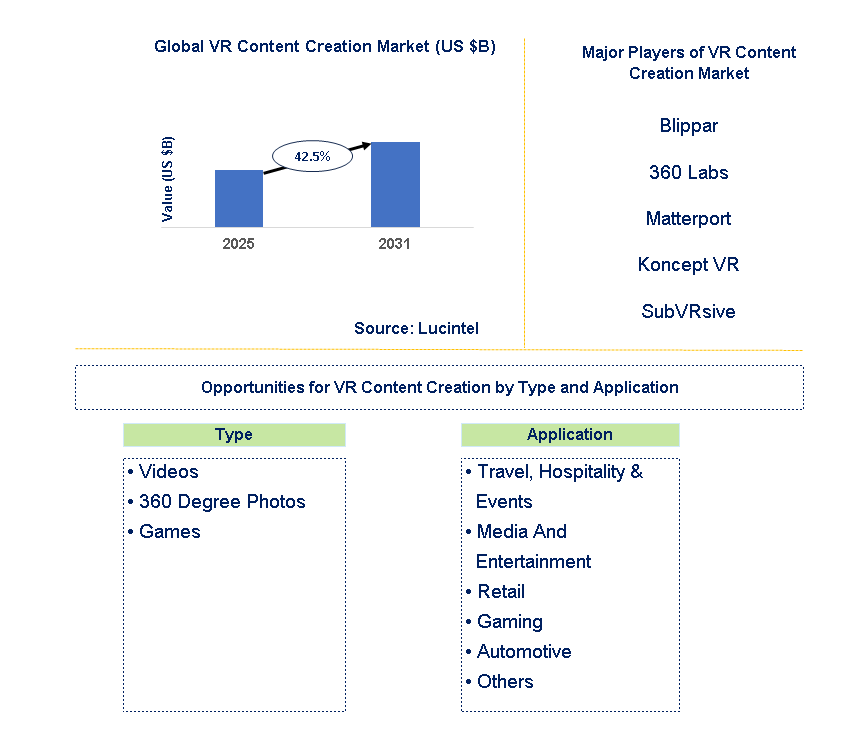
Key data points: The growth forecast = 42.5% annually for the next 7 years. Scroll below to get more insights. This market report covers Trends, opportunity and forecast in VR content creation market to 2031 by type (videos, 360 degree photos, and games), application (travel, hospitality & events, media & entertainment, retail, gaming, automotive, and others), and region (North America, Europe, Asia Pacific, and the Rest of the World)
We'll send your sample report shortly.
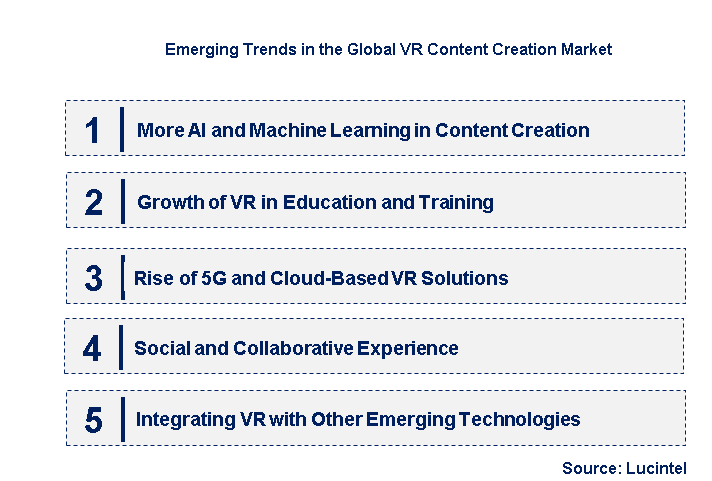
• More AI and Machine Learning in Content Creation: The technologies of artificial intelligence and machine learning are becoming integral to the creation of VR content. AI-driven tools help automate and enhance various aspects of the creation process, from the generation of realistic environments to the optimization of user interactions. They allow for more dynamic and personalized experiences, such as adaptive storylines or intelligent virtual characters responding to user actions. AI also helps with content testing and optimization, improving both development efficiency and the quality of the final product. As these technologies evolve, AI will play an even bigger role in shaping immersive VR experiences.
• Growth of VR in Education and Training: Virtual Reality is slowly gaining its place in education and professional training, with a growing number of VR content creators developing immersive learning experiences. VR enables highly interactive simulations that can enhance skill acquisition and offer realistic training scenarios. From medical training to aerospace and technical skills development, VR has proven to be an effective tool in hands-on learning. With educational institutions and companies looking for less expensive and more engaging ways to train their employees, the creation of VR content in this sector will continue to grow, enabling more opportunities for content developers to fill those needs.
• Rise of 5G and Cloud-Based VR Solutions: The combination of 5G networks and cloud computing is going to change the face of VR content creation, as it will make VR experiences more accessible, of better quality, and faster. With 5G offering faster data transfer rates and lower latency, cloud-based VR solutions will enable seamless streaming of high-quality content on devices without the need for powerful local hardware. This trend is opening up VR to a wider audience, making it more accessible to users without expensive equipment. For content creators, it opens possibilities to reach global audiences without the technical constraints of traditional VR setups.
• Social and Collaborative Experience: Expansion of VR: Social VR is on the rise, with more platforms offering multiplayer experiences where users can collaborate and interact in virtual environments. VR platforms like VRChat and AltspaceVR are changing the way social experiences are carried out; people can meet, socialize, and collaborate in these immersive virtual spaces. As these platforms gain traction, more and more content creators are leaning toward developing social and collaborative experiences, from virtual events and conferences to shared gaming and educational environments. That has redefined how VR is perceived in terms of social interaction, forcing content creators to shift focus to communal and participatory experiences.
• Integrating VR with Other Emerging Technologies: VR is increasingly being integrated with other emerging technologies such as Augmented Reality, Mixed Reality, and haptic feedback systems. Integration of these kinds of technologies has enabled experiences that are much more immersive and interactive than what traditional VR alone could offer. For example, mixed reality blends real and virtual environments, letting users engage with a world that feels more seamless and realistic. Haptic feedback lets users sense the texture of virtual objects through touch, and as creation of content for VR becomes more sophisticated, integration with other emerging technologies will make possible even more engaging, multisensory experiences. These emerging trends are shaping the future of the VR content creation market by introducing more innovative tools, expanding the range of applications, and enhancing user experiences. From AI-driven content creation to cloud-based solutions and the rise of social VR, these trends are redefining the possibilities of virtual reality. As VR technology continues to evolve, creators will have access to more advanced tools, enabling them to craft increasingly immersive and engaging experiences for users across various sectors.
• Advancements in VR Hardware: Innovations in VR hardware, particularly headsets and controllers, have made it easier for content creators to produce high-quality immersive experiences. Devices with higher resolution, improved field of view, and more precise motion tracking have significantly enhanced the realism and interactivity of VR content. This has led to the production of more detailed and engaging VR experiences, attracting wider audiences. Additionally, advancements in wireless and standalone VR headsets have reduced the barriers to entry for content creators and users alike, making VR more accessible.
• VR Content Creation Platforms Emerge: New VR content creation platforms are providing creators with more accessible tools for building immersive experiences. Well-established platforms like Unity and Unreal Engine offer creators a suite of strong development tools, while relative newcomers like Mozilla Hubs make creating social and collaborative VR environments an ease. 3D modeling, real-time rendering, and interactive content capabilities are some of the features offered on these platforms. The rise of these platforms lowered the technical barriers for creators and allowed both professionals and amateurs to enter the space of VR content creation.
• Integration of AI and Automation Tools: Integration of artificial intelligence and automation tools in the process of creating VR content has smoothed development workflows and improved the quality of content. AI tools can help create realistic environments, optimize performance, and personalize interactions between users. Automation tools allow for faster content creation, reducing both development time and costs. As technologies around AI are rapidly advancing, they will find even greater applicability in automating the many aspects involved in VR content creation, making it easier for creators to give due attention to more complex, creative tasks.
• Increased VR Content in Education and Training: In the sphere of education and training, VR content creation has grown massively, with more immersive and interactive learning experiences. Simulations of real-world environments are done in VR for professional training, such as medical procedures, flight simulations, and emergency response drills. Similarly, educational content creators are developing virtual classrooms and interactive lessons for students to engage in learning. With the increasing demand for remote learning and virtual training, VR content creators are increasingly targeting these sectors with customized, immersive educational content.
• Social and Collaborative VR Growth: Social and collaborative VR experiences are on the rise, with platforms like VRChat, Rec Room, and AltspaceVR offering spaces for users to socialize, collaborate, and be engaged in virtual activities. Content creators are creating shared virtual environments in gaming, education, and professional networking, where users can interact with other users in real time. With increasing demand for social VR experiences, creators are now focusing on the development of more dynamic and immersive social environments that allow users to have meaningful interactions with each other. Recent developments in the VR content creation market are empowering creators with advanced tools and technologies, allowing for the production of more immersive and interactive experiences. From hardware innovations to new platforms, AI integration, and growing applications in education and social VR, these developments are expanding the possibilities for VR content creators and reshaping the market.
• VR in Gaming and Entertainment: The main driver of the VR content creation market remains gaming and entertainment. With the continuous improvement in VR technology, content creators are able to create more complex and interactive gaming experiences. From interactive narratives to fully immersive virtual worlds, VR gaming offers levels of engagement that players have never experienced before. In the entertainment sector, VR is used to create virtual concerts, movies, and live performances, opening up new dimensions for creators to engage their audiences.
• VR in Education and Training: VR opens up vast possibilities for the growth of education and training. Content creators are developing more VR-based learning modules that include hands-on experiences, such as virtual classrooms and professional simulations. In the preparation of professionals in medicine, aviation, engineering, and other fields, VR is used for practical training without the real-life risks. The potential for big expansion in VR content creation within education still exists with increasing demands for immersive experiences.
• VR in Healthcare: In healthcare, VR content creation is gaining increased importance in such areas as therapeutic simulations, pain management, and mental health treatments. VR is used to support patients in physical therapy by offering them immersive exercises that stimulate the healing process. In the field of mental health, VR technology is being applied to treat disorders like PTSD and anxiety by placing patients inside controlled virtual environments. With health providers seeking improved treatment options, the demand for VR content will only continue to grow in this sector.
• Social VR and Virtual Collaboration: Social VR platforms are rapidly growing in number, with more and more creators developing shared virtual spaces for gaming, work, and social interaction. With the growing trend of remote work and virtual collaboration, social VR platforms are opening up new ways for people to interact and collaborate in immersive virtual environments. Content creators are capitalizing on this trend by developing VR meeting rooms, virtual coworking spaces, and social networking platforms that offer more engaging alternatives to traditional video conferencing.
• VR for Virtual Tourism and Real Estate: Virtual tourism and real estate are among the developing industries where VR content creation is making a difference. Thanks to VR, travelers can visit virtual places or take immersive tours of landmarks without leaving the comfort of their own homes. In real estate, the tech allows potential buyers to walk through properties remotely with virtual tours. With these applications taking off, VR content creators have the opportunity to develop interactive and realistic virtual experiences for both the tourism and real estate sectors. These strategic growth opportunities show that the VR content creation market is set to expand across diverse applications. With the increasing demand for immersive experiences, content creators can use such opportunities to gain new audiences, heighten existing industries, and push the boundaries of what's possible in virtual reality.
• Blippar
• 360 Labs
• Matterport
• Koncept VR
• SubVRsive
• Panedia
• Voxelus
• Vizor
• Wevr
• WeMakeVR
• Videos
• 360 Degree Photos
• Games
• Travel, Hospitality & Events
• Media & Entertainment
• Retail
• Gaming
• Automotive
• Others
• North America
• Europe
• Asia Pacific
• The Rest of the World
• United States: The VR content creation market has experienced massive growth in the United States, driven by the entertainment and gaming sectors. Innovations in VR hardware and software have made it easier for creators to develop highly immersive experiences. Companies like Oculus, now part of Meta, continue to drive the market forward with advancements in consumer-friendly headsets and content platforms. Further, VR is increasingly being used in education, training, and healthcare; for example, virtual classrooms and therapeutic simulations are becoming more common. The U.S. is also home to a large number of VR development studios, which helps to nurture a vibrant VR content ecosystem.
• China: China has become one of the significant players in the global VR content creation market, with major investments from the government and private sector. The Chinese market has seen rapid adoption of VR in gaming, entertainment, and retail, driven by advancements in VR hardware like high-resolution headsets and motion controllers. Besides, Chinese companies such as HTC Vive and Pico are developing their own VR content creation tools, which give more options for creators to be localized. Virtual tourism, education, and live streaming platforms are also gaining popularity in China, making VR more accessible to a broader audience.
• Germany : Germany has been at the forefront of the VR content creation market in Europe, with a strong focus on industrial applications and engineering simulations. High-skilled labor, intensive research in virtual environments, and industry-academia partnerships have supported VR adoption in the country. In the automotive, architecture, and manufacturing sectors, VR helps companies visualize prototypes and optimize production processes. German VR creators also work on interactive art installations and cultural experiences, positioning the country as a hub for diverse VR content development across various sectors.
• India: India’s VR content creation market is emerging, driven by growing interest in gaming, education, and entertainment. The availability of affordable VR headsets and the country’s large tech-savvy population are key factors in accelerating VR adoption. Indian startups are increasingly developing VR content focused on education, with virtual classrooms and immersive learning environments gaining popularity. Additionally, the gaming industry in India is embracing VR, with a growing number of VR games being developed and played by consumers. The Indian government is also supporting VR growth through initiatives aimed at fostering innovation in technology and content creation.
• Japan: Japan continues to be a major force in the global VR content creation market, particularly in the fields of gaming, entertainment, and robotics. Japanese companies have developed cutting-edge VR technologies, and the country is known for its strong culture of gaming and immersive experiences. VR content creation is not only focused on traditional media but also on innovative applications such as virtual tourism and training simulations for industries like healthcare and manufacturing. Japan’s advancements in motion capture technology, haptic feedback, and 3D audio are setting new standards for VR content creation and providing creators with more tools for enhancing user immersion.


• Blippar
• 360 Labs
• Matterport
• Koncept VR
• SubVRsive
• Panedia
• Voxelus
• Vizor
• Wevr
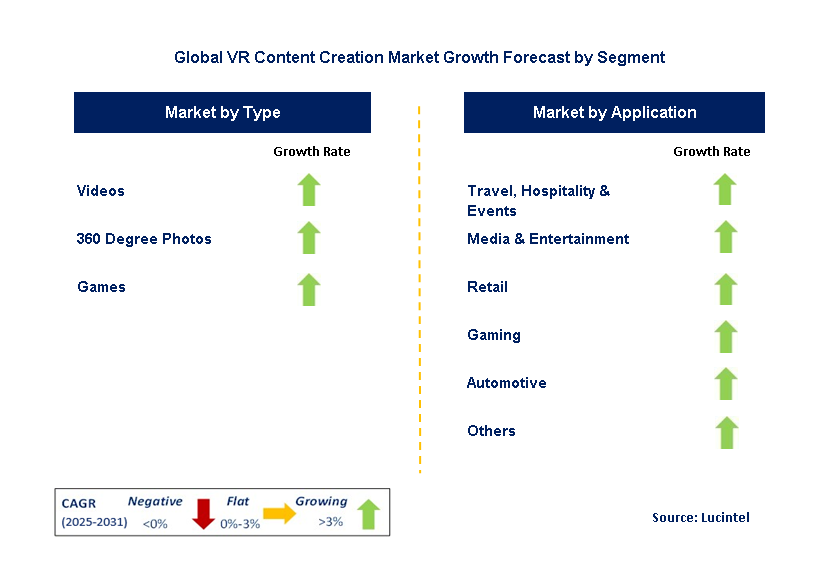
• WeMakeVR Q5. Which VR content creation market segment will be the largest in future? Answer: Lucintel forecasts that, within the type category, video is expected to witness the highest growth over the forecast period. Q6. In VR content creation market, which region is expected to be the largest in next 5 years? Answer: In terms of region, APAC is expected to witness the highest growth over the forecast period. Q7. Do we receive customization in this report? Answer: Yes, Lucintel provides 10% customization without any additional cost.


Choose a license that fits your team. Instant PDF delivery.
Prices exclude taxes. Instant delivery. Custom licensing available on request.
Market Report · July 15, 2026
Market Report · June 26, 2026
Market Report · June 24, 2026
Trusted partner for strategic intelligence and business growth


Receive a complimentary market analysis tailored to your industry. Our analysts will identify key growth opportunities and competitive dynamics specific to your business.

Market size, growth rate, and key trend analysis for your specific sector.

Top competitor positioning and market share analysis.

Strategic recommendations backed by data-driven insights.
Get curated market intelligence and competitive moves straight to your inbox.
By subscribing, you agree to receive our monthly insights. Unsubscribe anytime.
Receive a complimentary market analysis tailored to your industry. Our analysts will identify key growth opportunities and competitive dynamics specific to your business.
Market size, growth rate, and key trend analysis for your specific sector.
Top competitor positioning and market share analysis.
Strategic recommendations backed by data-driven insights.
Get curated market intelligence, emerging trends, and competitive moves straight to your inbox each month.
By subscribing, you agree to receive our monthly insights. Unsubscribe anytime.
We'll send your sample report shortly.