
Market Report · July 15, 2026

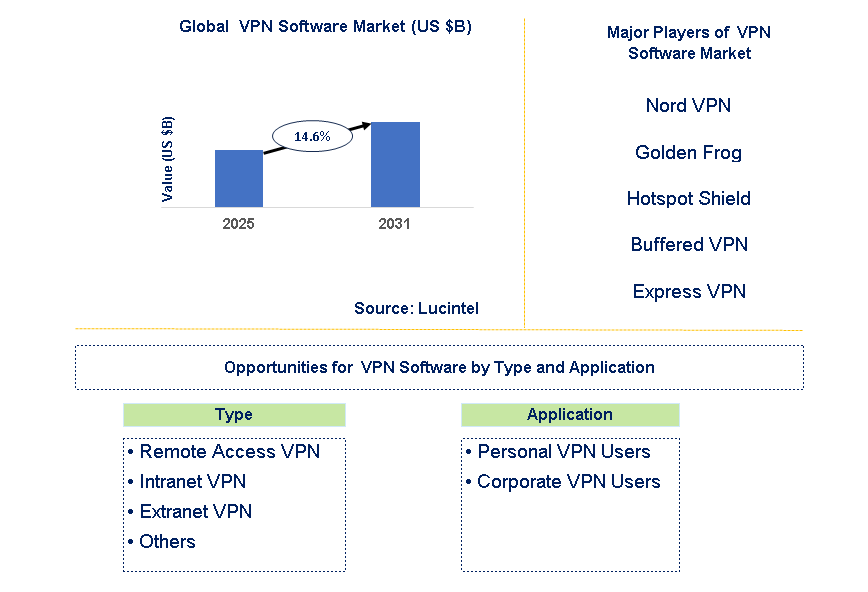
Key data points: The growth forecast = 14.6% annually for the next 7 years. Scroll below to get more insights. This market report covers Trends, opportunity and forecast in VPN software market to 2031 by type (remote access VPN, intranet VPN, extranet VPN, and others), application (personal VPN users and corporate VPN users), and region (North America, Europe, Asia Pacific, and the Rest of the World)
We'll send your sample report shortly.
• Increased Adoption of VPNs for Remote Work: Due to increased prevalence of remote working, VPN software is being sought after by various people. Companies are investing in VPN solutions to ensure secure communication between remote employees and business networks. VPNs help safeguard sensitive company data, protect against cyberattacks, and maintain data privacy for workers accessing networks from diverse locations. The current trend of remote work, especially after the COVID-19 pandemic, is pushing businesses to look for more robust and scalable VPN solutions that can support remote and hybrid work models.
• Rising Concern Over Data Privacy and Cybersecurity: With growing awareness about data privacy and cybersecurity threats, more individuals and businesses have taken to VPN software. With increasing concerns over online tracking, hacking, and surveillance, VPNs provide users with a secure and anonymous way to access the internet, protect personal data, and avoid third-party tracking. Growing concerns regarding cybersecurity from the governments of these countries, including the U.S. and Germany, directly reflect in the expansion of VPNs across different verticals. In fact, growing concerns over secured online communication along with sensitive information protection directly affect the adoption rate of VPN usage.
• Mobile VPN Adoption Rate: As people are surfing increasingly on their smartphones and tablets using mobile internet, the demand for mobile-based VPN solutions has risen. With the increasing use of mobile devices to browse the internet, access financial information, and shop online, the demand for VPN services to secure mobile connections is growing. VPN providers are developing mobile-specific solutions to cater to this demand, ensuring secure browsing experiences for users on the go. Mobile VPN usage is particularly prevalent among travelers and remote workers who require secure connections in public spaces or on unsecured networks.
• VPN and Streaming Services: As more and more people watch content from around the world through services like Netflix, Hulu, and Amazon Prime, the need for bypassing regional content restrictions using VPNs to access geo-blocked media is increasing. The use of VPNs by consumers to view content from other countries has therefore created a great demand for VPNs that have optimized streaming capabilities. As geo-restrictions are being enforced more strictly by streaming platforms, VPN providers are continually updating their services to provide users with seamless streaming experiences. This trend is changing the VPN market, especially for users who consider entertainment as a priority and want to access more content online.
• Decentralized VPN Solutions: Decentralized VPN solutions, such as blockchain-based ones, are becoming increasingly popular in the market. These VPNs improve user privacy and security by forwarding traffic through a decentralized network of nodes, decreasing reliance on central servers. These changes are because of the requirement for greater transparency, security, and privacy for VPN services. Decentralized VPNs want to overcome central service providers who might log in user data or are subject to government surveillance. This emerging trend will likely entice privacy-minded consumers looking to exercise more authority over their own online security.
The increasing adoption for remote work and surging mobile VPN usage, in addition to the marriage of VPNs with streaming services, is molding future landscapes for the VPN software market. The integration and growth in the VPN market will, in turn, expand it into more advanced, decentralized, and user-friendly solutions as concerns over privacy and cybercrime rise.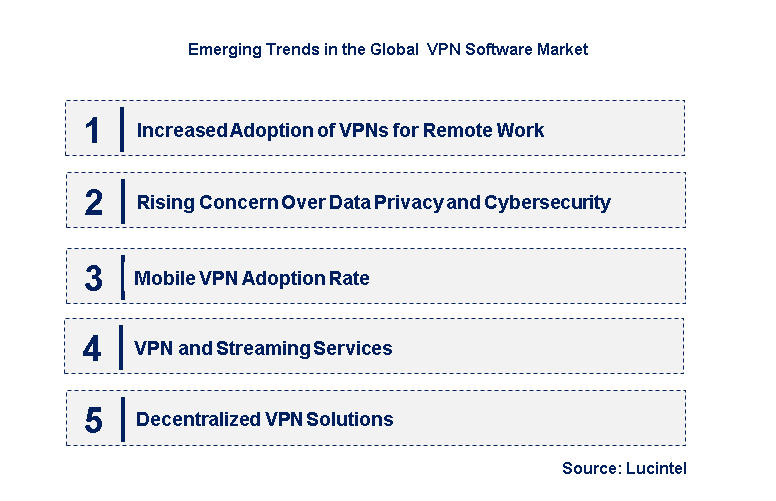
• Security features: As advanced cybersecurity attacks evolve day by day, VPN vendors have been competing to prioritize more security elements, like multi-factor authentication, military-grade encryption, and leak protection. These features give users a higher level of privacy and security while surfing the internet. Improved security measures are becoming a necessity for businesses, especially those in finance, healthcare, and government sectors, where sensitive data must be protected. VPN providers are also improving their encryption protocols to address vulnerabilities and ensure secure online communication.
• VPN on Mobile: The demand for secure mobile browsing has led VPN providers to expand their services to mobile platforms. As the number of users of smartphones and tablets increases, with more using these devices to perform any online activity, the demand for secure connections on mobile devices has grown significantly. The applications of VPN providers are now optimized for mobile platforms, providing easy-to-use interfaces with secure connections for mobile users. This is transforming the way organizations and users of public Wi-Fi or accessing critical information from cell phones can now protect their information.
• Geo-Restrictions Bypass and Streaming Content Access: This is through development of better VPN services that avoid geo-restrictions to permit users to enjoy streaming content on various regions. VPN services are also adjusting to ensure users can stream through Netflix, Amazon Prime, and Hulu as they increasingly tighten their regional content restrictions. This means the need for streaming VPN services is in huge demand since most users require wider entertainment offerings. This factor contributes to an upsurge in the consumer market for VPN services.
• Improvement in Privacy Laws and Regulations: Governments and regulatory bodies are setting stricter privacy and data protection laws, which leads to a huge demand for VPNs. For example, the General Data Protection Regulation in the European Union raised awareness about online privacy and secure browsing. Therefore, VPN service providers are working to improve their services to keep up with these regulations and rising demands for private solutions. These have led to significant increases in users seeking safe, private, and anonymous online experiences within the market.
• Adoption of Decentralized VPN Networks: The need to grow further with regard to increased privacy and security has led to a decentralised VPN network. Decentralised VPNs are designed using distributed peer-to-peer technologies. The higher transparency and security brought about by decentralization are greater than the more conventional centralised VPN services. Decentralized VPN solutions can be seen widely adopted because these solutions offer great privacy, prevent data logging from happening, and protect against any government surveillance activities. As user awareness about having privacy increases, decentralized VPN network solutions are something that is relatively attractive compared with centralized solutions as well, bringing growth to this market.
The recent developments in the VPN software market, such as enhanced security features, mobile platform expansion, and the rise of decentralized VPN networks, are transforming the industry. These innovations are responding to growing concerns about online privacy, cybersecurity, and content accessibility, driving the market's expansion across various regions.• Remote work solutions: Since remote work will be the order of the day, businesses would invest more in VPN solutions securing their remote workers. Secure remote communications and protect sensitive data by VPN software in home or any other remote office locations for their employees. Through VPNs, companies can easily access internal systems while preventing cyberattacks and regulatory requirements for the protection of data. The market for VPN software is witnessing growth due to growing demand for safe remote work solutions.
• Cybersecurity and Data Privacy for Enterprises: The rise in cyber threats is compelling enterprises to take up cybersecurity and data privacy measures, thereby driving the demand for VPN solutions. Companies are taking up VPNs to secure their confidential information and prevent any breach of data in the future. In this respect, the industries involved include finance, healthcare, and government. VPNs assist businesses in complying with data privacy laws and secure their sensitive assets from external threats. Increasing corporate demand for data protection is creating a strategic growth opportunity for VPN providers targeting enterprise customers.
• Government and Public Sector Adoption: Governments across the world are adopting VPN solutions to protect sensitive data, ensure secure communication channels, and safeguard national security interests. Government agencies require VPNs to provide secure access to internal systems for employees and contractors working remotely. As the cyber attacks develop, so does the dependency of government institutions on VPN services for maintaining privacy and securing national infrastructure. It is a sector with big growth potential for VPN providers offering specialized services catering to the needs of the public sector's security area.
• Mobile and Consumer Market: With more consumers looking for secure browsing options on their smartphones and tablets, the mobile VPN market is booming rapidly. Increasing interest in mobile security and access to region-restricted content will boost the use of mobile VPNs. As more consumers target the market with cost-effective, user-friendly VPN solutions for mobile platforms, the consumer segment is a significant growth opportunity for VPN providers to expand their share while strengthening security for mobile users.
• IOT and Smart Device Integration: The Internet of Things will continue to grow, and the demand for secure connectivity on smart devices will increase with that. With this in mind, VPN providers are interested in hosting services that integrate their provision with smart devices, including smart home appliances, wearable gadgets, and more. IoT networks can also be secured through VPNs, preventing anyone unauthorized from accessing personal information. This trend holds strategic growth opportunities for VPN providers as the IoT market expands further and more devices require secure connections to the internet.
Strategic growth opportunities in the VPN software market are driven by the need for remote work, enterprise cybersecurity, government adoption, mobile demand, and IoT integration. All these applications are creating diverse avenues for growth and innovation for VPN software markets.• Nord VPN
• Golden Frog
• Hotspot Shield
• Buffered VPN
• Express VPN
• Private Internet Access
• PureVPN
• Cisco Anyconnect
• Stackpath
• Torguard
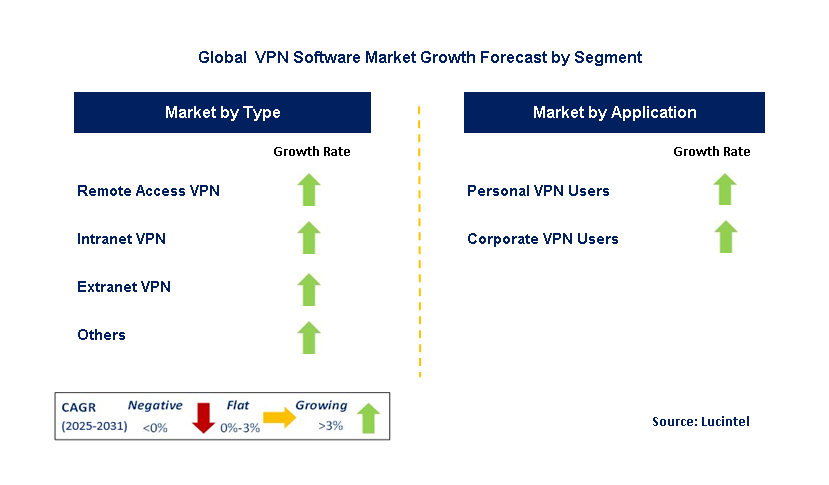
• Remote Access VPN
• Intranet VPN
• Extranet VPN
• Others
• Personal VPN Users
• Corporate VPN Users
• North America
• Europe
• Asia Pacific
• The Rest of the World
• United States: The VPN software market in the United States has been growing at a rapid pace due to increased concerns over data privacy, especially after some high-profile data breaches and surveillance revelations. Adoption of VPNs is increasing among both individual consumers and businesses, who are focusing on encrypted internet access and bypassing geo-restrictions. Companies are investing in VPNs to protect remote workers, secure communication channels, and prevent cyberattacks. The increasing usage of public Wi-Fi, coupled with the increased trend towards online services, has added to the demand for the need for secure VPN solutions. The debate regarding government surveillance and privacy laws continues to grow for the demand of VPN in the U.S.
• China: VPN usage is restrictive in China as the government enforces strict regulations on internet censorship. Despite all these restrictions, the Chinese citizens and businesses still try to find ways to circumvent the supposed "Great Firewall" to reach the restricted global content. VPN software providers have been tailoring their products to meet local requirements, including solutions programmed to ensure security while finding ways around government-ordered restrictions. As China's tech industry continues to boom, companies are investing in VPNs that ensure data protection and compliance with stringent cybersecurity regulations. However, the backlash against illegal VPN services by the government creates a perennial regulatory headache for the VPN providers in China.
• Germany: In Germany, the use of VPN is rising sharply, based mainly on issues of privacy, data protection under GDPR compliance, and the threat landscape of cybercrimes. As a country known for its strict data protection laws, Germany is witnessing a growing demand for VPN solutions to secure sensitive personal and business data. In Germany, VPNs are commonly used by businesses and individuals alike to protect browsing activities, avoid surveillance, and maintain privacy in the digital space. The VPN software market is booming in Germany, especially in finance, healthcare, and technology sectors, due to the strong emphasis on cybersecurity measures.
• India: The VPN market is picking up rapidly in India due to increasing concerns about online privacy, government surveillance, and data protection. As internet usage is increasing exponentially, both individuals and businesses are adopting VPN solutions to protect their data and maintain privacy while accessing content from different regions. Indians increasingly want to circumvent censorship and geo-restrictions, particularly in entertainment and streaming services. Furthermore, more and more companies are adopting remote work practices, so the need for secure and reliable VPN solutions that protect corporate data and maintain confidentiality is increasing in India.
• Japan: As observed in Japan, the VPN software market is in a growth cycle and primarily catalyzed due to the mounting concern about keeping sensitive data under cover. Because of growing reliance on remote workplaces, companies around Japan are considering VPN solutions in order to strengthen corporate networks against threats. Enhanced security measures from the Japanese perspective in regard to data protection promote demand for a secure internet and VPN services. Other drivers of the VPN market include the growth of e-commerce, digital banking, and government services online. In addition, Japanese consumers are increasingly using VPNs for personal privacy and to access region-restricted content, which has contributed to the growth of the market.


• Nord VPN
• Golden Frog
• Hotspot Shield
• Buffered VPN
• Express VPN
• Private Internet Access
• PureVPN
• Cisco Anyconnect
• Stackpath
• Torguard
Q5. Which VPN software market segment will be the largest in future?

Choose a license that fits your team. Instant PDF delivery.
Prices exclude taxes. Instant delivery. Custom licensing available on request.
Market Report · July 15, 2026
Market Report · June 26, 2026
Market Report · June 24, 2026
Trusted partner for strategic intelligence and business growth


Receive a complimentary market analysis tailored to your industry. Our analysts will identify key growth opportunities and competitive dynamics specific to your business.

Market size, growth rate, and key trend analysis for your specific sector.

Top competitor positioning and market share analysis.

Strategic recommendations backed by data-driven insights.
Get curated market intelligence and competitive moves straight to your inbox.
By subscribing, you agree to receive our monthly insights. Unsubscribe anytime.
Receive a complimentary market analysis tailored to your industry. Our analysts will identify key growth opportunities and competitive dynamics specific to your business.
Market size, growth rate, and key trend analysis for your specific sector.
Top competitor positioning and market share analysis.
Strategic recommendations backed by data-driven insights.
Get curated market intelligence, emerging trends, and competitive moves straight to your inbox each month.
By subscribing, you agree to receive our monthly insights. Unsubscribe anytime.
We'll send your sample report shortly.