
Market Report · July 15, 2026

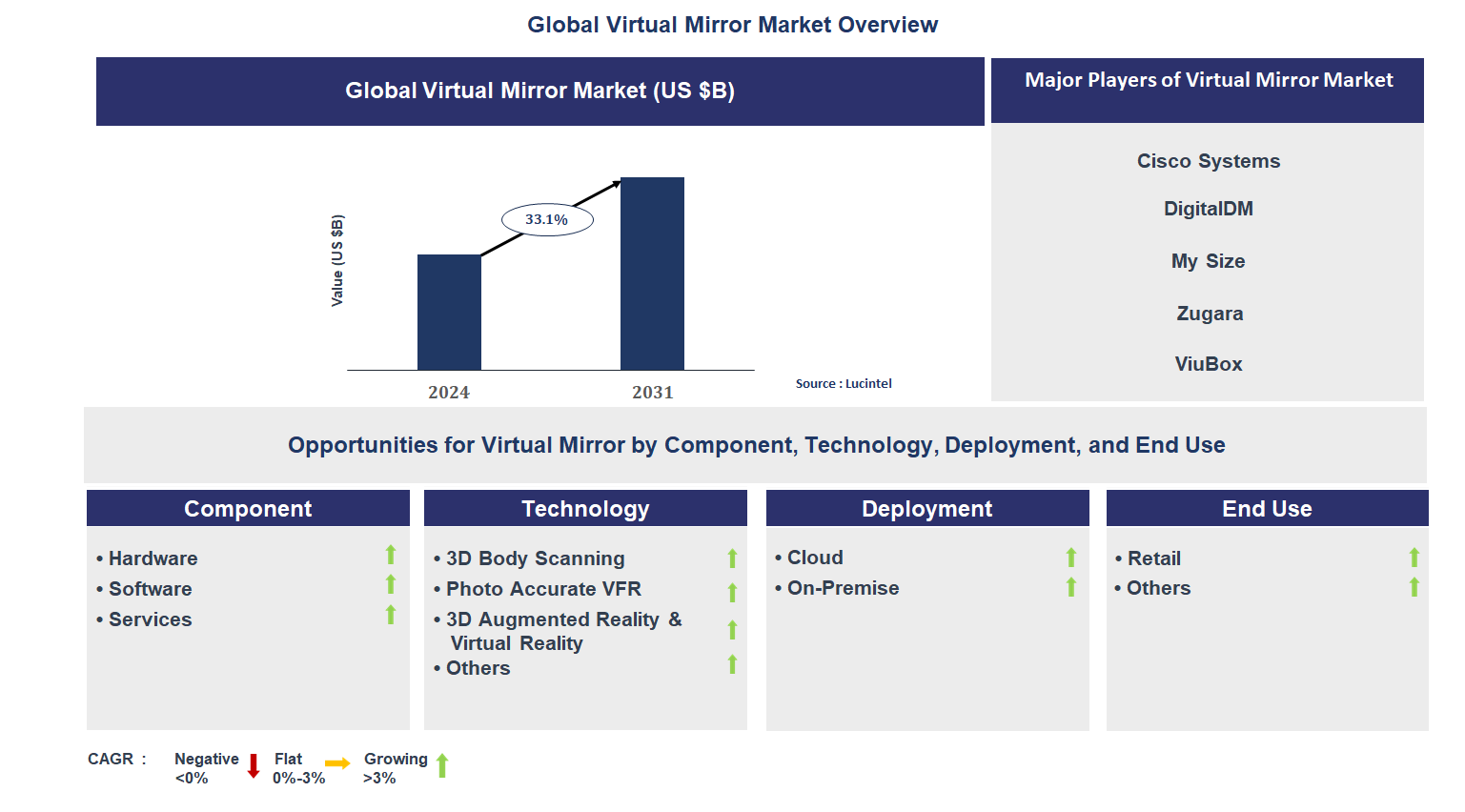
Key data points: The growth forecast = 33.1% annually for the next 7 years. Scroll below to get more insights. This market report covers trends, opportunities and forecasts in virtual mirror market to 2031 by component (hardware, software, and services), technology (3D body scanning, photo accurate VFR, 3D augmented reality & virtual reality, and others), deployment (cloud and on-premise), end use (retail and others), and region (North America, Europe, Asia Pacific, and the Rest of the World)
We'll send your sample report shortly.
• Lucintel forecasts that, within the component category, software is expected to witness the highest growth over the forecast period.
• Within the technology category, 3D body scanning is expected to witness the highest growth.
• In terms of region, APAC is expected to witness the highest growth over the forecast period. Gain valuable insights for your business decisions with our comprehensive 150+ page report. Sample figures with some insights are shown below.
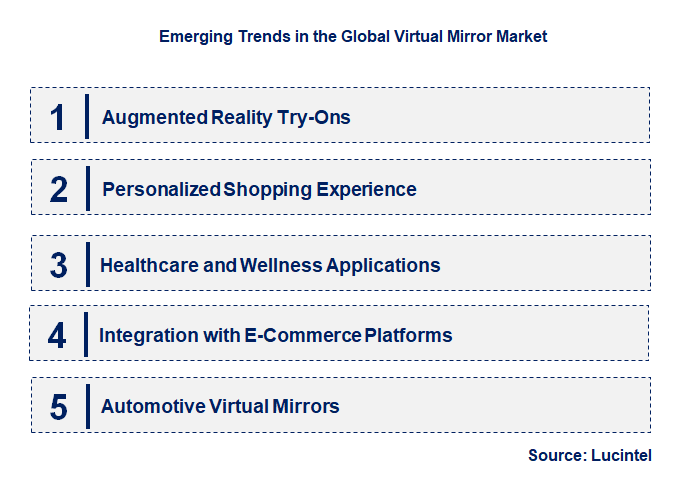
• Augmented Reality Try-Ons: Augmented reality virtual try-ons are a significant trend, especially in fashion and beauty. Consumers can now try on clothes, makeup, and accessories virtually using their smartphones or in-store kiosks. This enhances the shopping experience by reducing the need for physical interaction and allowing customers to visualize products in a personalized context, improving decision-making and reducing return rates.
• Personalized Shopping Experience: Virtual mirrors are becoming integral to offering a highly personalized shopping experience. By collecting data on customer preferences and past behavior, virtual mirrors suggest products that best suit individual tastes and needs. Retailers are using AI-powered virtual mirrors to offer product recommendations based on previous interactions, enhancing customer satisfaction and driving brand loyalty.
• Healthcare and Wellness Applications: Virtual mirrors are increasingly being used in the healthcare and wellness sectors to monitor and assess health metrics. For example, virtual mirrors can track body posture, analyze skin conditions, or even provide fitness feedback. This trend is helping individuals take a more active role in their health, offering a unique combination of convenience, personalization, and real-time insights.
• Integration with E-Commerce Platforms: The integration of virtual mirrors with e-commerce platforms is accelerating, allowing consumers to virtually try on products before purchasing them online. This trend is particularly beneficial for the apparel, cosmetics, and eyewear industries, where sizing and fit can be a significant concern. E-commerce platforms are increasingly incorporating virtual try-ons to improve customer satisfaction and reduce returns.
• Automotive Virtual Mirrors: The automotive industry is adopting virtual mirror technology to enhance car customization and vehicle design. Virtual mirrors are allowing customers to visualize car features, colors, and interior options in real-time, providing a more interactive and engaging shopping experience. This trend is helping car manufacturers and dealerships offer a more personalized and innovative sales process. Emerging trends in the virtual mirror market, such as augmented reality try-ons, personalized shopping experiences, and applications in healthcare and automotive sectors, are reshaping how consumers interact with products. As these trends continue to grow, the virtual mirror market will see further innovations that enhance both customer satisfaction and business operations, making it a central element in modern retail and tech-driven industries.
• Retail Adoption of AR Try-Ons: Retailers are integrating AR-based virtual mirrors into their stores and online platforms to allow customers to try on products virtually. Companies like L'Oréal, Gucci, and Warby Parker have embraced this technology to provide personalized shopping experiences. This development is enhancing customer engagement, reducing the need for physical fittings, and increasing online sales by improving product visualization.
• AI-Powered Virtual Mirrors for Personalization: AI-powered virtual mirrors are transforming retail by offering a personalized shopping experience. These mirrors use machine learning algorithms to analyze customer preferences and recommend products based on their past behavior and style choices. This personalized approach is helping brands enhance customer satisfaction, increase conversion rates, and create more engaging shopping experiences.
• Virtual Mirrors for Fitness and Wellness: In the health and wellness sector, virtual mirrors are being used to monitor users’ fitness progress and provide personalized workout suggestions. Companies like Mirror and Tonal have developed virtual mirrors that track body movements, assess posture, and offer real-time feedback during workouts. This development is helping users optimize their fitness routines and making home workouts more interactive and engaging.
• Automotive Virtual Mirror Technologies: Automotive manufacturers are using virtual mirror technology to allow customers to customize vehicles and visualize features in real-time. Brands like Audi and BMW are incorporating virtual mirrors into their car configurations, enabling consumers to visualize different car models, colors, and features before making a purchase. This innovation enhances customer engagement and helps drive sales.
• Virtual Mirrors in Healthcare: Virtual mirrors are being integrated into healthcare applications to help users assess their appearance, monitor skin conditions, or track age-related changes. For instance, virtual mirrors can simulate potential aging effects on facial features, helping users manage skincare and health regimens. This development is particularly valuable in aging care and dermatology, providing a more personalized and engaging healthcare experience. Recent developments in the virtual mirror market, such as the integration of AR try-ons in retail, AI-powered personalization, and the use of virtual mirrors in fitness and healthcare, are driving the sector forward. These innovations are enhancing user engagement, improving decision-making, and offering new business opportunities across industries, positioning virtual mirrors as a transformative tool for consumer-facing applications.
• E-Commerce Integration for Retail: Integrating virtual mirrors into e-commerce platforms is a significant growth opportunity. By offering virtual try-ons for clothing, eyewear, and cosmetics, brands can improve customer satisfaction and reduce return rates. This opportunity is especially crucial for online retailers looking to provide a more engaging and personalized shopping experience, boosting conversion rates and fostering customer loyalty.
• AI and Data-Driven Personalization: AI-powered virtual mirrors that use customer data to offer personalized product recommendations represent a key growth opportunity. Retailers and service providers can enhance the shopping experience by tailoring recommendations to individual preferences, leading to higher conversion rates. This personalization also helps businesses improve inventory management by predicting trends based on user interactions.
• Healthcare and Wellness Applications: Virtual mirrors are gaining traction in the healthcare and wellness sectors. With applications such as tracking body posture, providing fitness feedback, or monitoring skin conditions, virtual mirrors can offer a new layer of personalization and care. This growing trend presents opportunities for companies to develop health-related virtual mirror solutions that empower users to take control of their well-being.
• Automotive Customization: Automotive companies can leverage virtual mirrors for real-time vehicle customization. Consumers can visualize various car configurations, colors, and interior options, enhancing the buying process. This application is expected to grow as more car manufacturers embrace digital transformation, offering consumers interactive experiences that will drive engagement and increase sales in the automotive sector.
• Integration with Smart Home Devices: Integrating virtual mirrors with smart home technologies is an emerging growth opportunity. Virtual mirrors can function as interactive interfaces for controlling home automation systems, enhancing convenience and accessibility. This integration could transform the way users interact with their homes, offering real-time insights into household management, wellness, and personal care routines. Strategic growth opportunities in the virtual mirror market include e-commerce integration, AI-driven personalization, healthcare applications, automotive customization, and smart home integration. By capitalizing on these opportunities, businesses can enhance consumer experiences, improve operational efficiency, and tap into new markets, positioning themselves for long-term success in the growing virtual mirror sector.
• Cisco Systems
• DigitalDM
• My Size
• Zugara
• ViuBox
• Astrafit
• Virtual On
• Terawe Corp
• Fits.me
• MirrAR
• Hardware
• Software
• Services
• 3D Body Scanning
• Photo Accurate VFR
• 3D Augmented Reality & Virtual Reality
• Others
• Cloud
• On-Premise
• Retail
• Others
• North America
• Europe
• Asia Pacific
• The Rest of the World
• United States: In the U.S., virtual mirrors are increasingly used in retail, particularly in fashion and cosmetics, to enable customers to try on products virtually. Companies like L’Oréal and Sephora have integrated augmented reality-based virtual try-on solutions into their apps and in-store experiences. Retailers are also enhancing shopping experiences by using virtual mirrors to personalize recommendations and optimize customer engagement.
• China: China has seen rapid adoption of virtual mirrors, particularly in e-commerce and retail. Companies like Alibaba and JD.com are investing heavily in AR technologies to offer virtual try-on experiences for clothing, cosmetics, and eyewear. Virtual mirrors are also becoming increasingly popular in the automotive industry for vehicle customization, allowing customers to visualize car features and designs in real-time.
• Germany: Germany is leading innovation in virtual mirrors for health and wellness applications. German companies are developing virtual mirrors that track body measurements for fitness and wellness routines, offering personalized recommendations for workout equipment and clothing. Additionally, the automotive sector is leveraging virtual mirrors for in-car interfaces, enhancing user experiences with smart mirrors for navigation and safety features.
• India: In India, the virtual mirror market is expanding with a focus on fashion retail and beauty products. Startups and established brands are integrating AR technology into online platforms to offer virtual try-ons for clothes and makeup. This shift is particularly important in light of the rise of e-commerce, allowing Indian consumers to explore virtual fitting rooms before making purchases.
• Japan: Japan’s virtual mirror market is highly advanced, with applications across retail, healthcare, and automotive industries. Japanese companies are developing AI-powered virtual mirrors that help with aging care, allowing users to see potential future changes in their appearance. Retailers, especially in cosmetics and fashion, are also integrating virtual mirrors to enhance customer experiences by offering personalized virtual try-ons and skin diagnostics.


• Cisco Systems
• DigitalDM
• My Size
• Zugara
• ViuBox
• Astrafit
• Virtual On
• Terawe Corp
• Fits.me
• MirrAR Q5. Which virtual mirror market segment will be the largest in future? Answer: Lucintel forecasts that, within the component category, software is expected to witness the highest growth over the forecast period. Q6. In virtual mirror market, which region is expected to be the largest in next 5 years? Answer: In terms of region, APAC is expected to witness the highest growth over the forecast period. Q7. Do we receive customization in this report? Answer: Yes, Lucintel provides 10% customization without any additional cost.


Choose a license that fits your team. Instant PDF delivery.
Prices exclude taxes. Instant delivery. Custom licensing available on request.
Market Report · July 15, 2026
Market Report · June 26, 2026
Market Report · June 24, 2026
Trusted partner for strategic intelligence and business growth


Receive a complimentary market analysis tailored to your industry. Our analysts will identify key growth opportunities and competitive dynamics specific to your business.

Market size, growth rate, and key trend analysis for your specific sector.

Top competitor positioning and market share analysis.

Strategic recommendations backed by data-driven insights.
Get curated market intelligence and competitive moves straight to your inbox.
By subscribing, you agree to receive our monthly insights. Unsubscribe anytime.
Receive a complimentary market analysis tailored to your industry. Our analysts will identify key growth opportunities and competitive dynamics specific to your business.
Market size, growth rate, and key trend analysis for your specific sector.
Top competitor positioning and market share analysis.
Strategic recommendations backed by data-driven insights.
Get curated market intelligence, emerging trends, and competitive moves straight to your inbox each month.
By subscribing, you agree to receive our monthly insights. Unsubscribe anytime.
We'll send your sample report shortly.