
Market Report · July 16, 2026

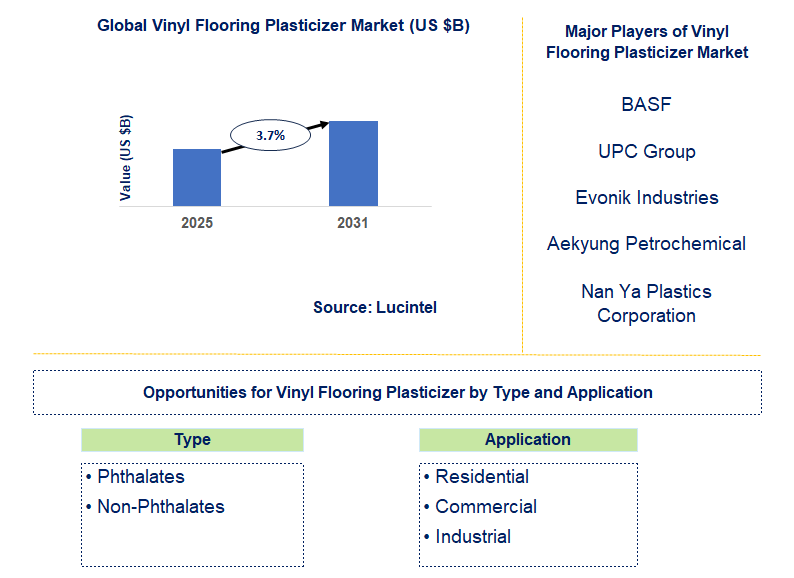
Key data points: The growth forecast = 3.7% annually for the next 7 years. Scroll below to get more insights. This market report covers trends, opportunities and forecasts in vinyl flooring plasticizer market to 2031 by type (phthalates and non-phthalates), application (residential, commercial, and industrial), and region (North America, Europe, Asia Pacific, and the Rest of the World)
We'll send your sample report shortly.
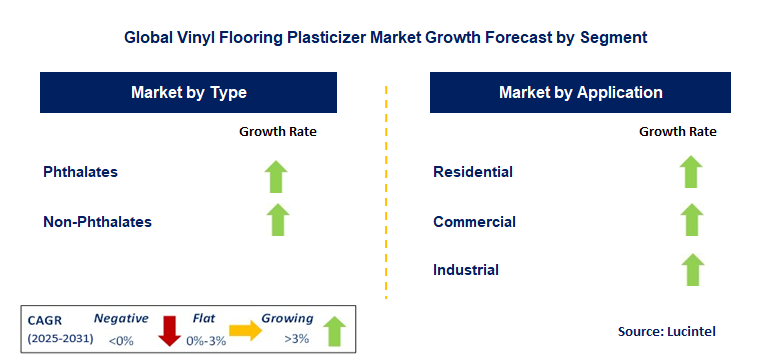
• Lucintel forecasts that, within the type category, non-phthalate is expected to witness higher growth over the forecast period.
• Within the application category, commercial is expected to witness the highest growth.
• In terms of region, APAC is expected to witness the highest growth over the forecast period. Gain valuable insights for your business decisions with our comprehensive 150+ page report. Sample figures with some insights are shown below.
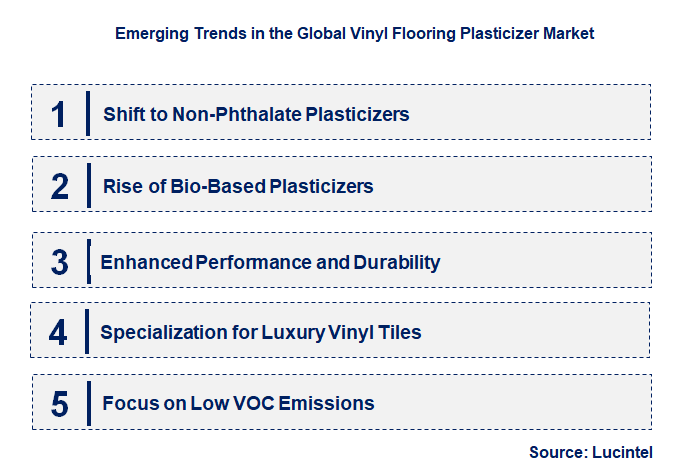
• Shift to Non-Phthalate Plasticizers: Growing awareness of the potential health and environmental impacts of phthalates is driving a significant transition. Manufacturers are increasingly adopting non-phthalate alternatives, such as DOTP and DINCH, to comply with stricter regulations and meet consumer demand for safer indoor air quality in homes and commercial spaces.
• Rise of Bio-Based Plasticizers: There’s a strong emerging trend towards developing and utilizing plasticizers derived from renewable resources like vegetable oils and agricultural waste. This addresses sustainability concerns, reduces reliance on petrochemicals, and offers a greener alternative, appealing to eco-conscious consumers and supporting a circular economy.
• Enhanced Performance and Durability: Manufacturers are focusing on plasticizers that not only offer flexibility but also contribute to the overall performance and longevity of vinyl flooring. This includes improved resistance to scratches, stains, and UV degradation, ensuring that vinyl flooring retains its aesthetic appeal and structural integrity over a longer period.
• Specialization for Luxury Vinyl Tiles: The booming popularity of LVT is driving the need for specialized plasticizers that can accommodate its unique composition and aesthetic requirements. These plasticizers are crucial for achieving the desired rigidity, dimensional stability, and realistic embossing that mimic natural wood or stone, enhancing LVT’s premium appeal.
• Focus on Low VOC Emissions: With increasing emphasis on indoor air quality, the market is seeing a trend towards plasticizers that contribute to lower Volatile Organic Compound (VOC) emissions from vinyl flooring. This development is vital for meeting green building certifications and ensuring healthier living and working environments for occupants. These emerging trends are significantly reshaping the vinyl flooring plasticizer market by compelling a shift from conventional to more sustainable, high-performance, and health-friendly solutions. This transformation is fostering innovation in chemical formulations, promoting environmentally responsible manufacturing, and ultimately leading to a new generation of vinyl flooring that is both durable and safer for consumers and the planet.
• Increased Adoption of Non-Phthalates: A primary development is the accelerating shift from traditional phthalate-based plasticizers to non-phthalate alternatives. Driven by stricter regulations and consumer health concerns, this involves a greater use of compounds like DINCH and DOTP, ensuring safer vinyl flooring products for residential and commercial applications.
• Expansion of Bio-Based Solutions: There’s a notable development in the commercialization and use of bio-based plasticizers derived from renewable resources. This trend responds to sustainability goals, reduces the carbon footprint of vinyl flooring, and offers environmentally friendly options to manufacturers and consumers, gaining traction in green building projects.
• Development of High-Performance Plasticizers: Recent advancements have focused on creating plasticizers that not only provide flexibility but also enhance other critical performance attributes. These include improved resistance to wear, tear, UV light, and chemicals, leading to more durable and long-lasting vinyl flooring solutions, especially for high-traffic areas.
• Innovation in Low VOC Formulations: To address indoor air quality concerns, manufacturers are developing plasticizers that contribute to significantly lower Volatile Organic Compound (VOC) emissions. This development is crucial for meeting green building standards and consumer preferences for healthier living and working environments, impacting product formulation.
• Strategic Partnerships and Collaborations: A key development involves increased collaboration between plasticizer manufacturers, vinyl flooring producers, and raw material suppliers. These partnerships aim to accelerate the research, development, and commercialization of next-generation plasticizers, ensuring a consistent supply of innovative and compliant materials for the market. These developments are profoundly impacting the vinyl flooring plasticizer market by driving a significant move towards more sustainable, safer, and higher-performing products. They are not only meeting evolving regulatory demands but also satisfying consumer expectations for healthier and environmentally responsible building materials, thereby fueling innovation and reshaping market competition.
• Residential Renovation and Remodeling: The increasing trend of residential renovation and remodeling, coupled with a preference for durable and aesthetically pleasing flooring, offers significant growth. Opportunities lie in developing plasticizers that enhance the ease of installation (e.g., for Luxury Vinyl Tiles) and improve the long-term performance and visual appeal in homes.
• Commercial and Institutional Projects: The booming commercial and institutional construction sectors, including offices, healthcare facilities, and educational institutions, demand high-traffic, durable, and easily maintainable flooring. Strategic growth involves plasticizers that provide superior wear resistance, chemical resistance, and slip resistance for these demanding environments.
• Healthcare Facility Applications: The healthcare sector requires flooring that is hygienic, easy to clean, and resistant to stains and harsh disinfectants. Opportunities include developing specialized plasticizers that contribute to antimicrobial properties and low VOC emissions, meeting stringent health and safety standards for hospitals and clinics.
• Luxury Vinyl Tile Expansion: The continued strong growth of the Luxury Vinyl Tile (LVT) segment represents a major opportunity. Manufacturers can focus on developing plasticizers that enhance the dimensional stability, flexibility, and printability of LVT, enabling more intricate designs and mimicking natural materials with greater authenticity.
• Sustainable and Green Building Initiatives: The global push for green building certifications and sustainable construction practices opens avenues for growth. This involves developing and promoting bio-based and non-phthalate plasticizers that reduce the environmental footprint of vinyl flooring, catering to environmentally conscious developers and consumers. These opportunities are significantly impacting the vinyl flooring plasticizer market by directing research and development towards specialized, application-specific solutions. By focusing on these high-growth segments, manufacturers can develop tailored products that meet evolving market needs, enhancing their competitive advantage and driving overall market expansion in the construction and interior design industries.
• BASF
• UPC Group
• Evonik Industries
• Aekyung Petrochemical
• Nan Ya Plastics Corporation
• LG Chem
• Eastman Chemical Company
• Shandong Qilu Plasticizers
• Shandong Hongxin Chemicals
• ExxonMobil Corporation
• Phthalates
• Non-Phthalates
• Residential
• Commercial
• Industrial
• North America
• Europe
• Asia Pacific
• The Rest of the World
• United States: The US market is characterized by a strong push for non-phthalate plasticizers due to stringent regulations from the EPA and CPSC. Manufacturers are focusing on developing safer alternatives like DINCH and bio-based options, meeting consumer demand for healthier indoor environments and driving significant investment in R&D for sustainable formulations.
• China: China, as the largest producer and consumer, is witnessing a dual trend. While phthalate-based plasticizers still dominate due to cost, there’s a growing movement towards eco-friendly and phthalate-free alternatives, spurred by increasing environmental awareness and the "Made in China 2025" strategy focusing on higher-quality and sustainable industrial growth.
• Germany: Germany is a leader in adopting sustainable solutions, with a strong preference for non-phthalate and bio-based plasticizers in its vinyl flooring market. The presence of key chemical companies like BASF and Evonik, actively developing innovative and environmentally friendly plasticizers, further supports this trend, emphasizing high performance and safety.
• India: India vinyl flooring plasticizer market is experiencing robust growth, fueled by rapid urbanization and infrastructure development. While cost-effectiveness remains a key factor, there’s increasing awareness of eco-friendly alternatives. Government initiatives and a burgeoning construction sector are driving demand for durable and aesthetic flooring solutions, including those with advanced plasticizers.
• Japan: Japan market is showing a gradual but steady shift towards non-phthalate and more environmentally conscious plasticizers. While smaller in volume compared to other Asian markets, the emphasis is on high-quality, durable, and safe flooring solutions, aligning with consumer preferences for advanced materials and sustainability in construction and renovation projects.


• BASF
• UPC Group
• Evonik Industries
• Aekyung Petrochemical
• Nan Ya Plastics Corporation
• LG Chem
• Eastman Chemical Company
• Shandong Qilu Plasticizers
• Shandong Hongxin Chemicals
• ExxonMobil Corporation Q5. Which vinyl flooring plasticizer market segment will be the largest in future? Answer: Lucintel forecasts that, within the type category, non-phthalate is expected to witness higher growth over the forecast period. Q6. In vinyl flooring plasticizer market, which region is expected to be the largest in next 5 years? Answer: In terms of region, APAC is expected to witness the highest growth over the forecast period. Q7. Do we receive customization in this report? Answer: Yes, Lucintel provides 10% customization without any additional cost.


Choose a license that fits your team. Instant PDF delivery.
Prices exclude taxes. Instant delivery. Custom licensing available on request.
Market Report · July 16, 2026
Market Report · July 15, 2026
Market Report · July 15, 2026
Trusted partner for strategic intelligence and business growth


Receive a complimentary market analysis tailored to your industry. Our analysts will identify key growth opportunities and competitive dynamics specific to your business.

Market size, growth rate, and key trend analysis for your specific sector.

Top competitor positioning and market share analysis.

Strategic recommendations backed by data-driven insights.
Get curated market intelligence and competitive moves straight to your inbox.
By subscribing, you agree to receive our monthly insights. Unsubscribe anytime.
Receive a complimentary market analysis tailored to your industry. Our analysts will identify key growth opportunities and competitive dynamics specific to your business.
Market size, growth rate, and key trend analysis for your specific sector.
Top competitor positioning and market share analysis.
Strategic recommendations backed by data-driven insights.
Get curated market intelligence, emerging trends, and competitive moves straight to your inbox each month.
By subscribing, you agree to receive our monthly insights. Unsubscribe anytime.
We'll send your sample report shortly.