
Market Report · July 24, 2026

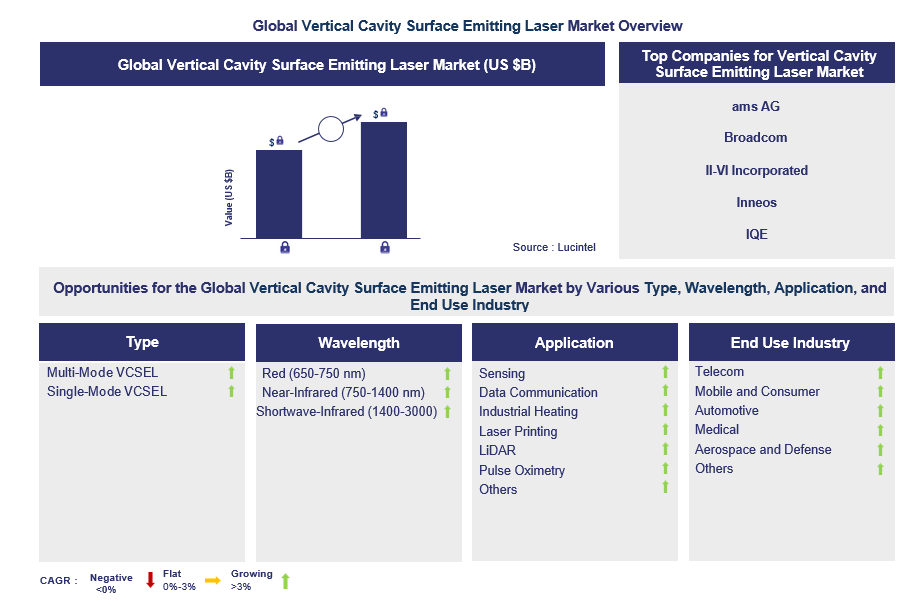
Key data points: The market size in 2031 = $5.3 billion, growth forecast = 13.5% annually for the next 7 years. Scroll below to get more insights. This market report covers trends, opportunities, and forecasts in the global vertical cavity surface emitting laser market to 2031 by type (multi-mode VCSEL and single-mode VCSEL), wavelength (red (650-750 nm), near-infrared (750-1400 nm), and shortwave-infrared (1400-3000 nm)), application (sensing, data communication, industrial heating, laser printing, LiDAR, pulse oximetry, and others), end use industry (telecom, mobile and consumer, automotive, medical, aerospace and defense, and others), and region (North America, Europe, Asia Pacific, and the Rest of the World)
We'll send your sample report shortly.
• Lucintel forecasts that, within the application category, sensing is expected to witness the highest growth over the forecast period due to the increasing use of vertical cavity surface emitting laser in this technology to improve its efficiency and broaden its potential industrial applications.
• Within the end use category, mobile and consumer will remain the largest segment due to substantial application of vertical cavity surface emitting laser in this sector to enable various revolutionary features, such as facial recognition systems, 3D sensing in augmented reality software, and reliable gesture identification, optimizing user experiences and device security.
• In terms of regions, APAC is expected to witness the highest growth over the forecast period due to the existence of major semiconductor manufacturing hubs, robust economic growth, and the presence of key players in the region. Gain valuable insights for your business decisions with our comprehensive 150+ page report.
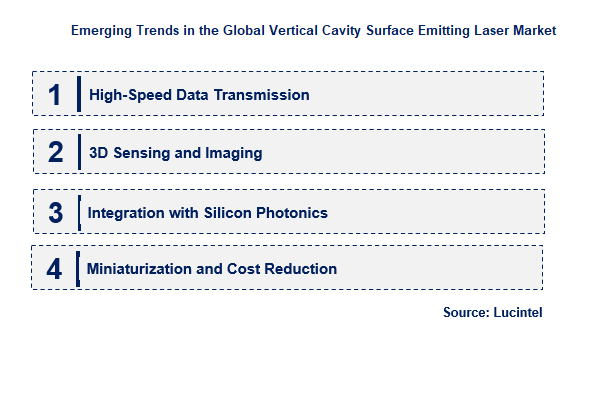
• High-Speed Data Transmission: Vertical cavity surface emitting lasers are used more frequently for high-speed data transmission in data centers and communication networks. They support higher rates and greater bandwidths to address demands from current optical interconnects while improving overall network performance.
• 3D Sensing and Imaging: In 3D sensing applications, vertical cavity surface emitting lasers are gaining popularity, particularly in consumer electronics and automotive systems. This enables exact depth sensing and imaging, enhancing functionalities in augmented reality (AR), virtual reality (VR), and self-driving cars.
• Integration with Silicon Photonics: Another developing trend is the integration of silicon photonics with vertical cavity surface emitting lasers. They become smaller and cheaper, significantly contributing to the development of compact optical communication system solutions, which are currently required for use in data centers or telecommunications. This allows them to scale and advance further while also enhancing their performance and quality.
• Miniaturization and Cost Reduction: Efforts are focused on miniaturizing the vertical cavity surface emitting laser size, thus reducing its production cost. Through innovations in manufacturing processes and materials, vertical cavity surface emitting lasers have become affordable, making them useful across a wider range of applications, including wearable devices and consumer electronics. Emerging trends such as high-speed data transmission, 3D sensing, silicon photonics integration, miniaturization, and enhanced reliability are reshaping the vertical cavity surface emitting laser market. These trends drive improvements in performance and application flexibility, enhancing optical technology growth across different industries.
• Better Data Communications Performance: Novel vertical cavity surface emitting laser designs are improving data transfer rates and bandwidths, which are essential for high-performance data centers. These advances meet the growing need for faster, more effective optical communication systems.
• Advances in 3D Sensing Technology: The introduction of high-resolution vertical cavity surface emitting laser arrays is boosting 3D sensing capabilities, particularly in consumer electronics and the automotive sector. These advancements enable better depth sensing and enhanced imaging performance.
• Integration with Emerging Technologies: AI and machine learning are some of the technologies where vertical cavity surface emitting lasers are playing a key role. This integration enhances vertical cavity surface emitting laser functionality and supports new directions such as robotics and automated systems.
• Cost Reduction and Manufacturing Improvements: Efforts to reduce vertical cavity surface emitting laser production costs, as well as improve manufacturing processes, have led to greater popularity. These enhancements fuel demand for consumer electronic devices and industrial uses. Developments in vertical cavity surface emitting laser technology, such as improved efficiency, 3D sensing breakthroughs, integration with new technologies, price reductions, and better energy consumption, have propelled growth and innovation in the market. These improvements are driving the growing applications of vertical cavity surface emitting lasers across a wide range of products.
• Telecommunications: In the telecommunications industry, vertical cavity surface emitting lasers are essential for transmitting data at high speeds. These include developing high-performance vertical cavity surface emitting lasers for data centers and optical networks that can meet the increasing demands for even faster communication systems.
• Mobile and Consumer Electronics: The integration of vertical cavity surface emitting lasers in mobile and consumer electronics is growing. Opportunities range from compact, high-resolution vertical cavity surface emitting lasers designed for facial recognition and AR/VR applications, enhancing user experience and functionality.
• Automotive Applications: There is potential for growth in the use of vertical cavity surface emitting lasers for Advanced Driver Assistance Systems (ADAS) and LIDAR in the automotive sector. This includes developing robust vertical cavity surface emitting laser solutions for accurate sensing and imaging to enable advances in autonomous driving technologies.
• Medical Devices: The use of vertical cavity surface emitting lasers has expanded into various medical devices, such as imaging and diagnostics. Growth opportunities include creating higher-resolution vertical cavity surface emitting lasers with better imaging, thereby contributing to advancements in medical technology, such as enhanced sensing capabilities. The vertical cavity surface emitting laser market is expanding due to strategic growth opportunities in telecommunications, mobile and consumer electronics, automotive applications, medical devices, aerospace, and defense. These opportunities foster technological progress and innovation in various markets.
• Technological Advancements: The vertical cavity surface emitting laser market is stimulated by continuous developments, such as improved device performance and integration with emerging technologies. Data communication advancements, 3D sensing trends, and miniaturization are extending the applications and capabilities of vertical cavity surface emitting lasers.
• Rising Demand for High-Speed Communication: The growing need for high-speed data transmission in data centers and telecommunication networks drives demand for high-performance vertical cavity surface emitting lasers. This trend contributes to the development of faster and more efficient optical interconnects.
• Growth in Consumer Electronics: The expansion of consumer electronic devices, including smartphones and AR/VR gadgets, has triggered increased demand for vertical cavity surface emitting laser products. Applications like face recognition and depth sensing contribute to the growth of this market.
• Advancements in Automotive Technology: The increased adoption of vertical cavity surface emitting lasers in automotive systems, such as ADAS and LIDAR, has been observed. The need for precise sensing and imaging in autonomous driving supports the growth of the vertical cavity surface emitting laser market. Challenges in the vertical cavity surface emitting laser market include:
• High Cost of Manufacture: A significant obstacle to market expansion is the high cost involved in creating and producing advanced vertical cavity surface emitting lasers. This challenge is particularly relevant for emerging markets and smaller firms.
• Complex Integration: Integrating existing systems and technologies with vertical cavity surface emitting lasers may be difficult. Expertise in technology and extensive planning are necessary to ensure compatibility and smooth operation. Technological advancements, the increasing demand for high-speed communication, growth in consumer electronics, progress in automotive technology, and an energy conservation focus will drive the vertical cavity surface emitting laser market. Future development and sustainability depend on addressing issues such as high production costs, complex integration, and regulatory requirements.
• Ams AG
• Broadcom
• II-VI Incorporated
• Inneos
• IQE
• Leonardo Electronics
• Lumentum Operations
• Teledyne FLIR
• The TRUMPF
• TT Electronics
• Multi-Mode vertical cavity surface emitting laser
• Single-Mode vertical cavity surface emitting laser
• Red (650-750 nm)
• Near-Infrared (750-1400 nm)
• Shortwave-Infrared (1400-3000 nm)
• Sensing
• Data Communication
• Industrial Heating
• Laser Printing
• LiDAR
• Pulse Oximetry
• Telecom
• Mobile and Consumer
• Automotive
• Medical
• Aerospace and Defense
• Others
• North America
• Europe
• Asia Pacific
• The Rest of the World
• United States: In the United States, recent developments include the production of high-speed vertical cavity surface emitting lasers for data communication and 3D sensing. Companies are working on improving vertical cavity surface emitting laser performance to meet the needs of high-speed optical networks and advanced consumer electronics. Packaging and integration innovations are also making vertical cavity surface emitting lasers more functional and reliable.
• China: China is focusing on bulk manufacturing and cost-cutting in its strides into vertical cavity surface emitting laser technology. Developments include the introduction of vertical cavity surface emitting lasers for smartphones and AR/VR devices used by consumers. The market is driven by large-scale manufacturing capacities and government support for developing optoelectronics technologies.
• Germany: Germany is advancing in vertical cavity surface emitting laser technology, particularly for high-precision industrial and automotive applications. Innovations include improved wavelength stability and power efficiency in vertical cavity surface emitting lasers. High-end LIDAR and advanced sensing systems are key areas where Germany emphasis on quality and performance is driving growth.
• Indian: The focus in India is on making vertical cavity surface emitting laser technology more affordable and accessible to emerging markets. This involves lowering production costs and improving laser performance for industries such as telecommunications. This aligns with the growing trend of local manufacturing and innovation that supports the growth of electronics.
• Japan: Japan holds a dominant position in developing vertical cavity surface emitting lasers for advanced robotics and medical equipment applications. Recent advancements include high-resolution imaging arrays based on vertical cavity surface emitting lasers, which can be used for sensing purposes. Japan strong focus on research and development is advancing optical technologies.


• Ams AG
• Broadcom
• II-VI Incorporated
• Inneos
• IQE
• Leonardo Electronics
• Lumentum Operations
• Teledyne FLIR
• The TRUMPF
• TT Electronics Q6. Which vertical cavity surface emitting laser market segment will be the largest in future? Answer: Lucintel forecast that sensing is expected to witness highest growth over the forecast period due to increasing use of vertical cavity surface emitting laser in this technology to improve its efficiency and broaden their potential industrial applications. Q7. In vertical cavity surface emitting laser market, which region is expected to be the largest in next 5 years? Answer: APAC is expected to witness highest growth over the forecast period due to existence of major semiconductor manufacturing hubs, robust economic growth, and presence of key players in the region. Q.8 Do we receive customization in this report? Answer: Yes, Lucintel provides 10% customization without any additional cost.


Choose a license that fits your team. Instant PDF delivery.
Prices exclude taxes. Instant delivery. Custom licensing available on request.
Market Report · July 24, 2026
Market Report · July 20, 2026
Market Report · July 20, 2026
Trusted partner for strategic intelligence and business growth


Receive a complimentary market analysis tailored to your industry. Our analysts will identify key growth opportunities and competitive dynamics specific to your business.

Market size, growth rate, and key trend analysis for your specific sector.

Top competitor positioning and market share analysis.

Strategic recommendations backed by data-driven insights.
Get curated market intelligence and competitive moves straight to your inbox.
By subscribing, you agree to receive our monthly insights. Unsubscribe anytime.
Receive a complimentary market analysis tailored to your industry. Our analysts will identify key growth opportunities and competitive dynamics specific to your business.
Market size, growth rate, and key trend analysis for your specific sector.
Top competitor positioning and market share analysis.
Strategic recommendations backed by data-driven insights.
Get curated market intelligence, emerging trends, and competitive moves straight to your inbox each month.
By subscribing, you agree to receive our monthly insights. Unsubscribe anytime.
We'll send your sample report shortly.