
Market Report · July 29, 2026

This market report covers trends, opportunities, and forecasts in the global valves, actuators and positioners market to 2031 by technology (directional control valves, pneumatic valves, solenoid valves, and others), end use industry (aerospace and defense, automobile, oil & gas, mining, and railways), and region (North America, Europe, Asia Pacific, and the Rest of the World)
We'll send your sample report shortly.
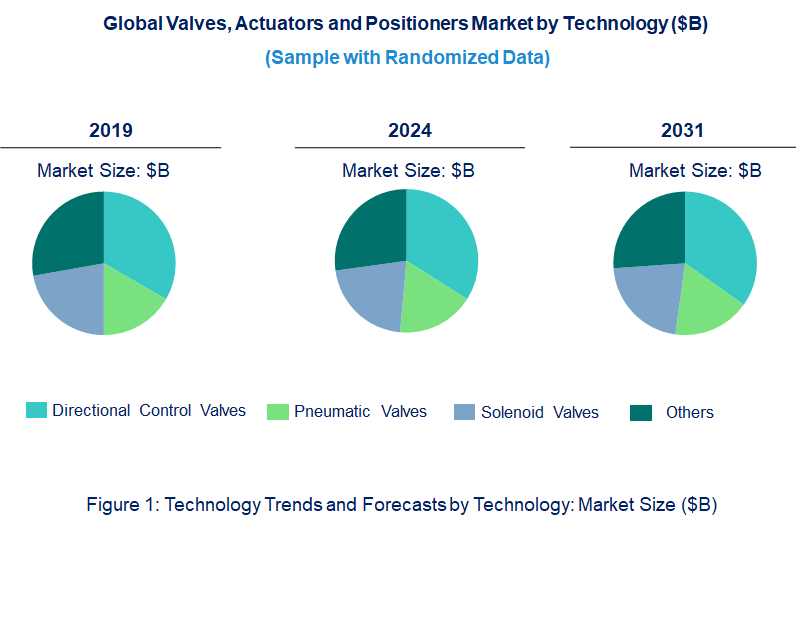
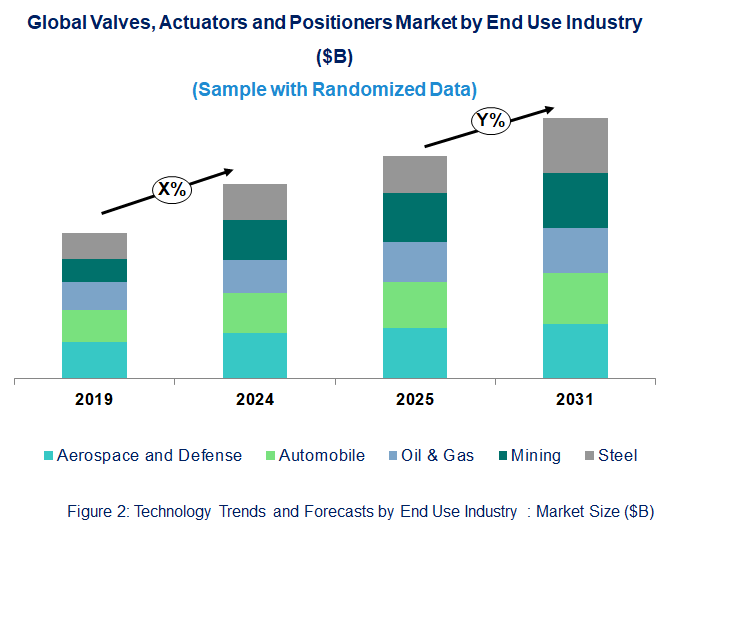
• Smart Valves Integration: Smart valves with digital controllers, sensors, and remote monitoring capabilities are becoming increasingly popular across industries like oil & gas, automotives, and aerospace. These valves enhance operational efficiency and provide real-time data analytics.
• Energy-Efficient Actuators: The demand for energy-efficient actuators has risen as industries strive to reduce operational costs. Electric actuators, in particular, offer precise control and energy savings compared to traditional pneumatic systems.
• Internet of Things (IoT) Connectivity: The integration of IoT into valves, actuators, and positioners is enabling remote monitoring and predictive maintenance. This connectivity allows for real-time performance tracking and optimization.
• Pneumatic to Electric Actuators Shift: There’s a growing trend towards replacing pneumatic actuators with electric alternatives, offering more precise control, lower maintenance, and energy efficiency.
• Increased Automation in Industrial Processes: Automation technologies are playing a significant role in enhancing process efficiency, leading to a growing adoption of advanced valves and actuators that support automated systems. These technology trends are significantly transforming the valves, actuators, and positioners market by improving performance, operational efficiency, and reducing costs.
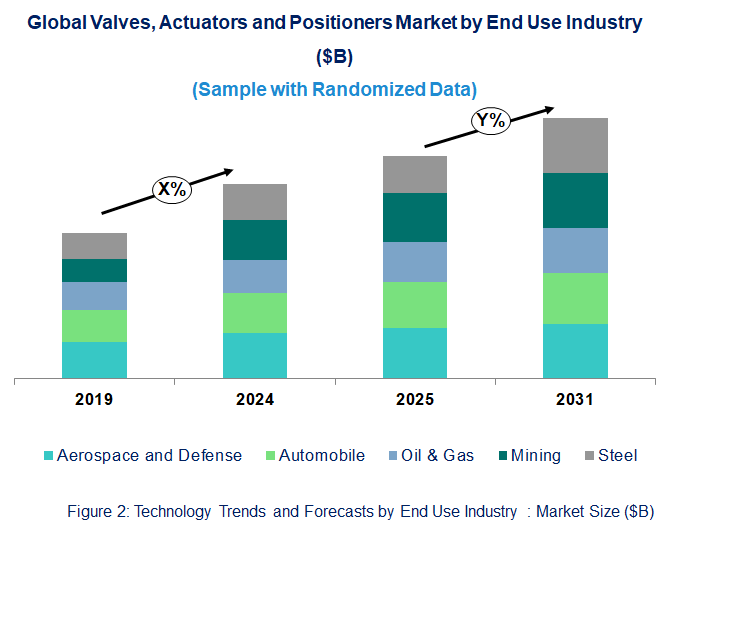
• Technology Potential: The valves, actuators, and positioners market holds significant technological potential as industries increasingly shift toward automation, precision control, and energy efficiency. These components are crucial in managing fluid flow across sectors such as oil & gas, power generation, water treatment, pharmaceuticals, and manufacturing. The evolution of smart valves and digital positioners, incorporating IoT, AI-based diagnostics, and real-time feedback mechanisms, is driving enhanced system reliability, predictive maintenance, and operational efficiency. Integration with SCADA and DCS systems further boosts their strategic relevance in automated environments. As industrial processes become more complex and data-driven, the demand for intelligent flow control solutions is expected to grow rapidly.
• Degree of Disruption: The degree of disruption in this market is moderate to high, particularly due to the adoption of smart and connected devices. Traditional mechanical systems are increasingly being replaced by electro-mechanical or digital alternatives offering real-time data and remote control. This shift challenges legacy manufacturers while opening opportunities for technology-driven entrants. In sectors like oil & gas, where downtime is costly, predictive maintenance capabilities offered by smart actuators and positioners are reshaping maintenance strategies. The move toward sustainability and energy-efficient systems is also disrupting design philosophies and favoring innovative flow control technologies with lower carbon footprints.
• Level of Current Technology Maturity: Valves, actuators, and positioners are largely mature technologies in their basic forms, with well-established standards and applications. However, their smart and digital variants are at different stages of development and adoption. While electro-pneumatic actuators and digital positioners are increasingly commercialized and integrated into modern facilities, full convergence with Industry 4.0 frameworks remains ongoing. Wireless valve positioners and IIoT-enabled actuators are emerging but face adoption challenges related to interoperability, cybersecurity, and cost. The core mechanical technologies remain stable, but innovation is focused on enhancing intelligence, connectivity, and compatibility with digital control ecosystems.
• Regulatory Compliance: Compliance in this market is tightly governed by industry-specific and international standards, focusing on safety, environmental impact, and operational reliability. For example, in oil & gas, valves and actuators must meet API and ANSI standards, while industries like pharmaceuticals and food require compliance with FDA and EHEDG norms. ISO and IEC standards also guide product testing, performance, and interoperability. Environmental regulations, such as those limiting emissions from leaking valves (e.g., LDAR programs), are becoming stricter, driving demand for higher-integrity sealing and automated control. Manufacturers must also ensure compliance with ATEX or IECEx certifications for use in explosive environments.
• Siemens: Siemens has been integrating digital technologies in valve actuators, such as adding IoT capabilities for remote monitoring and predictive maintenance.
• Baker Hughes: The company has developed smart valves and advanced control systems, which have improved operational efficiency in oil & gas applications.
• Honeywell International Inc.: Honeywell’s efforts focus on smart actuators and valves that enhance automation and connectivity across industries like aerospace and automotive.
• Emerson Electric Co.: Emerson has launched innovations like Fisher valves, incorporating advanced materials and digital capabilities to ensure reliability in critical applications.
• Bürkert: Bürkert has introduced cutting-edge valve technology with an emphasis on precision and energy efficiency, particularly in industrial applications. These developments are strengthening the market, providing enhanced functionality, precision, and energy efficiency.
• Rising Demand for Industrial Automation With industries moving towards smart manufacturing and Industry 4.0, the demand for automated flow control systems has surged. Valves, actuators, and positioners play a crucial role in automating critical processes, reducing human error, and increasing operational efficiency.
• Growth in Water and Wastewater Treatment Projects Governments and municipalities are heavily investing in water infrastructure to ensure clean water supply and wastewater management. This directly drives demand for advanced valve and actuator systems for accurate and safe fluid control.
• Expansion of Oil & Gas and Power Sectors Exploration, refining, and power generation activities require robust valve systems for handling high pressure and corrosive fluids. Ongoing investments in these sectors support consistent market growth.
• Technological Advancements in Smart Valves Integration of IoT, sensors, and predictive maintenance technologies in valves and actuators enables real-time monitoring and remote control, improving reliability and reducing downtime in critical applications.
• Stringent Environmental and Safety Regulations Environmental regulations around emissions and process safety have pushed industries to adopt more reliable and precise flow control devices, fueling demand for high-performance valves and actuators. Challenges
• High Initial Costs and System Complexity The deployment of advanced control systems involves high capital expenditure and engineering complexity, which may hinder adoption, especially in small and medium enterprises.
• Volatility in Raw Material Prices Fluctuating prices of metals and components used in valves and actuators, such as stainless steel and aluminum, can impact production costs and profit margins.
• Supply Chain Disruptions Global uncertainties, such as geopolitical tensions and pandemic-related delays, have affected the timely availability of components and finished products, delaying projects.
• Skilled Workforce Shortage Installing and maintaining modern automated valve systems require specialized technical skills, which are in short supply in many regions, affecting deployment and long-term use.
• Integration Challenges with Legacy Systems Many industries still operate with outdated control systems, making integration of new smart valves and actuators technically complex and cost-intensive. The valves, actuators, and positioners market is benefiting from strong demand in infrastructure, automation, and environmental management. While opportunities are plentiful due to industrial growth and technological innovation, market players must address cost, supply, and integration challenges to fully realize this growth potential and ensure long-term scalability.
• Siemens
• Baker Hughes
• Honeywell International Inc
• Emersion Electric Co
• Bürkert
• Technology Readiness and Applications: Directional control valves are highly mature, used widely in hydraulics and industrial automation. Pneumatic valves are also fully commercialized, ideal for applications requiring clean energy use like food processing and packaging. Solenoid valves are technologically ready and versatile, especially suited for HVAC, medical equipment, and irrigation systems due to their compactness and precision. Other technologies, such as smart valves and piezoelectric actuators, are emerging, mostly in pilot or specialized industrial applications requiring fine control, low energy consumption, and fast response. These technologies are transitioning from niche uses to broader market acceptance as digital transformation advances across industries.
• Competitive Intensity and Regulatory Compliance: The market sees high competitive intensity with global players competing on performance, durability, smart integration, and price. Directional control and pneumatic valve markets are dominated by traditional industrial automation giants, while solenoid and advanced valve players focus on innovation. Regulatory compliance is shaped by safety (ISO, CE), environmental (RoHS, REACH), and industry-specific standards (e.g., ATEX for explosive environments), especially in critical applications like food processing, pharmaceuticals, and energy. Companies are under pressure to offer more sustainable, intelligent, and compliant valve solutions, which increases R&D spending and influences product design and materials.
• Disruption Potential: Directional control valves have high disruption potential due to their critical role in automation and fluid control in advanced manufacturing and smart systems. Pneumatic valves, while mature, are evolving with better energy efficiency and integration with IoT. Solenoid valves are highly adaptable and disruptive in compact, rapid-switching applications. Other emerging valve technologies, like electrohydraulic or piezoelectric valves, offer novel actuation mechanisms with higher precision, compact design, and energy savings. These advancements drive smarter and more responsive industrial systems, contributing significantly to Industry 4.0 and reshaping control architectures across sectors such as oil & gas, water treatment, and process industries.
• Directional Control Valves
• Pneumatic Valves
• Solenoid Valves
• Others
• Aerospace and Defense
• Automobile
• Oil & Gas
• Mining
• Railways
• North America
• Europe
• Asia Pacific
• The Rest of the World
• Latest Developments and Innovations in the Valves, Actuators and Positioners Technologies
• Companies / Ecosystems
• Strategic Opportunities by Technology Type


Choose a license that fits your team. Instant PDF delivery.
Prices exclude taxes. Instant delivery. Custom licensing available on request.
Market Report · July 29, 2026
Market Report · July 20, 2026
Market Report · July 20, 2026
Trusted partner for strategic intelligence and business growth


Receive a complimentary market analysis tailored to your industry. Our analysts will identify key growth opportunities and competitive dynamics specific to your business.

Market size, growth rate, and key trend analysis for your specific sector.

Top competitor positioning and market share analysis.

Strategic recommendations backed by data-driven insights.
Get curated market intelligence and competitive moves straight to your inbox.
By subscribing, you agree to receive our monthly insights. Unsubscribe anytime.
Receive a complimentary market analysis tailored to your industry. Our analysts will identify key growth opportunities and competitive dynamics specific to your business.
Market size, growth rate, and key trend analysis for your specific sector.
Top competitor positioning and market share analysis.
Strategic recommendations backed by data-driven insights.
Get curated market intelligence, emerging trends, and competitive moves straight to your inbox each month.
By subscribing, you agree to receive our monthly insights. Unsubscribe anytime.
We'll send your sample report shortly.