
Market Report · July 29, 2026

Key data points: The growth forecast = 8.7% annually for the next 7 years. Scroll below to get more insights. This market report covers trends, opportunities and forecasts in UXO detection equipment market to 2031 by platform (drone-based systems, handheld systems, marine-based systems, and vehicle-mounted systems), application (aerial surveying, land mine detection, underwater UXO detection, and others), end use (commercial enterprises and military & government agencies), and region (North America, Europe, Asia Pacific, and the Rest of the World)
We'll send your sample report shortly.
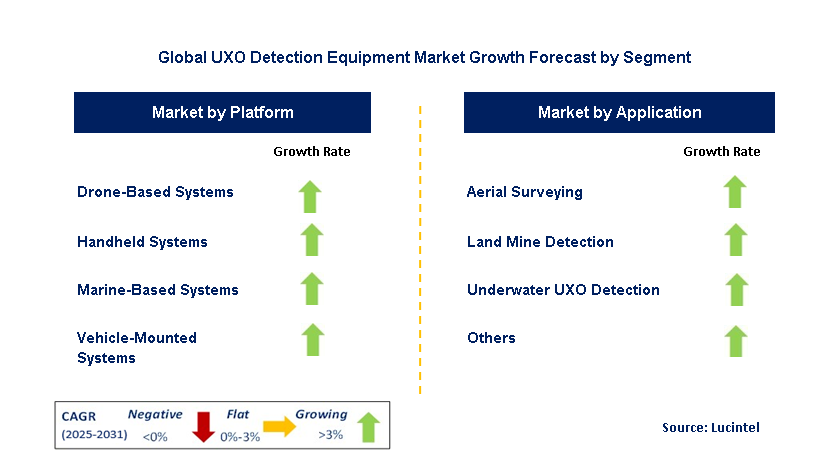
• Lucintel forecasts that, within the platform category, drone-based system is expected to witness the highest growth over the forecast period.
• Within the application category, aerial surveying is expected to witness the highest growth.
• In terms of region, North America is expected to witness the highest growth over the forecast period.
Gain valuable insights for your business decisions with our comprehensive 150+ page report. Sample figures with some insights are shown below.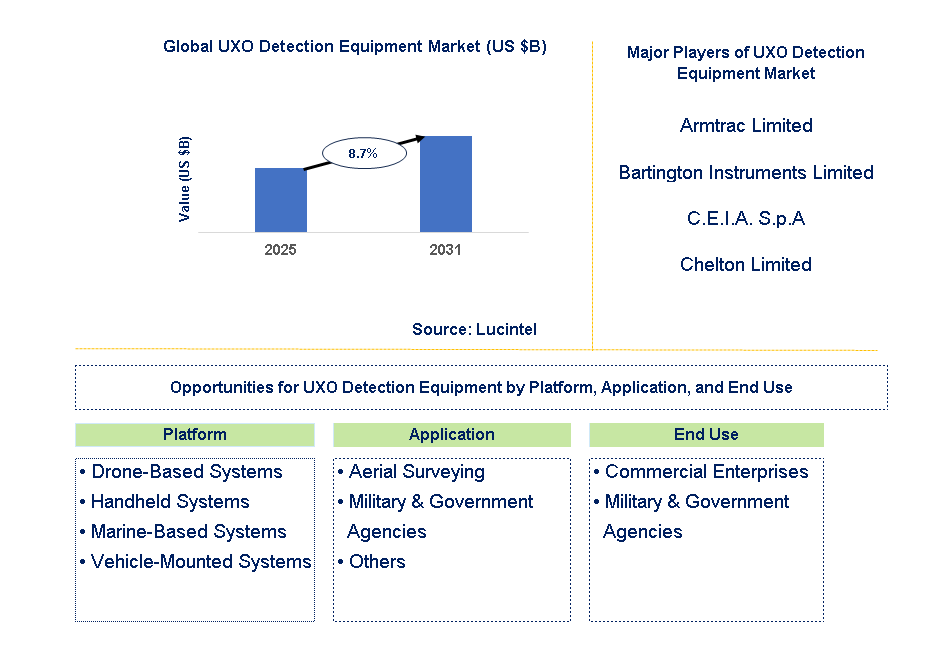
• Multi-Sensor Fusion for Enhanced Detection and Discrimination: One dominant trend is the combination of two or more sensor technologies, e.g., magnetometry, electromagnetic induction (EMI), and ground-penetrating radar (GPR), into one platform. Data fusion from these complementary sensors creates a more complete subsurface image, allowing for enhanced detection of all UXO types, including non-metallic objects, as well as enhanced discrimination between ordnance and harmless clutter. Sophisticated algorithms are essential to combine and interpret the disparate datasets effectively.
• Technological Advancements in Machine Learning and Data Processing: The huge volumes of data produced by contemporary UXO detection technology require advanced processing methods. Trends in the future revolve around the use of new data analytics and machine learning algorithms to automatically detect potential UXO targets, minimize false alarms, and offer better estimates of the subsurface. AI-based systems have the capability to learn from past experience and progressively enhance detection accuracy.
• Integration with Unmanned Aerial Vehicles (UAVs) and Robotics: In order to improve efficiency and safety, increasing use is being made of deploying UXO detection sensors on unmanned platforms. UAVs mounted with magnetometers and other sensors can quickly cover broad areas, while robotic ground vehicles can traverse dangerous terrain and make detailed investigations. Autonomous systems minimize human exposure to danger and improve the speed and range of surveys.
• Technology Development of Advanced Ground-Penetrating Radar (GPR) : GPR is becoming increasingly significant in the detection of non-metallic UXO and the identification of buried objects in challenging geological environments. Emerging trends in GPR involve the creation of multi-frequency and polarimetric systems that produce greater subsurface detail and better discrimination capabilities. Advanced signal processing is also being used to improve the depth penetration and resolution of GPR data.
• Real-Time Data Processing and Mapping: The ability to process and visualize detection data in real-time is becoming increasingly crucial for efficient UXO clearance operations. Trends include the development of integrated systems that provide immediate feedback to operators in the field, allowing for on-the-spot analysis and decision-making. Real-time mapping and 3D visualization tools help to create accurate and up-to-date assessments of contaminated areas, streamlining the remediation process.
These new trends together are collectively transforming the UXO detection equipment market by spurring innovation toward more precise, effective, and safer systems. The convergence of multi-sensor platforms, sophisticated data analytics, autonomous technologies, improved GPR, and real-time processing capabilities will play a key role in solving the worldwide problem of UXO pollution.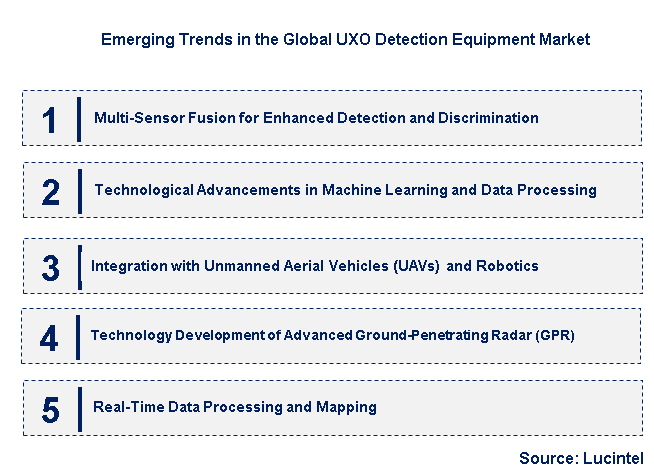
• Advanced Electromagnetic Induction (EMI) Sensor Development: New technologies in EMI sensors have seen the development of multi-frequency and transient EMI systems that are capable of offering greater information on the size, shape, and metallic composition of buried targets. Advanced EMI sensors provide greater discrimination power and can more effectively discriminate between UXO and benign metallic trash, cutting false alarms and enhancing the effectiveness of clearance operations.
• High-Resolution Magnetometer Integration: High-resolution magnetometers, such as fluxgate and gradiometer systems, are being integrated more and more in UXO detection systems. These highly sensitive magnetic sensors can measure the ferrous content of in-ground ordnance with higher precision and at deeper depths. Miniaturization of these sensors to fit on UAVs and robotic platforms is of recent focus, allowing faster and safer reconnaissance of large contaminated fields.
• Ground-Penetrating Radar (GPR) Improvements for Non-Metallic UXO: In recognition of the shortcomings of metal detectors in detecting non-metallic ordnance, many improvements are being made to UXO detection through GPR technology. Some recent advances include wider frequency bands, better antenna design, and more advanced signal processing algorithms to improve buried non-metallic detection and subsurface imaging of complex soils.
• New Developments in Data Fusion and Interpretation Software: The sheer amount of data, as well as its complexity, from multi-sensor UXO detection systems requires sophisticated data fusion and interpretation software. The latest innovations concentrate on developing easy-to-use platforms capable of merging data from multiple sensors, utilizing advanced algorithms for target identification, and presenting clean, actionable results to field operators, frequently with 3D visualization and augmented reality features.
• Autonomous and Robotic System Deployment: As a measure to reduce human contact with the risks presented by UXO, autonomous and robotic systems with sophisticated detection sensors are increasingly being developed and deployed. New developments have seen the development of UAVs that are integrated with magnetic and electromagnetic sensors for quick aerial reconnaissance, as well as robotic ground vehicles for conducting thorough subsurface explorations and even facilitating the safe evacuation of detected ordnance.
These advances are making substantial influences on the UXO detection equipment market by delivering more accurate, adaptable, and safer devices for combating the worldwide UXO threat. Advances in sensor technologies, data processing, and autonomous systems are making UXO clearance operations more efficient and effective, eventually saving lives and facilitating the safe utilization of land previously contaminated.• Humanitarian Demining Organizations: Humanitarian demining organizations working in post-conflict areas continuously and increasingly require efficient and low-cost UXO detection technology. Producing robust, easy-to-use, and low-cost multi-sensor systems and offering extensive training and support to these organizations is a strong growth potential with broad social implications.
• Military and Defense Agencies: Military and defense agencies need advanced UXO detection tools for force protection, range clearance, and battlefield remediation. Designing high-performance, rugged, and deployable multi-sensor platforms, both airborne and robotic, with advanced data processing, provides a wide growth opportunity in the defense sector.
• Commercial Land Construction and Development: Construction and land development activities in regions of possible UXO contamination need comprehensive site investigations prior to initiation of work. Supplying effective and precise UXO detection services and equipment designed for commercial use, such as fast assessment instruments and integrated reporting systems, is an expanding market segment.
• Conservation and Environmental Remediation: UXO contamination can interfere with environmental remediation and be harmful to ecosystems. Creating specialized detection devices and survey techniques for environmentally sensitive environments, such as underwater UXO detection for marine environments, offers a distinctive opportunity for growth centered around ecological safety.
• GIS and Mapping Service Integration: Proper UXO contamination management calls for precise mapping and data handling. Creating UXO detection technology with smooth integration into GIS software and offering extensive mapping services within contaminated zones presents a worthwhile growth potential by increasing clearance operation efficiency and effectiveness and long-term land use management.
These growth opportunities are strategic in nature and underscore the varied needs in the UXO detection equipment market. By targeting applications of a particular nature like humanitarian demining, military activities, commercial development activities, environmental remediation, and data integration, equipment vendors and service providers are able to tackle key challenges and help make the world a safer place.• Armtrac Limited
• Bartington Instruments Limited
• C.E.I.A. S.p.A
• Chemring Group
• Drone-Based Systems
• Handheld Systems
• Marine-Based Systems
• Vehicle-Mounted Systems
• Aerial Surveying
• Land Mine Detection
• Underwater UXO Detection
• Others
• North America
• Europe
• Asia Pacific
• The Rest of the World
• United States: The US market is dominated by continued research and development sponsored by the Department of Defense and the environmental agencies aimed at enhancing UXO detection and discrimination capabilities. Recent advancements involve breakthroughs in multi-sensor platforms combining magnetometry, electromagnetic induction (EMI), and ground-penetrating radar (GPR). There is a clear focus on creating sophisticated machine learning and data processing algorithms to cut down on false alarms and enhance the detection of deep-buried or non-metallic ordnance. It also focuses on using unmanned aerial vehicles (UAVs) and robotic ground vehicles with advanced sensors for more efficient and safe surveys.
• China: China is confronted with UXO contamination arising from previous wars and industry, spurring innovations in local detection technology. The latest developments include the design of high-sensitivity magnetometers and EMI sensors specifically for local soil conditions and ordnance types. Enhanced emphasis is also placed on combining these sensors with geographic information systems (GIS) and drone-based platforms for mass-area surveys. Chinese research institutions and companies are now working more closely together to design cost-effective and efficient UXO detection means.
• Germany: Germany possesses large areas of World War II UXO-contaminated terrain, creating an established and evolving UXO detection market. Recent trends involve the optimization of advanced geophysical techniques, like full-tensor radiometry and multi-frequency EMI, for high-resolution subsurface imaging. There is also a priority on creating advanced data interpretation software and 3D visualization tools to enhance the efficiency of UXO identification and minimize the necessity for intrusive investigations. In addition, safety and efficiency in detection and disposal activities are primary motivators for innovation.
• India: India has UXO issues in certain areas as a result of past wars and border conflicts, necessitating effective detection equipment. Recent trends involve the adoption and modification of available technology such as ground-penetrating radar and magnetic locators for local conditions. Drilling is also increasingly researched with a view to considering drone-based surveying for extensive contaminated sites. Attempting to acquire and utilize effective and affordable detection tools is likely aimed at enabling landmine clearance and UXO cleaning operations.
• Japan: Japan experiences UXO contamination mainly from World War II, and this is especially widespread in some island areas. Recent activities in the Japanese market involve the use of advanced electromagnetic techniques and ground-penetrating radar for detailed subsurface exploration. Emphasis on developing remote-controlled systems for remote detection and manipulation of UXO to minimize risk also exists. Research work can be aimed at modifying available technology to suit the types of ordnance and burial situations encountered in Japan.


• Armtrac Limited
• Bartington Instruments Limited
• C.E.I.A. S.p.A
• Chemring Group
Q5. Which UXO detection equipment market segment will be the largest in future?

Choose a license that fits your team. Instant PDF delivery.
Prices exclude taxes. Instant delivery. Custom licensing available on request.
Market Report · July 29, 2026
Market Report · July 20, 2026
Market Report · July 20, 2026
Trusted partner for strategic intelligence and business growth


Receive a complimentary market analysis tailored to your industry. Our analysts will identify key growth opportunities and competitive dynamics specific to your business.

Market size, growth rate, and key trend analysis for your specific sector.

Top competitor positioning and market share analysis.

Strategic recommendations backed by data-driven insights.
Get curated market intelligence and competitive moves straight to your inbox.
By subscribing, you agree to receive our monthly insights. Unsubscribe anytime.
Receive a complimentary market analysis tailored to your industry. Our analysts will identify key growth opportunities and competitive dynamics specific to your business.
Market size, growth rate, and key trend analysis for your specific sector.
Top competitor positioning and market share analysis.
Strategic recommendations backed by data-driven insights.
Get curated market intelligence, emerging trends, and competitive moves straight to your inbox each month.
By subscribing, you agree to receive our monthly insights. Unsubscribe anytime.
We'll send your sample report shortly.