
Market Report · May 18, 2026

This market report covers trends, opportunities, and forecasts in the global uv light stabilizers market to 2031 by technology (hindered amine light stabilizers, uv absorbers, quenchers, and others), application (automotive, packaging, agriculture films, building & construction, adhesives & sealants, and others), and region (North America, Europe, Asia Pacific, and the Rest of the World)
We'll send your sample report shortly.
• Shift to Bio-based Stabilizers: Increasing emphasis on sustainability has led to the development of bio-based and biodegradable UV stabilizers, reducing dependency on fossil fuels and meeting environmental goals.
• Nanotechnology Integration: The adoption of nanotechnology is enabling ultra-efficient stabilizers that offer superior UV protection at lower dosages, enhancing performance in thinner or lighter materials.
• Hybrid Stabilizers: Innovations combining HALS with advanced UV absorbers are gaining traction, providing dual-action protection and extended product life for automotive and construction applications.
• Smart Additives for Adaptive Protection: The Development of intelligent UV stabilizers capable of adapting their protective properties based on exposure levels is creating smarter materials for specialized uses.
• Regulatory-driven Innovations: The push for compliance with strict environmental standards has spurred the creation of stabilizers with reduced toxicity and improved recyclability. These trends are reshaping the UV light stabilizers market, driving the creation of more sustainable, efficient, and intelligent solutions for diverse applications.
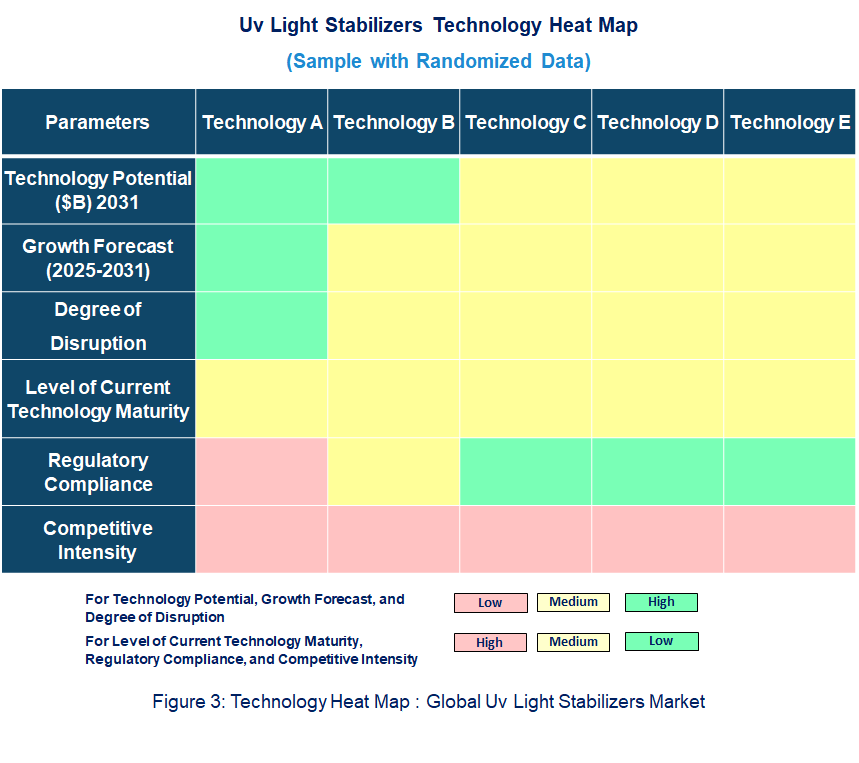
• Technology Potential: The potential for UV light stabilizers lies in expanding applications like smart coatings, lightweight automotive components, and recyclable packaging. Advanced stabilizers offer improved efficiency and compatibility with newer materials.
• Degree of Disruption: Emerging technologies such as nanotechnology and adaptive stabilizers are moderately disruptive, pushing traditional stabilizers towards obsolescence while opening new markets.
• Level of Current Technology Maturity: Most UV stabilizer technologies are in advanced stages of maturity, but innovations like bio-based and smart additives are in the growth phase, presenting opportunities for early adoption.
• Regulatory Compliance: Stringent regulations on chemical additives have driven advancements in non-toxic, environmentally friendly stabilizers, ensuring compliance while enhancing market acceptance.
• BASF SE: BASF launched advanced HALS (hindered amine light stabilizers) products tailored for high-performance plastics, enhancing durability and weather resistance. These innovations cater to automotive and construction industries, boosting BASF’s market position and supporting sustainable practices.
• Evonik Industries AG: Evonik introduced novel UV absorbers designed to improve the longevity of coatings and polymers. This development strengthens their product portfolio and emphasizes their commitment to eco-friendly solutions, enabling customers to achieve long-term material protection.
• SONGWON Industrial Co. Ltd.: SONGWON expanded its production capacity for light stabilizers in Asia, aiming to meet the growing regional demand. This strategic move enhances supply chain efficiency and positions SONGWON as a leading provider in emerging markets.
• Clariant AG: Clariant unveiled a series of high-efficiency light stabilizers suitable for bio-based polymers, addressing sustainability concerns. This aligns with market trends towards eco-friendly materials and strengthens Clariant’s appeal to environmentally conscious industries.
• Solvay S.A.: Solvay developed next-generation UV stabilizers targeting high-temperature applications, such as advanced automotive components. This innovation highlights Solvay’s focus on technological advancements and expands its product applications.
• Unitechem Group: Unitechem introduced cost-effective light stabilizers with improved dispersion characteristics for coatings and films. This ensures better product performance while maintaining affordability, catering to a diverse customer base.
• Everlight Chemical Industrial Corporation: Everlight launched a comprehensive range of light stabilizers for agricultural films, enhancing crop protection against UV damage. This reinforces Everlight’s role in supporting the agricultural sector with specialized solutions.
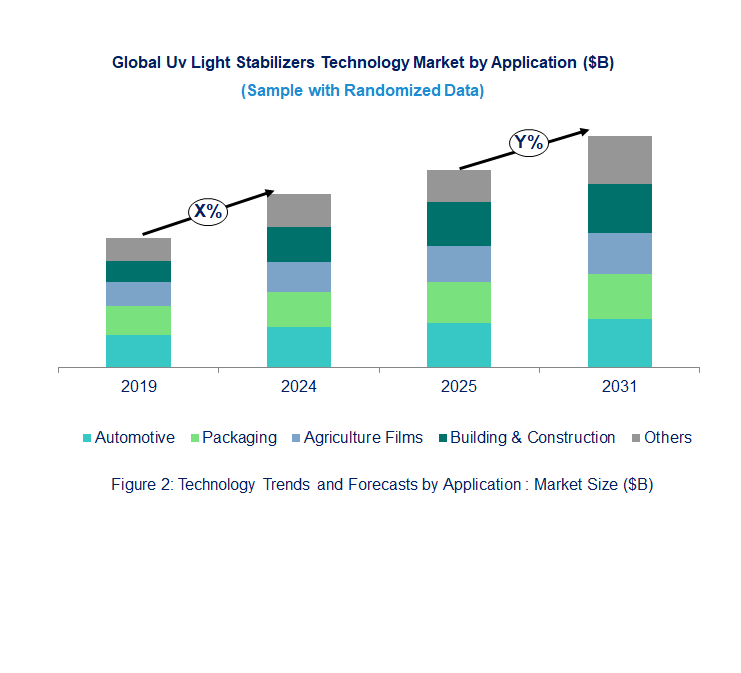
• Increasing Demand for Durable Materials: The rising need for weather-resistant and long-lasting materials in industries like automotive, construction, and packaging fuels demand for UV stabilizers. Enhanced product lifecycles reduce maintenance costs, offering substantial value to consumers.
• Growth in Emerging Economies: The rapid industrialization and infrastructure development in countries such as China and India create opportunities for UV stabilizer manufacturers. Expanding consumer awareness about material protection further drives market growth.
• Sustainability Trends: The shift towards environmentally friendly products drives the development of bio-based and recyclable UV stabilizers. These innovations align with regulatory standards and customer preferences, expanding market opportunities. Challenges in the UV stabilizers market are:
• High Costs of Raw Materials: Fluctuating prices of raw materials, such as HALS and UV absorbers, impact profit margins. Manufacturers face challenges in balancing cost-efficiency with product quality.
• Stringent Regulations: Complying with environmental and safety regulations demands significant R&D investments, increasing operational complexities. This affects market entry for small and medium enterprises. The UV light stabilizers market is poised for sustained growth, driven by advancements in product technology, emerging market demands, and sustainability initiatives. However, addressing cost and regulatory challenges is critical to maintaining competitive advantages. Strategic innovation and investment are reshaping the market, enabling stakeholders to harness growth opportunities effectively.
• Basf Se
• Evonik Industries Ag
• Songwon Industrial Co. Ltd.
• Clariant Ag
• Solvay S.A.
• Unitechem Group
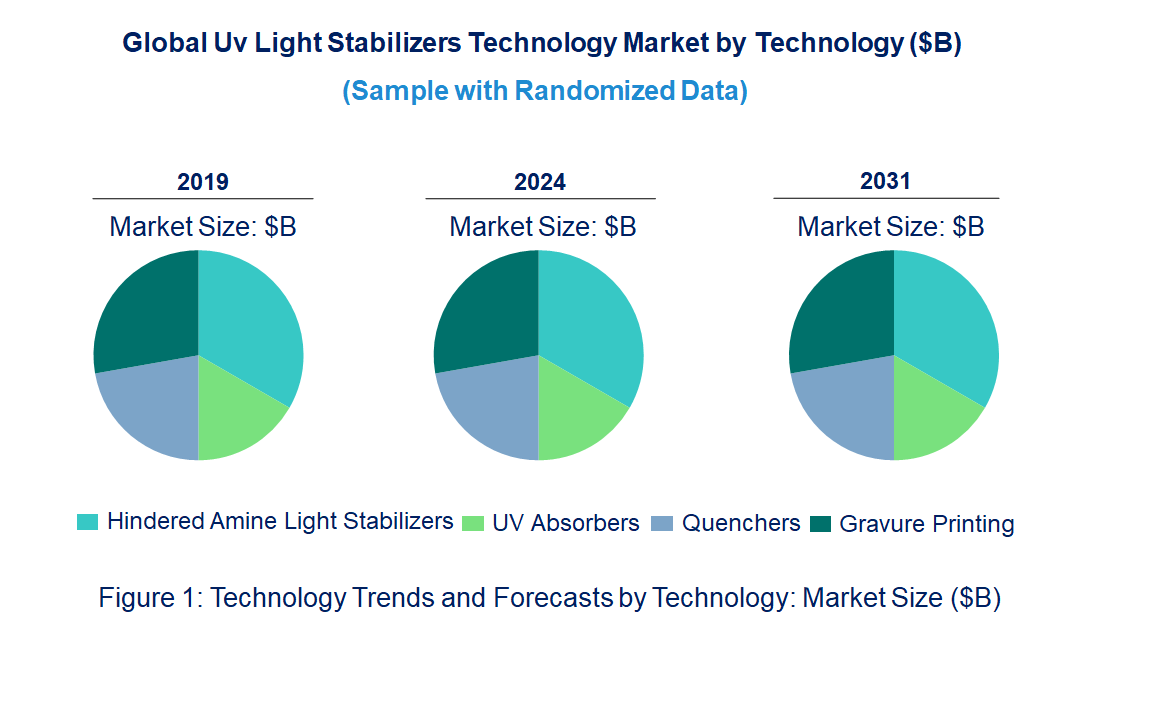
• Technology Readiness by Technology Type: Hindered amine light stabilizers exhibit the highest technology readiness, driven by their proven efficiency, scalability, and compliance with environmental regulations, making them dominant in automotive and packaging applications. UV absorbers have moderate readiness due to their application-specific suitability but require further innovation for broader usage. Quenchers lag slightly due to their niche role and dependency on complementary stabilizers for effectiveness. Other technologies, including advanced hybrids, show varying readiness, with significant R&D investment needed for market penetration. The competitive level is intense for HALS and UV absorbers, while quenchers face lower competition due to specialized use cases. Regulatory compliance is well-established for HALS, with UV absorbers closely following, whereas quenchers and hybrids encounter stricter adaptation challenges. Key applications span the automotive, construction, and packaging industries, with innovations enhancing durability and UV resistance across products.
• Competitive Intensity and Regulatory Compliance: The Uv light stabilizers competitive intensity is high among hindered amine light stabilizers, UV absorbers, and quenchers due to their overlapping applications and continuous product innovation. HALS maintains a competitive edge with broad industrial adoption and cost efficiency, while UV absorbers compete in niche applications requiring high UV-blocking capabilities. Quenchers face moderate competition, primarily targeting specific applications like adhesives. Regulatory compliance plays a critical role, especially in meeting stringent environmental and safety standards across regions. HALS and UV absorbers excel in compliance due to well-established formulations, while quenchers and others face challenges in adapting to evolving regulations. Emerging hybrid solutions add complexity, intensifying rivalry in the market as companies seek eco-friendly certifications.
• Disruption Potential: Hindered amine light stabilizers (HALS) exhibit significant disruption potential due to their superior efficiency in preventing polymer degradation and extending product life. UV absorbers, on the other hand, are highly effective for specific applications, such as coatings and films, but face limitations in achieving broad-spectrum stability. Quenchers play a niche role by neutralizing excited states of molecules, but often require a combination with other stabilizers for comprehensive performance. Other technologies, including hybrid stabilizers, show emerging promise, particularly in multifunctional applications. Innovation in material compatibility, environmental sustainability, and long-term performance has amplified their impact across industries such as automotive, packaging, and construction. HALS leads the market due to its adaptability and cost-effectiveness, while UV absorbers and quenchers continue to innovate in specialized domains. Disruptive advancements in formulations and integration with nanotechnology enhance the potential for competitive advantage in this dynamic market.
• Hindered Amine Light Stabilizers
• UV Absorbers
• Quenchers
• Others
• Automotive
• Packaging
• Agriculture Films
• Building & Construction
• Adhesives & Sealants
• Others
• North America
• Europe
• Asia Pacific
• The Rest of the World
• Latest Developments and Innovations in the Uv Light Stabilizers Technologies
• Companies / Ecosystems
• Strategic Opportunities by Technology Type


Choose a license that fits your team. Instant PDF delivery.
Prices exclude taxes. Instant delivery. Custom licensing available on request.
Market Report · May 18, 2026
Market Report · May 18, 2026
Market Report · May 18, 2026
Trusted partner for strategic intelligence and business growth


Receive a complimentary market analysis tailored to your industry. Our analysts will identify key growth opportunities and competitive dynamics specific to your business.

Market size, growth rate, and key trend analysis for your specific sector.

Top competitor positioning and market share analysis.

Strategic recommendations backed by data-driven insights.
Get curated market intelligence and competitive moves straight to your inbox.
By subscribing, you agree to receive our monthly insights. Unsubscribe anytime.
Receive a complimentary market analysis tailored to your industry. Our analysts will identify key growth opportunities and competitive dynamics specific to your business.
Market size, growth rate, and key trend analysis for your specific sector.
Top competitor positioning and market share analysis.
Strategic recommendations backed by data-driven insights.
Get curated market intelligence, emerging trends, and competitive moves straight to your inbox each month.
By subscribing, you agree to receive our monthly insights. Unsubscribe anytime.
We'll send your sample report shortly.