
Market Report · July 15, 2026

Key data points: The growth forecast = 13.6% annually for the next 7 years. Scroll below to get more insights. This market report covers Trends, opportunity and forecast in unified threat management system market to 2031 by type (on-premises and cloud based), application (large enterprises and SMEs), and region (North America, Europe, Asia Pacific, and the Rest of the World)
We'll send your sample report shortly.
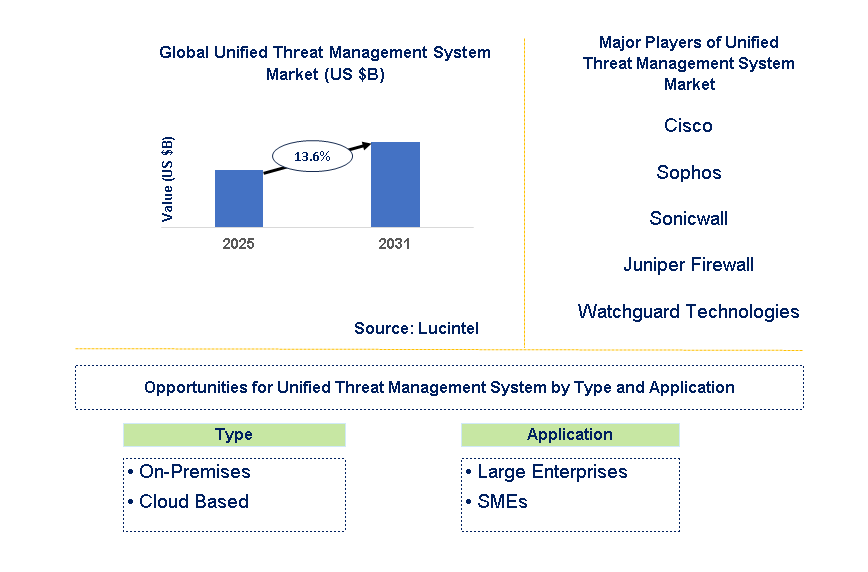
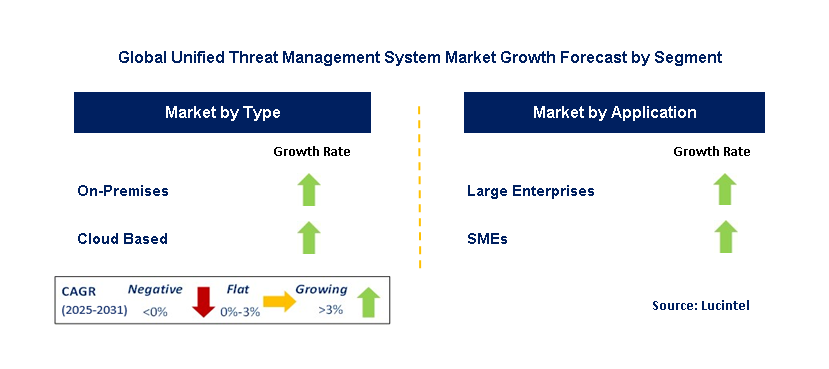
• AI and Machine Learning Integration: AI and machine learning are now becoming integral parts of UTM systems, enabling more proactive and automated threat detection. These technologies can analyze huge datasets, detect anomalies, and predict potential threats in real-time, helping businesses respond faster. With cyberattacks getting more sophisticated, AI-enabled UTM systems are essential for staying ahead of potential threats. Companies are investing in UTM solutions with AI and ML integration, to enhance the level of threat intelligence, automate response times, and reduce manual intervention in order to achieve better overall security efficacy.
• Cloud-based UTM Solutions: The adoption of cloud technologies has also accelerated the move towards cloud-based UTM solutions, offering greater scalability, flexibility, and cost-effectiveness. Cloud-based UTM systems help businesses to remotely protect their networks, data, and endpoints for more comprehensive security in cloud-based applications and services. These solutions are especially in demand among small to medium-sized businesses that cannot afford large-scale on-premises security systems. Cloud UTM platforms also come with advanced threat intelligence and real-time monitoring, making it easier for organizations to detect and respond to changing cyber threats.
• Integration with Next-Generation Technologies: The rising integration of UTM systems with next-generation technologies like IoT, 5G, and edge computing is transforming the market. With businesses embracing these technologies, the security landscape is becoming more complex, and UTM solutions need to be more flexible. UTM providers are developing solutions that can secure networks, devices, and data across various environments to ensure that emerging technologies are adequately protected against evolving cyber risks. This trend is especially important for industries such as healthcare, manufacturing, and telecommunications, where the security of connected devices and infrastructure is critical.
• Automation and Orchestration: Automation and orchestration in UTM systems are now becoming critical for enhancing response times to cyber threats. The rate at which threats are evolving makes it impossible to depend on manual intervention to mitigate risks. UTM systems are now introducing automation to detect, analyze, and respond to threats without human input. Orchestration tools help streamline workflows across security tools and systems, thus improving the overall operational efficiency. It frees the resources of an organization from repetitive security tasks, thus leaving them to work on more strategic areas of cybersecurity. In addition, it reduces the human error involved in operations as well as other operational costs.
• Regulatory Compliance and Data Protection: As regulations on data privacy become stricter, UTM systems are increasingly designed focusing on compliance. Many businesses nowadays require solutions that can ensure compliance with various data protection laws such as GDPR, HIPAA, and CCPA. Other tools through which UTM systems integrate with business tools for managing and protecting sensitive data; tracking compliance status; and generating audit logs for reporting are furthers strengthened by such trends. In this regard, increased cyberattacks involving data breaches have driven businesses to opt for UTM solutions that protect sensitive information while adhering to laws and regulations.
The sum total of these new trends is the reshaping of the UTM system market. More advanced, flexible, and automated solutions are being introduced by these new trends. AI and cloud-based offerings are adding the next level of security and scalability. With growing automation and orchestration, these operations are getting streamlined, while regulatory compliance tools ensure that a business meets an increasing number of legal requirements. Together, all these trends make UTM systems more intelligent and adaptable, in addition to giving organizations the chance to protect them from a higher category of threats.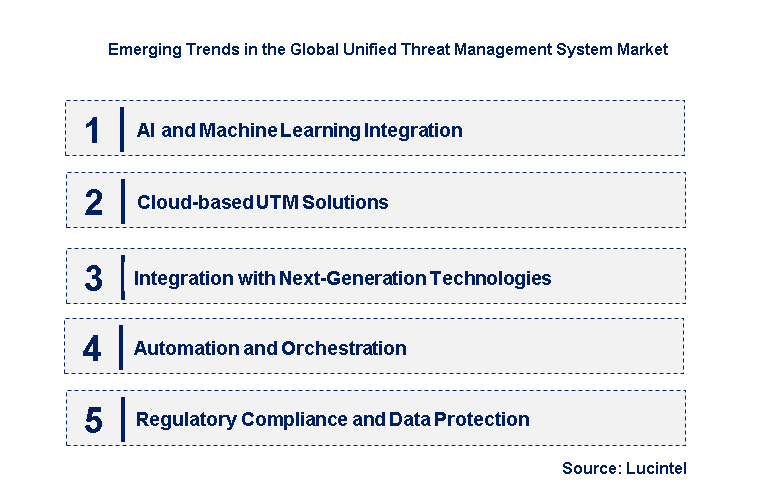
• AI-Powered Threat Detection Adoption: It also represents key market developments in bringing the integration of AI and ML with UTM. AI-equipped systems can make live discoveries of all sorts of innovative evolving threats across various patterns built by large databases, thus having more proactive strength behind UTM solutions to know of risks better ahead of significant damages and attacks by cybercriminals. Advancements in advanced AI algorithms are also supporting the development of UTM systems, which are predicting future attacks and implementing preventive measures, thus strengthening the entire strategy of cybersecurity.
• More on Cloud Security: Cloud-based UTM systems are fast gaining prominence as companies increasingly shift their operations to the cloud. UTM providers are designing solutions that are integrated into the cloud environment and offer end-to-end security across both on-premises and cloud networks. It is driven by the ever-growing need for scalable, cost-effective, and easy-to-deploy security solutions protecting dynamic cloud infrastructures and hybrid environments. Features such as data encryption, secure access controls, and threat intelligence in the cloud have become the core component of modern UTM solutions.
• Shift towards Subscription-based Pricing Models: Most UTM vendors are shifting to subscription-based pricing models as the need for more flexible security solutions increases. This transition makes it easy for even the smallest organization to deploy UTM solutions without investing much upfront. Subscription models further enable continuous updates and support to ensure that a business always has access to the most current security features and threat intelligence. This trend is especially good for small to medium-sized businesses, which have tight budgets but require comprehensive protection from cyber threats.
• Integration with Third-party Security Solutions: Many UTM vendors now offer better integration with third-party security tools and services to make their solutions more effective. These integrations include those with firewalls, intrusion detection systems, and endpoint security solutions, which will eventually form a holistic security ecosystem. Such integrations enable UTM systems to benefit from the strengths of specialized tools while providing an overarching security strategy. UTM providers can enhance threat detection, response times, and overall security posture for an organization by enabling seamless communication among different security solutions.
• Regulatory Compliance-driven Innovation: As the data protection law is becoming more complex, vendors are creating UTM solutions with compliance-driven features in mind. Real-time monitoring, audit logs, and data encryption will help a business meet all regulations such as GDPR, HIPAA, and CCPA. Innovation on the compliance-driven front is creating UTM solutions that can automate reporting of compliance, track changes in regulation, and update businesses about what's required of them at the time.
These new developments are pushing the UTM system market toward more innovative and comprehensive solutions. AI-powered threat detection, cloud security integration, and subscription-based models are making UTM systems more accessible and effective. The growing demand for regulatory compliance and third-party integrations is further enhancing the value proposition of UTM solutions. These developments are helping businesses stay ahead of the evolving cyber threat landscape, positioning UTM systems as essential components of modern network security strategies.• Small and Medium-sized Business (SMB) Security: There is much growth potential for UTM solutions targeted at small and medium-sized businesses. Most small and medium-sized businesses do not have the capital to deploy expensive security infrastructures. UTM is an attractive choice for cost-effective, all-in-one solutions that can be deployed affordably. This market is set to be a goldmine for UTM providers who offer cost-effective, easily deployable solutions with strong cybersecurity features. The ever-growing awareness of cybersecurity threats and regulatory pressure will continue driving demand for UTM solutions by SMBs.
• Healthcare Sector: The healthcare sector will be one of the biggest users of UTM because of its increased susceptibility to cyberattacks. It is expected to grow in high numbers because solutions for UTM will ensure that data is secured, patient records are safe, and HIPAA compliance is upheld. The healthcare sector's shift toward electronic health records and telemedicine increases the need for a broad range of cybersecurity measures. Sectors like healthcare with specific security needs from UTM vendors will find extensive opportunities in this market.
• Enterprise Security and Data Protection: Advanced UTM solutions that offer robust protection to the networks, data, and cloud-based services of larger enterprises with complex IT infrastructures are being sought. As enterprises continue to rely more and more on digital transformation, remote workforces, and cloud-based operations, integrated and scalable security solutions are becoming increasingly critical. The end-to-end security coverage of various environments while ensuring regulatory compliance puts UTM systems in a strong position to benefit from this growth opportunity.
• Cloud Security Solutions: As the adoption of cloud computing continues to grow, it is a massive opportunity for UTM providers to enter the cloud security market. There is a high demand for UTM systems that can secure multi-cloud environments and hybrid cloud infrastructures. As more organizations move into the cloud, the demand for UTM solutions that can work in harmony with cloud platforms, offering real-time threat monitoring and data protection, will increase. Cloud security is poised to grow dramatically in the future.
• Internet of Things and Edge Computing Security: The use of IoT and edge computing creates a new area of growth for UTM providers. Securing these devices and their data exchanges requires specialized solutions, and UTM systems are evolving to meet these needs. UTM solutions that can secure devices at the edge of networks and ensure seamless communication between IoT devices are critical for industries like manufacturing, logistics, and smart cities. This trend is driving the development of more specialized UTM systems that address the unique challenges of IoT and edge computing security.
This growth opportunity can be seen through the various and diverse needs of different businesses in many sectors. Rising demand for security in SMB, healthcare protection, cloud security, and IoT integration will force UTM system vendors to innovate for different industries with specific solutions. As these markets expand further, UTM vendors will need to be flexible and address specific security challenges. These opportunities are reshaping the UTM market to ensure it remains an essential aspect of cybersecurity strategies within industries.• Cisco
• Sophos
• Sonicwall
• Juniper Firewall
• Watchguard Technologies
• Barracuda
• Check Point
• Fortinet
• Huawei
• Dell
• On-Premises
• Cloud Based
• Large Enterprises
• SMEs
• North America
• Europe
• Asia Pacific
• The Rest of the World
• United States: Growth of the U.S. UTM market is on a strong track with respect to security threats through cyberattacks, especially within health care, finance, and other critical infrastructure organizations. The threat environment for U.S. business continues to expand and therefore demands comprehensive security solutions in an integrated fashion. Most of the U.S. companies have recently been investing in UTM systems that combine the functionalities of a firewall, intrusion prevention, and antivirus. This sector incorporates AI and ML with evolving threat detection tools and responses; for increasing demand on an adaptive form of cybersecurity measures. Government regulations as well as government-based compliance mandates that include Cybersecurity Maturity Model Certification are hastening adoption also.
• China: The UTM market is currently growing fastly in China while considering digital economy related rise in cyberthreats the nation is facing. The Chinese government has particularly focused on the strengthening of cybersecurity through tight laws and regulations, which has pressured business entities to adopt better UTM solutions. With the digital trend rising, enterprises are expecting that they can receive protection by mitigating cyber risks with integrated security systems. Local UTM providers are concentrating on developing solutions well-suited for those market needs, like enhanced data protection and surveillance capabilities. The increasing adoption of 5G and IoT technologies is also contributing to the growing demand for advanced UTM systems in China.
• Germany: Germany, with its strong industrial and technological base, has experienced tremendous growth in the UTM market, primarily due to the growing need for secure IT infrastructures across manufacturing, automotive, and finance sectors. The country has been emphasizing data privacy and strict data protection regulations, such as the General Data Protection Regulation (GDPR), which has increased the adoption of UTM systems. Companies are now looking for solutions that provide comprehensive protection against a wide range of cyber threats, including advanced persistent threats (APTs). German firms are also focusing on integrating UTM with existing IT systems to optimize security workflows and reduce vulnerabilities.
• India: India's UTM market has grown significantly, driven by the rising number of cyberattacks on critical infrastructure, government agencies, and businesses. As companies are shifting towards digitalization, the demand for affordable yet comprehensive security solutions is growing. UTM providers in India are focusing on making cybersecurity solutions accessible to small and medium enterprises (SMEs) while ensuring compliance with local regulations. The Indian government has been very aggressive on the adoption of cybersecurity initiatives and frameworks, further pushing up the demand for UTM systems. Cloud technology, mobile devices, and IoT adoption are pushing up the need for advanced and scalable UTM solutions.
• Japan: UTM in Japan is also gaining ground due to a higher requirement for more stringent cybersecurity solutions with an increasing cyberattack trend targeting public as well as private sectors. Japanese organizations are focusing on bringing UTM systems into their existing infrastructures so that they can curb all forms of cyber attacks. The government's impetus toward digitalization and an APPI regulation drive demand for more advanced and secure IT solutions. Furthermore, the growing adoption of AI, IoT, and 5G technologies in Japan is increasing dependence on UTM solutions to manage vulnerabilities across these technologies.


• Cisco
• Sophos
• Sonicwall
• Juniper Firewall
• Watchguard Technologies
• Barracuda
• Check Point
• Fortinet
• Huawei
• Dell
Q5. Which unified threat management system market segment will be the largest in future?

Choose a license that fits your team. Instant PDF delivery.
Prices exclude taxes. Instant delivery. Custom licensing available on request.
Market Report · July 15, 2026
Market Report · June 26, 2026
Market Report · June 24, 2026
Trusted partner for strategic intelligence and business growth


Receive a complimentary market analysis tailored to your industry. Our analysts will identify key growth opportunities and competitive dynamics specific to your business.

Market size, growth rate, and key trend analysis for your specific sector.

Top competitor positioning and market share analysis.

Strategic recommendations backed by data-driven insights.
Get curated market intelligence and competitive moves straight to your inbox.
By subscribing, you agree to receive our monthly insights. Unsubscribe anytime.
Receive a complimentary market analysis tailored to your industry. Our analysts will identify key growth opportunities and competitive dynamics specific to your business.
Market size, growth rate, and key trend analysis for your specific sector.
Top competitor positioning and market share analysis.
Strategic recommendations backed by data-driven insights.
Get curated market intelligence, emerging trends, and competitive moves straight to your inbox each month.
By subscribing, you agree to receive our monthly insights. Unsubscribe anytime.
We'll send your sample report shortly.