
Market Report · July 15, 2026

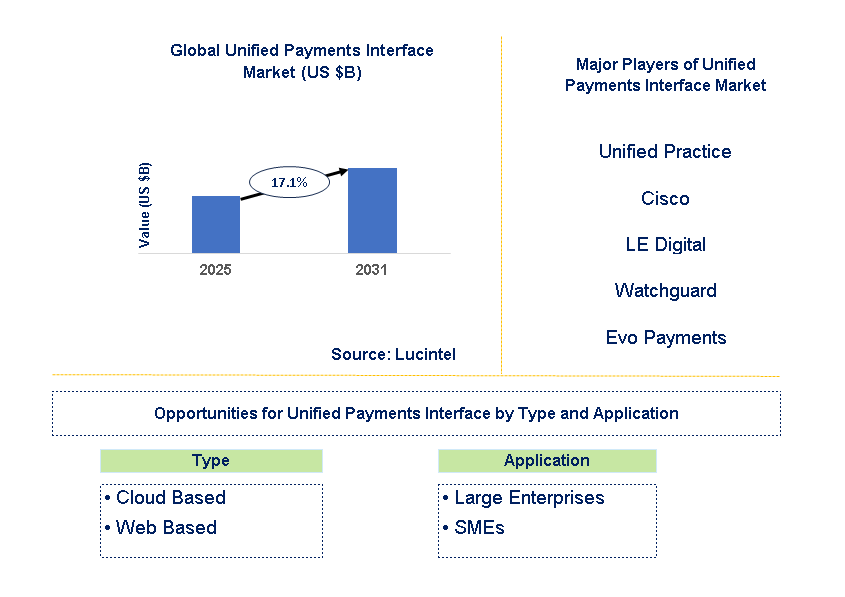
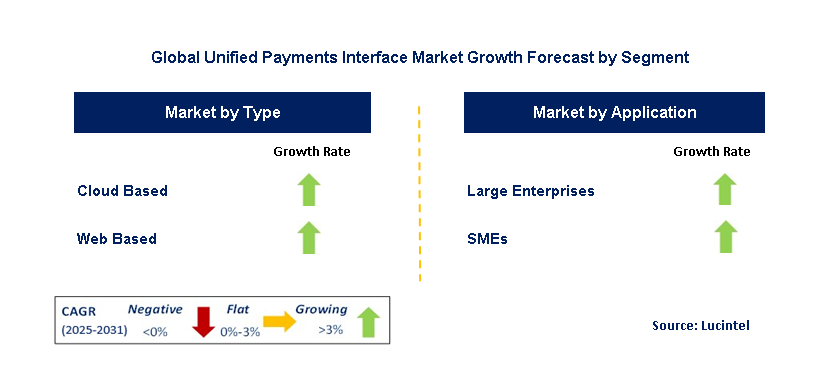
Key data points: The growth forecast = 17.1% annually for the next 7 years. Scroll below to get more insights. This market report covers Trends, opportunity and forecast in unified payments interface market to 2031 by type (cloud based and web based), application (large enterprises and SMEs), and region (North America, Europe, Asia Pacific, and the Rest of the World)
We'll send your sample report shortly.
• Real-Time Payments: Real-time payments are increasingly becoming a fundamental part of UPI systems worldwide. Countries are opting for faster payment infrastructures, which ensure transactions are processed in real-time. In India, UPI has been successful in ensuring instant payments. The same thing is being designed in the United States and Europe. Real-time payments enable consumers and businesses to have faster transfers. It enhances the efficiency of the financial system.
• Mobile and Contactless Payments: Mobile and contactless payments are increasingly becoming popular with the increased usage of smartphones and NFC technology. Google Pay, Apple Pay, and Alipay have made it possible for users to make secure payments by just tapping their phones. This trend is changing the UPI market as consumers look for convenience and speed in their transactions. The COVID-19 pandemic also accelerated the adoption of contactless payments as people sought safer, touch-free options.
• Government-Led Initiatives for Digital Payment: Governments are increasingly playing an active role in promoting digital payments to achieve financial inclusion and reduce cash dependence. In India, the government has heavily supported the UPI system, while similar initiatives are underway in China and Europe. The push for digital payment adoption is also evident in other regions, where governments are introducing regulations and infrastructure to support mobile payment solutions. These initiatives aim to enhance accessibility, security, and trust in digital payments.
• Integration with Digital Identity Systems: The integration of digital payments with national digital identity systems is a growing trend. For example, India’s Aadhaar-based authentication is used for UPI transactions, while other countries are exploring similar models. This integration allows for secure, instant identification and verification of users, reducing fraud risks and enhancing the user experience. It also opens the door for greater financial inclusion, as more people can access payment services even without traditional bank accounts.
• Integration of Blockchain and Cryptocurrency: Blockchain and cryptocurrencies are slowly but surely finding a space in the digital payments ecosystem. Many UPI-like systems are looking to tap into blockchain's potential for secure, decentralized, and cost-effective transactions. While some platforms now accept Bitcoin and Ethereum for making payments, there are even more examples, like China, testing CBDCs. Blockchain will bring speed, cheapness, and security into payments through disintermediation.
The emerging trends in the unified payments interface market are focused on enhancing transaction speed, user convenience, and security. As more countries implement real-time payment systems, mobile payment options, and blockchain-based technologies, the global payment ecosystem is becoming more unified, efficient, and accessible to consumers and businesses alike.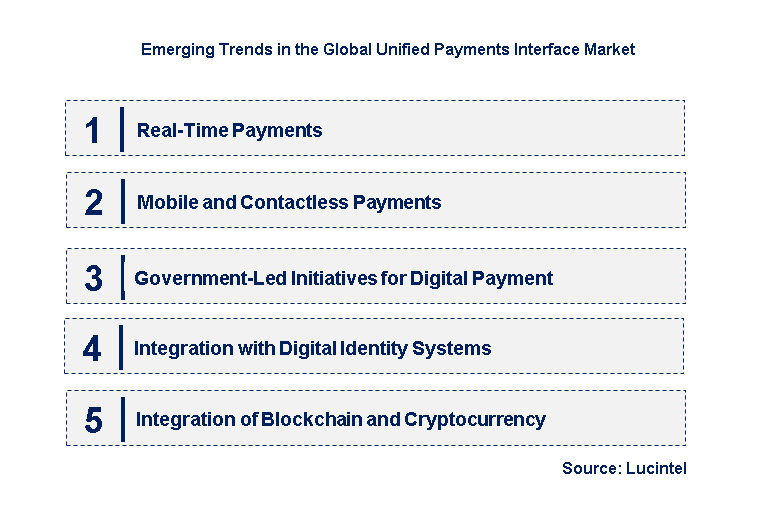
• Global UPI Services Expansion: India's UPI is growing further than its own borders as other countries are eyeing the adoption of their own identical systems. India's UPI has received worldwide attention due to its success as Bhutan and UAE have recently adopted UPI-based payment systems. This will bring crossborder transactions, make remittance flows more efficient, and generate a much more interconnected global payment network.
• Integration with E-Commerce and Retail Platforms: Increased consumer payment experience through integration of UPI with e-commerce and retail platforms. Online retailers are adopting UPI-based solutions, making the process of complete transaction simple and secure for customers. The adoption rate for UPI is growing among sectors like e-commerce, hospitality, and entertainment due to their customers' need for smooth digital payments.
• Growth in Mobile Wallets and QR Code Payments: Mobile wallets and QR code payments have been the latest significant development in the UPI market. With more acceptance on the merchant platforms, UPI-enabled mobile wallets have made the life of the customer convenient enough in terms of payments using smartphones. Retail has witnessed increased use of QR codes that can help people make faster and easier payments without a need for a physical card or cash.
• Enhance Security Features: Security has become one of the highest priorities as digital payments continue to grow. Improving the security of transactions overall, UPI systems are integrating MFA, biometric verification, and end-to-end encryption. These advanced security features are important in building consumer confidence and protecting from cyber threats.
• Cross-Border Payments and Remittance Solutions: Cross-border payments seem to become essential in the overall UPI architecture, as such remittance-based solutions have gathered much popularity today. International money transfers have emerged as one the best means under UPI that minimizes costs rather than using systems of banks at a considerable magnitude. It proves to be valuable for countries having numerous migrants since, with the above facility, an individual can manage to send hard-earned amounts back home efficiently and effectively.
Recent advancements in the unified payments interface market are driving global expansion in digital payments. Through integration of UPI with different sectors and improving security features, the market is offering more efficient, accessible, and secure payment solutions to businesses and consumers.• Financial Inclusion in Developing Regions: A significant growth opportunity related to UPI systems is financial inclusion in developing regions: offering access to digital payment for individuals who do not have facilities of traditional banking, thereby empowering millions of unbanked people. The government and fintech firms collaborate for the expansion of reach of UPI-based services to underprivileged groups' access to financial services.
• Consumer Services Integration: UPI is getting increasingly integrated into consumer services like utility services, transport, and other government services. These services through UPI have the facility for payment of utility bills, tickets booking, among other services seamlessly. This would mean opening more avenues for revenues from UPI service providers to consumers who tend to manage finances in one application.
• Microtransactions and Digital Content: Microtransactions in digital content consumption have opened up growth opportunities for UPI. Consumers are increasingly paying for small, on-demand services like streaming, gaming, and online content. Low-cost transactions from UPI can be perfect fits for this model. Through micro-payments, UPI will be able to capture a greater share of the ever-growing digital content market to the benefit of consumers and content providers.
• Merchant Adoption and Digital Retail: The growth opportunity for UPI, especially in the retail sector, lies in the large-scale acceptance by merchants. While small businesses are increasingly adopting UPI-based payments as a low-cost alternative to traditional point-of-sale systems, this is dramatically accelerating digital retail growth because consumers crave contactless, secure, and convenient payments.
• Fintech and Embedded Finance: Another significant growth opportunity is the integration of UPI with fintech platforms and embedded finance solutions. Fintech companies are using UPI to provide a variety of financial services, such as lending, savings, and insurance. These companies can simplify payment processes and develop new revenue models that appeal to tech-savvy consumers by embedding UPI into their offerings.
These strategic growth opportunities show that there is an expansive scope for Unified Payments Interface in terms of both expansion and innovation across applications. As UPI systems integrate into different sectors, the market is going to keep transforming, offering business and consumers even more convenient, efficient, and accessible payment solutions.• Unified Practice
• Cisco
• LE Digital
• Watchguard
• Evo Payments
• Cloud Based
• Web Based
• Large Enterprises
• SMEs
• North America
• Europe
• Asia Pacific
• The Rest of the World
• United States: In the United States, the digital payments market is changing due to the growth of QR codes, contactless payments, and real-time payment systems. The U.S. does not have a centralized system like UPI, but services like Zelle, PayPal, and Venmo are reshaping the space. In addition, the Federal Reserve's new facility for a real-time payment system, known as Fed Now, should improve the speedy and more efficient payments across the United States. In the United States itself, mobile wallets and implementation of blockchain technology should help improve transaction security, consequently lowering transaction costs.
• China: China is at the forefront globally in digital payments. Alipay and WeChat Pay have dominated payments in the Chinese market. These platforms provide services like a UPI system by allowing easy P2P transactions, bill payments, and online shopping. The Chinese government has been instrumental in the adoption of these systems through initiatives that promote digital finance. China is also expanding its digital currency efforts with the introduction of the Digital Yuan, further enhancing the country's shift toward cashless and unified payment solutions.
• Germany: Germany has been slow in the adoption of UPI-like systems but is catching up with the digital payment solutions that are gaining momentum. The strong banking infrastructure of the country has helped its citizens easily adapt to digital payment methods like Giropay and Klarna, which allow for instant bank transfers. SEPA (Single Euro Payments Area) of the European Union, in an effort to make the entire union a unified digital payment system, is also having an influence on the market. Germany is also working towards ensuring compliance with data protection regulations such as GDPR, impacting payment systems. The government also focuses on safe authentication methods for increasing consumer trust in digital payments.
• India: India has pioneered the adoption of the UPI system, which is a key driver of financial inclusion and digital payments in the country. Launched by the National Payments Corporation of India (NPCI), UPI allows real-time bank-to-bank transfers using mobile phones. It has gained significant traction, with millions of transactions being processed daily. UPI's success has been driven by government policies aimed at promoting cashless transactions, as well as partnerships with various financial institutions and fintech companies. Finishing with a focus on financial inclusion and digital literacy, India will continue to reach rural and urban areas through UPI services.
• Japan: The popularity of digital payment services is expanding in Japan. Services like Rakuten Pay and LINE Pay make for easy payments for users. Part of the reason Japan moved toward digital payment services quicker was due to strong government initiatives toward building a cashless society. Advancements in mobile wallet technologies, QR code payments, and integration with banking apps are also supporting the adoption of UPI-like systems. Japan is also working to ensure that the security and privacy of digital payments are at the highest level, especially to match international standards and satisfy consumer demands regarding data safety.


• Unified Practice
• Cisco
• LE Digital
• Watchguard
• Evo Payments
Q5. Which unified payments interface market segment will be the largest in future?

Choose a license that fits your team. Instant PDF delivery.
Prices exclude taxes. Instant delivery. Custom licensing available on request.
Market Report · July 15, 2026
Market Report · June 26, 2026
Market Report · June 24, 2026
Trusted partner for strategic intelligence and business growth


Receive a complimentary market analysis tailored to your industry. Our analysts will identify key growth opportunities and competitive dynamics specific to your business.

Market size, growth rate, and key trend analysis for your specific sector.

Top competitor positioning and market share analysis.

Strategic recommendations backed by data-driven insights.
Get curated market intelligence and competitive moves straight to your inbox.
By subscribing, you agree to receive our monthly insights. Unsubscribe anytime.
Receive a complimentary market analysis tailored to your industry. Our analysts will identify key growth opportunities and competitive dynamics specific to your business.
Market size, growth rate, and key trend analysis for your specific sector.
Top competitor positioning and market share analysis.
Strategic recommendations backed by data-driven insights.
Get curated market intelligence, emerging trends, and competitive moves straight to your inbox each month.
By subscribing, you agree to receive our monthly insights. Unsubscribe anytime.
We'll send your sample report shortly.