
Market Report · July 15, 2026

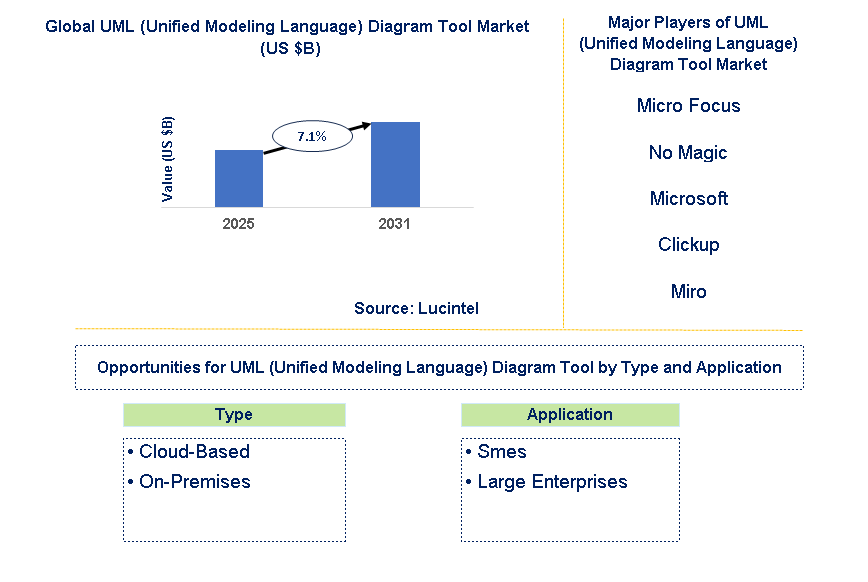
Key data points: The growth forecast = 7.1% annually for the next 7 years. Scroll below to get more insights. This market report covers Trends, opportunity and forecast in UML (unified modeling language) diagram tool market to 2031 by type (cloud-based and on-premises), application (SMEs and large enterprises), and region (North America, Europe, Asia Pacific, and the Rest of the World)
We'll send your sample report shortly.
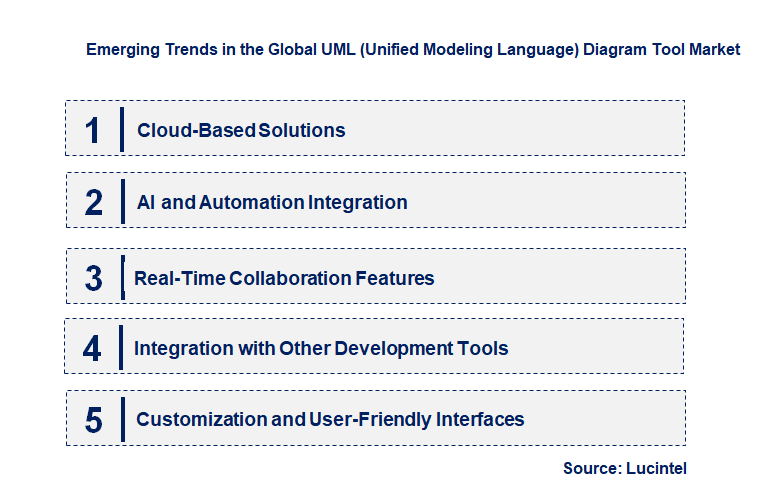
• Cloud-Based Solutions: Cloud-based UML diagram tools are rapidly gaining popularity as businesses look for ways to enhance collaboration and flexibility. These tools allow teams to work together in real-time, regardless of location, and access their diagrams from any device. Cloud solutions also offer scalability, automatic updates, and easy integration with other cloud-based project management tools. This trend is especially useful in agile environments where quick changes and iterative development are necessary, enabling teams to create, share, and revise diagrams efficiently without the constraints of traditional software.
• AI and Automation Integration: The integration of AI and machine learning into UML diagram tools is a growing trend. These technologies can automate tasks such as diagram generation, error-checking, and consistency validation, helping users save time and avoid mistakes. AI-powered features can also recommend design improvements, flagging potential issues before they become problems. This automation is particularly beneficial for large projects with complex systems, as it reduces manual effort and increases accuracy, enabling developers to focus on more strategic aspects of system design and development.
• Real-Time Collaboration Features: As remote work and distributed teams become more common, real-time collaboration features in UML diagram tools are becoming essential. These tools allow multiple team members to work on the same diagram simultaneously, providing instant feedback and making collaborative editing easier. Features such as chat, comment threads, and version history help improve communication and coordination among team members. This trend is especially important in large-scale projects where cross-functional teams need to collaborate across different time zones and locations.
• Integration with Other Development Tools: The growing demand for seamless integration between UML diagram tools and other software development tools is a key trend. Integrating UML tools with version control systems, project management platforms, and coding environments streamlines workflows and ensures consistency between system design and development stages. This integration reduces the risk of errors and ensures that diagrams are always up to date with the latest project requirements. As businesses adopt more integrated toolchains for software development, UML diagram tools that offer easy integration with other platforms are increasingly in demand.
• Customization and User-Friendly Interfaces: As UML diagram tools are used by a wider range of users, including non-technical stakeholders, the demand for customization and intuitive user interfaces is rising. Tools that allow users to tailor the diagramming experience to their specific needs—such as custom templates, easy drag-and-drop functionality, and intuitive visual design—are becoming more popular. This trend is making UML tools accessible to a broader audience, including business analysts, product managers, and project leaders, enabling them to contribute to the design process without needing deep technical expertise. Emerging trends in the UML diagram tool market, including cloud-based solutions, AI integration, real-time collaboration, tool integration, and increased customization, are reshaping the way organizations approach software and system design. These trends are enabling greater collaboration, enhancing design accuracy, and improving efficiency across industries.
• Cloud-Integrated UML Tools: Cloud-based UML tools, such as Lucidchart and Creately, have revolutionized the way teams collaborate and share diagrams. These tools enable remote teams to work together in real-time, access diagrams from anywhere, and store data securely on cloud platforms. This development has enhanced the flexibility of software development teams, especially those working in agile environments, as cloud integration provides seamless access and ensures that all team members are working with the latest versions of diagrams.
• AI-Powered Diagram Generation: AI-driven features in UML tools are making diagram generation and validation faster and more accurate. AI algorithms can automate repetitive tasks, such as generating classes or associations, and perform error detection by checking for inconsistencies in the diagrams. This development reduces manual work and minimizes the chances of human error, making it especially beneficial for large projects that involve complex systems and numerous design components.
• Advanced Collaboration Features: The introduction of advanced collaboration features has significantly impacted the UML diagram tool market. Tools like Miro and Visual Paradigm now support real-time editing, team collaboration, and version control. These features are critical in ensuring that teams can work together on large-scale projects, regardless of their geographic location. The ability to add comments, track changes, and integrate with other collaboration platforms (such as Slack or Jira) has improved communication and project management.
• Integration with Other Development Platforms: UML diagram tools are increasingly being integrated with other development platforms, such as Git, Jenkins, and Atlassian tools. These integrations streamline workflows by allowing diagrams to stay up to date with changes in the codebase or project management tools. Integration with project management platforms ensures that the system design remains aligned with the development process, minimizing discrepancies between the design and implementation stages.
• Simplified User Interfaces and Customization: Many UML diagram tools are now focusing on making their interfaces more user-friendly and customizable. Tools such as Draw.io and Microsoft Visio have introduced drag-and-drop functionality, customizable templates, and intuitive visual design elements that make it easier for both technical and non-technical users to create complex diagrams. This development has expanded the user base for UML tools beyond just developers, allowing business analysts and other stakeholders to contribute to system design without extensive technical knowledge. Recent developments in the UML diagram tool market, including cloud integration, AI-powered automation, advanced collaboration features, tool integrations, and simplified user interfaces, are improving the design, development, and collaboration processes for businesses. These innovations are making UML diagramming tools more efficient, accessible, and versatile, contributing to the growth of the market.
• Software Development: Software development is one of the most significant applications of UML diagram tools. With the rise of agile development practices and the demand for efficient system modeling, there is a growing need for UML tools that support rapid diagramming, collaboration, and integration with other development tools. Companies are investing in these tools to streamline design processes, improve software quality, and accelerate time to market.
• Process Management and Workflow Optimization: UML diagram tools are gaining traction in process management applications, especially in industries like manufacturing, healthcare, and finance. These tools help organizations map out complex processes, identify inefficiencies, and optimize workflows. As businesses increasingly focus on improving operational efficiency and automation, UML diagram tools are being adopted to streamline process design and enhance decision-making.
• Systems Engineering: In systems engineering, UML tools are being used to model complex systems, ensuring that all components interact effectively. The growth of industries such as aerospace, defense, and automotive is driving the demand for advanced UML tools that can handle intricate system designs. As systems engineering projects become more complex, there is a growing need for tools that support multi-disciplinary teams, offer robust modeling capabilities, and integrate with other engineering platforms.
• Agile and DevOps Methodologies: The adoption of agile and DevOps methodologies is creating a significant opportunity for UML diagram tools. These methodologies require tools that support iterative design, collaboration, and continuous integration. UML tools that integrate with version control systems and CI/CD pipelines are increasingly in demand, helping teams align design and development processes while maintaining flexibility and speed in delivering software products.
• Education and Training: The increasing use of UML diagramming in educational settings, particularly in software engineering and computer science courses, is creating opportunities for growth. UML tools are being used to teach students about system modeling, software design, and architecture. As educational institutions and corporate training programs expand their curricula to include UML and other modeling techniques, there is a growing demand for user-friendly, cost-effective UML tools. Strategic growth opportunities in the UML diagram tool market are being driven by applications in software development, process management, systems engineering, agile methodologies, and education. As businesses continue to embrace digital transformation and complex system designs, the demand for advanced UML tools is expected to grow, supporting innovation and efficiency across industries.
• Micro Focus
• No Magic
• Microsoft
• Clickup
• Miro
• Sparx Systems
• Jgraph
• Adobe Express
• Lucid Software
• Computer Systems Odessa Llc
• Cloud-Based
• On-Premises
• SMEs
• Large Enterprises
• North America
• Europe
• Asia Pacific
• The Rest of the World
• United States: In the United States, the UML diagram tool market has witnessed significant growth, driven by the increased adoption of agile development practices and digital transformation initiatives. Companies are integrating UML tools with cloud platforms and collaborative tools like Jira and Confluence to enable real-time collaboration and streamline software development workflows. AI and machine learning features are also being introduced to help automate the process of creating and validating diagrams. Popular tools like Lucid chart, Visual Paradigm, and Microsoft Visio are leading the market with innovations that enhance usability and design efficiency.
• China: The Chinese UML diagram tool market is experiencing growth, primarily due to the expansion of the tech industry and the rising demand for efficient software development tools. With the growing adoption of digital transformation across various industries, Chinese businesses are increasingly using UML diagram tools to map out complex systems and software architectures. Local companies, such as Yozone and Meituan, are developing region-specific UML tools that focus on collaborative features and integration with local platforms. Additionally, the use of UML tools is being promoted by government initiatives to support innovation in software development.
• Germany: The German UML diagram tool market benefits from the country’s strong engineering and IT sectors. The demand for advanced UML tools has increased due to the adoption of Industry 4.0 technologies, such as IoT, automation, and AI. Tools that support system modeling for complex engineering projects and multi-disciplinary teams are gaining traction. German companies are integrating UML diagram tools with enterprise resource planning (ERP) systems and adopting solutions with cloud support to enhance collaboration across geographically dispersed teams. Additionally, there is a strong focus on ensuring compliance with European Union regulations regarding data privacy and security.
• India: In India, the UML diagram tool market is growing due to the expanding IT outsourcing industry and the need for efficient system design tools. Software developers in India are increasingly adopting UML tools to improve system architecture and design processes for both local and international clients. Cloud-based UML diagramming solutions are gaining popularity due to their cost-effectiveness and scalability. Additionally, there is a rising trend of integrating UML tools with other development environments and platforms to streamline workflows, particularly in agile and DevOps environments.
• Japan: The Japanese UML diagram tool market is characterized by high adoption rates in the manufacturing, automotive, and electronics industries. Japanese companies are increasingly relying on UML tools for system design, software engineering, and process management. UML tools that integrate with other modeling tools, such as SysML for systems engineering, are in high demand. The focus on precision and quality in Japan’s manufacturing sector is driving the demand for advanced modeling tools that can handle complex system designs. Additionally, the integration of AI and automation features into UML tools is improving efficiency and reducing the risk of errors in diagramming.


• Micro Focus
• No Magic
• Microsoft
• Clickup
• Miro
• Sparx Systems
• Jgraph
• Adobe Express
• Lucid Software
• Computer Systems Odessa Llc Q5. Which UML (unified modeling language) diagram tool market segment will be the largest in future? Answer: Lucintel forecasts that cloud-based is expected to witness higher growth over the forecast period. Q6. In UML (unified modeling language) diagram tool market, which region is expected to be the largest in next 5 years? Answer: APAC is expected to witness the highest growth over the forecast period. Q7. Do we receive customization in this report? Answer: Yes, Lucintel provides 10% customization without any additional cost.


Choose a license that fits your team. Instant PDF delivery.
Prices exclude taxes. Instant delivery. Custom licensing available on request.
Market Report · July 15, 2026
Market Report · June 26, 2026
Market Report · June 24, 2026
Trusted partner for strategic intelligence and business growth


Receive a complimentary market analysis tailored to your industry. Our analysts will identify key growth opportunities and competitive dynamics specific to your business.

Market size, growth rate, and key trend analysis for your specific sector.

Top competitor positioning and market share analysis.

Strategic recommendations backed by data-driven insights.
Get curated market intelligence and competitive moves straight to your inbox.
By subscribing, you agree to receive our monthly insights. Unsubscribe anytime.
Receive a complimentary market analysis tailored to your industry. Our analysts will identify key growth opportunities and competitive dynamics specific to your business.
Market size, growth rate, and key trend analysis for your specific sector.
Top competitor positioning and market share analysis.
Strategic recommendations backed by data-driven insights.
Get curated market intelligence, emerging trends, and competitive moves straight to your inbox each month.
By subscribing, you agree to receive our monthly insights. Unsubscribe anytime.
We'll send your sample report shortly.