
Market Report · July 15, 2026

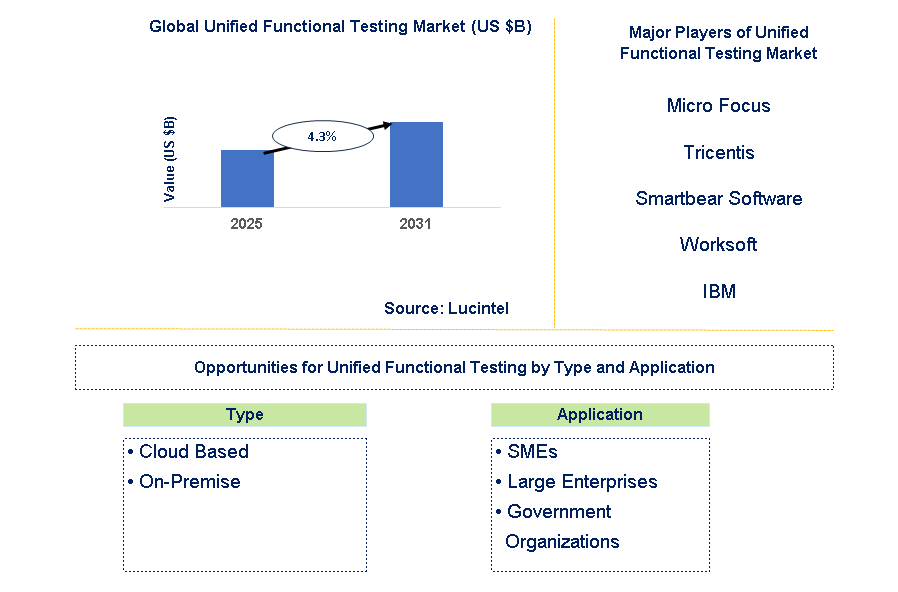
Key data points: The growth forecast = 4.3% annually for the next 7 years. Scroll below to get more insights. This market report covers Trends, opportunity and forecast in unified functional testing market to 2031 by type (cloud based and on-premise), application (SMEs, large enterprises, and government organizations), and region (North America, Europe, Asia Pacific, and the Rest of the World)
We'll send your sample report shortly.
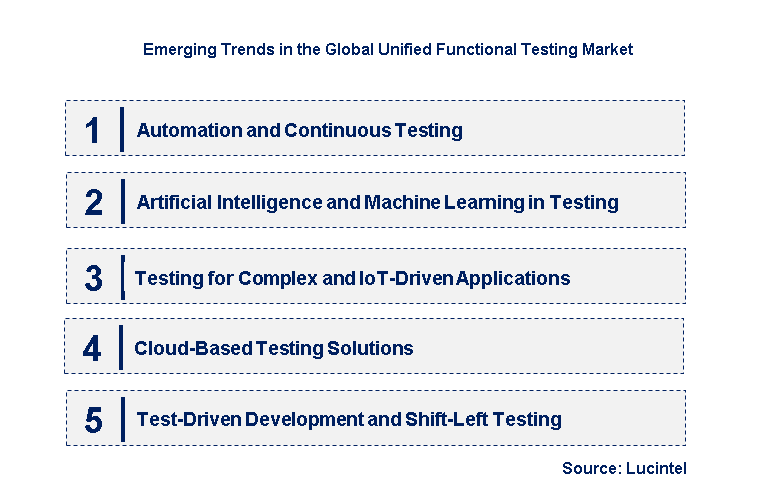
• Automation and Continuous Testing: Automation is changing the face of UFT. It helps speed up the testing process, reduce human error, and enable companies to deliver real-time software quality through integration with CI and CD pipelines. It has become especially beneficial for agile and DevOps teams, who have to test their products very frequently without compromising the quality. Regression testing is also done in more detail using automation tools, thereby making the long-term process much more efficient.
• Artificial Intelligence and Machine Learning in Testing: AI and machine learning are increasingly being used in the UFT market. With these technologies, testing tools can identify patterns in data, optimize testing processes, and improve accuracy. AI-powered testing tools can predict potential issues based on historical data, automate repetitive testing tasks, and detect anomalies that might be missed by traditional testing methods. This trend is expected to drive efficiency, reduce testing time, and enhance the overall quality of software applications.
• Testing for Complex and IoT-Driven Applications: With the proliferation of Internet of Things (IoT) applications and smart devices, the requirement for more complex testing tools is emerging. The UFT solution is evolving to meet the requirements for testing applications across multiple devices, networks, and sensors. The proliferation of IoT will demand a UFT tool that can be used for large-scale, cross-platform testing not only of software applications but also of hardware components. This trend is remodelling the market because the companies look for tools that ensure proper working of their systems that are getting highly interconnected.
• Cloud-Based Testing Solutions: Cloud-based testing solutions are an emerging trend in the Unified Functional Testing market. The solution offered by cloud-based testing is flexible, scalable, and cost-effective, making it suitable for diverse environments where testing is to be performed on the applications. Cloud-based UFT tools allow teams to test across multiple platforms without the need for expensive on-premise infrastructure. This allows organizations with geographically dispersed teams or those working in hybrid cloud environments, for example, to increase their usage of this technology. Cloud is more cost-effective, of course, and less tedious, making testing easier to approach and more commonplace.
• Test-Driven Development and Shift-Left Testing: Test-driven development (TDD) and shift-left testing are trends that encourage early testing in the software development lifecycle. By integrating testing early on, developers can identify and fix issues before they escalate into major problems. UFT tools are increasingly being used to support these practices, helping teams detect and resolve issues in the early stages of development. This trend is particularly significant in agile and DevOps environments, where rapid development cycles require constant testing to ensure high-quality code. In so many respects, the following trends are impacting the Unified Functional Testing market on how efficiency goes hand in hand with time it takes to reduce the time cycle in testing; therefore, good quality is promoted. Business involvement will keep adding investments into new tools and improvements for UFT in accordance with growing application sophistication and new developmental approaches.
• AI-Driven Test Automation: AI-driven test automation is one of the most significant developments in the Unified Functional Testing market. Tools powered by AI and machine learning are enabling businesses to automate complex testing processes, such as regression testing and performance testing. These tools can learn from historical data to improve testing strategies, identify patterns, and predict potential issues. As a result, businesses are experiencing faster testing cycles and enhanced software quality.
• Cross-Platform Testing Integration: Cross-platform testing integration is becoming a core focus for UFT solutions. Companies are increasingly developing applications that need to function across multiple platforms, devices, and operating systems. UFT tools are evolving to support testing in a wide variety of environments, including mobile, web, and desktop applications. This development ensures that software performs consistently, regardless of where it is being accessed, which is critical in today's multi-platform digital world.
• Cloud-Based Testing Platforms: In effect, the United Functional Testing marketplace is witnessing radical transformation due to this shift in trends toward a cloud-based platform for testing. Companies can provide immediate access to all necessary testing tools while scaling resource demands as quickly as needed in any environment they need without increased expenses to preserve a dedicated onsite testing environment by the cloud's help. Collaborating effectively using such cloud-based systems helps teams operate efficiently as each individual can quickly retrieve access from around the globe.
• DevOps and Agile Practices Integration: Integration with DevOps and Agile practices is a significant development in the UFT market. As businesses increasingly adopt agile and DevOps methodologies, UFT tools are being integrated into continuous integration and delivery (CI/CD) pipelines. This integration ensures that testing occurs continuously throughout the development lifecycle, helping teams deliver high-quality software faster. By automating tests and providing real-time feedback, UFT tools enable organizations to accelerate their release cycles without compromising quality.
• Advanced Security and Compliance Testing: As cybersecurity and regulation compliance are business priorities, new UFT tools would provide more added security and compliance tests. These add-ons allow for the testing of applications for security vulnerabilities, meet industry standards in place, or avoid costly breach or fines of penalties. Nowadays, security as well as compliance testing has become vital parts of software development lifecycle that UFT has been enhanced and is being incorporated to address some of these challenges. The recent advancements in the Unified Functional Testing market drive innovation and efficiency across industries. Businesses are making their software development processes better quality and faster with AI-driven automation, cloud-based platforms, and integration of cross-platform testing. And as these continue to evolve, the UFT market will go on to further grow, thus providing organizations with the tools that they need in order to adapt to the requirements of a complexly digital world.
• Financial Services and Fintech: The financial services sector provides a great opportunity for growth for Unified Functional Testing tools, especially with the increased complexity of digital banking and fintech applications. Solutions from UFT are critical in ensuring that financial software works perfectly across multiple devices and platforms, while adhering to very stringent regulations. Testing tools are on the rise in this sector because companies are increasingly looking to make their applications more secure, functional, and user-friendly.
• E-commerce and Retail: E-commerce and retail industries are adopting UFT solutions as a means to ensure that websites, mobile applications, and payment systems work correctly. With more and more consumers shopping online and availing services digitally, there is a great need for stronger testing tools. UFT solutions help businesses test their platforms in terms of usability, performance, and security. This ensures the business meets its customers' expectations and remains ahead in the competition in a dynamic market.
• Healthcare and Life Sciences: Healthcare and life sciences industries are one of the fast-emerging areas for UFT tools, especially as digital health technologies, electronic health records, and telemedicine platforms are on the rise. UFT solutions are vital to ensuring that these critical systems function, interoperate, and are secure. As healthcare organizations become more digitally enabled, so will the need for end-to-end testing solutions.
• Automotive and Manufacturing: Smart manufacturing and connected systems have increasingly become popular in the automobile and manufacturing sectors. Therefore, it has opened the gates to UFT solution requirement in industries as more and more systems become automatic and connected. In this, the tools from UFT would be a pre-requisite in the testing of the embedded system, IoT, and autonomous technology. The advancement of Industry 4.0 has also pushed demand for testing tools, which guarantee functionality and safety of complex systems.
• Telecommunications: The telecommunications industry is booming with the rising demand for 5G technology and next-generation networks. The UFT solutions are vital to guarantee the reliability and performance of telecom applications and infrastructure. As new technologies are rolled out by telecom companies, the UFT tools will be required to validate the functionality of the network and ensure that users do not experience any glitches. The Unified Functional Testing market holds considerable growth prospects across various applications, especially in the sectors of fintech, e-commerce, healthcare, automotive, and telecommunications. As companies embrace digital technologies, there will be an increased demand for reliable and efficient testing solutions, thereby further pushing the innovation and expansion in the UFT market.
• Micro Focus
• Tricentis
• Smartbear Software
• Worksoft
• IBM
• Uipath
• Soapui
• Katalon
• Oracle
• Browserstack
• Cloud Based
• On-Premise
• SMEs
• Large Enterprises
• Government Organizations
• North America
• Europe
• Asia Pacific
• The Rest of the World
• United States: United Functional Testing market in the United States is rapidly growing due to increasing demands on automation and continuous delivery in software development. Companies are integrating UFT tools with DevOps pipelines to ensure that functional testing aligns with agile and DevOps methodologies. Additionally, the adoption of AI-powered testing tools is gaining momentum as organizations seek to enhance the speed and accuracy of their testing processes. In the U.S., key players such as Micro Focus and IBM continually innovate to satisfy the growing need for end-to-end testing solutions that simplify testing with high-quality delivery of software.
• China: Unified Functional Testing market in China is experiencing rapid growth due to digital transformation in the public and private sectors. The adoption of cloud computing, IoT, and AI technologies has increased the complexity of applications, which in turn has led to a surge in demand for functional testing tools. Companies in China are focusing on integrating UFT solutions with automation and machine learning to improve testing accuracy and reduce time-to-market. Besides, the government has made efforts to promote tech-driven innovation and enhanced quality of software, which is boosting the UFT market across the region.
• Germany: Germany is a big player in the Unified Functional Testing market. Its strength can be seen in automotive, industrial automation, and finance sectors. As Germany continues to lead in manufacturing and automation, there is an increasing need for efficient and reliable testing tools for the functionality of complex systems. UFT tools are being used to test everything from embedded systems in automotive software to financial applications. Companies are now utilizing AI-based testing solutions to increase the efficiency of testing and to make sure that the products are up to the standard regulations of the EU, especially when it comes to data privacy law, GDPR.
• India: Unified Functional Testing in India is developing rapidly. It is so because the country's IT and software development industries are booming. The growing focus on automation and software quality has made UFT a very essential tool for Indian tech companies, especially in the fintech, e-commerce, and telecom industries. Many Indian enterprises are investing in AI and machine learning-powered testing tools to keep pace with global competition. Additionally, the government's push to promote digitalization and the widespread adoption of agile methodologies are boosting the demand for UFT tools in the country. The UFT market in India is likely to grow as digital transformation initiatives increase across various sectors.
• Japan: The Unified Functional Testing market in Japan is growing rapidly, especially in the manufacturing and technology sectors. As Japanese companies embrace automation and smart manufacturing, there is a growing need for comprehensive functional testing to ensure the reliability and performance of their systems. In Japan, companies are rapidly adopting UFT solutions integrated with AI and machine learning to manage the complex and high-volume testing requirements of modern applications. Additionally, the focus of the government on improving software quality and digital infrastructure is a factor that's driving the use of UFT tools as companies look for quicker and more efficient testing methods.


• Micro Focus
• Tricentis
• Smartbear Software
• Worksoft
• Ibm
• Uipath
• Soapui
• Katalon
• Oracle
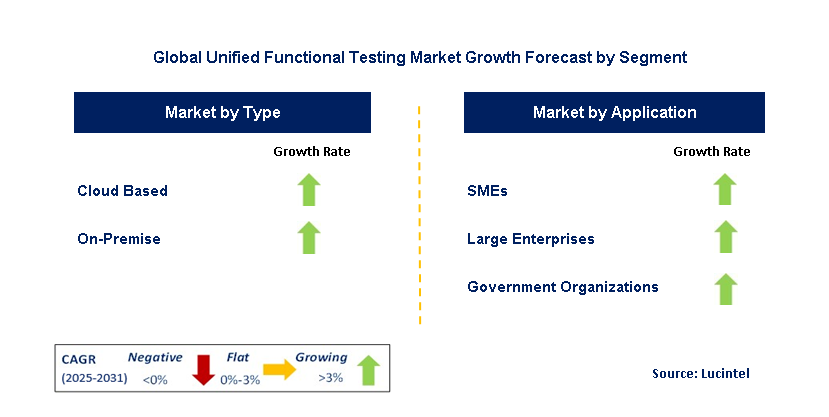
• Browserstack Q5. Which unified functional testing market segment will be the largest in future? Answer: Lucintel forecasts that cloud-based is expected to witness higher growth over the forecast period. Q6. In unified functional testing market, which region is expected to be the largest in next 5 years? Answer: APAC is expected to witness the highest growth over the forecast period. Q7. Do we receive customization in this report? Answer: Yes, Lucintel provides 10% customization without any additional cost.


Choose a license that fits your team. Instant PDF delivery.
Prices exclude taxes. Instant delivery. Custom licensing available on request.
Market Report · July 15, 2026
Market Report · June 26, 2026
Market Report · June 24, 2026
Trusted partner for strategic intelligence and business growth


Receive a complimentary market analysis tailored to your industry. Our analysts will identify key growth opportunities and competitive dynamics specific to your business.

Market size, growth rate, and key trend analysis for your specific sector.

Top competitor positioning and market share analysis.

Strategic recommendations backed by data-driven insights.
Get curated market intelligence and competitive moves straight to your inbox.
By subscribing, you agree to receive our monthly insights. Unsubscribe anytime.
Receive a complimentary market analysis tailored to your industry. Our analysts will identify key growth opportunities and competitive dynamics specific to your business.
Market size, growth rate, and key trend analysis for your specific sector.
Top competitor positioning and market share analysis.
Strategic recommendations backed by data-driven insights.
Get curated market intelligence, emerging trends, and competitive moves straight to your inbox each month.
By subscribing, you agree to receive our monthly insights. Unsubscribe anytime.
We'll send your sample report shortly.