
Market Report · May 16, 2026

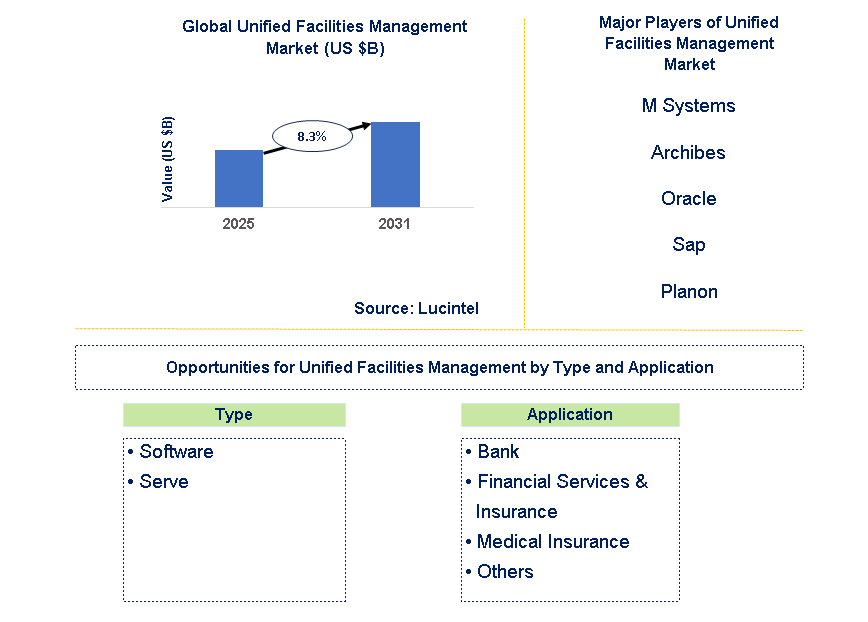
Key data points: The growth forecast = 8.3% annually for the next 7 years. Scroll below to get more insights. This market report covers Trends, opportunity and forecast in unified facilities management market to 2031 by type (software and service), application (bank, financial services & insurance, medical insurance, and others), and region (North America, Europe, Asia Pacific, and the Rest of the World)
We'll send your sample report shortly.
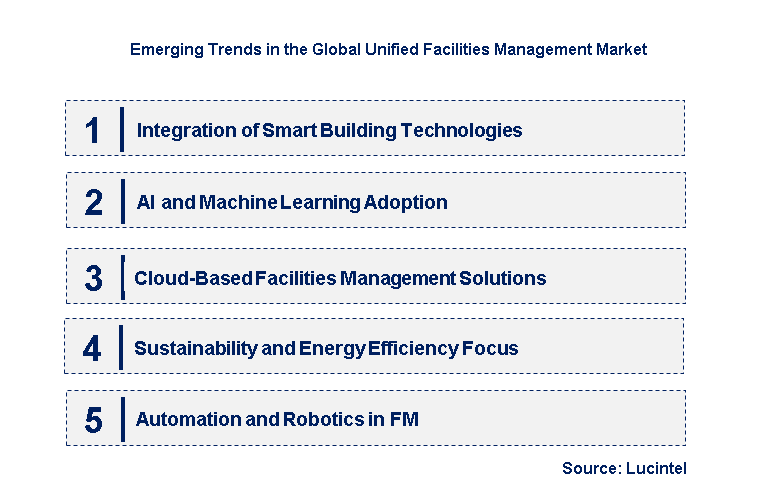
• Integration of Smart Building Technologies: Smart building technologies, involving IoT devices, sensors, and AI-based systems, are revamping Unified Facilities Management. These technologies allow for real-time monitoring and management of building systems such as HVAC, lighting, and security, leading to better operational efficiency and cost savings. By integrating these smart systems, facilities can be optimized for energy usage, reducing waste and improving sustainability. Predictive maintenance is also enabled, allowing facilities managers to address issues before they cause significant downtime, reducing operational costs and extending the lifespan of equipment.
• AI and Machine Learning Adoption: Increasingly, UFM systems are integrating AI and machine learning technologies for facilitating a more automated decision-making process and also to optimize facility operation processes. This new technology can analyze vast amounts of data from smart sensors and devices to predict the required maintenance, monitor energy consumption, and improve security. Predictive failure, a hallmark of AI-powered systems, minimizes downtime and repair costs while indicating wasted energy usage. This trend empowers facilities managers with actionable insights that enable them to improve both operational performance and sustainability, thus making UFM systems more proactive and responsive.
• Cloud-Based Facilities Management Solutions: Cloud-based facilities management solutions are also gaining popularity since they provide scalable and flexible platforms that enable organizations to manage several facilities from a centralized location. These solutions allow for real-time monitoring, reporting, and collaboration, which allows facilities managers to make data-driven decisions promptly. Cloud solutions minimize the need for on-site infrastructure and offer greater accessibility for remote management, which is very important for businesses with multiple locations. The cloud also supports integration with other enterprise systems, streamlining operations and enhancing overall efficiency.
• Sustainability and Energy Efficiency Focus: Sustainability and energy efficiency are two primary drivers in the Unified Facilities Management market. Climate change is increasingly a cause of concern, and stricter environmental regulations have compelled companies to opt for UFM solutions that reduce energy consumption, waste management, and carbon footprint. IoT sensors and smart meters monitor energy consumption in real time and allow businesses to identify inefficiencies and take corrective actions. UfM-based sustainable systems that are being applied in building design and retrofitting contribute to the achievement of sustainability goals by firms while reducing the running costs.
• Automation and Robotics in FM: Automation and robotics are very much penetrating into the Unified Facilities Management market, where robots apply for cleaning activities, security patrol, and sometimes even maintenance works in facilities. Automation in tasks such as HVAC control, lighting, and cleaning helps raise efficiency and cheap labor, making the overall building experience better. Robotics can be used for repetitive and routine jobs that human employees can work on high-value tasks. As automation technology increases, so is its applicability in facilities management. It will make the operations of the facilities much more efficient and cost-effective. The emerging trends in the Unified Facilities Management market: rising smart building technologies, adoption of AI, cloud-based solutions, sustainability initiatives, and automation are changing the managing style of the facilities. These are helping organizations improve their operational efficiency, save money, and achieve sustainability goals; this is resulting in great modifications in the facilities management sector.
• Smart Building Integrations: The rise of smart building integrations is one of the most significant developments in UFM. By integrating IoT devices, AI, and other advanced technologies, buildings can be monitored and managed in real time to optimize their operations, including heating, cooling, lighting, and security systems. The integration of these smart systems promotes predictive maintenance, lowering the consumption of energy, and upgrading the performance of buildings. This is highly relevant to the sector of commercial real estate for which efficiency and sustainability are top priorities.
• Energy Management Solutions: Energy management solutions have emerged as a central focus of UFM developments. This is due to the necessity for businesses to reduce energy consumption and meet sustainability goals. Using IoT sensors and smart meters, UFM systems can monitor energy usage in real time and provide insights into inefficiencies. Such insights help businesses optimize their energy consumption, reduce waste, and lower costs. This concern over energy efficiency further stimulates UFM providers to produce solutions which can provide better control over energy management with energy efficiency.
• AI and Predictive Maintenance: This has brought about a change in the management of facilities as the adoption of AI and predictive maintenance is revolutionizing the way facilities are managed. AI-based systems can analyze data from connected devices to predict when maintenance will be needed, allowing facilities managers to address issues before they become costly problems. Predictive maintenance reduces downtime, extends the lifespan of equipment, and lowers repair costs. This development is particularly important in industries with complex infrastructure, such as manufacturing, where unplanned downtime can lead to significant losses.
• Cloud-Based UFM Solutions: Cloud-based UFM solutions are fast becoming quite popular because of their ability to scale up or down, flexibly accommodate changes, and remotely monitor and manage through real time from any place. This allows a facility manager to monitor several buildings or sites centrally, thereby improving operational efficiency and quality in decision-making. In the cloud-based approach, on-site infrastructure is minimized; interoperability with other enterprise systems is also enhanced. This has facilitated collaboration, reduced costs, and improved the management of facilities.
• Robotics and Automation Integration: Robotics and automation are increasingly being integrated into UFM solutions, helping businesses improve efficiency and reduce labor costs. Automated systems are being used for cleaning, security, and even basic maintenance tasks. Robots equipped with AI and sensors can perform routine tasks, freeing up human workers to focus on more complex duties. Automation in UFM systems improves consistency, reduces errors, and enhances the overall experience for building occupants. Recent trends that are shaping up the Unified Facilities Management market includes smart building integration, energy management solutions, the adoption of Artificial Intelligence, and cloud-based applications, and more recently, in robotics. With these new facilities management technologies improving efficiency, controlling costs, and even achieving sustainability goals for businesses, its future growth into the UFM market will be promoted. Strategic Growth Opportunities in the Unified Facilities Management Market
• Energy Management and Sustainability: Energy management is a critical application within this UFM market since firms are in search for ways of reducing consumptions in energy and minimizing harmful impacts on the environment. Real-time energy monitoring and inefficient utilization insights, for example, through UFM, have huge growth prospects. Renewable energy source utilization and energy efficiency solutions are leading the demand among the businesses that aspire to become environmentally friendly. Increased environmental compliance measures will see increased demand for energy management solutions; hence a massive opportunity awaits the UFM suppliers.
• Building Automation Systems: Building automation systems ensure enhanced efficiency for facilities. By centralized management from a platform, building operations related to heating, ventilation, air-conditioning; lighting; security systems can all be managed efficiently from one site. The rapidly emerging smart building technologies and wide implementation of IoT sensors are driving market expansion for UFM solutions across the building automation system market. Key growth opportunities include remote monitoring and control from cloud-based platforms, which enables the achievement of considerable operational savings and better performance.
• Predictive Maintenance: Predictive maintenance is a major growth opportunity in the UFM market. Advancements in AI and IoT technologies have been the main drivers. The use of UFM systems through data from connected devices will enable the prediction of when maintenance will be required, thus, making it possible for organizations to minimize downtime and extend the life of their assets. Predictive maintenance is very useful to industries with complex infrastructure and equipment, for example, manufacturing, healthcare, and hospitality. Through the reduction of unplanned downtime, predictive maintenance assists organizations in improving operational efficiency and reducing costs.
• Cloud-Based UFM Solutions: Cloud-based UFM solutions are growing in demand due to their scalability, flexibility, and ability to provide real-time monitoring and management. The ability to manage multiple facilities from a single platform offers significant benefits in terms of efficiency and cost savings. Cloud-based solutions are also easier to integrate with other enterprise systems, enhancing collaboration and data sharing across an organization. The increasing demand for remote monitoring and management is further propelling the adoption of cloud-based UFM platforms.
• Robotics and Automation: Robotics and automation are creating growth opportunities within the UFM market by streamlining routine tasks such as cleaning, security, and maintenance. Robotics can perform repetitive tasks, improving efficiency and reducing labor costs. As automation technology continues to evolve, its application in UFM is expected to expand, particularly in commercial and industrial settings. The use of robotics not only improves operational efficiency but also enhances the overall building experience for tenants and employees. The strategic growth opportunities in the Unified Facilities Management market, including energy management, building automation, predictive maintenance, cloud-based solutions, and robotics, are a clear indication of the increasing demand for integrated and efficient facilities management solutions. This is what is driving innovation and shaping the future of the UFM market.
• M Systems
• Archibes
• Oracle
• Sap
• Planon
• Trimble Corporation
• Broadcom
• Fm System
• IBM
• Accruent
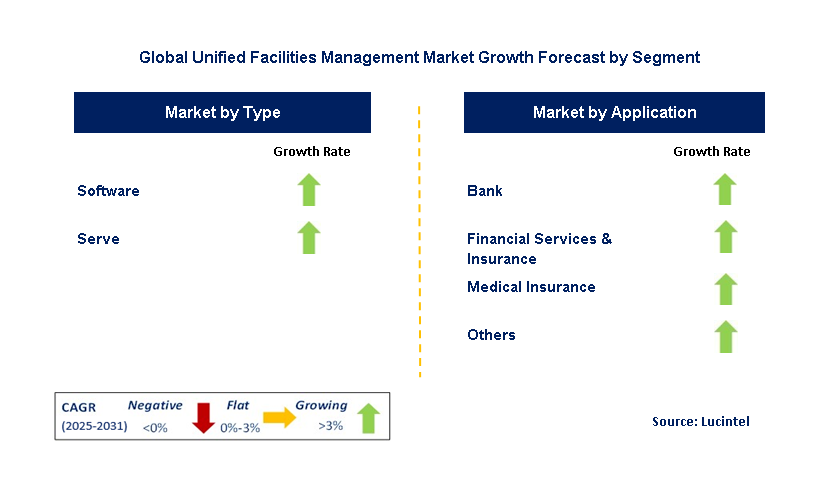
• Software
• Service
• Bank
• Financial Services & Insurance
• Medical Insurance
• Others
• North America
• Europe
• Asia Pacific
• The Rest of the World
• United States: In the United States, UFM is rapidly growing due to the rise in demand for integrated services across multiple industries, including healthcare, commercial real estate, and education. The application of smart building technologies and using data analytics in monitoring energy consumption to optimize operations further drives the need for UFM services. Another area of adoption is predictive maintenance using IoT sensors, which cuts down on downtime and maintenance costs. The UFM market in the U.S. is also growing because more businesses are focusing on sustainability and looking for green solutions to manage their facilities.
• China: China is rapidly expanding its Unified Facilities Management market, primarily driven by the country's booming urbanization and industrial growth. With the emphasis that the Chinese government is putting on sustainability, energy efficiency, and environmental regulations, more and more Chinese companies are incorporating UFM systems into their operation for ensuring compliance and improving operational efficiencies. Smart technologies, including IoT and AI, find more and more application in UFM systems nowadays to bring effective resource management and predictive maintenance. The Chinese market is also witnessing a rise in the demand for automation in facilities management, especially in large commercial and residential buildings.
• Germany: Germany is embracing Unified Facilities Management as part of its overall Industry 4.0 initiatives, which involve the integration of digital technologies into industrial operations. UFM solutions in Germany are becoming more sophisticated, with the incorporation of AI, IoT, and cloud-based software to automate processes and enhance operational efficiency. Germany is heavily focused on sustainability, and UFM solutions are therefore playing a key role in the optimization of energy consumption and reduction of carbon footprints. The trend for smart buildings is driving innovation in the facilities management sector and opening up new opportunities for service providers in UFM.
• India: The UFM market in India is growing at a rapid rate as businesses and industries increasingly discover the benefits of integrated facilities management. The increasing IT and real estate sectors lead to a vast demand for more efficient and economical facilities management services. Better energy consumption, waste generation, and stringent compliance with regulations for environmental security also push up the demand for better UFM system implementation in India. With infrastructure in India going more advanced, there is a necessity for smart building solutions and predictive maintenance, henceforth driving the uptake of IoT and AI-based UFM systems.
• Japan: Japan is leading in the use of smart technologies within the Unified Facilities Management industry. The need for automation, energy efficiency, and sustainability in the country has led to growth in the services of UFM, especially commercial real estate and industries. In Japan, UFM solutions are significantly influenced by the integration of IoT, AI, and robotics in cleaning, security, and predictive maintenance. As Japan approaches its sustainability goals, UFM services are designed to optimize energy use, reduce waste, and lower carbon emissions in both private and public sector buildings.


• M Systems
• Archibes
• Oracle
• Sap
• Planon
• Trimble Corporation
• Broadcom
• Fm System
• IBM
• Accruent Q5. Which unified facilities management market segment will be the largest in future? Answer: Lucintel forecasts that serve is expected to witness higher growth over the forecast period. Q6. In unified facilities management market, which region is expected to be the largest in next 5 years? Answer: APAC is expected to witness the highest growth over the forecast period. Q7. Do we receive customization in this report? Answer: Yes, Lucintel provides 10% customization without any additional cost.


Choose a license that fits your team. Instant PDF delivery.
Prices exclude taxes. Instant delivery. Custom licensing available on request.
Market Report · May 16, 2026
Market Report · September 4, 2025
Market Report · June 11, 2025
Trusted partner for strategic intelligence and business growth


Receive a complimentary market analysis tailored to your industry. Our analysts will identify key growth opportunities and competitive dynamics specific to your business.

Market size, growth rate, and key trend analysis for your specific sector.

Top competitor positioning and market share analysis.

Strategic recommendations backed by data-driven insights.
Get curated market intelligence and competitive moves straight to your inbox.
By subscribing, you agree to receive our monthly insights. Unsubscribe anytime.
Receive a complimentary market analysis tailored to your industry. Our analysts will identify key growth opportunities and competitive dynamics specific to your business.
Market size, growth rate, and key trend analysis for your specific sector.
Top competitor positioning and market share analysis.
Strategic recommendations backed by data-driven insights.
Get curated market intelligence, emerging trends, and competitive moves straight to your inbox each month.
By subscribing, you agree to receive our monthly insights. Unsubscribe anytime.
We'll send your sample report shortly.