
Market Report · July 15, 2026

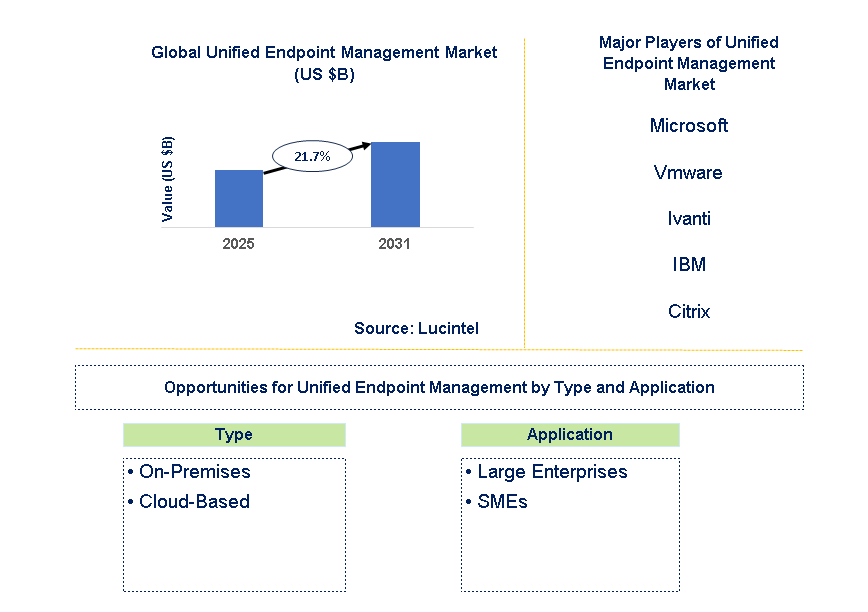
Key data points: The growth forecast = 21.7% annually for the next 7 years. Scroll below to get more insights. This market report covers Trends, opportunity and forecast in unified endpoint management market to 2031 by type (solutions and services), application (1000 ftes above, 250-999 ftes, 100-250 ftes, and 100 ftes below), and region (North America, Europe, Asia Pacific, and the Rest of the World)
We'll send your sample report shortly.
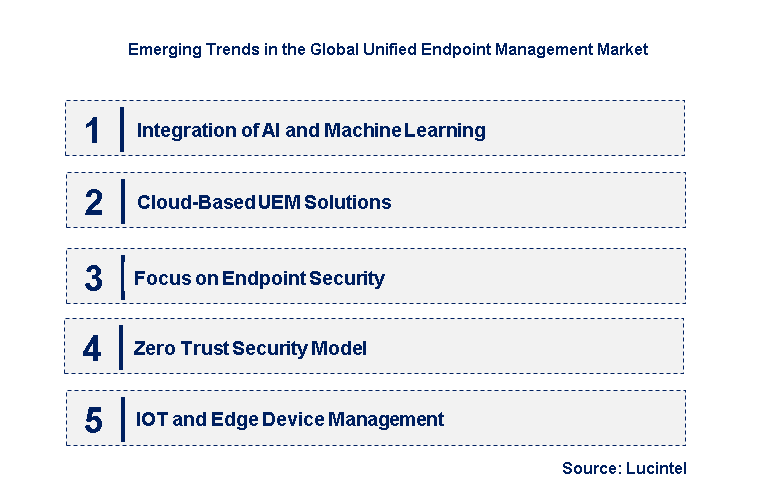
• Integration of AI and Machine Learning: AI and Machine Learning are being increasingly integrated into UEM solutions to automate tasks, detect security threats, and optimize performance. AI-driven insights can predict potential issues with endpoints and automate security protocols to prevent breaches. Additionally, ML algorithms are used to analyze vast amounts of data from endpoints to improve the overall management and operation of devices. This trend is enhancing both the efficiency and security of UEM solutions, helping businesses save time and reduce risks.
• Cloud-Based UEM Solutions: Cloud-based UEM solutions are gaining traction as organizations embrace cloud computing for flexibility and scalability. Cloud-based platforms allow businesses to manage a wide variety of endpoints across multiple locations without the need for on-premise infrastructure. These platforms offer businesses the ability to scale their endpoint management solutions based on the growing number of devices in their networks. The cloud also provides the benefit of remote management, making it easier for organizations with distributed workforces to manage and secure endpoints.
• Focus on Endpoint Security: With the rise of cyber threats targeting endpoint devices, there is an increasing focus on enhancing endpoint security in UEM solutions. Organizations are prioritizing solutions that provide real-time monitoring, threat detection, and automated responses to mitigate risks. Endpoint security is becoming a critical component of UEM strategies, especially in industries like healthcare and finance, where the protection of sensitive data is paramount. This trend is driving UEM vendors to enhance their offerings with integrated security features such as encryption, malware detection, and remote wipe capabilities.
• Zero Trust Security Model: The adoption of the Zero Trust security model is becoming a key trend in UEM. This model assumes that no device or user is trusted by default, even if they are inside the organization’s network. UEM solutions that align with Zero Trust principles continuously verify the identity and security posture of devices before granting access to corporate resources. By incorporating Zero Trust into UEM, organizations are strengthening their security measures, reducing the risk of data breaches, and ensuring compliance with evolving cybersecurity regulations.
• IOT and Edge Device Management: As the Internet of Things (IoT) and edge devices proliferate, UEM solutions are being enhanced to manage these diverse devices. The challenge of managing a vast number of IoT devices, which are often deployed in industries like manufacturing, healthcare, and logistics, is leading to the development of specialized UEM tools. These tools are designed to manage and secure devices that operate at the edge of networks, ensuring seamless performance and security across all connected devices. The emerging trends in the unified endpoint management market, such as AI integration, cloud-based solutions, enhanced endpoint security, Zero Trust adoption, and IoT/edge device management, are revolutionizing how organizations manage their endpoints. These trends are driving greater efficiency, improved security, and scalability for businesses worldwide.
• Increased Focus on Remote Work Management: As remote and hybrid work models become more common, organizations are increasingly investing in UEM solutions to manage endpoints securely. With employees using personal devices and working from various locations, UEM tools are essential for ensuring consistent security policies, software updates, and compliance across devices. This trend has led to a surge in demand for cloud-based UEM solutions that can be accessed remotely and provide centralized control over endpoints.
• Expansion of Device Support: UEM solutions are expanding to support a broader range of devices, including IoT devices, wearable technologies, and industrial systems. As businesses adopt more connected devices, UEM tools are evolving to ensure that these devices are properly managed, monitored, and secured. The expansion of device support allows organizations to integrate new technologies into their endpoint management strategies, ensuring comprehensive coverage and improved security across all devices in their networks.
• Automation and Self-Healing Capabilities: Automation and self-healing capabilities are becoming critical components of UEM solutions. By automating routine management tasks, such as device enrollment, configuration, and updates, UEM solutions are improving operational efficiency. Additionally, self-healing features enable endpoints to automatically detect and resolve issues, such as software misconfigurations or security vulnerabilities, without manual intervention. These capabilities are enhancing the overall reliability and speed of endpoint management processes.
• Integration with Other IT Management Systems: UEM solutions are increasingly being integrated with other IT management systems, such as Security Information and Event Management (SIEM) and IT Service Management (ITSM) platforms. This integration allows for a more comprehensive and streamlined approach to managing endpoints. For example, integrating UEM with SIEM systems enables real-time monitoring and threat detection, while linking UEM to ITSM platforms improves incident response and troubleshooting capabilities.
• Enhanced Analytics and Reporting: UEM vendors are enhancing their solutions with advanced analytics and reporting capabilities. These features allow organizations to gain deeper insights into their endpoint environments, such as device performance, security vulnerabilities, and user behavior. By leveraging these insights, businesses can make more informed decisions about their endpoint management strategies, improve security posture, and optimize device performance. Recent developments in the unified endpoint management market are focused on enhancing security, automating management processes, and expanding device support. These advancements are helping organizations address the challenges of managing increasingly complex endpoint environments while ensuring operational efficiency and robust security.
• Financial Services: Financial services organizations are increasingly adopting UEM solutions to manage and secure their endpoints, ensuring compliance with strict regulations and protecting sensitive customer data. With the rise of mobile banking, fintech solutions, and remote work in this sector, UEM solutions are essential for maintaining data integrity and security across all devices used by employees and customers.
• Healthcare: The healthcare sector presents a growing opportunity for UEM solutions, particularly as the industry adopts more connected devices such as medical equipment, wearable health devices, and mobile applications. UEM tools help ensure the security and compliance of these devices, which handle sensitive patient information. Additionally, healthcare organizations need UEM solutions to manage endpoints used by remote healthcare workers, ensuring smooth operations and data protection.
• Retail: In retail, UEM solutions are increasingly being used to manage a diverse range of devices, including point-of-sale (POS) systems, mobile devices, and IoT sensors used for inventory management. UEM tools help retailers maintain secure and efficient operations across their endpoint ecosystem while ensuring compliance with data privacy regulations.
• Government and Public Sector: The government and public sector are significant adopters of UEM solutions, driven by the need to manage and secure endpoints used by government employees, contractors, and field workers. UEM tools help ensure compliance with strict security protocols and regulations, while also offering the flexibility to manage a range of devices across multiple locations.
• Education: The education sector presents a growing opportunity for UEM solutions as schools and universities increasingly adopt digital learning tools and devices. UEM solutions are essential for managing a wide range of student and faculty devices, ensuring security, protecting sensitive data, and enabling a seamless learning experience. The strategic growth opportunities in the unified endpoint management market across sectors like finance, healthcare, retail, government, and education highlight the broad demand for endpoint management solutions. As businesses and organizations in these sectors continue to adopt more connected devices, the need for robust, scalable, and secure UEM solutions will continue to grow.
• Microsoft
• Vmware
• Ivanti
• IBM
• Citrix
• Manageengine (Zoho)
• Jamf
• Blackberry
• Sophos
• Matrix42
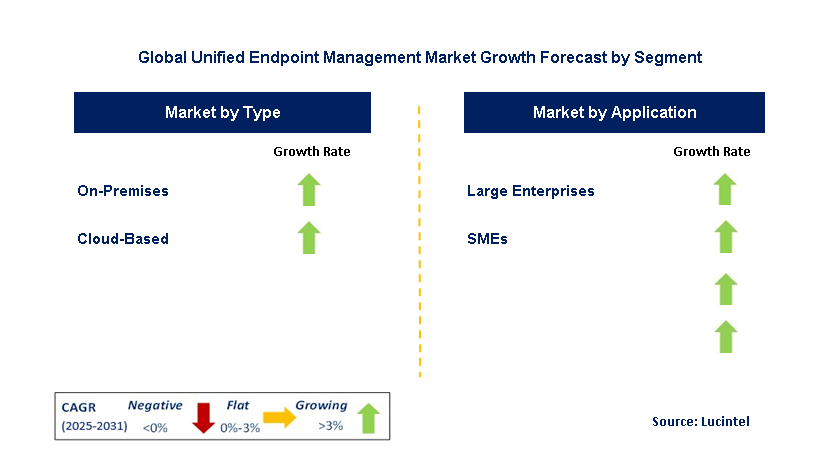
• Solutions
• Services
• 1000 Ftes Above
• 250-999 Ftes
• 100-250 Ftes
• 100 Ftes Below
• North America
• Europe
• Asia Pacific
• The Rest of the World
• United States: In the United States, the Unified Endpoint Management market is experiencing strong growth, driven by the rising demand for seamless and secure device management solutions. With the increased adoption of remote work and Bring Your Own Device (BYOD) policies, companies are seeking UEM solutions that can support a wide variety of devices. UEM tools are also being integrated with Artificial Intelligence (AI) and Machine Learning (ML) to enhance security and improve device performance. Moreover, the increasing focus on endpoint security, particularly to protect against cyber threats, is boosting the UEM market in the United States.
• China: China’s Unified Endpoint Management market is evolving as the government continues to prioritize cybersecurity and digital infrastructure development. As Chinese businesses expand their digital operations, UEM solutions are becoming vital for managing the growing number of connected devices and ensuring compliance with strict data security regulations. Additionally, Chinese enterprises are increasingly adopting cloud-based UEM platforms to streamline device management processes. As the Chinese market becomes more digitally connected, UEM providers are integrating AI and data analytics capabilities to optimize endpoint management and bolster device security.
• Germany: Germany’s UEM market is driven by the country’s leadership in industrial automation, manufacturing, and the finance sector, where managing a vast array of devices is crucial. German businesses are adopting UEM solutions to ensure that their endpoints, including smartphones, laptops, and IoT devices, are secure and compliant with data protection regulations like GDPR. Additionally, the rise of Industry 4.0 is pushing demand for UEM tools to manage devices used in smart factories and industrial environments. The market is also benefiting from the increasing adoption of cloud-based UEM solutions that allow businesses to centralize endpoint management across diverse platforms.
• India: In India, the Unified Endpoint Management market is expanding rapidly, driven by the booming IT and tech services sectors. With more businesses in India adopting cloud computing, remote work policies, and digital transformation strategies, UEM solutions are becoming essential for managing the proliferation of devices. Additionally, the increasing focus on cybersecurity in both private and public sectors is driving demand for UEM tools that ensure endpoint security and compliance with regulations. Indian enterprises are also leveraging AI and automation in their UEM solutions to streamline management and improve efficiency across their IT environments.
• Japan: Japan’s UEM market is growing as the country emphasizes digital innovation and IoT adoption across multiple industries, such as automotive, manufacturing, and technology. Japanese enterprises are increasingly adopting UEM tools to manage the diverse range of devices used within their organizations, from smartphones to industrial IoT devices. The country’s commitment to cybersecurity is also driving the need for robust endpoint management solutions to protect against cyber threats. Japan’s market is also benefiting from the shift towards cloud computing and the increased demand for UEM solutions that offer seamless integration with other IT management systems.


• Microsoft
• Vmware
• Ivanti
• IBM
• Citrix
• Manageengine (Zoho)
• Jamf
• Blackberry
• Sophos
• Matrix42 Q5. Which unified endpoint management market segment will be the largest in future? Answer: Lucintel forecasts that, within the type category, solution is expected to witness higher growth over the forecast period. Q6. In unified endpoint management market, which region is expected to be the largest in next 5 years? Answer: In terms of regions, APAC is expected to witness the highest growth over the forecast period. Q7. Do we receive customization in this report? Answer: Yes, Lucintel provides 10% customization without any additional cost.


Choose a license that fits your team. Instant PDF delivery.
Prices exclude taxes. Instant delivery. Custom licensing available on request.
Market Report · July 15, 2026
Market Report · June 26, 2026
Market Report · June 24, 2026
Trusted partner for strategic intelligence and business growth


Receive a complimentary market analysis tailored to your industry. Our analysts will identify key growth opportunities and competitive dynamics specific to your business.

Market size, growth rate, and key trend analysis for your specific sector.

Top competitor positioning and market share analysis.

Strategic recommendations backed by data-driven insights.
Get curated market intelligence and competitive moves straight to your inbox.
By subscribing, you agree to receive our monthly insights. Unsubscribe anytime.
Receive a complimentary market analysis tailored to your industry. Our analysts will identify key growth opportunities and competitive dynamics specific to your business.
Market size, growth rate, and key trend analysis for your specific sector.
Top competitor positioning and market share analysis.
Strategic recommendations backed by data-driven insights.
Get curated market intelligence, emerging trends, and competitive moves straight to your inbox each month.
By subscribing, you agree to receive our monthly insights. Unsubscribe anytime.
We'll send your sample report shortly.