
Market Report · July 15, 2026

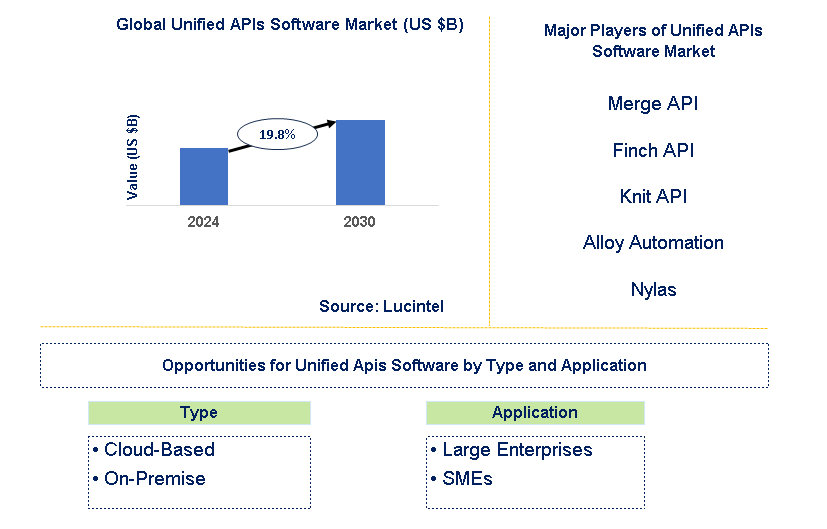
Key data points: The growth forecast = 19.8% annually for the next 7 years. Scroll below to get more insights. This market report covers Trends, opportunity and forecast in unified APIs software market to 2031 by type (cloud-based and on-premise), application (large enterprises and smes), and region (North America, Europe, Asia Pacific, and the Rest of the World)
We'll send your sample report shortly.
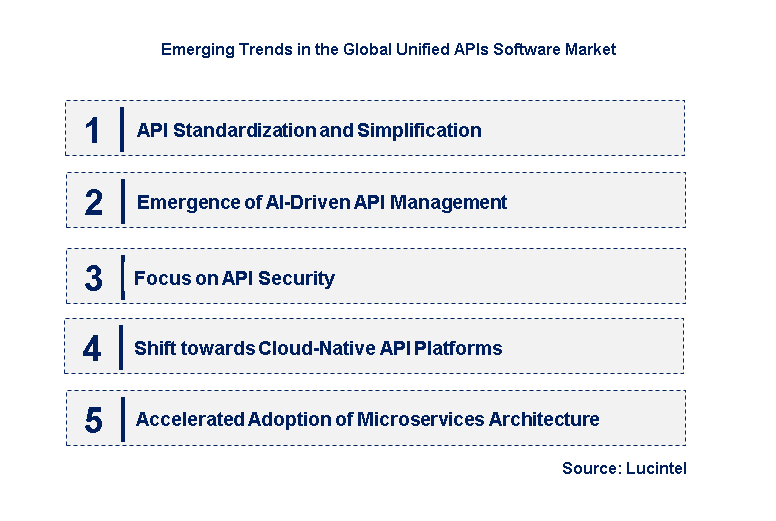
• API Standardization and Simplification: The growing complexity in the management of multiple APIs has made it a trend toward standardizing and simplifying API integration. Unified APIs are becoming more standardized, allowing companies to use one set of protocols to connect a variety of systems and applications. This simplifies management, reduces compatibility issues, and speeds up deployment. Standardized APIs also offer easier scalability, enabling businesses to adapt more rapidly to changing technological demands.
• Emergence of AI-Driven API Management: Artificial intelligence has been playing an important role in the development of Unified APIs Software. AI has been incorporated in API management platforms to automate errors, performance tuning, and security monitoring. Real-time prediction by AI-driven tools is enabling effective management of APIs by identifying probable issues before they strike. This trend is enhancing the efficiency of API integration, allowing businesses to focus on innovation while reducing the need for manual oversight.
• Focus on API Security: As the number of APIs increases, so do the risks associated with data breaches and cyberattacks. This is leading to a stronger focus on API security. Companies are adopting advanced security measures such as OAuth, encryption, and API gateways to secure data exchanges. There is also a need for APIs to be compliant with international data protection laws and regulations. API security is becoming the new factor for Unified APIs Software as companies focus on secure API frameworks to protect sensitive data.
• Shift towards Cloud-Native API Platforms: Migration to cloud-based infrastructures is boosting the adoption of cloud-native API platforms, designed to maximize scalability and flexibility from cloud environments to connect a service across various providers. Hybrid and multi-cloud strategies are also demanding the adoption of cloud-native APIs due to smoother integration and management of cloud resources.
• Accelerated Adoption of Microservices Architecture: With more companies adopting microservices for their flexibility, scalability, and ability to improve application development cycles, this trend is accelerating. Microservices enable businesses to break down monolithic applications into smaller, independent components that can be easily updated and managed. Therefore, Unified APIs Software is in increasing demand due to microservices architecture. These developing trends indicate that the Unified APIs Software market is constantly moving towards greater standardization, automation, and security. As more businesses focus on integrating diverse technologies to improve user experiences, these trends are reshaping how organizations manage and derive value from their APIs.
• API Integration Platforms: API integration platforms are growing at a rapid pace, as companies strive to simplify the process of integrating disparate systems. These platforms enable organizations to integrate several APIs from various providers into one cohesive system. By streamlining API management, these platforms reduce complexity, improve performance, and enhance scalability. This development is particularly beneficial for businesses in industries like e-commerce, fintech, and healthcare, which rely on third-party services for functionality.
• Low-Code/No-Code API Development Tools: The low-code and no-code development platforms are making it easy for businesses to build and integrate APIs with little need for deep programming expertise. These allow users to design and develop APIs more rapidly with very little technical knowhow. It is democratizing the integration of APIs, which will make it accessible for more organizations, especially SMEs, to embrace Unified APIs. Low-code/no-code solutions are accelerating the deployment of APIs, with a growing ecosystem allowing businesses to keep up with evolving customer expectations.
• Expanding API Ecosystems: API ecosystems are expanding because businesses are increasingly relying on APIs to reach partners, customers, and third-party services. Unified APIs play a central role in this expansion, allowing seamless integration across platforms. This development is particularly important because companies want to enhance customer experiences by providing more personalized and connected services. The expansion of API ecosystems has led to the collaboration and innovation across industries that give rise to new business models and services.
• API Performance Optimization: The reliance on APIs for mission-critical applications has heightened the focus on API performance optimization. There is a great deal of investment in technologies that help monitor and enhance API performance, ensuring APIs deliver the required speed, scalability, and reliability. This development is important for fintech, which depends on the performance and speed to ensure customer satisfaction. These API performance optimization tools are aiding businesses in reducing latency, improving response times, and ensuring consistent service delivery.
• API Governance and Compliance Solutions: As the regulatory requirements pertaining to data privacy and security have become tighter and tighter, the businesses are focusing on the API governance and compliance solutions. These tools help these organizations ensure their APIs meet the legal and industry standards for data protection. In such implementation of governance policies, companies would manage the life cycle of the API, understand its usage, and ensure security for the utilization of APIs according to the existing applicable regulations. The development will benefit businesses primarily from regulated industries such as health and finance sectors. The developments above suggest that the Unified APIs Software market is getting dynamic, focusing more on integration, security, and performance optimization. As more sophisticated technologies are being adopted by businesses, these developments are equipping them with tools to make API management more streamlined and enhance the functionality of digital ecosystems.
• Enterprise Integration Solutions: Enterprise integration is increasingly calling for Unified APIs as companies are looking to reduce complexity in their IT infrastructure and to improve operational efficiency. Organizations use Unified APIs to merge multiple systems and platforms into one cohesive ecosystem that reduces complexity and enhances collaboration between departments. It is particularly important for large enterprises that need to integrate legacy systems with modern technologies.
• E-Commerce and Retail: For APIs, e-commerce and retail can integrate payment gateways, inventory management systems, customer relationship management, and many others. Unified APIs offer the adaptability to bridge multiple systems; improve the quality of customer service; and perform real-time update of the status of the current inventory. That opportunity is constantly developing as more retail businesses shift attention to providing convenient online shopping for their customers.
• Financial Services and Fintech: The financial services industry is increasingly adopting Unified APIs to integrate banking systems, payment processors, and financial platforms. These APIs enable faster, more secure transactions and help companies comply with regulations. Fintech companies are driving innovation in this space, as they rely on Unified APIs to connect with payment gateways, wallets, and third-party services, improving the speed and efficiency of financial transactions.
• Healthcare Systems: The healthcare industry is using Unified APIs to integrate different medical systems, electronic health records, and patient management tools. This integration helps healthcare providers offer better patient care, streamline operations, and enhance data security. The growth of telemedicine and digital health initiatives is further fueling the demand for Unified APIs in healthcare.
• IOT and Smart Devices: The Internet of Things (IoT) is driving significant demand for Unified APIs to connect a variety of smart devices, sensors, and platforms. Unified APIs are essential for enabling seamless communication between devices, improving interoperability, and ensuring efficient data exchange. This opportunity is expanding as more businesses adopt IoT solutions to enhance operational efficiency and customer experiences. These strategic growth opportunities demonstrate that the Unified APIs Software market is evolving rapidly across multiple industries. As companies increasingly rely on digital transformation, these applications are offering the tools necessary to improve efficiency, enhance customer experiences, and streamline business operations.
• Merge API
• Finch API
• Knit API
• Alloy Automation
• Nylas
• Apideck
• Codat
• Hotglue
• Unified.To
• Rootfi
• Cloud-Based
• On-Premise
• Large Enterprises
• Smes
• North America
• Europe
• Asia Pacific
• The Rest of the World
• United States: The Unified APIs Software demand is growing manifold in the United States as various businesses are striving to integrate all their technology into one platform. The companies have increasingly turned towards Unified APIs in order to make different systems communicate effectively. Some of the major sectors, like fintech, healthcare, and e-commerce, are contributing to this growth because they seek to connect legacy systems with modern cloud services. Moreover, the increasing security issues related to APIs are making the development of safer and more scalable API management platforms that facilitate safe and seamless data exchange.
• China: The Unified APIs Software market is flourishing in China, as digital transformation is rapidly penetrating different sectors. Strong government support for technological advancement in areas such as smart cities and e-commerce has increased the demand for API integration. Chinese companies are increasingly adopting Unified APIs to connect multiple platforms and enhance user experiences across digital ecosystems. With the growing emphasis on data privacy and security, there is also a significant push for secure APIs that comply with local regulations such as the Personal Information Protection Law (PIPL), which governs data privacy.
• Germany: Germany has seen consistent growth in Unified APIs Software adoption, especially in industries such as automotive, manufacturing, and finance. API-based solutions have been in demand to integrate multiple enterprise systems with third-party services. Data security and compliance are also prominent concerns in the German market, with strict European Union regulations such as the General Data Protection Regulation (GDPR). Companies in Germany are making sure their API frameworks are both compliant with these regulations and resilient against cyber threats.
• India: Unified APIs Software in India has tremendous growth in the market as all businesses representing IT, e-commerce, and banking are embracing digital transformation. Unified APIs are adopted at a very large scale by Indian startups and SMEs as these companies are increasingly incorporating third-party services into their operations. The increase in adoption of APIs across various public and private sectors is being further driven by the government's thrust for initiatives such as the Digital India. As demand increases for seamless connectivity and better customer experiences, Indian companies are focusing on deploying APIs that can connect multiple systems and improve interoperability.
• Japan: Unified APIs Software in Japan has increasing demand as it improves the technology aspects of business companies and can tackle the older age population requirement. Businesses aim at streamlining digital operations while empowering better collaboration on platforms. Auto and robotics sectors have started integrating IoT and AI to use unified APIs, even health care does so. Moreover, the intense focus on security and compliance in Japan is resulting in the development of APIs that are robust and resilient in the face of cybersecurity risks while ensuring secure data exchange within the country.


• Merge API
• Finch API
• Knit API
• Alloy Automation
• Nylas
• Apideck
• Codat
• Hotglue
• Unified.To
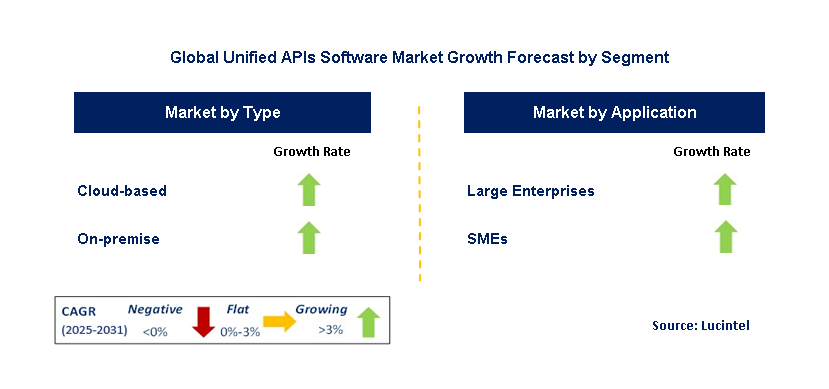
• Rootfi Q5. Which unified APIs software market segment will be the largest in future? Answer: Lucintel forecasts that, within the type category, cloud-based is expected to witness higher growth over the forecast period. Q6. In unified APIs software market, which region is expected to be the largest in next 5 years? Answer: In terms of region, APAC is expected to witness the highest growth over the forecast period. Q7. Do we receive customization in this report? Answer: Yes, Lucintel provides 10% customization without any additional cost.


Choose a license that fits your team. Instant PDF delivery.
Prices exclude taxes. Instant delivery. Custom licensing available on request.
Market Report · July 15, 2026
Market Report · June 26, 2026
Market Report · June 24, 2026
Trusted partner for strategic intelligence and business growth


Receive a complimentary market analysis tailored to your industry. Our analysts will identify key growth opportunities and competitive dynamics specific to your business.

Market size, growth rate, and key trend analysis for your specific sector.

Top competitor positioning and market share analysis.

Strategic recommendations backed by data-driven insights.
Get curated market intelligence and competitive moves straight to your inbox.
By subscribing, you agree to receive our monthly insights. Unsubscribe anytime.
Receive a complimentary market analysis tailored to your industry. Our analysts will identify key growth opportunities and competitive dynamics specific to your business.
Market size, growth rate, and key trend analysis for your specific sector.
Top competitor positioning and market share analysis.
Strategic recommendations backed by data-driven insights.
Get curated market intelligence, emerging trends, and competitive moves straight to your inbox each month.
By subscribing, you agree to receive our monthly insights. Unsubscribe anytime.
We'll send your sample report shortly.