
Market Report · July 29, 2026

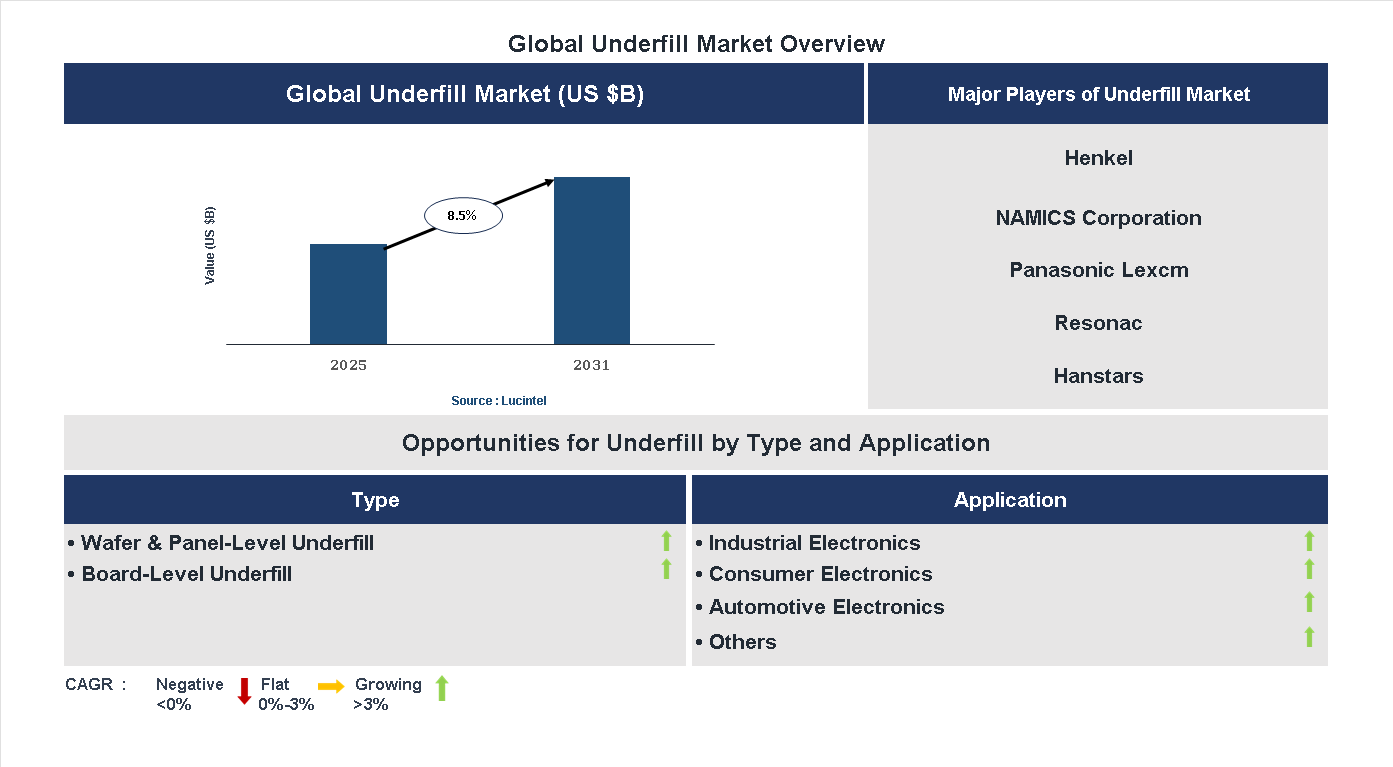
Key data points: The growth forecast = 8.5% annually for the next 7 years. Scroll below to get more insights. This market report covers trends, opportunities and forecasts in underfill market to 2031 by type (wafer & panel-level underfill and board-level underfill), application (industrial electronics, consumer electronics, automotive electronics, and others), and region (North America, Europe, Asia Pacific, and the Rest of the World)
We'll send your sample report shortly.
• Lucintel forecasts that, within the type category, wafer & panel-level underfill is expected to witness higher growth over the forecast period.
• Within the application category, automotive electronics is expected to witness the highest growth.
• In terms of region, APAC is expected to witness the highest growth over the forecast period. Gain valuable insights for your business decisions with our comprehensive 150+ page report. Sample figures with some insights are shown below.
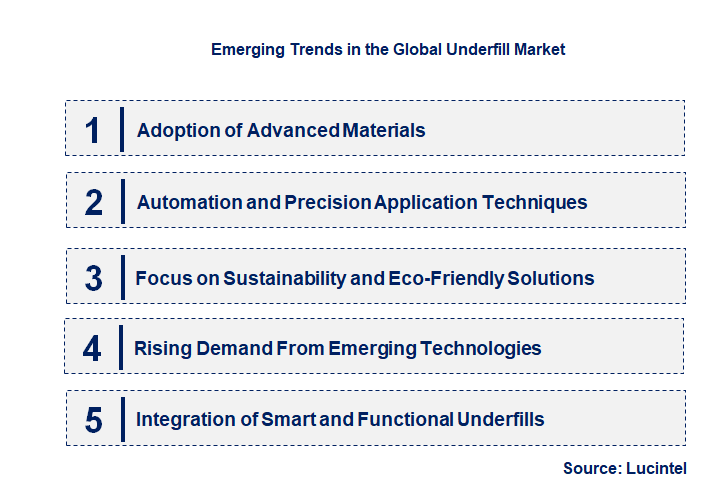
• Adoption of Advanced Materials: The market is shifting towards innovative underfill materials such as thermally conductive, low-viscosity, and environmentally friendly options. These materials improve thermal management, enhance mechanical strength, and reduce environmental impact. Manufacturers are investing in R&D to develop formulations that offer better adhesion, flexibility, and reliability, especially for high-performance applications like 5G and IoT devices. This trend is driving the creation of more durable and efficient underfill solutions, ultimately improving device longevity and performance.
• Automation and Precision Application Techniques: The integration of automation in underfill dispensing and curing processes is gaining momentum. Robotic systems and precision dispensing equipment ensure consistent application, reduce waste, and improve production efficiency. These advancements enable manufacturers to meet the demands of miniaturized and complex electronic assemblies with high accuracy. Automation also minimizes human error, leading to higher quality standards and faster production cycles, which are critical in high-volume manufacturing environments.
• Focus on Sustainability and Eco-Friendly Solutions: Environmental concerns are prompting the industry to develop sustainable underfill materials that are free from hazardous substances and have lower carbon footprints. Biodegradable and recyclable materials are being explored to align with global sustainability goals. This trend not only helps companies comply with strict regulations but also appeals to environmentally conscious consumers. The shift towards eco-friendly solutions is reshaping supply chains and encouraging innovation in material science within the underfill market.
• Rising Demand from Emerging Technologies: The proliferation of advanced technologies such as 5G, wearable electronics, and autonomous vehicles is fueling the need for specialized underfill solutions. These applications require materials that can withstand higher temperatures, mechanical stress, and miniaturization. The market is witnessing increased R&D investments to develop tailored underfill products that meet the unique demands of these high-tech sectors, thereby expanding market opportunities and driving growth.
• Integration of Smart and Functional Underfills: The development of smart underfill materials with embedded sensors and conductive properties is an emerging trend. These materials enable real-time monitoring of device health, improve thermal management, and enhance electrical performance. Such innovations are particularly relevant for critical applications in aerospace, healthcare, and automotive industries. The integration of functionality into underfill solutions is transforming traditional roles, making them integral to the overall device performance and reliability. In summary, these trends are collectively reshaping the underfill market by fostering innovation, improving efficiency, and emphasizing sustainability. They are enabling manufacturers to meet the evolving demands of high-tech industries, ensuring better device performance, and opening new avenues for growth and competitiveness.
• Introduction of advanced underfill materials: New formulations with enhanced thermal stability and mechanical properties are improving device reliability and lifespan, leading to broader adoption in high-performance electronics.
• Adoption of environmentally friendly solutions: Eco-friendly underfill materials with reduced volatile organic compounds (VOCs) and recyclable options are gaining popularity, aligning with global sustainability initiatives and regulatory requirements.
• Automation in application processes: The integration of robotics and automated dispensing systems has increased precision, reduced waste, and improved production efficiency, enabling manufacturers to meet high-volume demands.
• Development of low-temperature curing underfills: These materials facilitate faster manufacturing cycles and are compatible with temperature-sensitive components, expanding their use in flexible and wearable electronics.
• Expansion into emerging markets: Growing electronics manufacturing in regions like Asia-Pacific and Latin America is driving demand for cost-effective and scalable underfill solutions, fostering market growth and diversification. In summary, these recent developments are significantly impacting the underfill market by enhancing product performance, promoting sustainability, increasing manufacturing efficiency, and expanding market reach. As innovation continues, the industry is poised for sustained growth and technological advancement.
• Consumer Electronics: Increased demand for miniaturized devices : The growth of smartphones, tablets, and wearables requires advanced underfill solutions to enhance device reliability and longevity, driving market expansion in this segment.
• Automotive Electronics: Rising adoption of electric vehicles and advanced driver-assistance systems : Underfill materials are crucial for ensuring the durability of automotive electronic components, supporting safety and performance standards.
• Industrial Equipment: Growing automation and robotics applications : Underfill solutions improve the reliability of electronic assemblies in harsh industrial environments, boosting their adoption across manufacturing sectors.
• Material Innovation: Development of eco-friendly and high-performance underfills : New materials reduce environmental impact and enhance thermal and mechanical properties, attracting environmentally conscious manufacturers.
• Application Techniques: Advancements in dispensing and curing technologies : Improved application methods increase efficiency and precision, reducing costs and enabling complex device designs. In summary, these growth opportunities are significantly impacting the underfill market by fostering innovation, expanding application scopes, and enhancing product reliability. As industries continue to evolve, the demand for sophisticated underfill solutions is expected to rise, driving sustained market growth and creating competitive advantages for industry players.
• Technological Advancements: The rapid evolution of electronic components and packaging technologies necessitates innovative underfill solutions. As devices become smaller and more complex, the need for reliable, high-performance underfill materials increases. This drives research and development efforts, leading to improved formulations that enhance device durability and performance. The integration of nanotechnology and advanced curing processes further boosts efficiency and quality, supporting market growth. These technological innovations enable manufacturers to meet the demands of next-generation electronics, fostering a competitive edge and expanding market opportunities.
• Growing Electronics Industry: The expanding consumer electronics, automotive, and telecommunications sectors significantly contribute to the demand for underfill materials. As devices become more compact and sophisticated, the need for effective underfill solutions to ensure reliability and longevity intensifies. The rise in wearable devices, IoT gadgets, and electric vehicles amplifies this trend, requiring specialized underfill formulations. This growth stimulates investment in manufacturing capacity and innovation, creating a robust market environment. The increasing adoption of advanced packaging techniques, such as flip-chip and 3D integration, further propels demand, making the electronics industry a primary driver.
• Regulatory and Environmental Standards: Stringent regulations concerning environmental safety and material sustainability influence the market. Governments and industry bodies impose restrictions on hazardous substances, prompting manufacturers to develop eco-friendly underfill materials. Compliance with RoHS, REACH, and other standards necessitates innovation in formulation and sourcing. These regulations also encourage the adoption of biodegradable and low-toxicity materials, which can enhance brand reputation and market access. While compliance challenges may increase costs, they ultimately drive the industry toward safer, more sustainable solutions, shaping product development and market strategies.
• Increasing Adoption of Advanced Packaging Technologies: The shift toward advanced packaging methods like flip-chip, wafer-level packaging, and 3D IC stacking is a major growth driver. These technologies require specialized underfill materials that can withstand thermal and mechanical stresses while maintaining electrical performance. The demand for high reliability in high-density electronic assemblies pushes innovation in underfill formulations. This trend not only enhances device performance but also opens new markets for underfill suppliers. As the electronics industry continues to push the boundaries of miniaturization and performance, the adoption of these advanced packaging techniques will remain a key growth factor. The challenges facing this Underfill Market include:-
• High Material and Manufacturing Costs: The development and production of advanced underfill materials involve significant expenses. Specialized formulations, quality control, and manufacturing processes increase costs, which can impact profit margins and pricing strategies. Small and medium-sized enterprises may find it difficult to compete with larger players who benefit from economies of scale. Additionally, fluctuations in raw material prices, especially for specialty chemicals, can lead to cost volatility. These financial pressures may slow innovation and limit market expansion, especially in price-sensitive regions or sectors.
• Environmental and Regulatory Constraints: While regulations promote sustainability, they also pose challenges for market players. Compliance requires reformulation of products, investment in new manufacturing processes, and rigorous testing, all of which increase costs and time-to-market. Stricter environmental standards may limit the use of certain chemicals, reducing the availability of traditional materials and necessitating alternative solutions. Navigating these complex regulatory landscapes demands significant resources and expertise, potentially delaying product launches and increasing operational risks.
• Technological Complexity and Compatibility Issues: The rapid pace of technological innovation introduces compatibility challenges. Integrating new underfill materials with diverse electronic components and packaging techniques can be complex. Compatibility issues may lead to reliability concerns, increased testing requirements, and higher development costs. Additionally, the need for specialized equipment and processes can hinder adoption, especially for smaller manufacturers. Overcoming these technical hurdles requires ongoing research and collaboration across the industry, which can slow market growth and innovation. In summary, the underfill market is shaped by dynamic technological advancements, expanding electronics applications, and evolving regulatory standards. While these drivers foster growth and innovation, challenges such as high costs, regulatory constraints, and technological complexities pose significant hurdles. The markets future will depend on how effectively stakeholders can leverage opportunities and address these challenges, ensuring sustainable growth and technological progress.
• Henkel
• NAMICS Corporation
• Panasonic Lexcm
• Resonac
• Hanstars
• Shin-Etsu Chemical
• MacDermid Alpha
• ThreeBond
• Parker LORD
• Nagase ChemteX
• Wafer & Panel-Level Underfill
• Board-Level Underfill
• Industrial Electronics
• Consumer Electronics
• Automotive Electronics
• Others
• North America
• Europe
• Asia Pacific
• The Rest of the World
• United States: The US has seen substantial innovation in underfill materials, focusing on environmentally friendly formulations and high-performance composites. Leading tech companies are collaborating with research institutions to develop advanced underfill solutions that improve thermal management and mechanical strength, supporting the growth of the semiconductor and electronics industries.
• China: China is rapidly expanding its manufacturing capabilities and investing heavily in R&D for underfill materials. The country is focusing on developing cost-effective, high-quality underfills to meet the rising demand from consumer electronics and automotive sectors, with several domestic firms making significant technological advancements.
• Germany: Known for its engineering excellence, Germany is advancing in the development of high-reliability underfill materials suitable for automotive and industrial applications. The emphasis is on creating durable, temperature-resistant formulations that enhance product longevity and safety standards.
• India: India is witnessing a surge in electronics manufacturing, prompting increased demand for innovative underfill solutions. The country is focusing on developing affordable, eco-friendly materials to support its growing electronics and telecommunications sectors, with government initiatives encouraging local R&D efforts.
• Japan: Japan continues to lead in the development of high-performance underfill materials, emphasizing miniaturization and thermal stability. Japanese firms are pioneering new formulations that cater to advanced semiconductor packaging, ensuring compatibility with next-generation electronic devices.


• Henkel
• NAMICS Corporation
• Panasonic Lexcm
• Resonac
• Hanstars
• Shin-Etsu Chemical
• MacDermid Alpha
• ThreeBond
• Parker LORD
• Nagase ChemteX Q5. Which underfill market segment will be the largest in future? Answer: Lucintel forecasts that, within the type category, wafer & panel-level underfill is expected to witness higher growth over the forecast period. Q6. In underfill market, which region is expected to be the largest in next 5 years? Answer: In terms of region, APAC is expected to witness the highest growth over the forecast period. Q7. Do we receive customization in this report? Answer: Yes, Lucintel provides 10% customization without any additional cost.


Choose a license that fits your team. Instant PDF delivery.
Prices exclude taxes. Instant delivery. Custom licensing available on request.
Market Report · July 29, 2026
Market Report · July 20, 2026
Market Report · July 20, 2026
Trusted partner for strategic intelligence and business growth


Receive a complimentary market analysis tailored to your industry. Our analysts will identify key growth opportunities and competitive dynamics specific to your business.

Market size, growth rate, and key trend analysis for your specific sector.

Top competitor positioning and market share analysis.

Strategic recommendations backed by data-driven insights.
Get curated market intelligence and competitive moves straight to your inbox.
By subscribing, you agree to receive our monthly insights. Unsubscribe anytime.
Receive a complimentary market analysis tailored to your industry. Our analysts will identify key growth opportunities and competitive dynamics specific to your business.
Market size, growth rate, and key trend analysis for your specific sector.
Top competitor positioning and market share analysis.
Strategic recommendations backed by data-driven insights.
Get curated market intelligence, emerging trends, and competitive moves straight to your inbox each month.
By subscribing, you agree to receive our monthly insights. Unsubscribe anytime.
We'll send your sample report shortly.