
Market Report · July 22, 2026

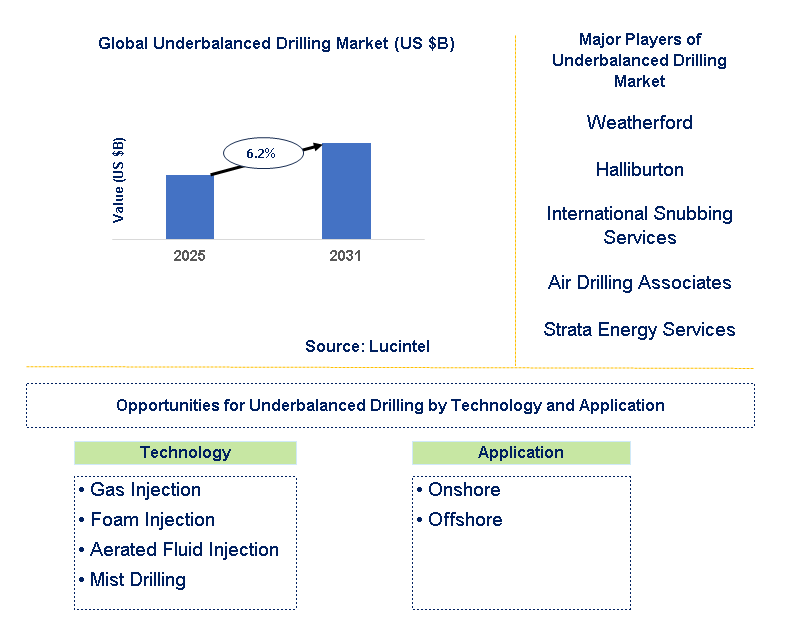
Key data points: The growth forecast = 6.2% annually for the next 7 years. Scroll below to get more insights. This market report covers trends, opportunities and forecasts in underbalanced drilling market to 2031 by technology (gas injection, foam injection, aerated fluid injection, and mist drilling), application (onshore and offshore), and region (North America, Europe, Asia Pacific, and the Rest of the World)
We'll send your sample report shortly.
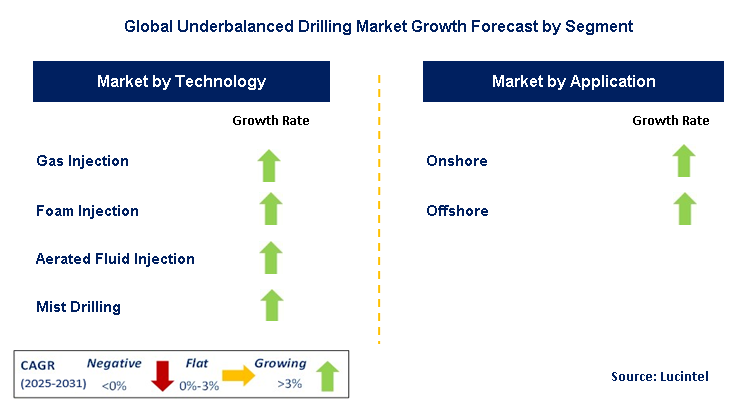
• Lucintel forecasts that, within the technology category, gas injection is expected to witness the highest growth over the forecast period.
• Within the application category, onshore is expected to witness higher growth.
• In terms of region, North America is expected to witness the highest growth over the forecast period. Gain valuable insights for your business decisions with our comprehensive 150+ page report. Sample figures with some insights are shown below.
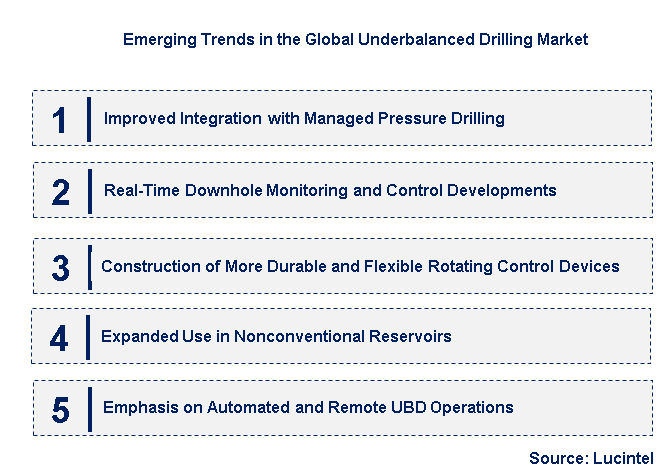
• Improved Integration with Managed Pressure Drilling: One of the most important new trends is the tighter integration of UBD with Managed Pressure Drilling (MPD) methods. This hybrid method enables greater control over downhole pressure during the drilling process, making it possible for operators to rapidly switch between underbalanced, near-balanced, and overbalanced conditions as necessary to maximize drilling efficiency and safety while reducing the risks of each approach.
• Real-Time Downhole Monitoring and Control Developments: The establishment and implementation of advanced real-time downhole monitoring and control tools are essential for the progress of UBD. They offer real-time data on pressure, temperature, flow rates, and wellbore stability, making it possible to immediately make drilling parameter adjustments and facilitate enhanced decision-making to maximize performance and avoid well control issues under underbalanced conditions.
• Construction of More Durable and Flexible Rotating Control Devices: Rotating Control Devices (RCDs) are key safety devices in UBD operations. Trends concentrate on the construction of RCDs that can withstand higher pressure, temperature, and rotational rates, and a larger variety of drilling fluids and multiphase flows. More durable and flexible RCDs improve the safety and operation window of UBD operations in harsh environments.
• Expanded Use in Nonconventional Reservoirs: Although conventionally applied in conventional reservoirs, there is an expanding role for applying UBD in nonconventional reservoirs, including shale gas and tight oil reservoirs. UBD has the ability to reduce formation damage in these sensitivity-permeability reservoirs, resulting in higher well productivity and ultimate recovery, making it a more compelling choice for maximizing production from nonconventional resources.
• Emphasis on Automated and Remote UBD Operations: To enhance efficiency and safety, interest is growing in automating parts of UBD operations and facilitating remote monitoring and control. This encompasses automated flow control systems, remote pressure management, and data-driven optimization of drilling parameters, which can minimize the need for personnel at the wellsite and maximize the overall efficiency and safety of UBD projects. These trends are revolutionizing the underbalanced drilling industry by turning it into a more accurate, secure, and feasible technology for more situations of drilling, especially in problem formations and nonconventional resources. MPD integration, the development of downhole equipment and RCDs, utilization in nonconventional reservoirs, and shifting toward automation are most influential factors for this change.
• Advanced Multiphase Flow Measurement and Management Systems: Precise measurement and management of multiphase flow (gas, oil, water, solids) back from the wellbore are essential to successful UBD operations. Recent advancements include more advanced flow meters, separators, and control systems that report real-time data and permit precise control of the influx, with optimal drilling parameters and increased safety.
• Integration of Coiled Tubing Drilling (CTD) with UBD Techniques: The integration of Coiled Tubing Drilling (CTD) with UBD techniques is beneficial in some applications, like drilling long reach wells and re-entry operations in old fields. New developments are directed towards enhancing the compatibility of CTD equipment with UBD flow control and pressure management systems, enabling efficient and cost-effective drilling in specific cases.
• New Developments in Downhole Adjustable Chokes and Flow Control Valves: Good control of downhole pressure and flow rates are critical in UBD. Emerging developments are the more responsive and reliable downhole adjustable chokes and flow control valves that have remote operability, enabling dynamic adjustments to allow for the targeted underbalanced condition and effective control of influxes.
• Specialized Drilling Fluid Formulation and Nitrogen/Gas Generation Equipment: The availability of the right drilling fluids and assured supply of nitrogen or other gases to ensure the underbalanced condition are vital. Recent advancements have seen the creation of specialized drilling fluids that cause less formation damage and the installation of more effective and compact on-site nitrogen/gas generation equipment, cutting logistical complexities and expenses.
• Improved Safety Procedures and Training Programs: Due to the risks involved in drilling underbalanced, there is ongoing emphasis on creating and implementing improved safety procedures and extensive training programs for UBD staff. These innovations are designed to standardize best practices, enhance risk assessment, and provide for the safe and effective operation of UBD operations. These advancements are profoundly affecting the underbalanced drilling industry by delivering operators more advanced tools, hybrid techniques, and upgraded safety protocols. The progress in multiphase flow management, hybridization with CTD, better downhole control, customized fluids and gas generation, and improved safety practices is giving UBD an increasingly dependable and feasible technology for well productivity optimization and accessing difficult reservoirs.
• Mature and Depleted Fields: UBD provides a notable chance to maximize production from mature and depleted fields where low reservoir pressure and formation damage can be limiting factors on conventional drilling success. By reducing formation damage and enhancing wellbore connectivity, UBD can release bypassed reserves and maximize ultimate recovery from such assets.
• Naturally Fractured Reservoirs: Drilling into naturally fractured reservoirs using standard overbalanced operations has the potential to cause invasion of mud into the fractures and plugging them, greatly impairing permeability. UBD reduces this likelihood to a greater extent, facilitating more effective interception and communication with the natural fracture system, with a consequent improvement in well productivity in such formations.
• Unconventional Shale and Tight Reservoirs: In permeability-sensitive unconventional reservoirs, drilling-induced formation damage can significantly impede hydrocarbon flow. UBD can reduce this damage, which results in more efficient stimulation treatments and increased initial production rates, making UBD an important method to optimize resource recovery from shale and tight formations
• Deepwater Drilling Operations: Although more complicated to execute, UBD presents potential advantages in deepwater drilling by minimizing the dangers of differential sticking and lost circulation in difficult subsea conditions. Improvements in RCD technology and subsea pressure control systems are rendering UBD a more practical choice for specific deepwater uses.
• Geothermal Well Drilling: The geothermal sector offers increasing opportunities for UBD, especially in high-temperature and fractured reservoirs of geothermal where lost circulation is an ordinary problem. UBD has the potential to enhance drilling efficiency and save costs in such difficult conditions for developing geothermal energy resources. These growth opportunities are affecting the underbalanced drilling market by bringing into focus its ability to increase production and minimize drilling problems in varying geological conditions. The advantages of UBD in mature fields, fractured reservoirs, unconventional resources, deepwater conditions, and geothermal drilling are stimulating heightened interest and usage of this technology.
• Weatherford
• Halliburton
• International Snubbing Services
• Air Drilling Associates
• Strata Energy Services
• Reform Energy Services
• Blade Energy Partners
• Gas Injection
• Foam Injection
• Aerated Fluid Injection
• Mist Drilling
• Onshore
• Offshore
• North America
• Europe
• Asia Pacific
• The Rest of the World
• United States: The United States continues to be an important market for UBD, most notably in producing oil and gas basins as well as unconventional shales where the issue of formation damage is significant. Recent advances involve the use of more advanced rotating control devices (RCDs) with increased pressure and flow capacities, as well as improved real-time downhole pressure monitoring and control systems. Increasing attention is also being paid to combining UBD with managed pressure drilling (MPD) methods for improved well control.
• China: The UBD market in China is expanding, based on the accelerating complexity of its oil and gas reservoirs and the necessity for increasing production from difficult formations. Recent trends have involved the extension of UBD methods to deepwater drilling and tight gas reservoirs. Increasing emphasis is placed on the cultivation of domestic UBD skills and equipment manufacturing bases to minimize reliance on overseas technology. Safety remains a top concern in the development of UBD in China.
• Germany: Germany's contribution to the UBD market is principally technological innovation and supplying high-tech equipment and services instead of mass domestic application. Recent innovations include the development of advanced multiphase flow meters and control systems applied in UBD operations worldwide. German engineering skill is involved in creating safer and more efficient technologies for UBD.
• India: India's UBD market is picking up, especially in mature fields and broken formations where conventional drilling tends to cause formation damage and decreased productivity. Recent trends involve the expanding use of UBD in onshore fields for improved oil and gas recovery. Training and capacity building are increasingly considered important to implement UBD procedures safely and effectively. Cost-effectiveness is still a major factor for broader uptake.
• Japan: Japan's UBD market is fairly niche, with uses mostly in geothermal drilling and bespoke oil and gas projects. Developments include the application of UBD methods to high-temperature and fractured geothermal reservoirs. Environmental considerations and well integrity are major areas of emphasis. High-tech monitoring and control technology are areas of interest.


• Weatherford
• Halliburton
• International Snubbing Services
• Air Drilling Associates
• Strata Energy Services
• Reform Energy Services
• Blade Energy Partners Q5. Which underbalanced drilling market segment will be the largest in future? Answer: Lucintel forecasts that, within the technology category, gas injection is expected to witness the highest growth over the forecast period. Q6. In underbalanced drilling market, which region is expected to be the largest in next 5 years? Answer: In terms of region, North America is expected to witness the highest growth over the forecast period. Q7. Do we receive customization in this report? Answer: Yes, Lucintel provides 10% customization without any additional cost.


Choose a license that fits your team. Instant PDF delivery.
Prices exclude taxes. Instant delivery. Custom licensing available on request.
Market Report · July 22, 2026
Market Report · July 22, 2026
Market Report · July 17, 2026
Trusted partner for strategic intelligence and business growth


Receive a complimentary market analysis tailored to your industry. Our analysts will identify key growth opportunities and competitive dynamics specific to your business.

Market size, growth rate, and key trend analysis for your specific sector.

Top competitor positioning and market share analysis.

Strategic recommendations backed by data-driven insights.
Get curated market intelligence and competitive moves straight to your inbox.
By subscribing, you agree to receive our monthly insights. Unsubscribe anytime.
Receive a complimentary market analysis tailored to your industry. Our analysts will identify key growth opportunities and competitive dynamics specific to your business.
Market size, growth rate, and key trend analysis for your specific sector.
Top competitor positioning and market share analysis.
Strategic recommendations backed by data-driven insights.
Get curated market intelligence, emerging trends, and competitive moves straight to your inbox each month.
By subscribing, you agree to receive our monthly insights. Unsubscribe anytime.
We'll send your sample report shortly.