
Market Report · July 16, 2026

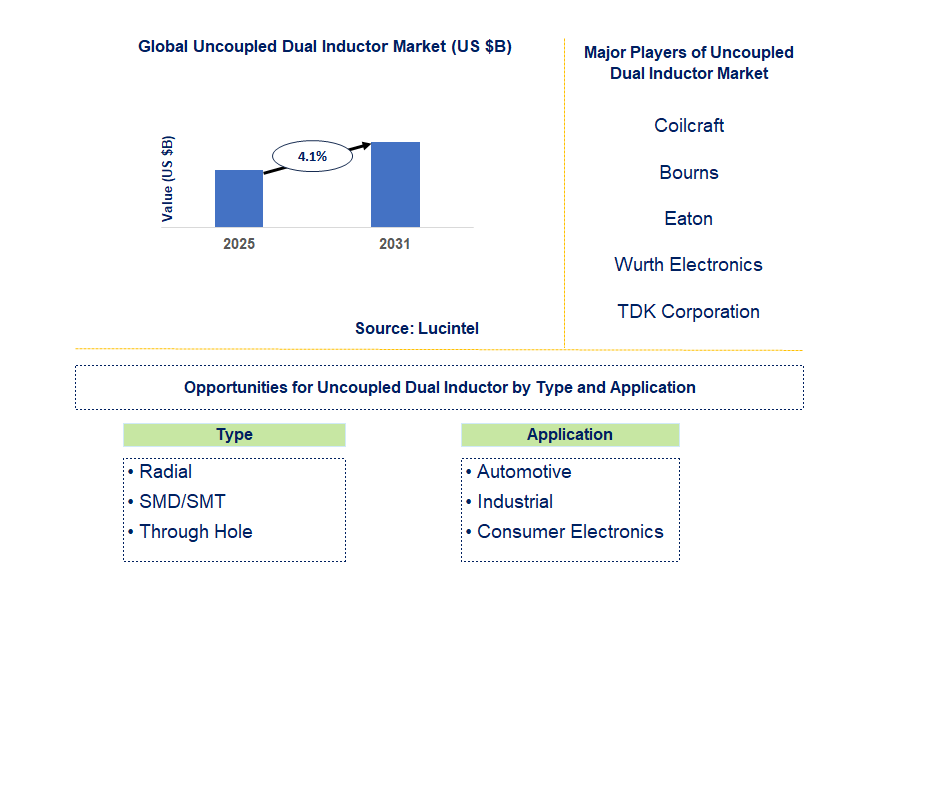
Key data points: The growth forecast = 4.1% annually for the next 7 years. Scroll below to get more insights. This market report covers Trends, opportunities and forecasts in uncoupled dual inductor market to 2031 by type (radial, smd/smt, and through hole), application (automotive, industrial, and consumer electronics), and region (North America, Europe, Asia Pacific, and the Rest of the World)
We'll send your sample report shortly.
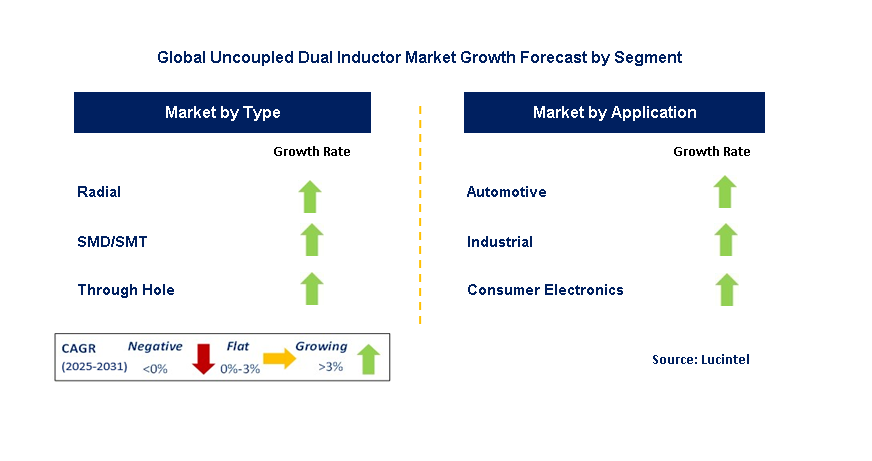
• Lucintel forecasts that, within the type category, smd/smt is expected to witness the highest growth over the forecast period due to it supports the miniaturization of electronic devices.
• Within the application category, consumer electronics is expected to witness higher growth due to which have high production volumes and frequent product turnover.
• In terms of region, APAC is expected to witness the highest growth over the forecast period due to its strong electronics manufacturing base.
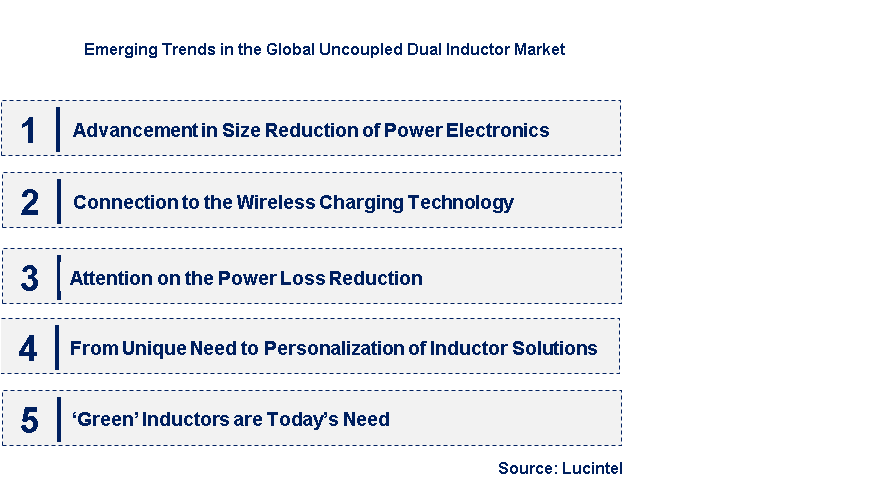
• Advancement in Size Reduction of Power Electronics: There is an increasing demand for small and lightweight electronic devices, which propels the need for high-efficiency compact inductors. This shift is encouraging innovation within the uncoupled dual inductor sector as manufacturers attempt to design smaller, highly efficient, and power dense components
• Connection to the Wireless Charging Technology: The constant growth of wireless charging used in mobile devices and electric vehicles has created a need for modernized inductors that manage high-frequency signals. On the other hand, dual inductors are increasingly being immersed on wireless charging platforms, where power transfer in consumer gadgets, especially for smartphones and EVs, becomes crucial.
• Attention on the Power Loss Reduction: The effective and energy-efficient power conversion design has become a fundamental goal for the electronics industry. The wireless standard in automotive, telecommunications and industrial application raise the bar for new inductors, which should enhance the overall energy efficiency within systems. Improvements on uncoupled dual inductors have led to lower energy losses and increased thermal performance.
• From Unique Need to Personalization of Inductor Solutions: Today's technologies, especially in the automotive and industrial sectors, are increasingly complex. This has had a positive impact on the demand for customizable inductor solutions. Different manufacturers are now providing tailored solutions for different industries so that performance can be improved while still maintaining the high-quality standards required for critical applications.
• ‘Green’ Inductors are Today’s Need: In light of the latest advancements, a global trend shows that sustainable energy can be harnessed more efficiently, and as such, the need for ‘green’ inductors is steadily increasing. The uncoupled dual inductor market is witnessing innovations that attempt to use green materials to power efficiency while reducing e-waste. With these developments, modernization of the market for uncoupled dual inductors is becoming a necessity. These shifts require new technology and innovations, greater product effectiveness, and new levels of use. To capture the market, industries will have to take a greater emphasis on miniaturization and sustainability, which leads to an expectation of a steady increase in the performance inductor market in the next few years.
• Miniaturization of Inductors: Many developments in the miniaturization of inductors have taken place over the past few years. Given the current trend of smaller electronic devices, the miniaturization of uncoupled dual inductors has reached new heights. Rather than sacrificing performance, developers are now using advanced materials such as ferrites and employing high contains winding techniques which allow for greater reduction in the size of inductors. Those benefits are crucial in powering EVs, wearables, and smartphones which have high efficiency requirements in limited spaces.
• Shift Towards Wireless Charging System Integration: The two-part inductors are being incorporated into wireless charging systems. They are being constructed for use in smartphones, wearables, and electric vehicles that do not use cords for power because the units are using high frequency for power effective power transfer. Manufactures are trying to design systems which will be economical and wireless charging system which will be economically feasible.
• Development of Sustainable Technology: There is a significant effort towards improving the performance uncoupled dual inductors as renewable and more energy responsive technologies are required. The decrease in energy efficiency is due to the large core losses and eddy current performs caused by employing core materials with low thermal conductivity and increased their overall efficiency during the energy wasted.
• Customization for Automotive and Industrial Applications: The automotive and industrial sectors are increasingly in need of customized unductor solutions that serve very specific performance requirements. It is now common practice for manufacturers to provide industry specific inductors such as high-temperature, high-current, and high-reliability indutors. The demand for custom inductor solutions continues to grow with the promise of offering enhanced performance.
• Focus on Cost Reduction: Any new technology in the market presents an opportunity for competition and the emerging markets for uncoupled dual inductors are no exception. For dual inductors, there is a real effort toward cost cutting in manufacturing while ensuring that the quality remains intact. Increasingly, these industries are turning to innovation in materials, production processes, and even automation to expand the range of industries that these inductors are available to. The uncoupled dual inductor market has witnessed significant advancements driven by technological innovation and the growing demand for energy-efficient components. From miniaturization to enhanced energy efficiency and customization for specific industries like automotive and consumer electronics, these developments are reshaping the market. The rise of wireless charging, the continued growth of electric vehicles, and the increasing need for power management solutions in industrial automation all represent key factors driving demand. However, challenges such as high production costs and supply chain disruptions remain. Overall, these developments signal a promising future for the uncoupled dual inductor market as it continues to evolve to meet the needs of diverse industries.
• Electric Vehicles (EVs): The surge in electric vehicles market brings forth fresh opportunities on the global uncoupled dual inductor market. Inductors are vital components in the power management systems and electric vehicle charging stations. As the worldwide adoption of electric vehicles increases, so does the need for high-efficiency inductors that are capable of managing higher currents and providing effective power conversion.
• Wireless Charging for Consumer Electronics: The main growth sector is in the implementing of wireless charging technology for smartphones, wearables and other electronics. Uncoupled dual inductors are central to improving the power transfer efficiency of wireless charging systems. Along with the rise of wireless charging, the performance requirements for inductors will grow.
• Renewable Energy Systems: In particular, solar and wind energy, there is a global shift towards using renewables which offers a new market prospect for power conversion systems with dual inductor uncouplers. Inductors can be found in power inverters, energy storage systems, and other components that are critical to renewable energy systems.
• 5G Telecommunications: The deployment of fifth generation telecommunication networks opens up new business opportunities alongside the need for more efficient power systems while boosting the unsatisfied need. Power amplifiers and other 5G components make use of uncoupled dual inductors. The advancement of telecommunications infrastructure translates into a higher unsatisfied need for modern inductors.
• Automated Industires and Manufacturing 4.0: The automation of manufacturing combined with the increasing use of IoT within industries is creating higher demand for uncoupled dual inductors. These inductors are needed for power management in automobiles, robotic systems, and any other forms of technology that fall under 4.0 industry and above. The requirements for energy saving components outline the strategic growth opportunities within the Uncoupled Dual Inductor market and all technological developments in power management systems. The growth of electric vehicles, telecommunications, and renewable energy will continue to drive the need for these high-performance inductors.
• Coilcraft
• Bourns
• Eaton
• Wurth Electronics
• Tdk Corporation
• Erocore
• Coilmaster Electronics
• Radial
• SMD/SMT
• Through Hole
• Automotive
• Industrial
• Consumer Electronics
• North America
• Europe
• Asia Pacific
• The Rest of the World
• Unites States: The United States has always been a cornerstone of technological innovations; demand for electric and wireless powered systems coupled with dual inductors translates to a greater demand for power management systems. US-based manufacturers are increasing the supply of high-performance electric inductors to meet the significant demand in EV and wireless electric vehicle (EV) charging application markets. Research activities and their collaborations with leading tech companies have had drastic improvements in modern designs; with rampant growth in the automotive and green energy industry, the demand surplus is only going to increase.
• China: China’s adaptation of electric vehicles and renewable energy use is greatly driving the growth of the uncoupled dual inductor market. Manufacturers set up cost effective processes to fulfill the local needs for compact, high performance switches for consumer and industrial grade electronics. China’s leadership position in electronics manufacturing enables the efficient in the production of advanced inductors. Adding to these developments is China’s government, which is stimulating energy efficient component construction through initiatives that promote green energy.
• Germany: Germany primary strength in industrial and automotive sectors will continue to drive the growth of uncoupled dual inductor market. Germany’s focus towards electric vehicles and renewable energy has led them to develop more advanced inductor devices for power management systems used within vehicles and industrial machines. Germany’s world-class engineering specialization and emphasis on quality place the country in a leading position to manufacture advanced inductors for high power critical applications.
• India: The demand for uncoupled dual inductors is booming in India owing to the rising consumer electronics, telecommunications, and renewable energy sectors. The demand for compact and high performance inductors is also increasing while India develops its infrastructure to support electric vehicles and power systems. Indian manufacturers are focusing on low-cost high-quality products to satisfy domestic and international market demands. Earlier government policies regarding clean energy and the construction of smart cities are also pushing the adoption of these advanced components in India.
• Japan: Japan, with its advanced technologies in power management systems and high precision manufacturing, remains one of the few countries that develop uncoupled dual inductors. In addition, Japan’s heavy focus on the automotive industry, especially electric vehicles, propelled the need for improved inductor solutions. As a result of Japan’s lax domestic policies regarding the industry, Japanese companies are devoting large investments in research and development to improve energy efficiency, miniaturization, and reliable design. Japan established its lead in the industry and continues to build on it due to having a strong domestic market and dependable manufacturing infrastructure.


• Coilcraft
• Bourns
• Eaton
• Wurth Electronics
• Tdk Corporation
• Erocore
• Coilmaster Electronics Q5. Which uncoupled dual inductor market segment will be the largest in future? Answer: Lucintel forecasts that, within the type category, smd/smt is expected to witness the highest growth over the forecast period due to it supports the miniaturization of electronic devices. Q6. In uncoupled dual inductor market, which region is expected to be the largest in next 5 years? Answer: In terms of region, APAC is expected to witness the highest growth over the forecast period due to its strong electronics manufacturing base. Q7. Do we receive customization in this report? Answer: Yes, Lucintel provides 10% customization without any additional cost.


Choose a license that fits your team. Instant PDF delivery.
Prices exclude taxes. Instant delivery. Custom licensing available on request.
Market Report · July 16, 2026
Market Report · May 18, 2026
Market Report · May 18, 2026
Trusted partner for strategic intelligence and business growth


Receive a complimentary market analysis tailored to your industry. Our analysts will identify key growth opportunities and competitive dynamics specific to your business.

Market size, growth rate, and key trend analysis for your specific sector.

Top competitor positioning and market share analysis.

Strategic recommendations backed by data-driven insights.
Get curated market intelligence and competitive moves straight to your inbox.
By subscribing, you agree to receive our monthly insights. Unsubscribe anytime.
Receive a complimentary market analysis tailored to your industry. Our analysts will identify key growth opportunities and competitive dynamics specific to your business.
Market size, growth rate, and key trend analysis for your specific sector.
Top competitor positioning and market share analysis.
Strategic recommendations backed by data-driven insights.
Get curated market intelligence, emerging trends, and competitive moves straight to your inbox each month.
By subscribing, you agree to receive our monthly insights. Unsubscribe anytime.
We'll send your sample report shortly.