
Market Report · July 15, 2026

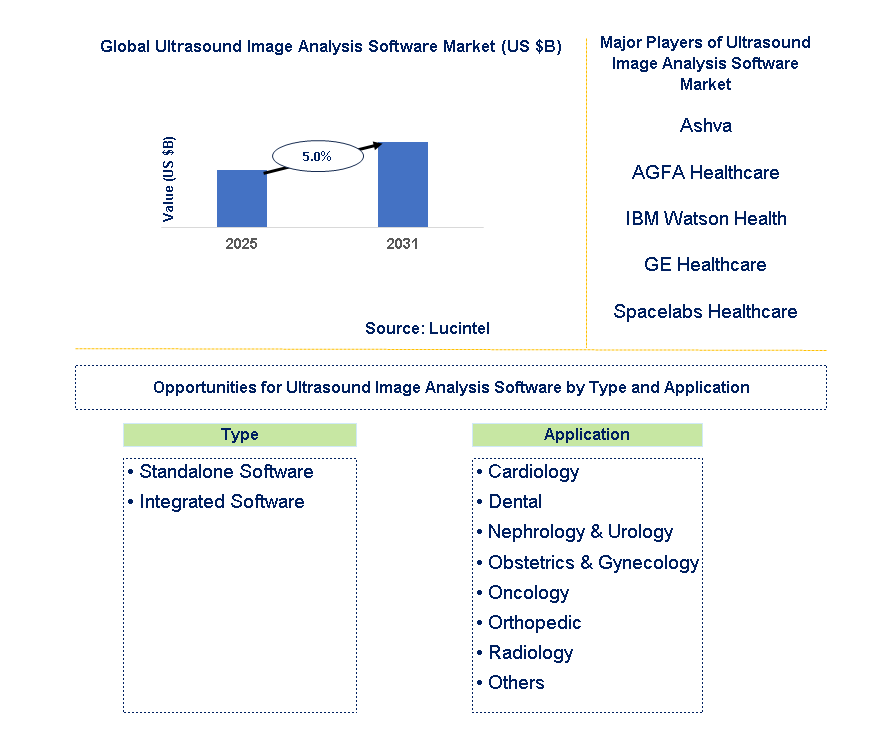
Key data points: The growth forecast = 5% annually for the next 7 years. Scroll below to get more insights. This market report covers trends, opportunities and forecasts in ultrasound image analysis software market to 2031 by type (standalone software and integrated software), application (cardiology, dental, nephrology & urology, obstetrics & gynecology, oncology, orthopedic, radiology, and others), and region (North America, Europe, Asia Pacific, and the Rest of the World)
We'll send your sample report shortly.
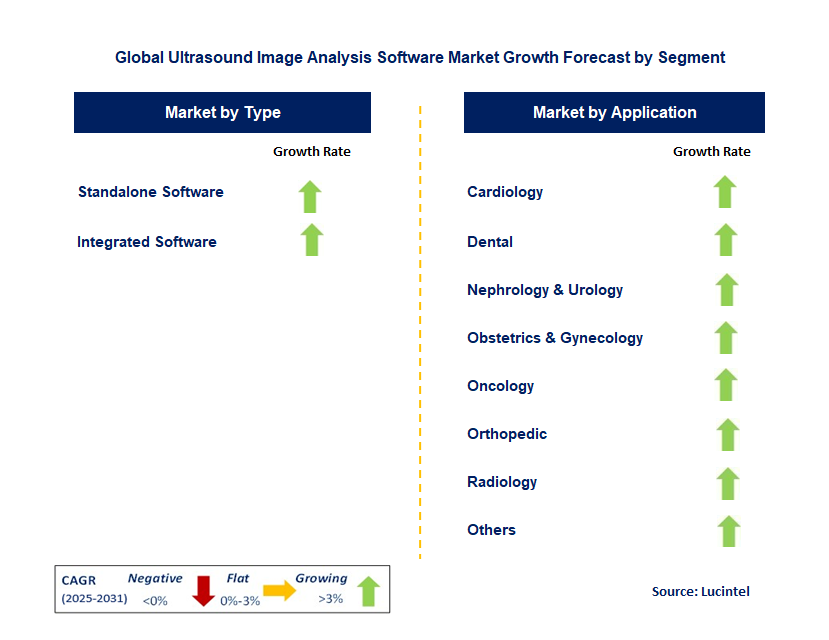
• Lucintel forecasts that, within the type category, standalone software is expected to witness higher growth over the forecast period.
• Within the application category, cardiology is expected to witness the highest growth.
• In terms of region, APAC is expected to witness the highest growth over the forecast period. Gain valuable insights for your business decisions with our comprehensive 150+ page report. Sample figures with some insights are shown below.
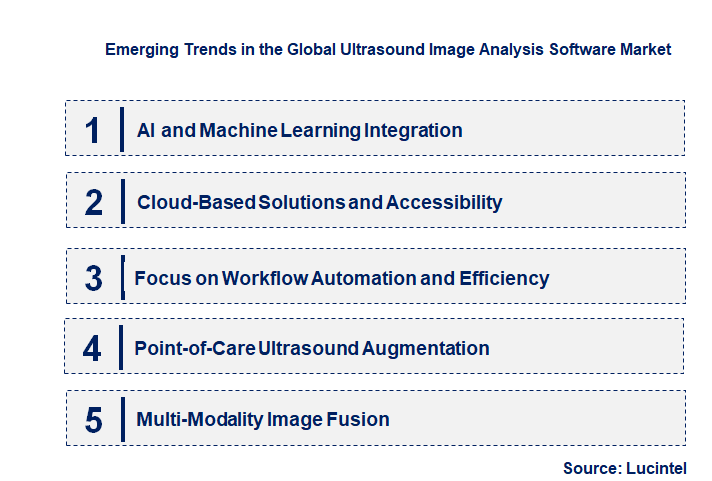
• AI and Machine Learning Integration: The most impactful trend is the deep integration of AI and machine learning algorithms. These technologies enable automated image segmentation, quantification of anatomical structures, anomaly detection, and even predictive analytics, significantly reducing inter-operator variability and enhancing diagnostic accuracy across various applications.
• Cloud-Based Solutions and Accessibility: There’s a strong shift towards cloud-based ultrasound image analysis software. This trend offers enhanced data accessibility, real-time collaboration among clinicians from different locations, reduced upfront hardware investments for healthcare providers, and scalable computing power for complex analyses, improving flexibility and reach.
• Focus on Workflow Automation and Efficiency: Software developers are increasingly focusing on automating repetitive tasks within the ultrasound workflow, such as automated measurements, report generation, and image optimization. This automation aims to reduce sonographer workload, improve throughput in diagnostic centers, and ensure more consistent and efficient clinical operations.
• Point-of-Care Ultrasound Augmentation: The rise of PoCUS, especially with handheld devices, is creating a demand for integrated, intuitive image analysis software that can be used by non-specialists at the patient’s bedside. AI-powered guidance and automated interpretation tools are critical for enhancing diagnostic confidence and expanding PoCUS capabilities.
• Multi-Modality Image Fusion: Emerging trends involve the fusion of ultrasound images with data from other imaging modalities (e.g., CT, MRI) within the analysis software. This integration provides a more comprehensive view of patient anatomy and pathology, aiding in complex diagnoses and treatment planning, fostering a holistic approach to medical imaging. These emerging trends are significantly reshaping the ultrasound image analysis software market by driving innovation towards intelligent, accessible, and efficient solutions. They are empowering healthcare providers with advanced diagnostic capabilities, improving workflow productivity, and ultimately leading to better patient outcomes.
• AI-powered real-time diagnostic assistance: A significant development is the advancement of AI algorithms that provide real-time diagnostic assistance during ultrasound scans. These tools can automatically detect and highlight abnormalities, perform measurements, and even offer preliminary interpretations, significantly reducing operator dependence and improving diagnostic speed and accuracy.
• Enhanced 3D and 4D imaging capabilities: Recent software developments have greatly improved the processing and analysis of 3D and 4D ultrasound data. This includes better visualization, automated volume measurements, and advanced rendering techniques, enabling more detailed anatomical assessments, particularly in obstetrics, cardiology, and oncology.
• Integration with Electronic Health Records and PACS: Seamless integration of ultrasound image analysis software with EHR and Picture Archiving and Communication Systems (PACS) is a key recent development. This interoperability ensures that diagnostic reports and images are readily accessible across healthcare systems, streamlining workflows and enhancing collaborative patient management.
• Specialized software for disease-specific analysis: There’s a growing trend in developing highly specialized ultrasound image analysis software tailored for specific diseases or anatomical regions (e.g., advanced cardiac function analysis, automated thyroid nodule classification). These niche solutions offer deeper insights and more precise diagnostics for complex conditions.
• Development of intuitive user interfaces and workflows: Manufacturers are investing in designing more intuitive and user-friendly interfaces, simplifying complex analysis tasks for clinicians. This focus on user experience aims to reduce the learning curve, increase adoption rates, and enable more healthcare professionals to effectively utilize advanced image analysis capabilities. These recent developments are significantly impacting the ultrasound image analysis software market by fostering greater diagnostic precision, improving clinical workflow efficiency, enhancing data integration across healthcare systems, and expanding the accessibility of advanced imaging analysis to a broader range of medical professionals.
• Cardiology: The cardiology segment presents substantial growth opportunities due to the rising prevalence of cardiovascular diseases and the need for non-invasive cardiac assessment. Software that offers advanced quantitative analysis of heart function (e.g., strain imaging, ejection fraction) and automated chamber segmentation is in high demand, improving diagnostic accuracy and treatment planning.
• Obstetrics and Gynecology: This segment offers significant growth potential, driven by the increasing use of ultrasound for prenatal diagnosis, fetal anomaly detection, and gynecological assessments. Software providing automated fetal biometry, 3D/4D volume analysis, and specialized tools for early detection of complications enhances prenatal care and reproductive health.
• Oncology: In oncology, ultrasound image analysis software is gaining traction for tumor detection, characterization, and treatment monitoring. Opportunities exist in developing software that can accurately quantify tumor size, assess vascularity (using Doppler), and provide real-time guidance for biopsies, supporting personalized cancer treatment strategies.
• Point-of-Care Ultrasound: The burgeoning adoption of PoCUS in emergency medicine, critical care, and primary care settings creates immense opportunities. Software tailored for PoCUS that offers automated image optimization, real-time guidance for less experienced users, and simplified analysis tools can significantly expand diagnostic capabilities beyond traditional radiology departments.
• Musculoskeletal Imaging: The increasing use of ultrasound for diagnosing musculoskeletal conditions (e.g., tendon tears, arthritis) offers a promising growth area. Software providing advanced quantification of soft tissue damage, automated measurements of joint effusion, and dynamic analysis of muscle function supports more accurate diagnosis and rehabilitation planning. These strategic growth opportunities are profoundly impacting the ultrasound image analysis software market by fostering specialized product development, expanding market penetration into diverse clinical areas, and emphasizing the software’s critical role in enhancing diagnostic precision and clinical decision-making across the healthcare spectrum.
• Ashva
• AGFA Healthcare
• IBM Watson Health
• GE Healthcare
• Spacelabs Healthcare
• Xinapse Systems
• Siemens Healthineers
• Esaote
• Standalone Software
• Integrated Software
• Cardiology
• Dental
• Nephrology & Urology
• Obstetrics & Gynecology
• Oncology
• Orthopedic
• Radiology
• Others
• North America
• Europe
• Asia Pacific
• The Rest of the World
• United States: The U.S. market leads in adopting AI-powered ultrasound image analysis solutions, driven by a well-established healthcare infrastructure and high R&D investments. Key advancements focus on integrating these software solutions into existing PACS and EHR systems for seamless workflow and enhanced diagnostic accuracy across various specialties.
• China: China’s ultrasound image analysis software market is experiencing rapid expansion due to massive government investments in healthcare and increasing demand for cost-effective diagnostics. Local companies are actively developing AI algorithms tailored for specific disease detection, particularly in cardiology and oncology, to meet the needs of a large patient population.
• Germany: Germany focuses on high-precision and certified ultrasound image analysis software, with a strong emphasis on data privacy and regulatory compliance (e.g., GDPR). Innovations prioritize robust analytical tools for sophisticated diagnostics in specialized medical fields, ensuring reliability and integration within advanced hospital systems.
• India: India’s market is growing significantly, spurred by a rising burden of chronic diseases and increasing healthcare expenditure. Demand is strong for affordable, user-friendly ultrasound image analysis software, with a focus on improving diagnostic accessibility in both urban and rural settings through cloud-based solutions and portable ultrasound device integration.
• Japan: Japan’s market emphasizes advanced, integrated ultrasound image analysis solutions for its high-tech medical environment. Developments focus on improving diagnostic speed and accuracy for complex cases, with ongoing research into next-generation AI algorithms and seamless integration with other imaging modalities to optimize clinical workflows.


• Ashva
• AGFA Healthcare
• IBM Watson Health
• GE Healthcare
• Spacelabs Healthcare
• Xinapse Systems
• Siemens Healthineers
• Esaote Q5. Which ultrasound image analysis software market segment will be the largest in future? Answer: Lucintel forecasts that, within the type category, standalone software is expected to witness higher growth over the forecast period. Q6. In ultrasound image analysis software market, which region is expected to be the largest in next 5 years? Answer: In terms of region, APAC is expected to witness the highest growth over the forecast period. Q7. Do we receive customization in this report? Answer: Yes, Lucintel provides 10% customization without any additional cost.


Choose a license that fits your team. Instant PDF delivery.
Prices exclude taxes. Instant delivery. Custom licensing available on request.
Market Report · July 15, 2026
Market Report · June 26, 2026
Market Report · June 24, 2026
Trusted partner for strategic intelligence and business growth


Receive a complimentary market analysis tailored to your industry. Our analysts will identify key growth opportunities and competitive dynamics specific to your business.

Market size, growth rate, and key trend analysis for your specific sector.

Top competitor positioning and market share analysis.

Strategic recommendations backed by data-driven insights.
Get curated market intelligence and competitive moves straight to your inbox.
By subscribing, you agree to receive our monthly insights. Unsubscribe anytime.
Receive a complimentary market analysis tailored to your industry. Our analysts will identify key growth opportunities and competitive dynamics specific to your business.
Market size, growth rate, and key trend analysis for your specific sector.
Top competitor positioning and market share analysis.
Strategic recommendations backed by data-driven insights.
Get curated market intelligence, emerging trends, and competitive moves straight to your inbox each month.
By subscribing, you agree to receive our monthly insights. Unsubscribe anytime.
We'll send your sample report shortly.