
Market Report · July 22, 2026

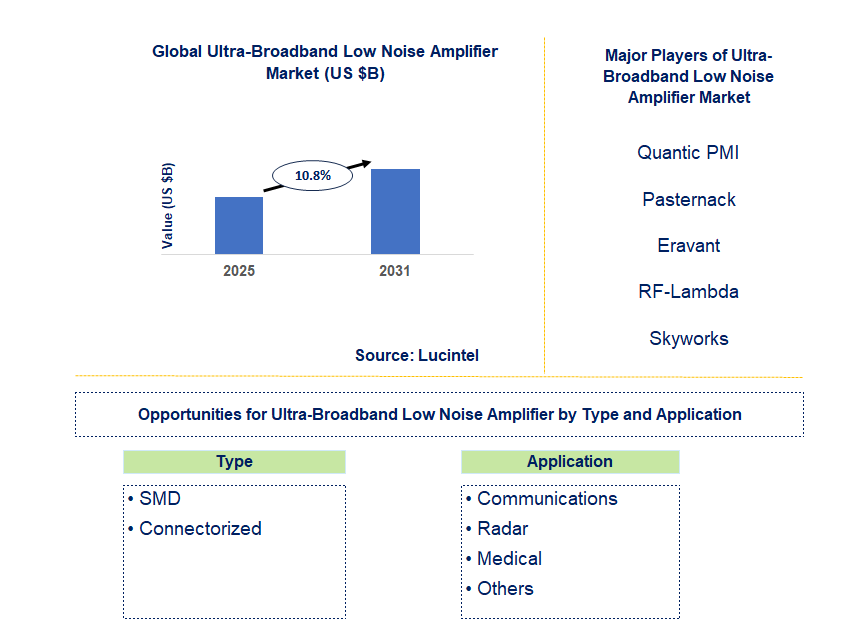
Key data points: The growth forecast = 10.8% annually for the next 7 years. Scroll below to get more insights. This market report covers Trends, opportunity and forecast in ultra-broadband low noise amplifier market to 2031 by type (SMD and connectorized), application (communications, radar, medical, and others), and region (North America, Europe, Asia Pacific, and the Rest of the World)
We'll send your sample report shortly.
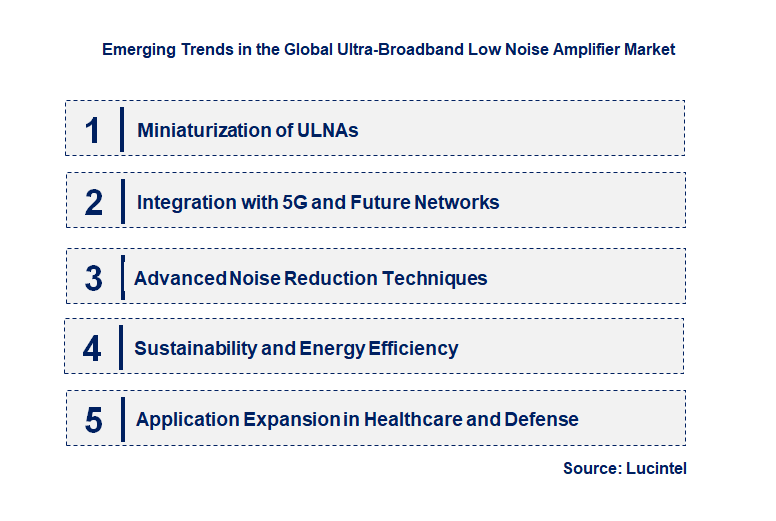
• Miniaturization of ULNA's: There is an increase in demand for portable devices and the requirement to reduce their size, keeping the same performance level, if not increasing it. ULNA manufacturers focus on downsizing them. As technology develops toward wearables, drones, and Internet of Things devices, with reduced spaces requiring efficient amplifiers that take as little space as possible, more compact devices use less energy and thus are required in battery-operated and environmentally friendly devices.
• Integration with 5G and Future Networks: The advent of 5G technology has exponentially increased the demand for ultra-broadband low noise amplifiers. These amplifiers are very crucial in managing higher frequencies and ensuring minimal noise interference, which is critical for the high-speed data transmission that 5G promises. The demand to have ULNA's which can process numerous frequency bands with low noise levels is giving rise to innovations aimed at increasing the bandwidth and performance of amplifiers to ensure that the reliability of 5G networks is not impacted with increasing traffic loads.
• Advanced Noise Reduction Techniques: Noise reduction is the central theme behind the development of ULNA, and the market is seeing improvements in noise-suppressing techniques. New materials, circuit strategies, and feedback mechanisms reduce thermal noise and other forms of distortions. This is of utmost importance in military, space, and telecommunication applications because signal integrity and clarity are always important in these fields. Such capabilities allow ULNA's to be used in more sensitive and demanding environments.
• Sustainability and Energy Efficiency: With the increase in environmental consciousness, there is a growing focus on developing energy-efficient ULNA's. This trend is well in line with the global move to reduce the power consumption in electronics. Being an integral part of many communication systems, ULNA's not only help save operational costs by being more energy-efficient but also support green technology initiatives in areas such as space exploration and telecommunication. Manufacturers are exploring materials and designs that minimize power consumption while maintaining high performance.
• Application Expansion in Healthcare and Defense: The expansion of ULNA applications beyond telecommunications is accelerating. In healthcare, ULNA's are used in medical devices that require high-frequency communication with minimal interference, such as in advanced imaging or diagnostic tools. In defense, there is increasing demand for ULNA's in radar, surveillance, and communication systems. Both sectors are pushing the envelope for ULNA performance, creating an opportunity for further innovations that meet the stringent requirements of these industries. These emerging trends reflect the growing importance of ultra-broadband low noise amplifiers in modern technology. As communication speeds, miniaturization, and energy efficiency continue to be priorities, ULNA technology will evolve to meet the diverse needs of sectors ranging from telecommunications to healthcare and defense.
• 5G Integration and High-Frequency ULNA's: One of the most important developments in the ULNA market is the integration of amplifiers that can support the high frequency requirements of 5G. With the emergence of new frequency bands, the amplifier needs to be more flexible and operate on a wider range of frequencies without compromising performance. Innovations in ULNA design, such as new semiconductor materials and hybrid architectures, enable these devices to meet the stringent demands of 5G infrastructure, with higher data rates and connectivity.
• Miniaturization and Portability: The other major development is the miniaturization of ULNA's for portable applications. With the increasing adoption of IoT devices, drones, and wearable technology, the need for compact amplifiers without sacrificing performance has become increasingly important. Manufacturers are now developing smaller and more efficient ULNA's that can be integrated seamlessly into small form factors. This is important because the markets involved in consumer electronics and automotive applications have space-saving and portability as critical aspects.
• Improvements in the Performance of Noise: There is continuous improvement in noise cancellation technologies. Novel approaches in terms of new designs, advanced signal processing techniques, and innovation in feedback systems have been realized with a decrease in noise. This has, in turn, reduced noise performance and significantly improved ULNA performance. Such improvements in noise performance are essential in space communications industries, where data fidelity is absolute. The same improvements are also realized in the application of ULNA's in radar and military defense systems, where precision and accuracy are crucial.
• Energy Efficient ULNA's: Another developing area is the energy efficiency of amplifiers. Markets are being propelled to amplify components that consume much less power; this is extremely crucial in a battery-powered application and mobile systems. Manufacturers focus on reducing their power consumption levels without sacrificing their performance. Manufacturers reduce operational cost and extend devices' lifetime; thus, they become relevant mainly in remote sensing, telecommunications, and mobile networks for sustainability.
• New Industries: Apart from telecommunications, ULNA's are being introduced into new industries such as healthcare and defense. In medical devices, for instance, ULNA's are used in advanced imaging techniques that require precision amplification of broadband signals. In defense, ULNA's are used in radar and surveillance systems, enhancing their ability to detect signals at long ranges while maintaining minimal noise. New applications open up significant market opportunities for manufacturers and fuel further innovation. These developments are fundamentally reshaping the ultra-broadband low noise amplifier market, driving technological advancements, creating new applications, and pushing the boundaries of performance in various industries. As the market continues to evolve, ULNA technology will remain a cornerstone in improving signal quality across diverse sectors.
• 5G Telecommunications: The 5G rollout is an enormous potential growth opportunity for ULNA technology. With 5G requiring higher-frequency bands and faster data transmission, ULNA's are crucial for maintaining signal quality and reducing interference. As countries invest heavily in 5G infrastructure, the demand for ULNA's to support base stations, antennas, and mobile devices is set to increase. Manufacturers can capture market share by focusing on developing high-performance, cost-effective ULNA's that meet the stringent requirements of 5G networks.
• Satellite Communications: With the prospects of increased constellations for satellites and thus, the demands on data transfers growing high, there lies a very potential growth aspect of ULNA's in satellite communication. With respect to the preservation of signal qualities coming from the satellite and traveling towards it, it is essentially indispensable for receiving crystal-clear messages irrespective of difficult transmission environments. For such applications both commercial and military satellites, will keep on seeing growing demands from organizations and governmental authorities.
• Aerospace and Defense: ULNA's play a prominent role in all applications of the aerospace and defense sector, mainly in radar, satellite communication, and secure networks for military application. The advancing defense technologies on drones, autonomous systems, radar detection, among others, increases the demand to achieve higher sensitivities and significantly lower noise values in ULNA designs. The manufacturers possess an excellent business opportunity to introduce special ULNA designs specifically in response to sectoral requirements; that is ruggedness, reliability, and stealthies.
• Medical Devices: Healthcare is an emerging growth sector for ULNA technology, especially in advanced medical imaging, diagnostic tools, and wireless health monitoring devices. ULNA's are used to amplify signals in these systems, ensuring accurate readings and minimal noise interference. With the increasing use of telemedicine and wearable health technology, ULNA's will be part of new medical applications, and companies will be able to expand their product offerings in the healthcare industry.
• Internet of Things (IoT) and Consumer Electronics: The proliferation of IoT devices and consumer electronics provides another growth opportunity for ULNA's. With these devices needing compact, low-power, and high-performance amplifiers to help them communicate through different platforms, from smart home devices to wearable gadgets, maintaining efficient data transmission requires ULNA's. Manufacturers can thus capitalize on this emerging market by developing smaller energy-efficient ULNA's that could be seamlessly integrated into a variety of consumer electronics. There is tremendous growth potential in ULNA market across key applications, driven by 5G telecommunication, satellite communication, aerospace and defense, healthcare, and consumer electronics. This can be capitalized on with specific offerings around applications; as companies are working toward filling the gap for developing opportunities in ULNA technology.
• Quantic PMI
• Pasternack
• Eravant
• RF-Lambda
• Skyworks
• Qorvo
• Elecsoft Solution
• Macom
• Lucix
• C&T RF Antennas
• SMD
• Connectorized
• Communications
• Radar
• Medical
• Others
• North America
• Europe
• Asia Pacific
• The Rest of the World
• United States: The US is the leader in ultra-broadband low noise amplifier development, with significant investments in military, aerospace, and telecommunications applications. Recent developments are focused on amplifiers that can handle higher frequencies, which are important for 5G networks and satellite communications. Furthermore, the country is promoting smaller, more energy-efficient devices to serve both defense and commercial markets. U.S. manufacturers are also innovating in noise reduction technologies with the aim of systems that will maintain performance under varying environmental conditions.
• China: The ULNA market in China is rapidly growing due to the country's push for technological self-sufficiency and strong demand for communication infrastructure. China government's investment into 5G deployments and satellite networks has created incentives to develop the amplification technology of broadband. In making these cost-effective solutions, a balance has been made to include performance within cost effectiveness. In other areas, there is development and focus in creating ultra-broadband amplifiers for the armed forces, such as its application in making better communication network that can survive very challenging conditions.
• Germany: Germany’s strong industrial and engineering sectors are advancing the ULNA market, with a particular focus on precision and high-performance amplifiers for automotive, aerospace, and telecommunications. German firms are working on enhancing the integration of ULNA's into new technologies like autonomous vehicles, where high-frequency data transmission is essential. Another key area is the development of high-efficiency ULNA's that can withstand extreme temperatures or high-pressure environments. Germany's drive for environmental sustainability is pushing forward innovation in energy-efficient ULNA's.
• India: The ULNA market in India is expanding, and this is mostly driven by the growth in telecommunication and space exploration. Space, ISRO-related, and some important telecom operators provide the major trigger for ULNA demand in sat com and 5G deployment activities. The native innovation is developing in India to increase the participation of local manufacturer in low-price yet high-quality ULNA's. The present defense sector, too, invested in ULNA technology for enhancing radar and surveillance systems, focusing on the emerging modernization activity of the respective country's arm.
• Japan: Japan holds leading positions in electronics and telecommunications innovations; therefore, the low noise amplifier market for ultra-broadband has a significant focus. Companies in Japan lead the development of amplifiers in 5G networks, satellite communications, and radar systems. Low-noise ULNA's are in a quest to miniaturize to various portable and wearable applications without impairing performance. Furthermore, Japan has a high proportion of aging people, and their commitment to health care technology makes ULNA's to be produced in medical equipment where high frequency communications and very less noise interferences are present.


• Quantic PMI
• Pasternack
• Eravant
• RF-Lambda
• Skyworks
• Qorvo
• Elecsoft Solution
• Macom
• Lucix
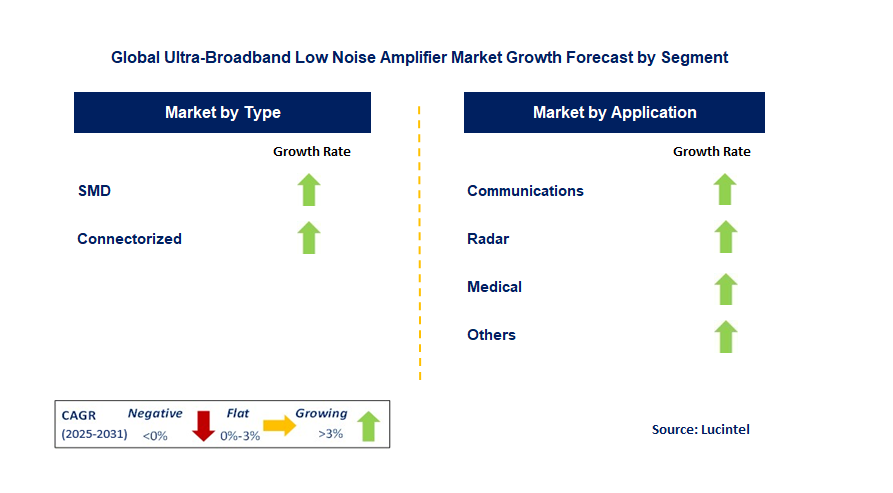
• C&T RF Antennas Q5. Which ultra-broadband low noise amplifier market segment will be the largest in future? Answer: Lucintel forecasts that, within the type category, SMD is expected to witness higher growth over the forecast period due to its compact size, ease of integration, and suitability for high-density applications. Q6. In ultra-broadband low noise amplifier market, which region is expected to be the largest in next 5 years? Answer: In terms of region, North America is expected to witness the highest growth over the forecast period. Q7. Do we receive customization in this report? Answer: Yes, Lucintel provides 10% customization without any additional cost.


Choose a license that fits your team. Instant PDF delivery.
Prices exclude taxes. Instant delivery. Custom licensing available on request.
Market Report · July 22, 2026
Market Report · July 17, 2026
Market Report · July 17, 2026
Trusted partner for strategic intelligence and business growth


Receive a complimentary market analysis tailored to your industry. Our analysts will identify key growth opportunities and competitive dynamics specific to your business.

Market size, growth rate, and key trend analysis for your specific sector.

Top competitor positioning and market share analysis.

Strategic recommendations backed by data-driven insights.
Get curated market intelligence and competitive moves straight to your inbox.
By subscribing, you agree to receive our monthly insights. Unsubscribe anytime.
Receive a complimentary market analysis tailored to your industry. Our analysts will identify key growth opportunities and competitive dynamics specific to your business.
Market size, growth rate, and key trend analysis for your specific sector.
Top competitor positioning and market share analysis.
Strategic recommendations backed by data-driven insights.
Get curated market intelligence, emerging trends, and competitive moves straight to your inbox each month.
By subscribing, you agree to receive our monthly insights. Unsubscribe anytime.
We'll send your sample report shortly.