
Market Report · July 15, 2026

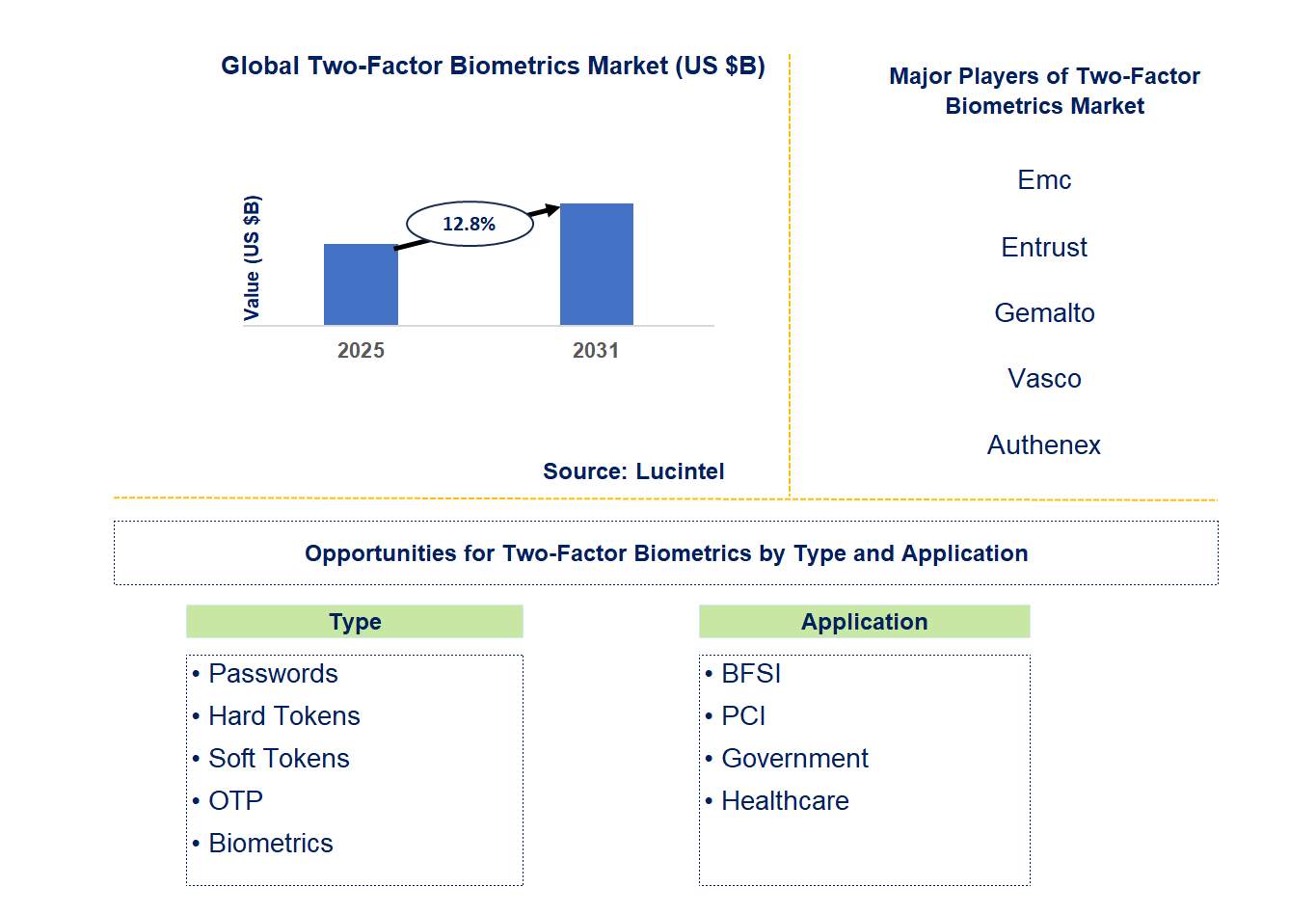
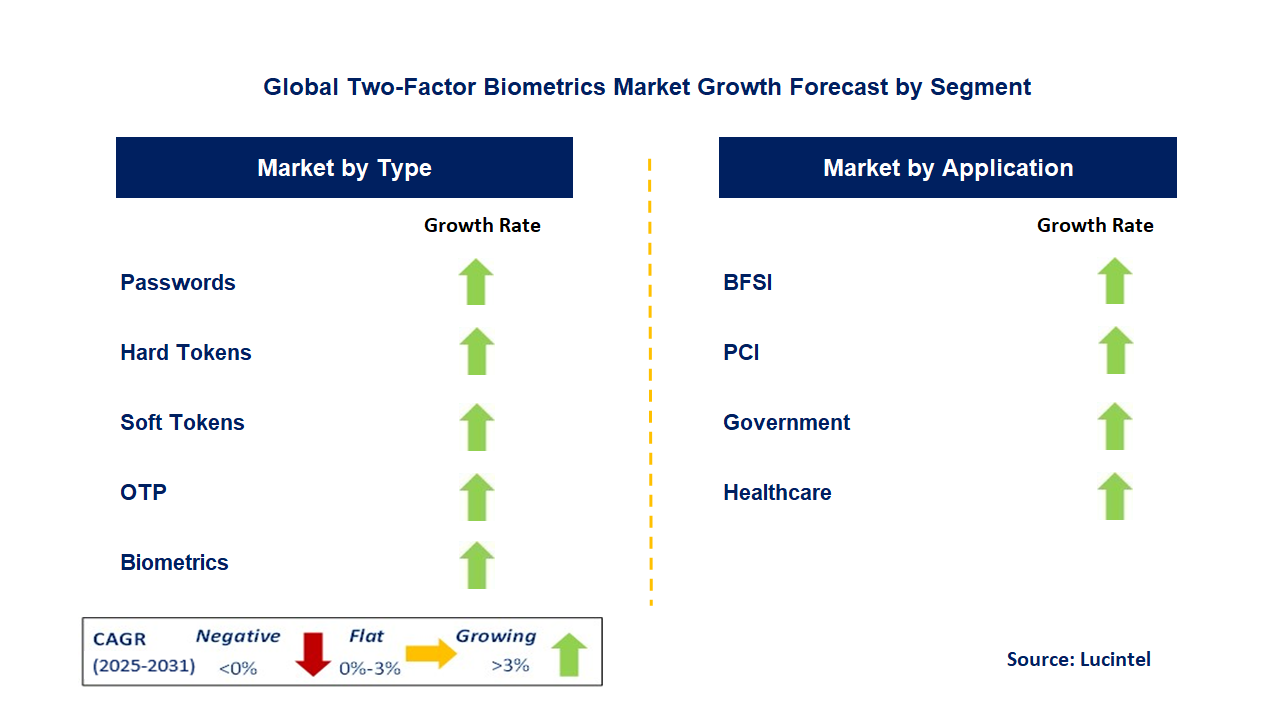
Key data points: The growth forecast = 12.8% annually for the next 7 years. Scroll below to get more insights. This market report covers Trends, opportunity and forecast in two-factor biometrics market to 2031 by type (passwords, hard tokens, soft tokens, otp, and biometrics), application (bfsi, pci, government, and healthcare), and region (North America, Europe, Asia Pacific, and the Rest of the World)
We'll send your sample report shortly.
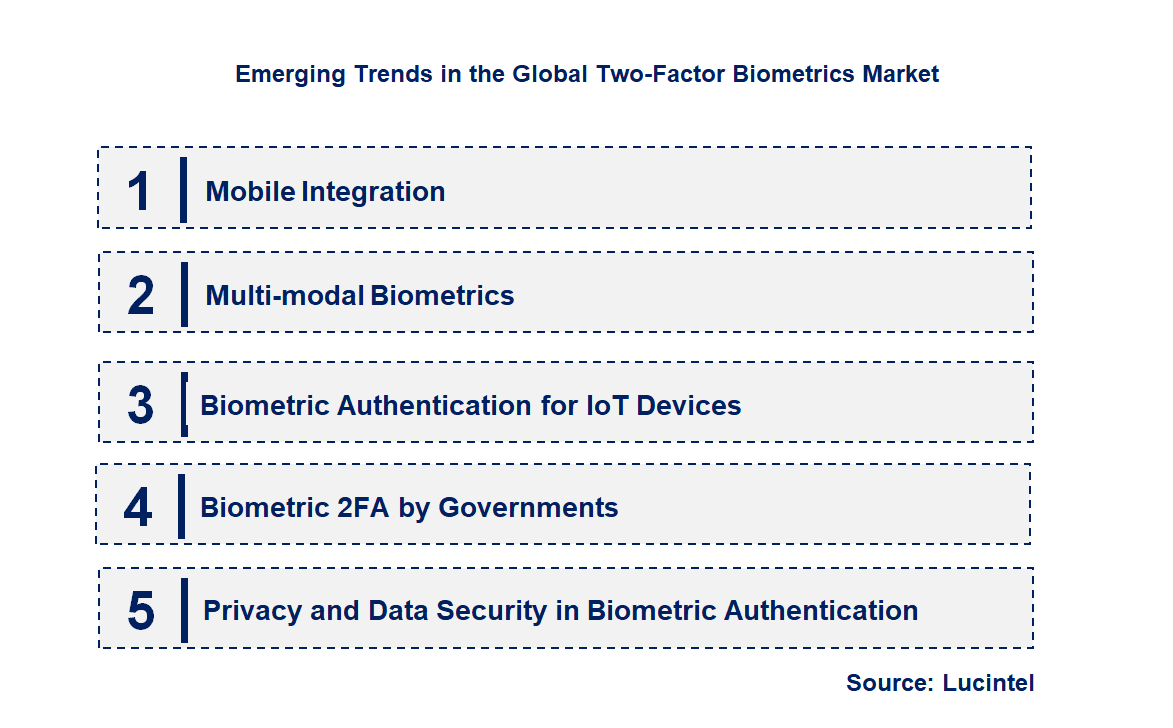
• Mobile Integration: With the growing demand for mobile-based financial transactions and online services, biometric 2FA solutions from mobile device manufacturers are increasingly integrated with fingerprint scanning and facial recognition. This trend has led to more secure mobile payment systems, making it easier for consumers to access their accounts and complete transactions securely. Mobile devices are becoming the central point of biometric authentication, improving convenience and reducing the risk of cybercrime.
• Multi-modal Biometrics: Two-factor authentication systems increasingly employ multi-modal biometrics that combine different methods of biometrics, such as fingerprint recognition, facial recognition, and voice authentication. This trend tends to increase the accuracy and reliability of biometric authentication by cross-checking different identifiers. Therefore, as fraud detection technologies improve, multi-modal systems are expected to play a significant role in security enhancement in sectors like finance, healthcare, and government.
• Biometric Authentication for IoT Devices: With the rapidly increasing adoption of IoT devices, two-factor biometric authentication systems are also increasingly being added to IoT devices in order to authenticate user and system interactions. Smart homes, wearable devices, and healthcare are application areas that heavily require the assurance of secure interactions between a user and connected systems. It's a convenient as well as safe way for preventing unauthorized people from accessing or controlling the IoT device by using a non-invasive yet reliable way.
• Biometric 2FA by Governments: The approach to national identification systems, e-government services, border security, and so forth, is widely being adopted by governments around the world through biometric two-factor authentication. This is mainly because public sector services need to be far more secure and free from identity frauds. Through biometric 2FA, it is possible to ensure that access to government service delivery, voting, and identification verification is highly secured. As digital government services expand globally, biometric 2FA will play a key role in facilitating secure access.
• Privacy and Data Security in Biometric Authentication: Privacy concerns and data security issues are driving the development of privacy-preserving biometric 2FA systems. As biometric data is sensitive, ensuring that biometric data is stored securely and managed in compliance with privacy regulations, such as GDPR, is becoming increasingly important. Encryption, decentralized data storage, and anonymous authentication methods are being developed to address privacy concerns. These solutions aim to build trust with consumers while ensuring the security of biometric data. Emerging Trends are influencing the two-factor biometrics market by offering higher security, increased convenience, and easier privacy. The involvement of biometric authentication in mobile devices and IoT devices, as well as increasing applications of multi-modal systems, will make way for two-factor authentication in a widespread manner. With continued emphasis on secure access coupled with increased convenience, the growing importance of biometric 2FA systems may be seen in almost all industries over time.
• Mobile Payment Integration: Two-factor biometric authentication for mobile payments has been the greatest development within recent times. In the biometrics sense, today one finds features of fingerprint scanning and facial recognition commonplace in most mobile banking and payment applications. Mobile payment systems also improve the safety factor where payment by an authenticated person only happens without risking mobile transaction frauds.
• Multi-modal Biometric Authentication Systems: Fingerprint, facial, and voice-based multi-modal authentication systems are on the rise nowadays. They give more accuracy and security since several biometric identifiers are cross-checked to grant or deny access to unauthorized users. This technology is especially relevant for industries like banking, which heavily rely on security.
• Biometric 2FA for Government Services: Governments are increasingly adopting biometric two-factor authentication systems to secure access to e-government services, including tax filings, welfare benefits, and national identification systems. This development ensures that citizens can securely access government services while preventing identity theft and fraud. Governments are also exploring biometric 2FA for border control and immigration security.
• Privacy-enhancing Biometric Technologies: As privacy concerns continue to grow, companies are developing privacy-enhancing technologies for biometric 2FA systems. These technologies include secure data encryption and decentralized data storage solutions that aim to protect biometric data from unauthorized access. Privacy-preserving solutions are becoming more crucial as regulatory requirements for data protection, such as GDPR, tighten.
• Enterprise Access Control: Two-factor biometric authentication is being widely adopted for enterprise access control systems. Companies are integrating biometric systems, including fingerprint and facial recognition, into their internal security protocols to restrict access to sensitive information and systems. This development is particularly important for industries dealing with classified information, intellectual property, and financial data. These trends point out that biometric 2FA has become an important aspect in the security of mobile payments, government services, and enterprise systems. The development of multi-modal systems, privacy-enhancing technologies, and government and enterprise adoption of biometric 2FA will add to a safer digital environment.
• Expansion in Mobile and Digital Payment: Two-factor biometrics is expected to have massive growth opportunities through the mobile payments sector with consumers demanding better security mechanisms that are also convenient. With growth in mobile banking and e-commerce, a burgeoning need for biometric 2FA solution would exist. The offering of fingerprint and facial recognition to be integrated into mobile payment applications holds promise for growth.
• Health Care Applications Adoption: Healthcare is another sector in which two-factor biometrics may play a major role. Biometric 2FA solutions will be used for securing access to EHRs and medical devices, thereby blocking unauthorized access to sensitive patient data. As digitization continues to dominate the healthcare sector, biometric authentication will prove to be important for privacy and security.
• Integration with Enterprise Security Systems: Two-factor biometric systems are being embraced by businesses to prevent sophisticated cyber attacks on internal systems and breach data. Companies would then be able to control access to sensitive information, intellectual property, and confidential data using two-factor biometrics. This would therefore be an opportunity for growth in the enterprise security market.
• Government Adoption of Biometric 2FA for Public Services: Governments are increasingly incorporating biometric 2FA to citizen services for voting, benefits, and accessing public sector benefits. This public sector adoption of biometric authentication is a new growth opportunity with improved security, efficiency, and reduced identity fraud risk in services offered by government.
• Increased Demand for Privacy-preserving Solutions: A growing demand for data privacy motivates the research of privacy-preserving biometric 2FA systems. Both consumers and businesses are becoming increasingly aware of the risks associated with collecting biometric data. Therefore, a demand for encryption, decentralized storage, and other privacy-enhancing solutions is evident. This trend, therefore provides an opportunity that is unique to innovate in the biometric 2FA market. This growth opportunity means that the two-factor biometrics market is spreading into various sectors such as mobile payments, healthcare, enterprise security, and government services. As the need for secure, privacy-conscious authentication systems grows, the two-factor biometric 2FA solution market will continue to expand, offering better security and convenience for users around the world.
• Emc
• Entrust
• Gemalto
• Vasco
• Authenex
• Authentify
• Authy
• Deepnet Security
• Dynapass
• Fortinet
• Passwords
• Hard Tokens
• Soft Tokens
• OTP
• Biometrics
• BFSI
• PCI
• Government
• Healthcare
• North America
• Europe
• Asia Pacific
• The Rest of the World
• United States: The United States, therefore, has experienced the highest growth in its two-factor biometrics. Its financial institutions and government services are key areas responding to these attacks. Tech giants integrate biometrics into their 2FA systems both for consumers and employees through face recognition, fingerprint scanning, and voice recognition as safe verification methods. This adoption is further expanding into mobile applications and digital banking, where consumers can enjoy secure and convenient login methods. However, there are still significant regulatory challenges and privacy concerns related to the collection of biometric data, and federal and state laws are trying to address those issues.
• China: China is moving forward with significant strides in two-factor biometrics, especially in the banking and e-commerce industries, where identity theft and fraud are major issues. Chinese companies and local tech players have started implementing biometrics on 2FA in mobile payment platforms and online services to improve security in digital transactions. Moreover, the Chinese government is researching biometrics in its national identification system, which takes advantage of facial recognition and fingerprint scanning. However, concerns over the mishandling of biometric data, security regarding data breaches, and individual privacy remain as China has strong data regulation policies collected centralistically.
• Germany: Germany focuses on data protection and privacy while adopting two-factor biometrics. The use of 2FA has been significantly impacted by the General Data Protection Regulation (GDPR), which deals with the usage of biometric data in the European Union. Biometrics are increasingly being used by financial institutions and enterprises as part of their secure authentication systems, including face recognition and fingerprint scanning. However, public concern over the handling and storage of biometric data has made it cautious and regulated in terms of integration. German companies are now developing privacy-aware solutions that meet GDPR standards.
• India: The case is different in India, where two-factor biometrics is gaining traction. The uptake is faster with regards to digital banking and e-commerce. With the advent of digital transactions and government initiatives such as the Digital India program, biometric authentication is now considered a feasible solution to counter fraud. Fingerprint scanning and iris recognition are being added to 2FA systems to ensure greater security in mobile payments and online services. Although it is growing, the issues related to data privacy, lack of infrastructure in rural areas, and digital literacy are still obstacles to the wider adoption of two-factor biometrics.
• Japan: Japan is at the forefront of two-factor biometrics in finance, healthcare, and public services. Advanced biometric technologies, such as facial recognition and voice authentication, are being incorporated into the 2FA systems of Japanese companies to enhance security and streamline user experiences. The government is also looking into biometric solutions for national identification and access control systems. However, just like other countries, Japan is concerned about the privacy and safe management of biometric data. As data protection laws become stricter, the two-factor biometrics market in Japan is likely to see a rise in privacy-preserving solutions.


• Emc
• Entrust
• Gemalto
• Vasco
• Authenex
• Authentify
• Authy
• Deepnet Security
• Dynapass
• Fortinet Q5. Which two-factor biometrics market segment will be the largest in future? Answer: Lucintel forecasts that biometrics is expected to witness the highest growth over the forecast period. Q6. In two-factor biometrics market, which region is expected to be the largest in next 5 years? Answer: APAC is expected to witness the highest growth over the forecast period. Q7. Do we receive customization in this report? Answer: Yes, Lucintel provides 10% customization without any additional cost.


Choose a license that fits your team. Instant PDF delivery.
Prices exclude taxes. Instant delivery. Custom licensing available on request.
Market Report · July 15, 2026
Market Report · June 26, 2026
Market Report · June 24, 2026
Trusted partner for strategic intelligence and business growth


Receive a complimentary market analysis tailored to your industry. Our analysts will identify key growth opportunities and competitive dynamics specific to your business.

Market size, growth rate, and key trend analysis for your specific sector.

Top competitor positioning and market share analysis.

Strategic recommendations backed by data-driven insights.
Get curated market intelligence and competitive moves straight to your inbox.
By subscribing, you agree to receive our monthly insights. Unsubscribe anytime.
Receive a complimentary market analysis tailored to your industry. Our analysts will identify key growth opportunities and competitive dynamics specific to your business.
Market size, growth rate, and key trend analysis for your specific sector.
Top competitor positioning and market share analysis.
Strategic recommendations backed by data-driven insights.
Get curated market intelligence, emerging trends, and competitive moves straight to your inbox each month.
By subscribing, you agree to receive our monthly insights. Unsubscribe anytime.
We'll send your sample report shortly.