
Market Report · July 15, 2026

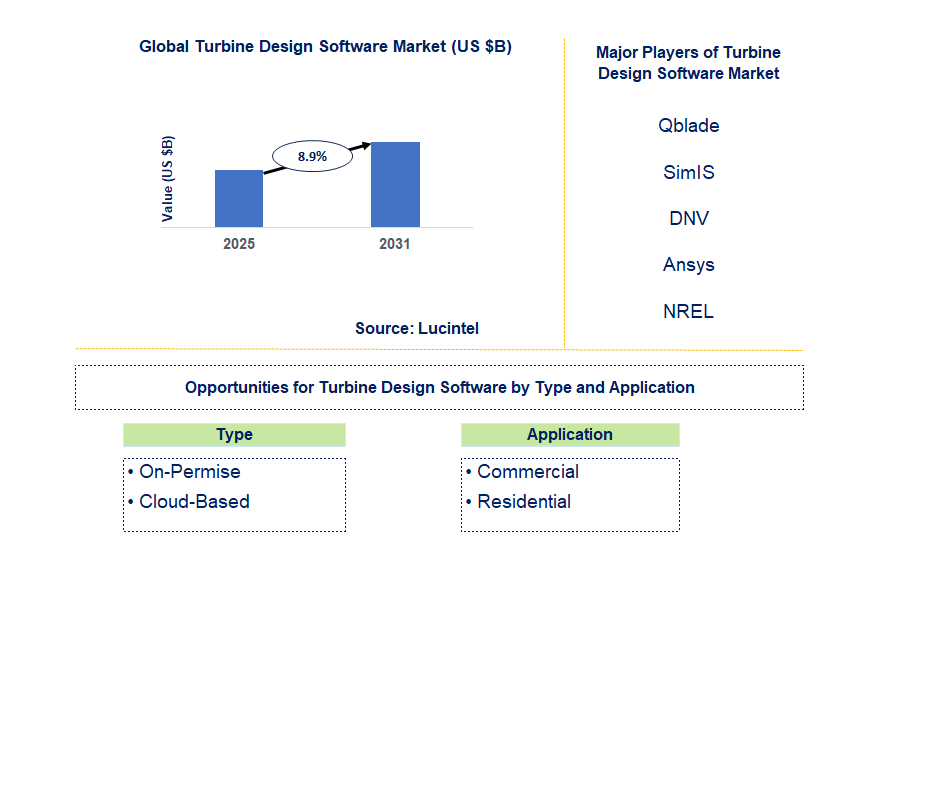
Key data points: The growth forecast = 0.089 annually for the next 7 years. Scroll below to get more insights. This market report covers Trends, opportunities and forecasts in turbine design software market to 2031 by type (on-permise and cloud-based), application (commercial and residential), and region (North America, Europe, Asia Pacific, and the Rest of the World)
We'll send your sample report shortly.
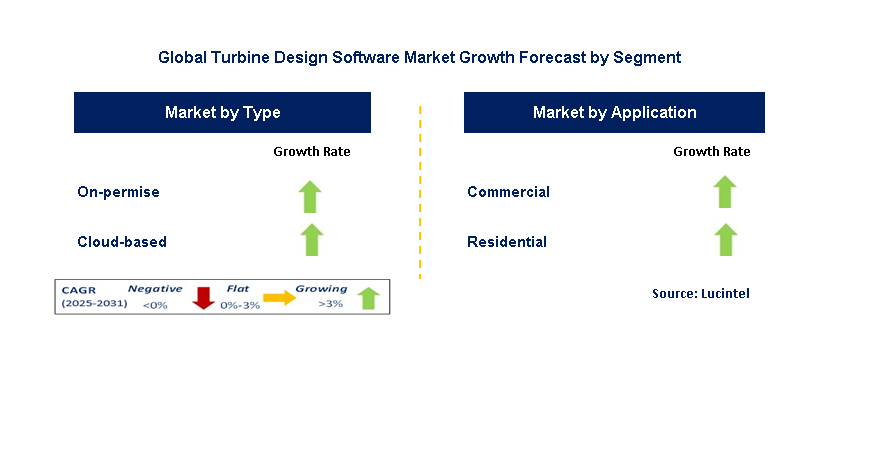
• Lucintel forecasts that, within the type category, cloud-based is expected to witness higher growth over the forecast period due to reduced infrastructure costs.
• Within the application category, commercial is expected to witness higher growth due to requires larger energy consumption for businesses.
• In terms of region, Europe is expected to witness the highest growth over the forecast period due to significant investments in renewable energy.
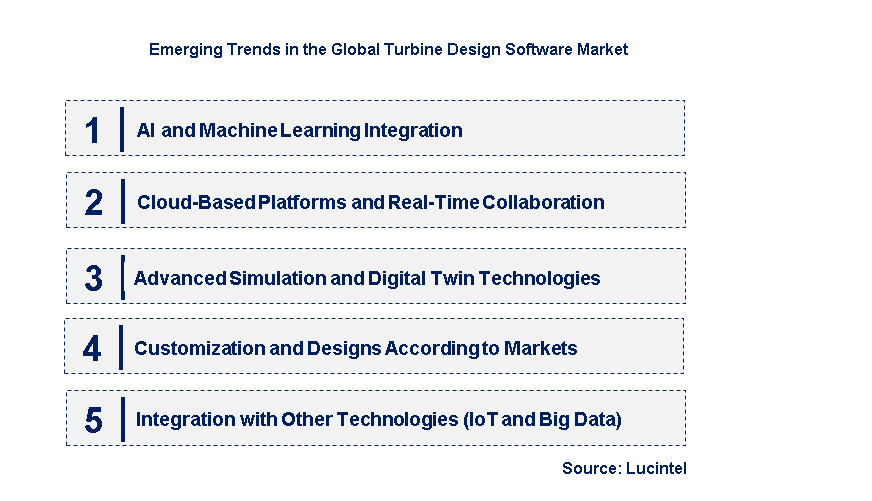
• AI and Machine Learning Integration: AI and machine learning are currently being considered for augmenting turbine design software. For instance, large datasets help analyze these technologies and provide design benefits to improve the performance of the turbine. AI can determine the behavior of a turbine under a set of conditions to design a system that could be much more efficient and durable. Early detection of design flaws by using machine learning algorithms helps in revising at lesser costs. It is highly useful in wind power, as there is an utmost need to optimize the turbine design for different environmental factors in order to get the maximum output from energy.
• Cloud-Based Platforms and Real-Time Collaboration: More and more use of cloud-based platforms for facilitating real-time collaboration between turbine design teams working in different locations is observed. It enables engineers to work on the design simultaneously and access it, hence improving efficiency and speeding up the design process. The cloud further enhances decision-making by storing large amounts of design data for analysis. Cloud-based tools make turbine design software more accessible, hence reducing costs for smaller companies that can compete with larger players in the industry. This trend is expected to continue growing as companies seek more flexible, scalable, and collaborative solutions.
• Advanced Simulation and Digital Twin Technologies: Digital twins and advanced simulation technologies are revolutionizing turbine design software. Digital twins create virtual replicas of turbine systems, allowing designers to simulate real-world conditions and predict performance before physical testing. This technology is used to optimize turbine design using over-time factors of airflow, mechanical stress, and wear. The capability of simulating and testing various scenarios without physical prototypes significantly minimizes the development costs and time. These technologies will be integral to optimizing turbine design as the demand for high-performance turbines continues growing.
• Customization and Designs According to Markets: With turbine design software, the trend nowadays is customization. The manufacturers focus more on producing software that lets designers tailor their models according to environmental conditions or the needs of the market. This is essential for regions that have unique wind patterns, geographical features, or even regulatory requirements. The customized software solutions help companies optimize their turbines to perform optimally in terms of performance and energy efficiency. With increasing diversity in the projects of wind power around the world, it is expected that the demand for turbine design software that is customizable will rise highly.
• Integration with Other Technologies (IoT and Big Data): There is an increasing trend of integrating turbine design software with other emergent technologies, such as IoT and big data analytics. IoT devices implanted in turbines can be used to send real-time data to design software, offering insights into turbine performance, health, and environmental conditions. Big data analytics can predict maintenance needs and optimize the operations of the turbines. It is transforming the way turbines are designed, maintained, and optimized for long-term performance and efficiency. These emerging trends, such as AI, cloud-based platforms, digital twins, customization, and IoT, are significantly changing the turbine design software market. They are driving the development of more efficient, cost-effective, and customized turbine systems. As industries continue to demand higher-performing turbines, these trends will enable the creation of more advanced design tools that enhance both the design and operational efficiency of turbines in various applications.
• AI-Powered Optimization: One of the major developments in turbine design software is AI-powered optimization. Artificial intelligence allows designers to create more efficient and durable turbines by simulating various operating conditions and optimizing performance parameters. This technology enables better decision-making during the design process, reduces development costs, and improves the overall performance of turbines. Another area is in predicting maintenance and identifying problems before they occur to extend the life of the turbine systems.
• Cloud-based collaboration tools: Cloud-based collaboration tools are one of the recent developments seen in turbine design software. These platforms allow the engineering teams collaborating around turbine designs in real time, improving efficiency and saving time to market. Cloud solutions offer the storage of huge design data and its associated analysis, and hence better decisions are made; there is interaction between different groups. As customers seek flexible solutions and scalable models, cloud solutions will play more prominent roles within the turbine design software market in the future.
• Advanced simulation has had a paramount impact on developing turbine design software. The use of simulation tools can help designers test the performance of turbines under different conditions, including wind speed changes or mechanical stress, without having to build physical prototypes. This reduces costs and accelerates the design process. Simulating real-world performance is critical in the development of more efficient and reliable turbines, particularly in offshore wind farms and other challenging environments. These developments are making turbine design software more accessible and effective for designers worldwide.
• Integration with IoT for Real-Time Monitoring: Another important development is the integration of turbine design software with Internet of Things (IoT) technologies. IoT sensors embedded in turbines can provide real-time data on turbine performance, which is then fed back into design software for analysis. This enables engineers to make data-driven decisions to optimize turbine operations, predict maintenance needs, and enhance performance over time. The integration of IoT with turbine design software is expected to improve the reliability and longevity of turbines in various industries.
• Customizable Design Solutions for Different Markets: Customizable turbine design software solutions are becoming more prevalent, allowing designers to tailor turbine models for specific environmental and regulatory conditions. This is especially so in areas characterized by special wind patterns and geographical features. Customization further allows manufacturers to cater for the specific needs of various industries such as aerospace, power generation, and industrial applications. As the market of wind power evolves, it will keep demanding customized design software for turbines. These advancements in recent years are pushing the turbine design software forward immensely through efficiency, collaboration, and customization towards individual market demands. As companies start implementing emerging technologies such as AI, cloud computing, IoT, and high-end simulation tools, the scale of turbine design software keeps advancing, offering powerful and cost-effective solutions for turbine optimization.
• Expansion of Renewable Energy Sources: Wind power is one area where there are significant opportunities in turbine design software. With increasing investments in renewable energy infrastructure across the globe, the demand for efficient and optimized wind turbines also increases. Optimizing turbine performance to generate the maximum amount of energy while cutting costs is exactly what turbine design software can assist manufacturers with. This is a trend likely to be witnessed for long due to international actions toward fighting global warming and minimizing carbon emission in projects by spending money on renewable energy sources.
• Aerospace Industry: Aerospace also requires design and optimization software to make and fine-tune turbines and their drives to use jet engines among other turbine-powered mechanisms. As the aerospace sector continues to expand, the requirement for advanced turbine systems that will provide higher efficiency and reliability increases. Turbine design software plays a critical role in simulating various conditions that are optimized in order to determine the performance of turbines, hence critical for safety and efficiency of aircraft engines.
• Industrial Application in Manufacturing: The software in designing turbines is used to optimize turbines used in manufacturing processes. For example, gas turbines for power generation and mechanical applications. As industries become more concerned with improving energy efficiency and reducing costs, the demand for efficient turbine systems in manufacturing will continue to grow. It has been providing immense value to manufacturers in the chemicals, metals, and machinery industries by simulating real-world conditions and optimizing turbine designs.
• Offshore wind farm development offers the most rapid growth area in the future: The use of advanced design software that simulates tough environmental conditions for optimization purposes will be mandatory in these complex designs. Hence, designing suitable turbines with optimum efficiency under demanding oceanic environments and supplying adequate power are among the many ways engineers will require software assistance for their turbines' designs. Because of its huge global potential expansion, advanced design software will keep gaining in importance in offshore wind energy development in the years ahead.
• Smart City Infrastructure: With the increasing number of smart cities, there is a need for energy-efficient and reliable turbine systems to power urban infrastructure. Turbine design software can play a crucial role in optimizing turbine systems used for district heating, cooling, and energy generation. Smart city projects are increasingly relying on advanced technology to optimize energy use, and turbine design software is an essential component of these initiatives. There is a significant growth opportunity for turbine design software due to the growing demand for efficient energy solutions in urban areas. Strategic growth opportunities in the turbine design software market are emerging across key sectors, including renewable energy, aerospace, industrial manufacturing, offshore wind farms, and smart city infrastructure. These industries are driving demand for advanced, customizable turbine design solutions that improve efficiency, reduce costs, and meet specific environmental needs. As these opportunities continue to grow, turbine design software will play an increasingly critical role in optimizing turbine systems across a variety of applications.
• Qblade
• SimIS
• DNV
• Ansys
• NREL
• WMC
• Simpack
• On-Permise
• Cloud-Based
• Commercial
• Residential
• North America
• Europe
• Asia Pacific
• The Rest of the World
• United States: The United States remains at the forefront of advancements in turbine design software due to its strong aerospace and renewable energy sectors. The U.S. is at the forefront of adopting cloud-based turbine design platforms that enable real-time collaboration across different teams. The integration of artificial intelligence (AI) and machine learning (ML) has been a key trend, allowing for the optimization of turbine efficiency and reduced energy consumption. These advancements help U.S. manufacturers create next-generation wind and aerospace turbines, improving overall performance. Furthermore, governmental support towards the clean energy technology has accelerated turbine design software.
• China: In China, development in turbine design software has highly accelerated mainly driven by rapid growth in renewable and aerospace industries. The country strives to become the world leader in wind power markets, thus developing and refining its turbine design software. China has embraced AI and big data analytics to enhance the precision and performance of its turbines. Moreover, the government's thrust for green energy solutions has seen a spiking demand for efficient design software that can optimize wind turbine performance. Local software developers are also targeting affordability in making these tools available to a broader market.
• Germany: Germany is known for having a good amount of cultural heritage and leadership in renewable energy, mainly wind power. The country's current investments include advanced turbine design software that can improve the turbine efficiency and increase energy production. Companies in Germany are transitioning to software that combines predictive maintenance and performance optimization via AI. Germany is also looking into the integration of turbine design software with other technologies, including digital twins, to be able to simulate and optimize the performance of turbines in real time. It thereby enables manufacturers to reduce the cost and improve their operational efficiency in energy production, especially in the expanding offshore wind power sector.
• India: Turbine design software use has accelerated because of growing country focus on renewable energy, and especially on wind power in this case. Now, the whole country wants to increase wind capacity, so improving turbine design under local conditions for better performance of turbines becomes the need of time. Indian vendors are adopting AI-based tools that enable turbine designs to be customized for specific wind conditions and environments present in India. Pressure from the government on clean energy and infrastructure development necessitates cost-effective, but high-performance turbine design software solutions.
• Japan: The ability of Japan to design its turbines has been shaped by its technology and industrial strengths. Japan is a key player in the development of efficient turbines for both wind power and aerospace industries. Japanese companies are focused on integrating simulation software with cloud computing, enabling real-time collaboration and data sharing. The country’s emphasis on energy efficiency and disaster-resilient infrastructure is driving the demand for innovative turbine design solutions. Japan is also research-oriented regarding advanced materials and smart monitoring systems to better the longevity and performance of turbines especially, in the case of wind farms offshore, whose conditions are more severe.


• Qblade
• SimIS
• DNV
• Ansys
• NREL
• WMC
• Simpack Q5. Which turbine design software market segment will be the largest in future? Answer: Lucintel forecasts that, within the type category, cloud-based is expected to witness higher growth over the forecast period due to reduced infrastructure costs. Q6. In turbine design software market, which region is expected to be the largest in next 5 years? Answer: In terms of region, Europe is expected to witness the highest growth over the forecast period due to significant investments in renewable energy. Q7. Do we receive customization in this report? Answer: Yes, Lucintel provides 10% customization without any additional cost.


Choose a license that fits your team. Instant PDF delivery.
Prices exclude taxes. Instant delivery. Custom licensing available on request.
Market Report · July 15, 2026
Market Report · June 26, 2026
Market Report · June 24, 2026
Trusted partner for strategic intelligence and business growth


Receive a complimentary market analysis tailored to your industry. Our analysts will identify key growth opportunities and competitive dynamics specific to your business.

Market size, growth rate, and key trend analysis for your specific sector.

Top competitor positioning and market share analysis.

Strategic recommendations backed by data-driven insights.
Get curated market intelligence and competitive moves straight to your inbox.
By subscribing, you agree to receive our monthly insights. Unsubscribe anytime.
Receive a complimentary market analysis tailored to your industry. Our analysts will identify key growth opportunities and competitive dynamics specific to your business.
Market size, growth rate, and key trend analysis for your specific sector.
Top competitor positioning and market share analysis.
Strategic recommendations backed by data-driven insights.
Get curated market intelligence, emerging trends, and competitive moves straight to your inbox each month.
By subscribing, you agree to receive our monthly insights. Unsubscribe anytime.
We'll send your sample report shortly.