
Market Report · July 22, 2026

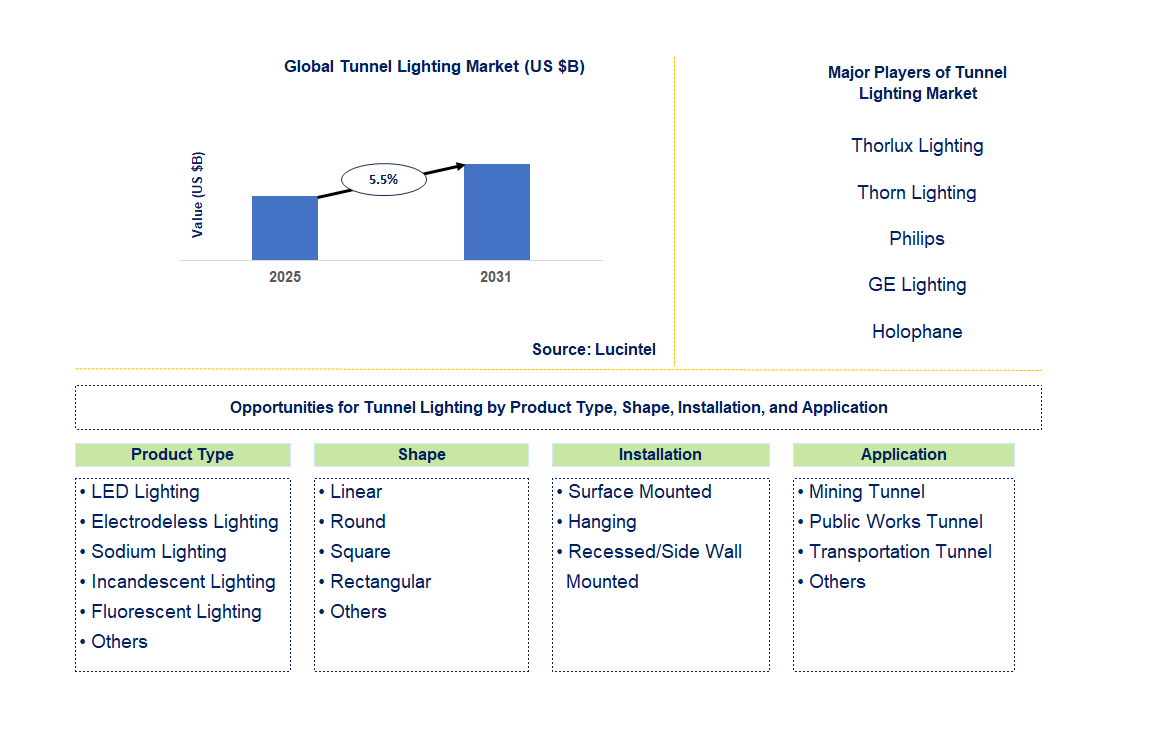
Key data points: The growth forecast = 5.5% annually for the next 7 years. Scroll below to get more insights. This market report covers trends, opportunities and forecasts in tunnel lighting market to 2031 by product type (LED lighting, electrodeless lighting, sodium lighting, incandescent lighting, fluorescent lighting, and others), shape (linear, round, square, rectangular, and others), installation (surface mounted, hanging, and recessed/side wall mounted), application (mining tunnel, public works tunnel, transportation tunnel, and others), and region (North America, Europe, Asia Pacific, and the Rest of the World)
We'll send your sample report shortly.
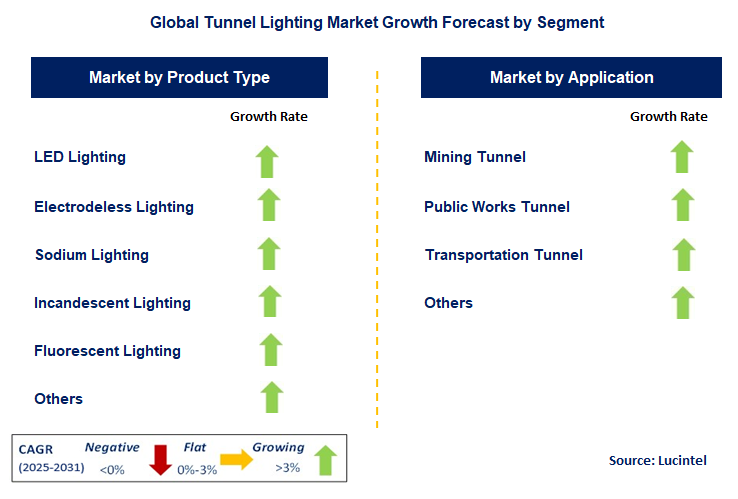
• Lucintel forecasts that, within the product type category, LED lighting is expected to witness the highest growth over the forecast period.
• Within the application category, the transportation tunnel is expected to witness the highest growth.
• In terms of region, APAC is expected to witness the highest growth over the forecast period. Gain valuable insights for your business decisions with our comprehensive 150+ page report. Sample figures with some insights are shown below.
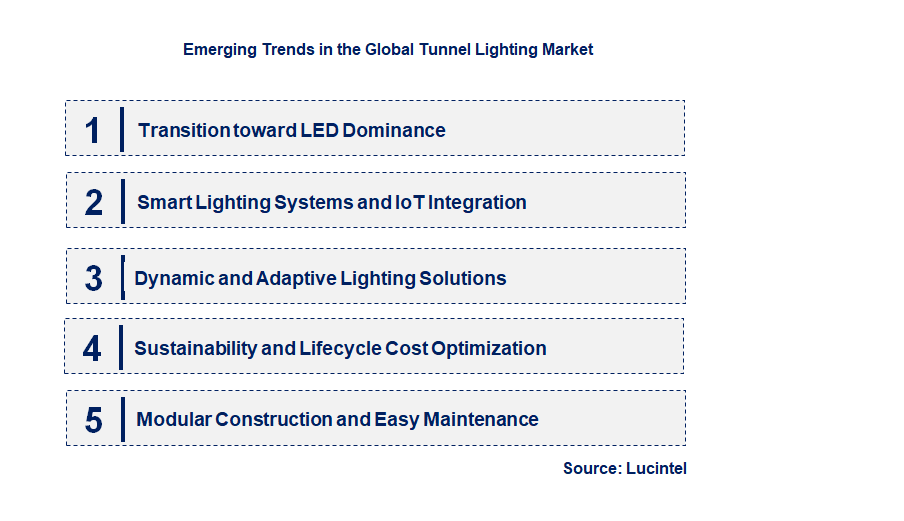
• Transition toward LED Dominance: One of the principal emerging trends is the widespread take-up and ongoing development of LED technology for tunnel lighting. LEDs are many times more energy-efficient, have longer service lives, better light quality, and greater controllability than conventional light sources such as high-pressure sodium or fluorescent lamps. The benefits are significant energy savings to the operators of tunnels, less maintenance with longer-lived lamps, improved safety with greater visibility and more consistent light, and LED as the new standard for installs and retrofits.
• Smart Lighting Systems and IoT Integration: Smart lighting system integration, driven by the Internet of Things (IoT), is a fast-growing trend. These systems utilize sensors, data analysis, and communication networks to allow for real-time monitoring and control of light levels. The effect is adaptive lighting that dynamically responds to traffic conditions, light levels, and surroundings such as fog or smoke, ensuring optimal energy use and uniform visual comfort and safety. This also allows for predictive maintenance and remote monitoring, enhancing operational efficiency.
• Dynamic and Adaptive Lighting Solutions: This trend entails using lighting systems that dynamically adjust brightness and even the color temperature depending on different parameters like time of day, weather, and vehicle speed. The aim is to achieve smooth visual adaptation for drivers entering and leaving tunnels. The effect is a greater driver safety by reducing the "black hole" effect when entering tunnel openings and avoiding visual fatigue. This is also energy saving since it gives "light on demand" instead of constant maximum lighting.
• Sustainability and Lifecycle Cost Optimization: There is an increasing focus on giving importance to sustainability and optimizing the overall lifecycle cost of tunnel lighting systems. It involves consideration not only of the initial acquisition cost but also energy use, maintenance costs, and the environmental impact of the products. The influence is a call for very long-lasting, energy-saving LED luminaires with long warranties that include recyclable materials and easy-to-replace designs. This integrated approach induces investment in better-quality, longer-term fixes.
• Modular Construction and Easy Maintenance: The creation of modular tunnel lighting solutions and easy-maintenance designs is a growing trend. Modular systems facilitate simpler installation, replacement of discrete components instead of whole fixtures, and simpler upgrading. The result is a major decrease in repair time and expenses, since tunnel operation can be very disruptive to traffic when it is being repaired. This also increases system robustness, since discrete module failure does not require a full system shutdown. These new trends are transforming the tunnel lighting industry inherently by shifting towards smarter, more energy-efficient, and user-focused solutions. The prevalence of LED technology, coupled with smart controls, adaptive features, lifecycle cost focus, and modularity, is building a future where the lighting of tunnels is no longer about luminosity but about intelligent, sustainable, and secure environments for road users of all sorts.
• LED Technology Widespread Adoption: A major recent trend is the widespread adoption of LED technology from conventional lighting sources such as high-pressure sodium and fluorescent lamps to tunnel applications. LED luminaires provide superior energy efficiency, much longer lifespan (improved maintenance cycles), and enhanced light distribution. The benefits are huge savings in energy usage and operating expenditure by tunnel owners, as well as enhanced safety and visibility for drivers through consistent high-quality lighting.
• Smart and Adaptive Lighting Systems Implementation: Another important development is the incorporation of smart control systems to facilitate adaptive and dynamic lighting in the tunnel. The smart control systems use sensors to detect ambient light intensity, traffic volume, and weather conditions, dynamically adapting light intensity in the tunnel. The benefit is improved driver comfort and safety through the elimination of sudden changes in brightness at entry and exit points of the tunnel, as well as optimizing energy usage through lighting only where and when it is necessary.
• Emphasis on Glare Control and Visual Guidance: The latest developments place a greater emphasis on glare minimization and clear visual guidance in tunnels. This includes high-level optical design for LED luminaires and a carefully determined location to minimize discomfort glare and establish a seamless luminance transition zone. The effect is enhanced driver perception and lowered visual fatigue, which results in safer driving conditions and fewer accidents, especially important in long tunnels or highly trafficked tunnels.
• Integrated Monitoring and Maintenance Platforms Development: A significant development has been observed in establishing integrated monitoring and maintenance platforms for tunnel lighting systems. Such platforms usually integrate IoT features, enabling real-time monitoring of performance, fault identification, and scheduling of predictive maintenance. The effect is improved operational efficiency since maintenance crews can detect and fix problems ahead of time, reducing downtime and delivering continuous, dependable light in tunnels.
• Flexible and Future-Proof Lighting Systems: Current trends also emphasize the creation of modular lighting systems and fixtures that are more flexible and upgradeable. This makes it possible to replace individual components in place of an entire fixture replacement and makes future technology inclusions easier. The result is lower long-term maintenance costs, more flexibility to accommodate changes in technology standards, and a more environmentally friendly way of managing tunnel infrastructure so that the systems stay effective for decades. All these recent advancements are collectively influencing the tunnel lighting industry in driving a move towards highly efficient, smart, and user-friendly solutions. The widespread use of LEDs, allied with intelligent controls, visual comfort focus, integrated management systems, and modular design, is transforming the tunnel lighting for greater safety, sustainability, and economic viability, effectively recasting the future of tunnel infrastructure.
• Roadway Tunnels: This is the biggest and most important strategic growth prospect. With growing urbanization and automobile traffic, new road tunnels are being built, and existing tunnels need to be upgraded to current safety and energy efficiency standards. Chances are in offering adaptive LED lighting that adjusts to ambient light levels and traffic volume, lessening the "black hole" effect at entryways and exit points, and providing extremely uniform lighting. The emphasis should be placed on improving driver comfort, safety, and lowering power usage.
• Railway Tunnels: As train networks are extending across the world, especially with high-speed train schemes, there is an increased need for professional tunnel lighting for railway use. Strategic opportunities include creating sturdy, vibration-resistant, and long-lasting LED light solutions that are applicable to railway conditions. The systems must provide vision for maintenance teams, offer emergency illumination for passenger security, and interface with railway signal systems, supporting the general efficiency and safety of train operations.
• Mining Tunnels: The mining sector, particularly underground mining processes, offers a niche but substantial strategic expansion opportunity. Safety is the top priority in mining tunnels, demanding very rugged, explosion-proof, and high-intensity lighting systems that can endure rough conditions (dust, humidity, vibrations). Opportunities lie in offering specialized LED luminaires with inbuilt emergency backup power, rugged casings, and intelligent monitoring features to maintain uninterrupted light supply and improve worker safety in difficult underground environments.
• Pedestrian and Bicycle Tunnels: As active transportation and city connectivity continue to grow, tunnel construction and refurbishment for pedestrians and bicycles are also on the rise. Strategic propositions include human-focused lighting solutions that prioritize comfort, security, and perception of security among non-vehicle traffic. This involves softer and more pleasing lighting, glare reduction features, vandal-proof designs, and surveillance system integration, making way for welcoming and secure routes for commuters and recreational users.
• Service and Utility Tunnels: Utility tunnels, which accommodate critical infrastructure such as power cables, water pipes, and communications cables, need energy-efficient and dependable lighting for maintenance and inspection purposes. This is a strategic development opportunity for low-maintenance and long-lasting lighting systems. The opportunities are in offering long-lasting LED luminaires with high ingress protection ratings, frequently with built-in smart monitoring for remote diagnostics, providing worker safety and effective infrastructure management in cramped and frequently challenging conditions. These targeted growth opportunities are deeply affecting the tunnel lighting market through specialized product development and focused market strategies. By exploiting the specific requirements of roadway, railway, mining, pedestrian, and utility tunnel markets, businesses have the potential to release strong market growth. This promotes innovation, generates higher-value products, and helps maintain the tunnel lighting market as a strong solution provider for varied illumination and safety needs in different types of infrastructure.
• Thorlux Lighting
• Thorn Lighting
• Philips
• GE Lighting
• Holophane
• Schreder
• AEC Illuminazione
• LEDiL
• Cree
• Kenall
• LED Lighting
• Electrodeless Lighting
• Sodium Lighting
• Incandescent Lighting
• Fluorescent Lighting
• Others
• Linear
• Round
• Square
• Rectangular
• Others
• North America
• Europe
• Asia Pacific
• The Rest of the World
• United States: The United States market for tunnels is seeing a strong drive for LED retrofits in the case of existing infrastructure as well as integration of smart lighting controls in new infrastructure. Recent trends involve substantial investment in replacing older, inefficient light systems with newer, more energy-efficient ones to enhance energy efficiency and road safety. Adaptive lighting systems that automatically adjust their brightness according to external light levels and traffic density are increasingly becoming a focus to enhance energy efficiency as well as visibility, especially at tunnel entrances and exits.
• China: China leads the tunnel lighting market with its widespread infrastructure development and smart city ambitions. Developments seen in recent times involve large-scale application of LED technology to new tunnel construction and extensive modernization initiatives. Chinese players are aggressively developing smart control systems that combine lighting with traffic management and environmental monitoring to promote energy efficiency and safety through advanced dimming and emergency lighting solutions.
• Germany: The German tunnel lighting sector is dominated by a robust emphasis on precision engineering, energy conservation, and durability. Some of the latest innovations involve the retrofitting of key tunnels with environmentally friendly LED illumination, as seen in initiatives in Munich. There is an effort to deploy smart software systems for automating lumen adjustment according to evolving conditions, maintaining optimal visibility while dramatically cutting energy loads. Sustainability and innovative technical solutions are major forces driving this market.
• India: The Indian tunnel lighting market is experiencing considerable growth, driven by ambitious infrastructure development endeavors, such as new roadways and rail networks. Some of the recent trends involve an expanding use of LED technology in fresh tunnel building and an escalating recognition of the need for energy-efficient and long-lasting illumination. Even though still in its developing stage, the focus is on bolstering road safety and lowering operating costs in a nation that has a fast-growing transportation infrastructure.
• Japan: The Japanese tunnel lighting market emphasizes high performance, reliability, and interconnection with advanced traffic management systems. The latest trends involve ongoing technological advancements in LED solutions that deliver greater efficiency and advanced control capabilities. Smart LED lighting systems that offer automated scheduling, wireless connectivity, and human-centric lighting designs are emphasized in order to achieve energy efficiency as well as an enhanced user experience for its large network of tunnels.


• Thorlux Lighting
• Thorn Lighting
• Philips
• GE Lighting
• Holophane
• Schreder
• AEC Illuminazione
• LEDiL
• Cree
• Kenall Q5. Which tunnel lighting market segment will be the largest in future? Answer: Lucintel forecasts that, within the product type category, LED lighting is expected to witness the highest growth over the forecast period. Q6. In tunnel lighting market, which region is expected to be the largest in next 5 years? Answer: In terms of region, APAC is expected to witness the highest growth over the forecast period. Q7. Do we receive customization in this report? Answer: Yes, Lucintel provides 10% customization without any additional cost.


Choose a license that fits your team. Instant PDF delivery.
Prices exclude taxes. Instant delivery. Custom licensing available on request.
Market Report · July 22, 2026
Market Report · July 22, 2026
Market Report · July 17, 2026
Trusted partner for strategic intelligence and business growth


Receive a complimentary market analysis tailored to your industry. Our analysts will identify key growth opportunities and competitive dynamics specific to your business.

Market size, growth rate, and key trend analysis for your specific sector.

Top competitor positioning and market share analysis.

Strategic recommendations backed by data-driven insights.
Get curated market intelligence and competitive moves straight to your inbox.
By subscribing, you agree to receive our monthly insights. Unsubscribe anytime.
Receive a complimentary market analysis tailored to your industry. Our analysts will identify key growth opportunities and competitive dynamics specific to your business.
Market size, growth rate, and key trend analysis for your specific sector.
Top competitor positioning and market share analysis.
Strategic recommendations backed by data-driven insights.
Get curated market intelligence, emerging trends, and competitive moves straight to your inbox each month.
By subscribing, you agree to receive our monthly insights. Unsubscribe anytime.
We'll send your sample report shortly.