
Market Report · July 16, 2026

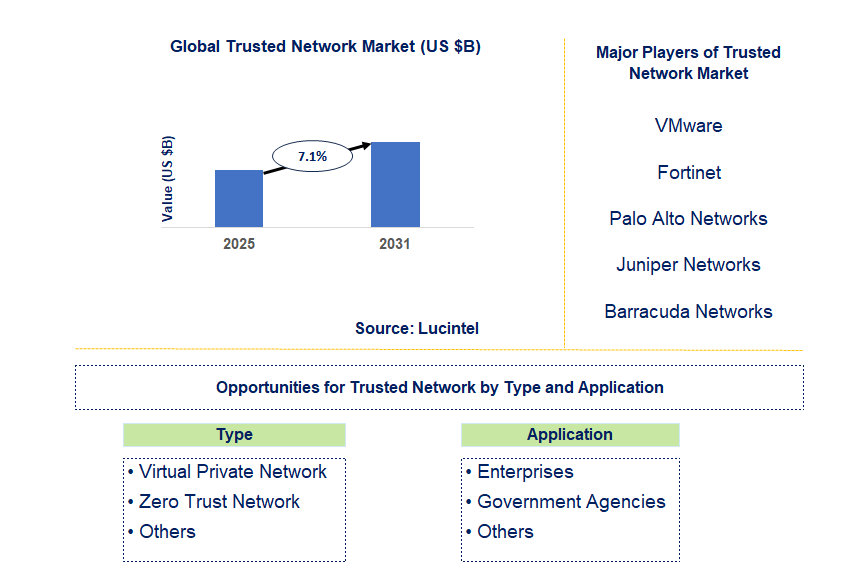
Key data points: The growth forecast = 7.1% annually for the next 7 years. Scroll below to get more insights. This market report covers Trends, opportunities and forecasts in trusted network market to 2031 by type (virtual private network, zero trust network, and others), application (enterprises, government agencies, and others), and region (North America, Europe, Asia Pacific, and the Rest of the World)
We'll send your sample report shortly.
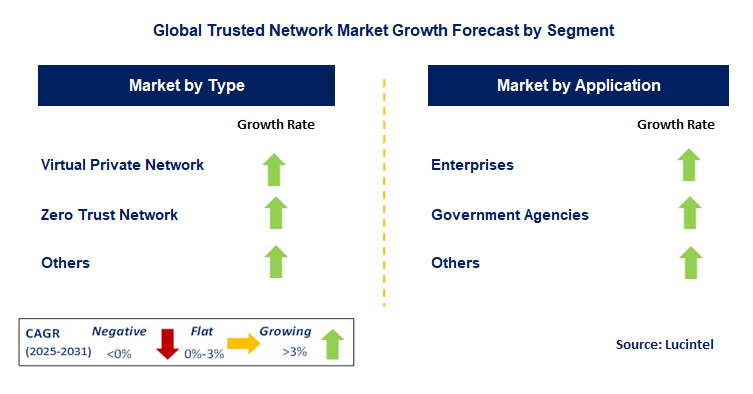
• Lucintel forecasts that, within the type category, zero trust network is expected to witness higher growth over the forecast period due to the growing cybersecurity threat & sophisticated cyberattack.
• Within the application category, government agency is expected to witness higher growth due to rising digital transformation in public sector service.
• In terms of region, North America is expected to witness the highest growth over the forecast period.
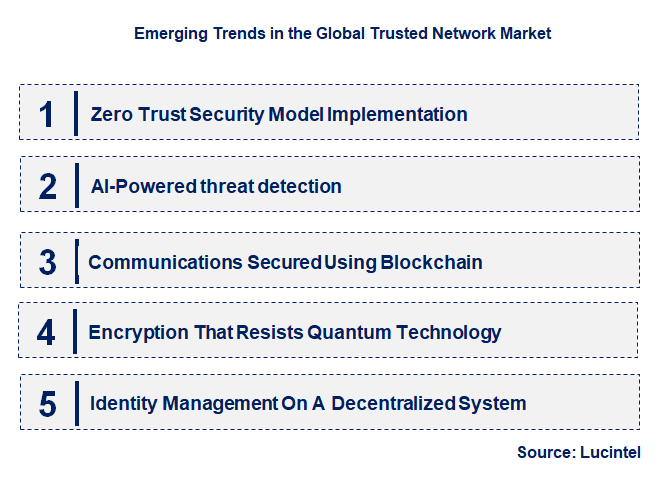
• Zero Trust Security Model Implementation: Trust within networks is no longer given and zero trust security models are becoming standard within enterprises. Organizations implement MFA alongside continuous surveillance and least privilege access controls to reduce the threat surface. Governments and industry regulators are already adopting zero-trust principles which is driving spending on Secure Network Architectures (SNA).
• AI-Powered threat detection: Advanced AI will significantly change the face of network monitoring since potential threats can now be detected in real time. Machine learning algorithms are studying network activities conduct per the pre-set protocols and autonomously manage responses to remove cyber risks. This development improves proactive posture of security operations, resulting in a reduced residual effects of cyberattacks at organizational and governmental levels.
• Communications Secured Using Blockchain: Blockchain technology has been fused into system security for the sake of authentication system protection. Enterprises are using trustless ledgers in an effort to secure digital transactions and stop intrusions. This is mainly in financial services, supply chain security, and secure messaging services.
• Encryption That Resists Quantum Technology: Quantum computing poses a risk to traditional methods of encryption. Network security is being planned by companies and governments using cryptography that can withstand quantum computing. Encrypting data in safe standards is what research institutions are racing to develop.
• Identity Management On A Decentralized System: The need to rely less on central authentication systems has prompted the development of decentralized identity solutions. Individuals are now able to manage their digital identities using blockchain-based identity verification and self-sovereign identity (SSI) models. User privacy, security, and autonomy greatly improve with this cross-platform initiative. As companies adopt newer technologies to address emerging threats, the market for trusted networks is transforming. AI Security developments, blockchain authentication, and zero-trust architectures are propelling changes to network security strategies. Investments will need to be made in quantum encryption resistant technologies as quantum computing develops. The introduction of decentralized identity management will improve privacy and security. trusted network will be maintained strong and compliant global network infrastructures by these trends during the forthcoming stage of growth.
• Increasing Adoption of Zero Trust Network Access: Zero Trust Network Access is becoming more widespread as most organizations move away from perimeter-based security models. ZTNA's framework denies access without strict verification, minimizing the chances of external and internal misuse. ZTNA is being incorporated by a number of enterprises into their security frameworks to improve identity-centric access controls and alleviate ransomware threats. This is essential for the cloud and conventional remote workspace where traditional VPNs are inadequate. ZTNA adoption is projected to increase with sophisticated and advanced cybersecurity challenges.
• Using Blockchain for Improvement in Network Security: Trust within networks is being augmented through the use of blockchain technology which provides decentralized authentication and integrity of data. Blockchain technology assists in identity verification processes to ensure no data is altered, no incorrect entry is made, and security operations remain transparent. Businesses in finance, healthcare, and supply chain management are using blockchain to strengthen security and trust in their networks. These emerging technologies attempt to alleviate concerns regarding data breaches and authentication deception while fortifying the infrastructure against cyberattacks.
• Using Artificial Intelligence for Threat Detection and Response: AI and machine learning (ML) technologies are enhancing trusted networks by adding real-time threat detection and automated response capabilities. Security analytics powered by AI can prevent attacks like DDoS and even phishing by detecting suspicious events before they happen. There is a growing trend towards integration between trusted network architectures and AI-powered security tools for advanced predictive analytics and threat intelligence. Organizations are increasingly adopting this technology to improve their defensive posture and to shorten the timelines for cyber threat detection, response, and mitigation.
• The Rise of SASE Solutions: The Secure Access Service Edge (SASE) framework is changing the way businesses manage network trust when it comes to the combination of networking and security. Along with SD-WAN, SASE incorporates security features like secure web gateways (SWGs), cloud access security brokers (CASBs), and zero-trust network access (ZTNA). This innovation offers a single integrated method for securing remote and cloud access without having to deploy multiple security appliances. SASE is rapidly gaining traction due to the growing need for cloud-native security, especially among organizations that support hybrid work models.
• Developments in Quantum-Safe Encryption: The rise of quantum computing puts traditional methods of encryption at risk. Organizations are starting to adopt quantum-safe encryption solutions in order to secure sensitive information from possible quantum attacks. Governments and businesses are partnering with cryptography research associations in order to create post-quantum cryptography standards that will safeguard networks for decades. This is especially important for sectors dealing with sensitive data, such as finance, defense, and healthcare. Trust Network’s market is experiencing crucial changes because of advancements with ZTNA, blockchain security, AI-powered threat detection, SASE integration, and quantum-safe encryption. Network security is improving and becoming more agile which is adaptive to the cyber threat landscape. As organizations undergo digital transformation, adopting trusted network solutions will be paramount in ensuring protection of sensitive data, regulatory compliance, and security assurance for the digital assets.
• Financial Services and Secured Transactions: The financial industry requires trusted networks to protect transactions and customer information. As digital banking, payment fraud, and compliance issues emerge, financial institutions implement blockchain-based identity verification, AI-powered fraud detection, and end-to-end data encryption. There is a remarkable opportunity for trusted network providers in finance by investing in tailored security measures.
• Healthcare and Medical Data Security: Cybersecurity threats make it necessary for healthcare organizations to protect patient records, medical devices, and telemedicine platforms. Network solutions must address HIPAA-regulated healthcare compliance and offer secure access to electronic health records (EHRs) under the, GDPR. The expansion of telehealth services and connected medical devices increases the need for protective network security solutions for operational and patient data.
• IoT Security for Smart Infrastructure: The rapid growth of IoT devices in smart cities, industrial automation, and home security systems creates an enormous market opportunity for trusted networks. IoT ecosystems need sophisticated protective solutions to prevent breach attempts and access from malicious actors. Businesses that provide trusted network solutions for IoT tailored security, device authentication, and anomaly detection will benefit from this emerging market.
• Government and Defense Infrastructure Security: National security and critical infrastructure are important assets for the governments and defense agencies that need high-security protected networks. Secure communication network, encrypted data storage, and cyber-resilient infrastructures are vital for mitigating cyber threats. Network trust requires the issuance of secure government grade solutions, and trusted network providers have high growth possibilities in this branch.
• Cloud Security and Protecting the Enterprise Network: Moving to cloud-based infrastructure requires enterprises to have secure, scalable networks with controlled access to resources, enabling threat mitigation and mask services. Businesses implementing multi clouds are demanding SASE and zero-trust solutions, and these businesses are on the rise. Vendors focusing on secure cloud compliance and connectivity driven offerings can take advantage of this opportunity. The trusted network market is growing in the segments of financial services, healthcare, IoT, government, cloud-based enterprises, and most of all, the cybersecurity infrastructure of networks. Tailored solution providers focus on these applications and will be able to sustain market growth while maintaining the position of the dominant innovator in network security.
• VMware
• Fortinet
• Palo Alto Networks
• Juniper Networks
• Barracuda Networks
• Zscaler
• Cloudflare
• Forcepoint
• A10 Networks
• Arista Networks
• Virtual Private Network
• Zero Trust Network
• Others
• Enterprises
• Government Agencies
• Others
• North America
• Europe
• Asia Pacific
• The Rest of the World
• United States: The United States continues to spearhead trusted network developments, with businesses utilizing zero-trust security frameworks in response to escalating cyber threats. The government is initiating cybersecurity policies by CISA and network CISA directives enforcing information-based security measures within organizational boundaries which enhances network perimeter defense measures. Major technology companies are focusing on AI threat detection, automated identity verification, and witness protection which is claiming streamlining by cloud protective services with cyber network companies maximizing productivity in the hybrid working model.
• China: China’s focus has largely been devoted to implementing secure and independent network infrastructure as a business vertical, paying particular attention to network security laws and compliance. The government has put in place additional restrictions for data privacy and network security, which compels businesses to start implementing trusted networks. Along these lines, Chinese technology companies are enhancing trust in digital communications by developing AI-driven security analytics, implementing blockchain authentication systems, and expanding the use of these technologies. In addition, the rollout of 5G networks is propelling investment in secure cloud and edge computing solutions.
• Germany: Germany to foster its trusted network ecosystem is strengthening data protection with elements such as the GDPR. The public and private sectors collaborate to better the network security architecture of enterprises. There is an increasing deployment of zero-trust frameworks across enterprises to mitigate cyber risk. In addition, cybersecurity firms in Germany are advancing the development of next-generation encryption and quantum-secure security solutions. Cloud service providers are starting to implement trusted network solutions in line with European Union security compliance directives.
• India: India is experiencing rapid adoption of the digital age, increasing the need for Network solutions in different industry sectors. The government is imposing new policies in cybersecurity to protect personal information and critical infrastructures. Indian corporations are acquiring new secure networking technologies such as artificial intelligence network monitoring and identity validation systems. Adoption of blockchain-based security systems is also on the rise. In addition, the Indian government’s focus on self-reliant technology is encouraging the development of innovative trusted networks compliant with local laws and regulations.
• Japan: Japan’s trusted network policies are being developed to improve the country’s infrastructure. This is part of the nation’s security strategy where stronger cybersecurity policies are adopted. The government works together with private companies to deploy active trusted network systems. Japan’s technological companies are applying AI-enabled security breach detection systems and complex encryptions to fight Cyber risks. The demand for secure networking technologies is also fueled by the advancement of smart cities. Furthermore, Japan’s research efforts on 6G technology is already integrating trusted networks to guarantee secure data transmissions and exchange for these future systems.


• VMware
• Fortinet
• Palo Alto Networks
• Juniper Networks
• Barracuda Networks
• Zscaler
• Cloudflare
• Forcepoint
• A10 Networks
• Arista Networks Q5. Which trusted network market segment will be the largest in future? Answer: Lucintel forecasts that, within the type category, zero trust network is expected to witness higher growth over the forecast period due to the growing cybersecurity threat & sophisticated cyberattack. Q6. In trusted network market, which region is expected to be the largest in next 5 years? Answer: In terms of region, North America is expected to witness the highest growth over the forecast period. Q7. Do we receive customization in this report? Answer: Yes, Lucintel provides 10% customization without any additional cost.


Choose a license that fits your team. Instant PDF delivery.
Prices exclude taxes. Instant delivery. Custom licensing available on request.
Market Report · July 16, 2026
Market Report · May 18, 2026
Market Report · May 18, 2026
Trusted partner for strategic intelligence and business growth


Receive a complimentary market analysis tailored to your industry. Our analysts will identify key growth opportunities and competitive dynamics specific to your business.

Market size, growth rate, and key trend analysis for your specific sector.

Top competitor positioning and market share analysis.

Strategic recommendations backed by data-driven insights.
Get curated market intelligence and competitive moves straight to your inbox.
By subscribing, you agree to receive our monthly insights. Unsubscribe anytime.
Receive a complimentary market analysis tailored to your industry. Our analysts will identify key growth opportunities and competitive dynamics specific to your business.
Market size, growth rate, and key trend analysis for your specific sector.
Top competitor positioning and market share analysis.
Strategic recommendations backed by data-driven insights.
Get curated market intelligence, emerging trends, and competitive moves straight to your inbox each month.
By subscribing, you agree to receive our monthly insights. Unsubscribe anytime.
We'll send your sample report shortly.