
Market Report · July 20, 2026

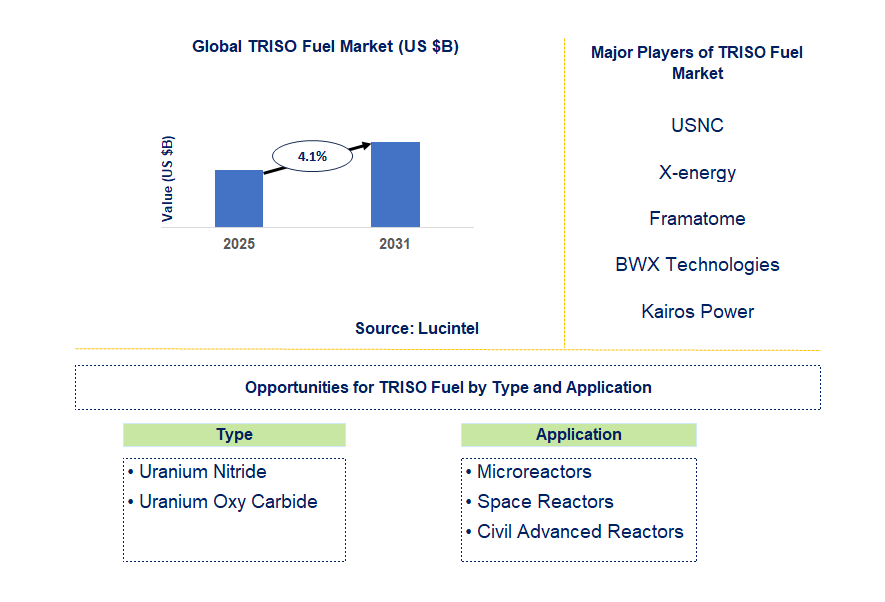
Key data points: The growth forecast = 4.1% annually for the next 7 years. Scroll below to get more insights. This market report covers trends, opportunities and forecasts in TRISO fuel market to 2031 by type (uranium nitride and uranium oxy carbide), application (microreactors, space reactors, and civil advanced reactors), and region (North America, Europe, Asia Pacific, and the Rest of the World)
We'll send your sample report shortly.
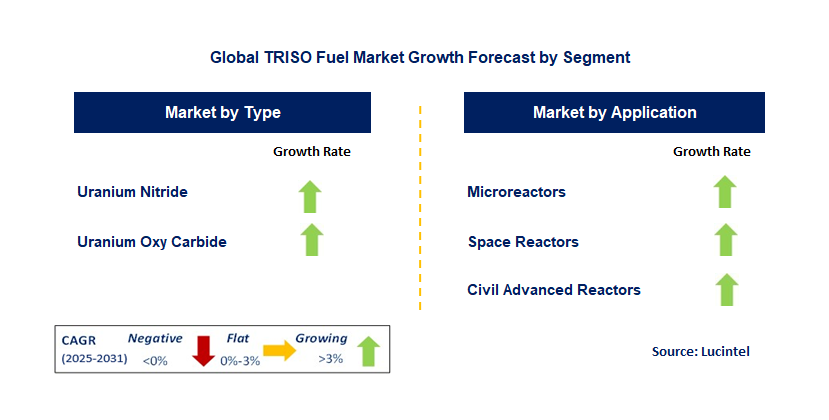
• Lucintel forecasts that, within the type category, uranium nitride is expected to witness higher growth over the forecast period.
• Within the application category, civil advanced reactors are expected to witness the highest growth.
• In terms of region, North America is expected to witness the highest growth over the forecast period due to increasing government investment in nuclear innovation. Gain valuable insights for your business decisions with our comprehensive 150+ page report. Sample figures with some insights are shown below.
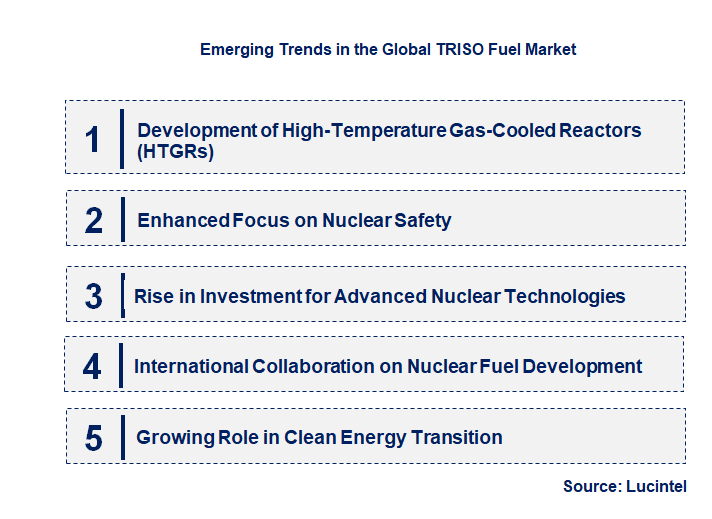
• Development of High-Temperature Gas-Cooled Reactors (HTGRs): The growing interest in high-temperature gas-cooled reactors (HTGRs) is a significant trend driving the TRISO fuel market. HTGRs, which are designed to use TRISO fuel, offer higher efficiency and enhanced safety over conventional reactors. Their ability to operate at higher temperatures enables the generation of electricity as well as process heat for industrial applications. As countries explore the potential of HTGRs for clean energy production, TRISO fuel’s role in these reactors is becoming increasingly critical, positioning it as a major growth driver in the global nuclear energy landscape.
• Enhanced Focus on Nuclear Safety: Safety concerns remain a central issue in the nuclear power industry. TRISO fuel’s inherent safety features, such as its robust design and the ability to withstand high temperatures without releasing radioactive materials, are attracting significant attention. The fuel’s potential to improve reactor safety is driving interest in its use in advanced reactors, particularly in regions like the United States and China, where there is a focus on developing safer, more reliable nuclear power solutions. The growing emphasis on nuclear safety is increasing demand for TRISO fuel technologies.
• Rise in Investment for Advanced Nuclear Technologies: Increased global investment in advanced nuclear technologies is a significant trend driving TRISO fuel development. Governments and private companies are funneling funds into next-generation nuclear reactors, with TRISO fuel at the forefront of these efforts. The U.S. Department of Energy, China, and other nations are investing in research, testing, and scaling up TRISO fuel production. This growing financial support is accelerating the development of TRISO fuel and advancing its commercialization, which could lead to a broader acceptance of nuclear power as a clean energy solution.
• International Collaboration on Nuclear Fuel Development: Collaboration between nations and international research institutions is becoming increasingly common in the development of TRISO fuel. Countries like the United States, China, and Japan are working together to share knowledge, resources, and technology to enhance the development and commercialization of TRISO fuel. Collaborative efforts are driving the improvement of fuel efficiency and reactor safety while addressing the challenges of scaling up production. This trend is helping to facilitate the global adoption of TRISO fuel in nuclear power plants.
• Growing Role in Clean Energy Transition: As the world focuses on reducing greenhouse gas emissions, TRISO fuel is gaining prominence as a clean energy solution in the nuclear industry. Its ability to produce more energy with fewer emissions is positioning it as a viable option for countries looking to transition to low-carbon energy sources. The increased focus on nuclear power as part of the global energy transition is driving demand for TRISO fuel in advanced reactors. This growing role in the clean energy transition is shaping the future of the TRISO fuel market, with significant implications for the global nuclear industry. These trends are driving the development of TRISO fuel technology, positioning it as a central component in the next generation of nuclear reactors. As these trends evolve, the TRISO fuel market is expected to experience significant growth and transformation.
• Advancements in TRISO Fuel Manufacturing Technology: One of the key developments in the TRISO fuel market is the improvement of fuel manufacturing technology. Companies and research institutions are refining the processes used to produce TRISO fuel, which involves the encapsulation of uranium fuel particles in multiple layers of ceramic material. These advancements are increasing the efficiency and safety of TRISO fuel, making it a more viable option for high-temperature reactors. Improved manufacturing techniques are also driving down production costs, which is crucial for the commercial viability of TRISO fuel.
• Successful Testing of TRISO Fuel in Reactors: Successful testing of TRISO fuel in advanced reactors is a major milestone in its development. Several reactor experiments, including those in the United States and China, have demonstrated the effectiveness of TRISO fuel in high-temperature gas-cooled reactors (HTGRs). These tests have shown that TRISO fuel can operate safely at higher temperatures with minimal risk of radioactive release. This success is encouraging further investment in TRISO fuel research and development and brings the global nuclear industry closer to the commercialization of TRISO-based reactors.
• Government Support for TRISO Fuel Projects: Governments worldwide are providing financial support for TRISO fuel development. In the United States, the Department of Energy has committed significant funding to advance the development and testing of TRISO fuel, with the goal of integrating it into next-generation reactors. China has also invested heavily in the research and development of TRISO fuel for its future reactors. This government backing is accelerating the pace of innovation and creating a favorable environment for TRISO fuel to be adopted as a key component of future nuclear energy systems.
• Collaborative Efforts Between Nations and Private Companies: International collaboration is playing a key role in the advancement of TRISO fuel technology. Countries like the United States, China, and Japan, along with private companies, are sharing research and development resources to accelerate the commercialization of TRISO fuel. Joint efforts are improving fuel performance, reactor designs, and safety features. By pooling resources and expertise, these collaborations are accelerating the development of TRISO fuel and increasing its potential for widespread adoption in future nuclear reactors.
• Growing Interest in Small Modular Reactors (SMRs): Small Modular Reactors (SMRs) are gaining popularity as potential applications for TRISO fuel. These reactors are designed to be more flexible, scalable, and safer than traditional large reactors, and they are expected to be a key component of the future nuclear power landscape. The use of TRISO fuel in SMRs offers several advantages, including enhanced safety, reduced waste, and the ability to operate at higher temperatures. This growing interest in SMRs is driving further research and development into TRISO fuel and its applications. These developments are helping to accelerate the commercialization of TRISO fuel, positioning it as a critical component in the future of nuclear energy. As these advancements continue, TRISO fuel is expected to play a major role in meeting global energy demands.
• Integration of TRISO Fuel in High-Temperature Gas-Cooled Reactors (HTGRs): The growing interest in HTGRs presents a significant opportunity for TRISO fuel. These reactors are designed to operate at higher temperatures and offer improved safety and efficiency compared to traditional reactors. TRISO fuel is ideally suited for HTGRs due to its ability to withstand high temperatures and its inherent safety features. Companies and governments can capitalize on this opportunity by focusing on the integration of TRISO fuel into HTGRs, positioning themselves as leaders in the next generation of nuclear reactors.
• Adoption of TRISO Fuel in Small Modular Reactors (SMRs): Small Modular Reactors (SMRs) represent another significant growth opportunity for TRISO fuel. SMRs are designed to be smaller, more flexible, and safer than traditional reactors, and they offer a promising solution for clean energy generation. TRISO fuel’s ability to enhance the safety and efficiency of SMRs makes it an ideal choice for these reactors. Manufacturers and researchers can focus on developing TRISO fuel specifically for SMRs, tapping into the growing market for advanced nuclear technologies.
• Commercialization of TRISO Fuel for Advanced Nuclear Reactors: The commercialization of TRISO fuel for use in advanced nuclear reactors is a major growth opportunity in the market. As countries around the world invest in next-generation nuclear technologies, TRISO fuel is becoming an increasingly attractive option for improving reactor safety and efficiency. By focusing on the large-scale production and deployment of TRISO fuel, companies can position themselves as key suppliers for the nuclear energy sector.
• Collaborations for TRISO Fuel Development: Strategic partnerships between governments, private companies, and research institutions present a valuable opportunity for accelerating TRISO fuel development. Collaborative efforts can improve fuel performance, reduce costs, and increase production capacity. Companies that engage in these collaborations can gain access to cutting-edge research and technology, accelerating the commercialization of TRISO fuel.
• Growing Demand for Clean Energy Solutions: The global push for clean energy solutions presents a significant opportunity for TRISO fuel. As nations strive to reduce carbon emissions and transition to low-carbon energy sources, TRISO fuel is a key component of the future of nuclear energy. Companies in the TRISO fuel market can leverage this demand by offering high-efficiency, low-emission fuel solutions for advanced nuclear reactors. These growth opportunities are shaping the future of the TRISO fuel market, offering significant potential for companies and countries involved in the development of next-generation nuclear technologies. As the demand for clean energy solutions increases, TRISO fuel is poised to play a central role in the global energy landscape.
• USNC
• X-energy
• Framatome
• BWX Technologies
• Kairos Power
• Uranium Nitride
• Uranium Oxy Carbide
• Microreactors
• Space Reactors
• Civil Advanced Reactors
• North America
• Europe
• Asia Pacific
• The Rest of the World
• United States: The United States is at the forefront of TRISO fuel research, with several national laboratories and private companies working to develop and commercialize TRISO fuel for advanced reactors. The U.S. Department of Energy (DOE) has heavily invested in TRISO fuel development, with the objective of using it in next-generation reactors, such as the high-temperature gas reactors (HTGRs). The DOE’s Nuclear Fuel Working Group has also been supporting efforts to increase the use of TRISO in the U.S. nuclear industry. With ongoing research projects and testing, the U.S. is positioning itself as a key player in the commercialization of TRISO technology.
• China: China is aggressively pursuing the development and deployment of TRISO fuel as part of its strategy to diversify and expand its nuclear energy capacity. The country’s nuclear sector is investing in advanced nuclear technologies, with a focus on high-temperature reactors that utilize TRISO fuel. China has already made substantial progress in the development of TRISO fuel and is conducting large-scale tests to assess its viability in operational reactors. As part of its national energy strategy, China is focused on achieving a cleaner energy mix, and TRISO fuel plays a significant role in enhancing the safety and efficiency of its nuclear energy production.
• Germany: Germany is taking a cautious yet progressive approach to TRISO fuel development. While Germany does not currently rely on nuclear power due to its phase-out policy, it continues to invest in advanced nuclear technologies like TRISO as part of its commitment to research in the nuclear sector. German institutions, such as the Helmholtz-Zentrum Dresden-Rossendorf, are involved in international collaboration for TRISO fuel development. These efforts focus on improving fuel efficiency and safety for potential future use in reactors, reflecting Germany’s interest in nuclear innovation despite its ongoing shift away from nuclear energy for domestic power production.
• India: India is actively exploring TRISO fuel as part of its broader nuclear energy strategy. The country has a growing nuclear energy program, and the development of TRISO fuel is seen as a key component for advancing its high-temperature gas-cooled reactors (HTGRs) and other next-generation nuclear technologies. India’s nuclear research institutions, such as the Bhabha Atomic Research Centre (BARC), are engaged in developing and testing TRISO fuel. The use of TRISO is expected to enhance the safety and efficiency of India’s nuclear reactors, which aligns with the country’s goal of reducing carbon emissions while increasing energy production.
• Japan: Japan, with its strong commitment to nuclear power post-Fukushima, is investing in the research and development of TRISO fuel. The Japanese government is exploring next-generation nuclear reactors as part of its strategy to achieve energy security and reduce dependence on fossil fuels. Japan’s nuclear energy research institutions, like the Japan Atomic Energy Agency (JAEA), are working on the development of advanced reactor concepts that would integrate TRISO fuel for enhanced safety and efficiency. Japan is actively collaborating with other nations on nuclear research, aiming to position itself as a leader in nuclear innovation through TRISO fuel technology.


• USNC
• X-energy
• Framatome
• BWX Technologies
• Kairos Power Q5. Which TRISO fuel market segment will be the largest in future? Answer: Lucintel forecasts that, within the type category, uranium nitride is expected to witness higher growth over the forecast period. Q6. In TRISO fuel market, which region is expected to be the largest in next 5 years? Answer: In terms of region, North America is expected to witness the highest growth over the forecast period due to increasing government investment in nuclear innovation. Q7. Do we receive customization in this report? Answer: Yes, Lucintel provides 10% customization without any additional cost.


Choose a license that fits your team. Instant PDF delivery.
Prices exclude taxes. Instant delivery. Custom licensing available on request.
Market Report · July 20, 2026
Market Report · July 20, 2026
Market Report · July 20, 2026
Trusted partner for strategic intelligence and business growth


Receive a complimentary market analysis tailored to your industry. Our analysts will identify key growth opportunities and competitive dynamics specific to your business.

Market size, growth rate, and key trend analysis for your specific sector.

Top competitor positioning and market share analysis.

Strategic recommendations backed by data-driven insights.
Get curated market intelligence and competitive moves straight to your inbox.
By subscribing, you agree to receive our monthly insights. Unsubscribe anytime.
Receive a complimentary market analysis tailored to your industry. Our analysts will identify key growth opportunities and competitive dynamics specific to your business.
Market size, growth rate, and key trend analysis for your specific sector.
Top competitor positioning and market share analysis.
Strategic recommendations backed by data-driven insights.
Get curated market intelligence, emerging trends, and competitive moves straight to your inbox each month.
By subscribing, you agree to receive our monthly insights. Unsubscribe anytime.
We'll send your sample report shortly.